Program: ASTRONOMER
Type: Educational/Technical
Machine: Spectrum or 2068 with Spectrum ROM
Length: 48K
Price: $14.95
Written in: Machine Code
Listable: no
Manufacturer: CP Software
Author: Paul Marshall
As an avid fan of astronomy, I have kept my eyes open for a 2068 program that could aid my star gazing interests. Eric Burgess‘ book More Uses for Your TS 1000: Astronomy on Your Computer was all I had found until now. Another book of his, Celestial Basic, has been useful. It is similar to the other but examples are for the Apple IIc.
ASTRONOMER by CP Software of England is an impressive package. It comes in a colorful box along with a professional sixteen page typeset instruction booklet. This is well written and though brief, adequate.
Using Doug Dewey‘s OMNI-EMU ROM board, ASTRONOMER loaded and ran without a hitch. I did load side two, which is just another copy. It loaded but appeared to fail completing its setting of bits in the UDG area before self-running. It later crashed.
The program takes 4 min. 40 sec. to load. Colorful graphics make the wait bearable. The opening menu lists six options. Option No.1 allows the user to enter the exact latitude and longitude, the time (to seconds), and the date for anywhere on the earth. This program throughout is very, very accurate. Options 2 and 3 give the user coordinates for his date and time of the planets, sun, moon, four of the largest asteroids, comet Encke, and yes, Halley’s comet, too. This and most information is easily printed out on the 2040 thermal printer. Options 2 and 3 allow the user to ask for the coordinates over a range of times and dates as well. Since most of the information is useful only to telescope owners, it may be less important than the other options.
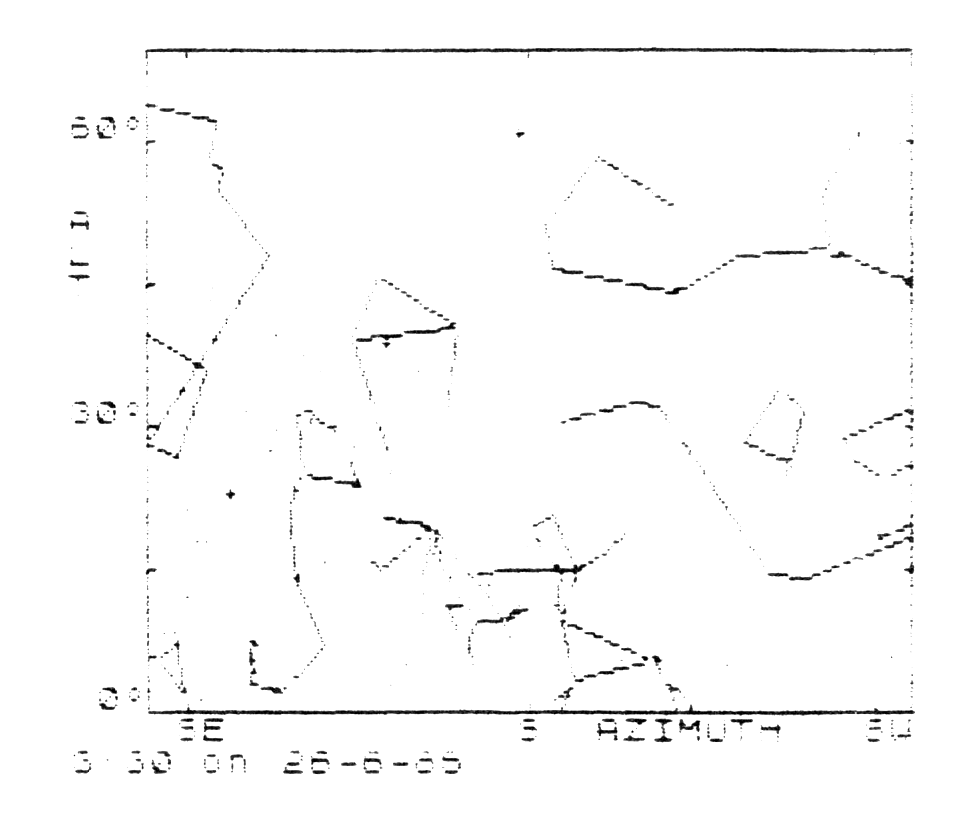
Option 4 is the most complex. Here the computer calculates and stores the position of 1090 stars (to magnitue 4.75) which are visible under normal conditions to the human eye. This is more stars than is shown on my Planisphere! It divided the night sky into five parts, treating the sky as a huge dome. The top is circular when cut out–this is part five. The rest is divided up equally into north, east, west, and south panels–parts one through four. These views can be chosen and within 25 second (2 min. for the circular part five) all the stars to magnitude 4.75 are plotted out. Faint stars are single pixel points, brighter stars more. The display is colorful and impressive. By entering any of the 79 constellation codes ASTRONOMER will trace out each (see fig. A). By re-entering the same code, it erases the lines it drew in. This is remarkable! There is even a code ALL which traces out all of the constellations. This takes nearly ten minutes.
Option 4 requires a calculation time of 10 min. 48 sec. the first time through. Once completed, the user can skip from option to option and to any view in option 4 without needing to recalculate anything. Only if the user changes the date, time or location using option 1 will option 4 require this period of re-calculation. The computer beeps loudly when done, in case the user has left the room.
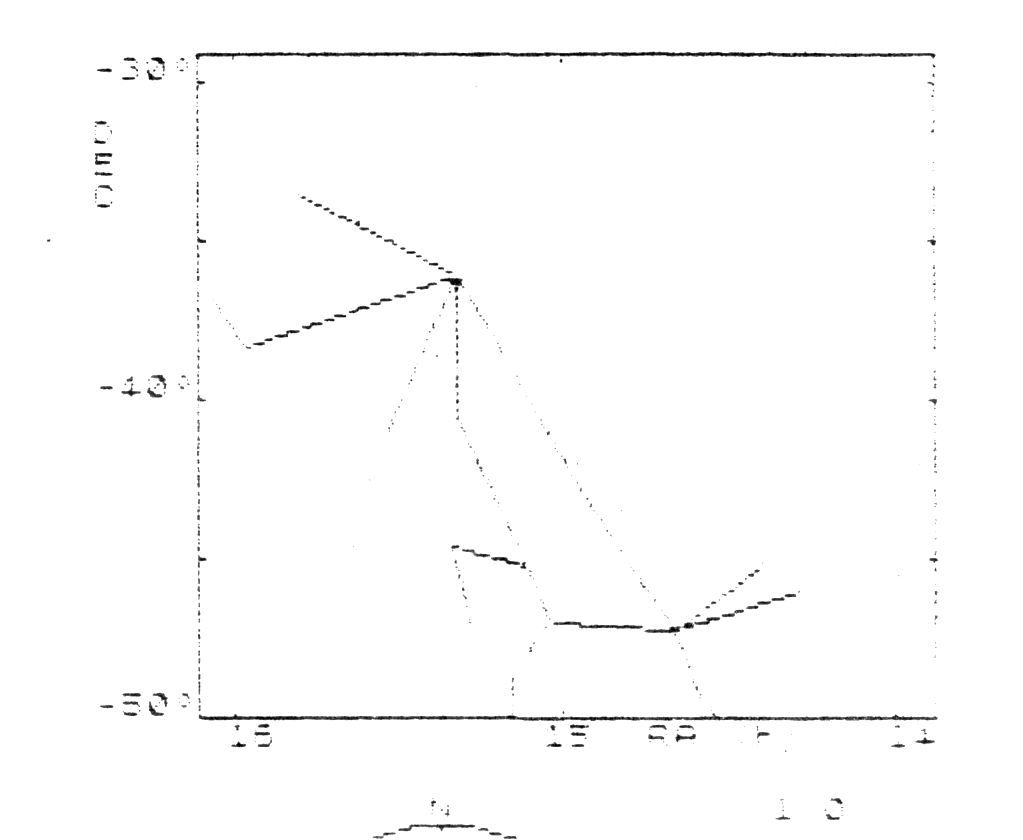
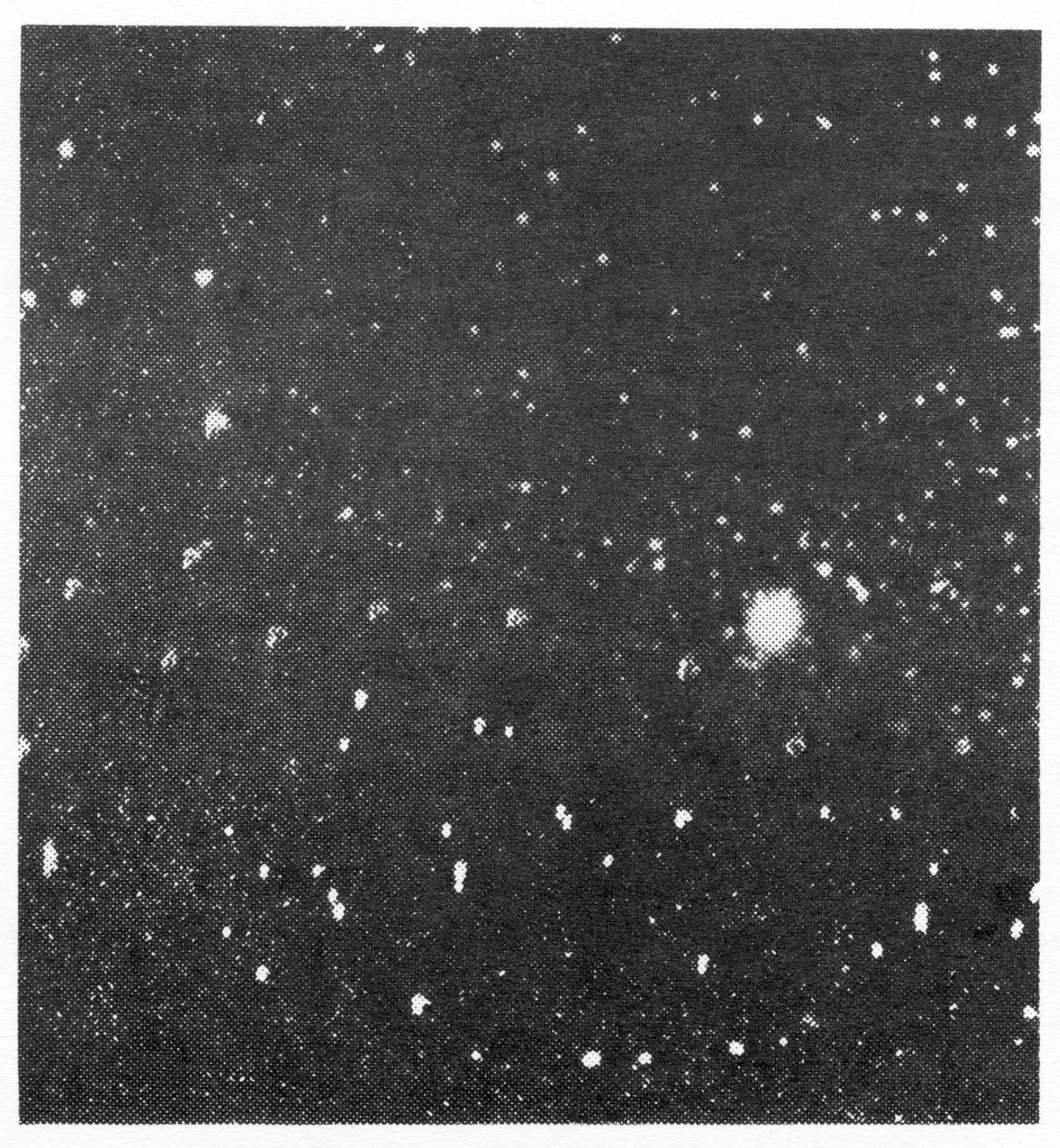
Option 5 is in a way a close-up or zoom of the views in option 4. Option 5 splits the sky into 362 overlapping charts of 20° Declination and 2 hour Right Ascension…… telescope coordinate values. As in option 4, option 5 will allow tracing of constellations. Fig. B (Lupus the Wolf) and Fig. A are given for comparison.
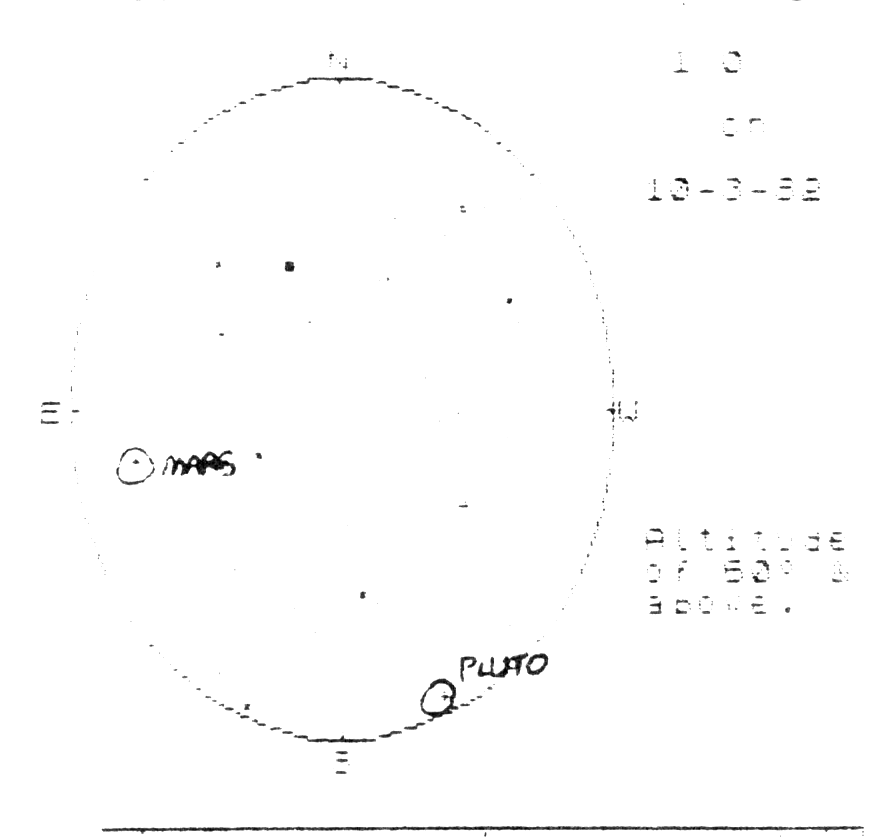
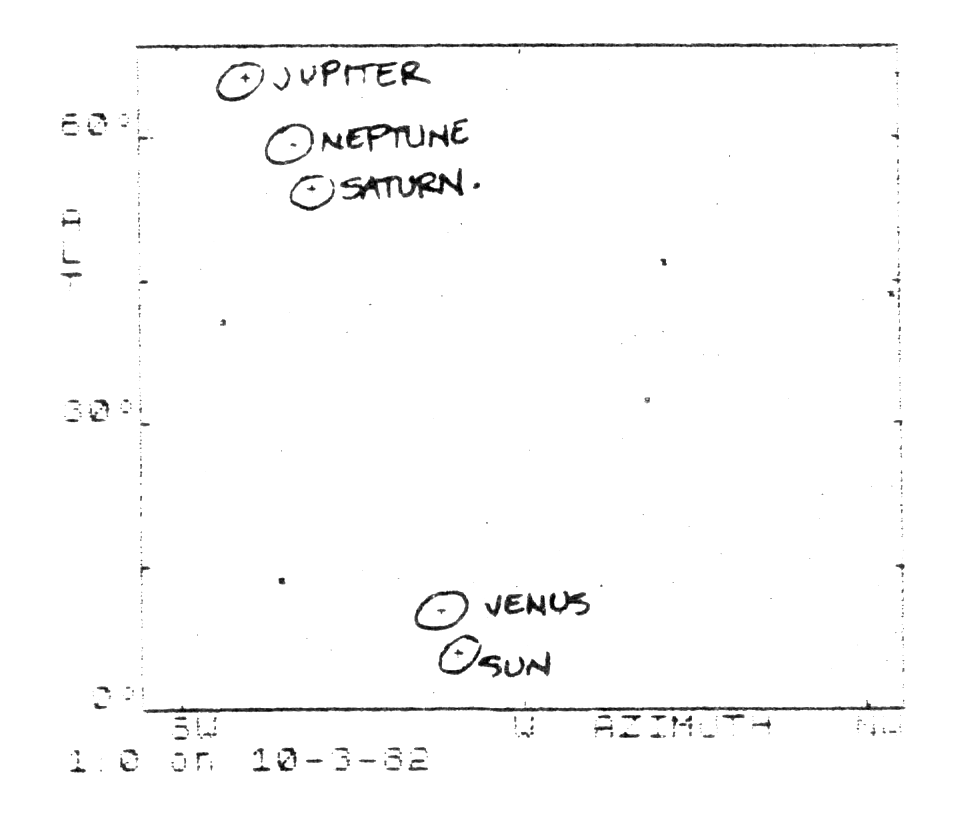
In both options 4 and 5, the location of all the objects available from options 2 and 3 (i.e. the planets, comets, ect.) can be superimposed among the constellations by using their three-letter codes. The position is shown as a tiny plus sign which blinks three times then remains. Entering the code again works in reverse and removes it. I found some star regions so busy with stars so as to miss the blinking plus sign the first time. Fig. C and D show all of the planets lined up with the setting sun on March 10, 1882. This answers a query put forth by Duncan Teague in the Jan/Feb ’85 issue of SYNCWARE NEWS for which a prize was to be awarded. (Does this mean I win?)
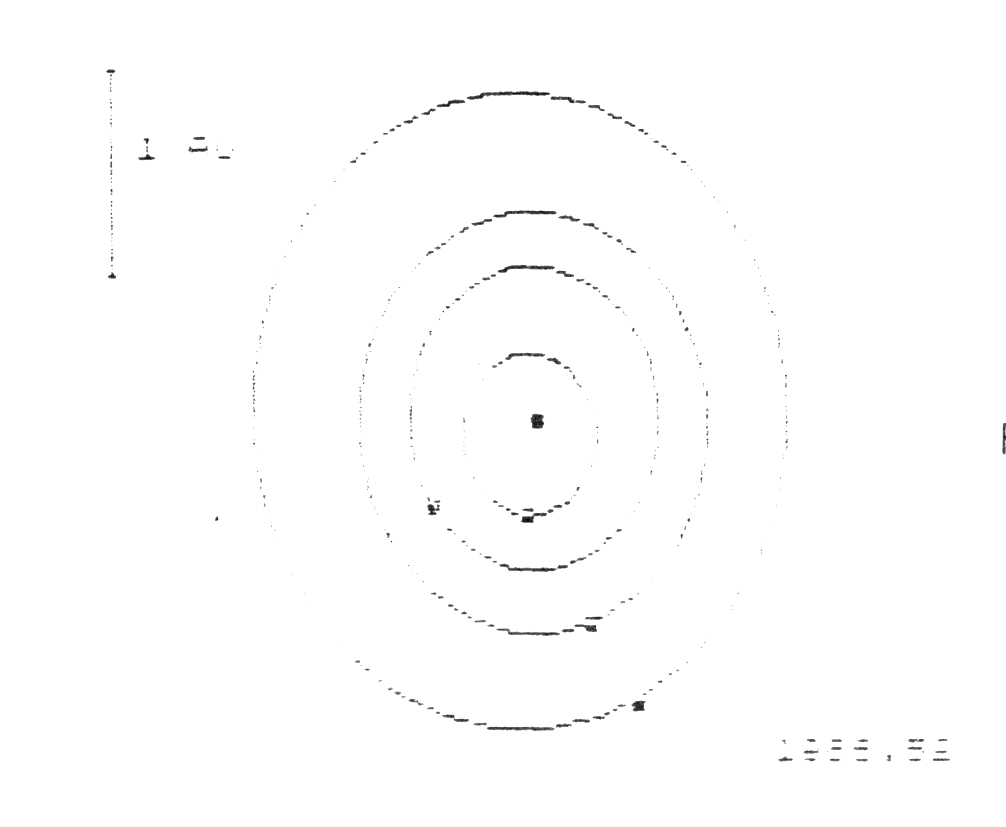
Option 6 lets the user find the rising and setting times of the solar system objects or to see an animated view of the solar system itself (see Fig. E). The user inputs the starting date and interval. The motion of the planets continues until the user stops it. This animated view I have found to be very educational and easily understandable by my small children.
ASTRONOMER is a very thorough and complete program. It can grow with the observer as the observer’s needs grow. It is also worthwhile to those following Halleys Comet or as an educational device.
Is ASTRONOMER perfect? No, it has a few drawbacks. In option 4 or 5 the user may be annoyed by a “POSITION NOT CALCULATED” ….. message accompanied by a loud beep when entering the code for a solar system objec. As it turns out, the position of each object to display in option 4 or 5 must first be called up in its menu in option 2 or 3. This is a four-key procedure for each object.
This boils down to TIME. The user must figure on 4:40 to load the program initially 4:30 to run through the four-key procedure for all the objects, 3:00 to change the date, time and location (which comes set for London, 1/1/84), and 10:48 for the initial sky calculations in option 4. The grand total is 23 minutes or so to get ready.
If I could make all the changes in 23 minutes and then SAVE the program it would be fantastic. Even a back-up copy would be nice to have. However, being a self-running machine code program, no provision for such is included. I have tackled ASTRONOMER using 007 SPY and have managed to make a back-up copy after several nights and lots of head-scratching. This is however only a copy as it comes from England. Maybe with HOT Z II I could wade through the 46K of data and find the bytes I need to alter…or maybe not.
At any rate, ASTRONOMER is an excellent aid to most any level of interest in astronomy. It works well, is professional, and at $14.95 is an exceptional value. Similar programs for the PC start at $65. My OMNI-EMU and ASTRONOMER together were less money. It is a good way to get ready for Halley’s Comet and much more. It rolls into one at least eleven of the 20 programs in Burgess’ book. The printouts do not do the real graphics justice–see the program for yourself.
ASTRONOMER is available from: Curry Computer, 5344 W. Banff, Glendale AZ 85306, for $14.95 plus 90¢ shipping.
            HALLEY'S COMET

    At 3h 30m 0s GMT on 26-6-1985

    Position is    RA  5h 29m 33s
                   Dec +18° 5' 34"

    Distance is 4.14 AU