
(Editor’s NOTE: this program could easily be adapted to the ZX81/TS1000 computer. Would anyone like to try?)
Blinker Signaling
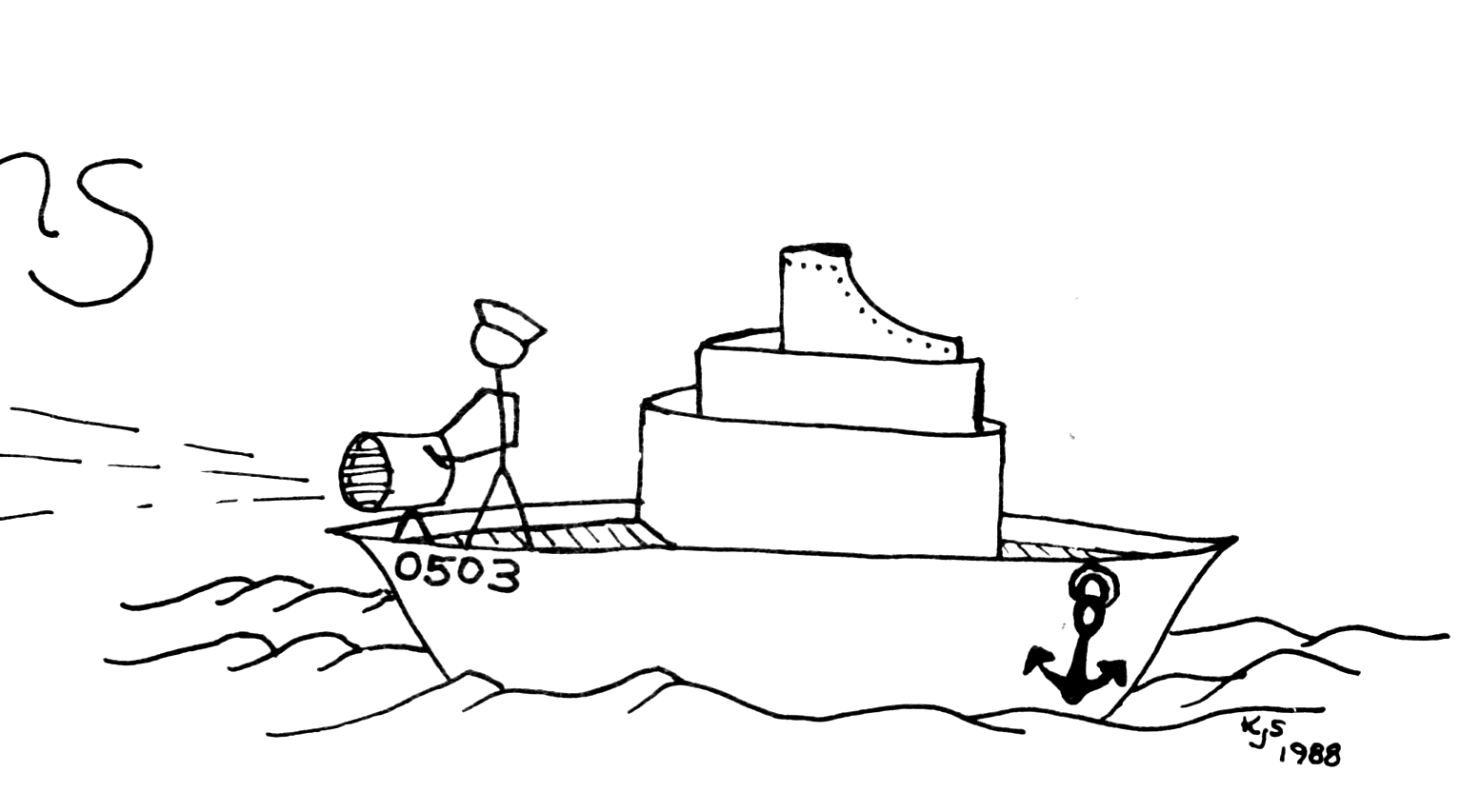
This program simulates a blinker signalling device. Nowadays, when radio communicators are constantly trying to use ever-higher ultra frequencies, we tend to forget that blinkers have been using, for centuries, frequencies higher than any radio signal yet generated.
Running Flash
When the program is RUN, night descends. You then tell your “instructor” how fast to send your test messages, and how many characters to send in each group.
You can then choose any one of three options:
1. A printed letter followed by the signal
2. The signal first, then the letter
3. Your own choice of letters
If you choose 1. or 2., the choice of letters is random; if you choose 3., then you (or the instructor) INPUT the message you want.
Coding Illuminated
The program, LISTed in Figure 1, is pretty straightforward. Line 1 makes sure that your inputs will all be in capital letters. Lines 70 to 340 set initial conditions, and establish the searchlight as User-Designed Graphic “S”. As an interesting sidelight: you can see the pattern of the light if you look sidewise at the LISTing of lines 220 to 290.
The “works” of the program are in array M, which is loaded with the data given in lines 650 to 1070. If you’re familiar with Morse code, you’ll be able to make out the letters within the DATA statements: 6 means a DIT, and 4 a DAH. The 3’s are NOPs (do-nothings), inserted to preserve the symmetry of the array.
The searchlight was designed to produce a very small pattern, to simulate the appearance of an actual ship at a distance. If you want to pretend that you have binoculars powerful enough to produce a larger display, you can use the statement in Figure 2 to replace lines 20, 40, 70, and 90. In this case, lines 220 through 290 can be left out.
(Editor’s NOTES:) You may find that the fast speeds attainable by this program are unrealistic. In real life, blinkers can not begin to approach the speeds of radio code, because of the mass of the mechanical shutter involved in modulating the light beam.
It is possible to shorten materially the initialization delay by the following steps:
Change line 120 to DIM M$(43,5) changed to a string array, size is not changed
Change line 170 to GO SUB 650
DELETE lines 180 through 210
Change line 530 to: GO SUB VAL M$(CODE J$(K)-47,I)
Change lines 650 to 1070 to the following form:
 650 LET M$(1)="44444"
 660 LET M$(2)="64444"
 660 LET M$(3)="66444"
 670 LET M$(4)="66644"
  *    *    *    *    *
1070 LET M$(43)="44663"
Add line 1080 RETURN
   1 POKE 23658,8: GO TO 110: REM POKE sets capital letters
   3 RETURN
   4 GO TO 70
  10 REM DIT
  20 PRINT AT 10,13;"▒": REM graphics "S"--also at lines 40,70, and 90
  30 PAUSE DIT
  40 PRINT AT 10,13;"▒"
  50 RETURN
  60 REM DAH
  70 PRINT AT 10,13;"▒"
  80 PAUSE DAH
  90 PRINT AT 10,13;"▒"
 100 RETURN
 110 DIM J$(60)
 120 DIM M(43,5)
 130 INK 7
 140 PAPER 0
 150 BORDER 0
 160 CLS
 170 FOR I=1 TO 43
 180 FOR J=1 TO 5
 190 READ M(I,J)
 200 NEXT J
 210 NEXT I
 220 POKE USR "S"  ,BIN 00000000
 230 POKE USR "S"+1,BIN 00000000
 240 POKE USR "S"+2,BIN 00011000
 250 POKE USR "S"+3,BIN 00111100
 260 POKE USR "S"+4,BIN 00111100
 270 POKE USR "S"+5,BIN 00011000
 280 POKE USR "S"+6,BIN 00000000
 290 POKE USR "S"+7,BIN 00000000
 300 OVER 1
 310 PRINT "INPUT SPEED (1-9)": INPUT LPM
 320 IF LPM>10 THEN PRINT "ERROR: NUMBER TOO HIGH": GO TO 310
 330 PRINT "GROUPING (1-60)": INPUT GRP
 340 PRINT "ENTER :";,,"1 FOR SIGNAL THEN LETTER";,"2 FOR LETTER THEN SIGNAL";,"3 YOU GIVE LETTER"
 350 INPUT O
 360 LET DIT=10/LPM
 370 LET DAH=30/LPM
 380 LET WP=60/LPM
 390 CLS
 400 PRINT AT 1,1;"LETTERS/SECOND = ";LPM*.335
 410 IF O=3 THEN PRINT AT 3,1;"ENTER LETTER(S)"
 420 FOR K=1 TO GRP
 430 IF O<>3 THEN LET J$(K)=CHR$ INT (RND*43+48): IF J$(K)<"A" AND J$(K)>"9" THEN GO TO 430
 440 IF O<>3 THEN GO TO 480
 450 PAUSE 0
 460 LET J$(K)=INKEY$
 465 IF J$(K)<"A" AND J$(K)<"0" OR J$(K)>"Z" THEN GO TO 450
 470 PRINT J$(K);
 480 NEXT K
 490 PAUSE 30
 500 IF O=2 THEN PRINT AT 12,13;J$: PAUSE 60*GRP
 510 FOR K=1 TO GRP
 520 FOR I=1 TO 5
 530 GO SUB M(CODE J$(K)-47,I)
 540 PAUSE WP/2
 550 NEXT I
 560 PAUSE WP
 570 NEXT K
 580 IF O<>3 THEN PRINT AT 12,13;J$
 590 IF GRP>2 THEN PRINT AT 20,1;"ENTER ANY KEY TO CONTINUE": PAUSE 0: LET K$=INKEY$: GO TO 390
 600 PAUSE 60
 640 GO TO 390
 650 DATA 4,4,4,4,4
 660 DATA 6,4,4,4,4
 670 DATA 6,6,4,4,4
 680 DATA 6,6,6,4,4
 690 DATA 6,6,6,6,4
 700 DATA 6,6,6,6,6
 710 DATA 4,6,6,6,6
 720 DATA 4,4,6,6,6
 730 DATA 4,4,4,6,6
 740 DATA 4,4,4,4,6
 750 DATA 3,3,3,3,3
 760 DATA 3,3,3,3,3
 770 DATA 3,3,3,3,3
 780 DATA 3,3,3,3,3
 790 DATA 3,3,3,3,3
 800 DATA 3,3,3,3,3
 810 DATA 3,3,3,3,3
 820 DATA 6,4,3,3,3
 830 DATA 4,6,6,6,3
 840 DATA 4,6,4,6,3
 850 DATA 4,6,6,3,3
 860 DATA 6,3,3,3,3
 870 DATA 6,6,4,6,3
 880 DATA 4,4,6,3,3
 890 DATA 6,6,6,6,3
 900 DATA 6,6,3,3,3
 910 DATA 6,4,4,4,3
 920 DATA 4,6,4,3,3
 930 DATA 6,4,6,6,3
 940 DATA 4,4,3,3,3
 950 DATA 4,6,3,3,3
 960 DATA 4,4,4,3,3
 970 DATA 6,4,4,6,3
 980 DATA 4,4,6,4,3
 990 DATA 6,4,6,3,3
1000 DATA 6,6,6,3,3
1010 DATA 4,3,3,3,3
1020 DATA 6,6,4,3,3
1030 DATA 6,6,6,4,3
1040 DATA 6,4,4,3,3
1050 DATA 4,6,6,4,3
1060 DATA 4,6,4,4,3
1070 DATA 4,4,6,6,3
Fig. 1 LISTing for FLASH
20 PRINT AT 10,12;"▒▒▒";AT 11,12;"▒▒▒";AT 12,12;"▒▒▒"NOTE: Graphics are as follows:
1st line: Shifted 2, Shifted 8, Shifted 1
2nd line: Shifted 8 (three times)
3d line: UNshifted 7, Shifted 8, Shifted 4
Fig. 2 A larger searchlight
Note: Type-in program listings on this website use ZMAKEBAS notation for graphics characters.