
“themed” issues
We’re going to focus on a central theme for the next two issues, complete with key articles (and even some programs and product reviews). This time around, we will take a look into the area of DESKTOP PUBLISHING. This has been a favorite topic of many personal computer publications for the last couple of years and through the dedicated effort of some software developers, you can now apply this technique to our beloved Sinclair computers. Desktop Publishing gives the user some very powerful “tools” to combine both text and graphics for the development of many types of documents, including: newsletters, magazines, reports, instruction manuals, or even a letter to a friend. You don’t necessarily have to be an editor or publisher for this type of program, as much simpler applications are possible. But the Desktop-type program has really changed the way small scale publishing is performed. Magazines and Journals have literally cropped up overnight as a result.
Of course, if you have no interest in this subject, we still offer a host of other articles and programs, as well as all of our regular features.
Our next issue’s theme will be TELECOMMUNICATIONS. Some of you may remember our March/April ’86 (Vol 2, No.3) issue, which ran an article on converting a surplus 2050 modem board into an RS-232 Serial port. By far, that has been our best selling back issue. I won’t go into a lot of detail here, but what we have in store for the next issue, should be every bit as good (if not better). Don’t miss out on the November/December ’87 issue!
I’d like to take this opportunity to thank Mr. Bill Ferrebee of Mountaineer Software for his hand in designing the front cover of our Desktop issue. Bill was formally a columnist for the now defunct TS-HORIZONS. Currently, he is collaborating with Stan Lemke of Lemke Software Development on some hot new software packages.
Do you have an idea for a future themed issue? Send us your suggestion, and if we use it, you will get credit (where credit is due) here in this column.
Where to get your computer fixed.
Still the most popular correspondence we receive, is the question, “Where can I get my computer fixed?” If you own a Sinclair QL or Spectrum, you need to contact the dealer where you purchased your computer for advice. But for TS1000/TS1500/ZX81 and TS2068 owners, the answer is a bit different.
Just before we went to press, we contacted Timex to get an official statement as to the status of repairs preformed by their service department. As of yet, they have not provided an answer. We should have it by next issue. One reader wrote in to tell us that they had just recently sent in a TS2068 to be repaired, and received a refurbished computer as a replacement (a practice that Timex has used for quite awhile–refurbished units come from Portugal). Yet other TDM readers have reported that when they contacted the Timex Service Dept., they were told by “front office” personnel that repairs were no longer performed.
Your BEST insurance against “down time” due to a faulty computer, is to purchase a “BACK UP” computer. You can usually find a reasonable deal on a second-hand one, and if you ever have to use it, it will be worth it’s weight in gold. In our office here at TDM, we have several back ups ready to go if anything ever happens. It’s just too expensive NOT to have them. Our Classified section is a good source for finding a good buy on a spare computer.
We have also been contacted by a company that will repair Timex Sinclair computers for a very reasonable cost, called PROMISE LAND ELECTRONICS. Dan Elliott is the owner and service technician; full time he is a troubleshooter for a large supplier of computerized medical equipment and then repairs color TV’s and computers part-time. Along with repair’s, he will also perform modifications and will even assemble and test circuit boards. If you are interested in getting your TS2068, TS1500, or TS1000 (and ZX81) repaired, you can write and request a flyer that includes a price sheet of various service charges. Dan Elliott told TDM that Promise Land Electronics specializes in reasonable rates and good customer service. Write to: Promise Land Electronics, Attention: Dan Elliott, Rt. 1, Box 117, Cabool, MO 65689. You can also phone: (314) 739-1712 evenings from 5 p.m.-9 p.m., and (417) 469-4571 weekends.
Computer In Business.
Here is an excerpt from a letter we recently received:
“I just finished reading the July/August TDM and always enjoy discovering new TS products and information in every issue.
I’ve noticed that much of TDM is devoted to programming techniques and technical information, which is great for a computer whiz and serious programmers. But how about an article on someone who uses their Timex computer system for business use?
I’m just starting out as a self-employed bookkeeper and freelance writer and I’m planning to use my TS2068. I’m aware that many “computer experts” do not consider the TS2068 applicable for business use, but surely there must be others who either use it in business or hope to.
Hope you consider the idea…I’d be interested in reading about others who actually use their computers in business, how they went about starting and what their systems include.”
Sincerely,
Carolyn Bower
Wooster, Ohio
A very good suggestion Carolyn. And since you asked for this, our first “spotlight” on using Sinclair’s in business follows. If anyone knows of individuals or a company that is putting an inexpensive TS to work for them in a professional setting, please contact us, and we may run the story in an upcoming issue.
Maryland Doctor Uses ZX81.
Larry Sheingorn, M.D., is an Opthamologist who practices in Rockville, Maryland. About five years ago he purchased a ZX81. This was a fully assembled model, and began to experiment in Sinclair BASIC. A year later, and he had programmed a software package called DAYSHEET that he continues to use in his medical office today. “Daysheet” as the name implies keeps a running total of patients that are processed in one day, and what care was administered, and the appropriate charges. The daysheet is totalled and balanced at the end of the day, and greatly helps to simplify bookkeeping.
Daysheet is entirely written in BASIC, but requires a 64K Rampack and a full size printer. At this time, the program is set up to handle a patient load of 25, but it could be re-defined for more accounts. Built-into the program are ICD and CPT codes, which are standard medical office codes to represent medical procedures that are performed. For example if the user would type “CE”, the computer recognizes this to mean “Complete Exam” and adds the correct charge to the patients record. Doctor Sheingorn’s three secretaries are all trained to use the program.
“Our ZX81 runs 24 hours a day. It’s never turned off, and there have been NO problems,” Dr Sheingorn told TDM. None of the typical anti-heat and Rampack crash modifications have been performed, except a little more compound was added to the heat sink. “The printer can’t be on the same table as the computer. There is too much vibration,” advised Sheingorn.
Speaking of printers, the Daysheet software was originally set up to drive a Seikosha (Gorilla Banana) printer, but high volume use literally wore it out, and was replaced with an Epson.
A Memotech keyboard replaces the ZX81’s membrane keyboard, a Memotech Centronics printer interface is used, along with a Byte Back 64K Ram module. “Basically, the ZX81 is used just as a circuit card. We have lots of them,” said Sheingorn.
Another program called “Fast Office” is used for billing purposes, but was programmed on a Commodore 64 by the doctor. He is currently converting this program to an IBM PC, which will soon replace the Commodore.
When asked about programming with the Sinclair, Doctor Sheingorn replied, “Timex BASIC is suprisingly powerful, like the way it dimensions arrays. You are really only limited by memory. The BASIC is fairly straightforward…and is very similar to other versions like MicroSoft BASIC.”
TDM readers who are interested in the DAYSHEET program, or would like to contact the doctor, can write to: Larry Sheingorn, M.D., Suite 502, 9715 Medical Center Drive, Rockville, MD 20850.
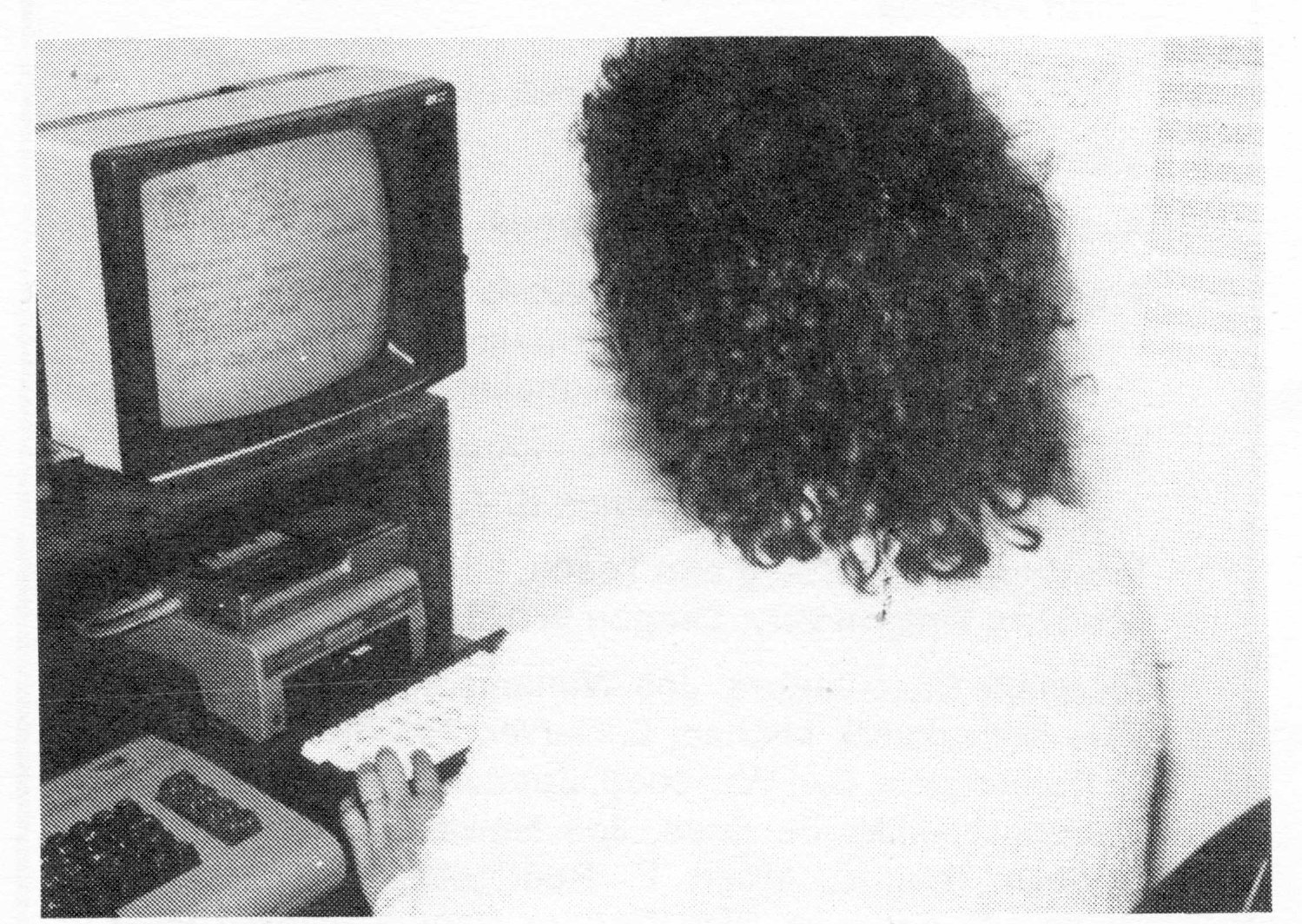
Brazil’s TK 90X
In our last issue, we reported on Timex Sinclair clones which are manufactured in Argentina, and also briefly mentioned another Sinclair clone from Brazil. International Correspondent, Bob Lussier, has supplied us with more details on the TK 90X, which is fully compatible with the Sinclair Spectrum, but also shows some internal copying of the TS2068.
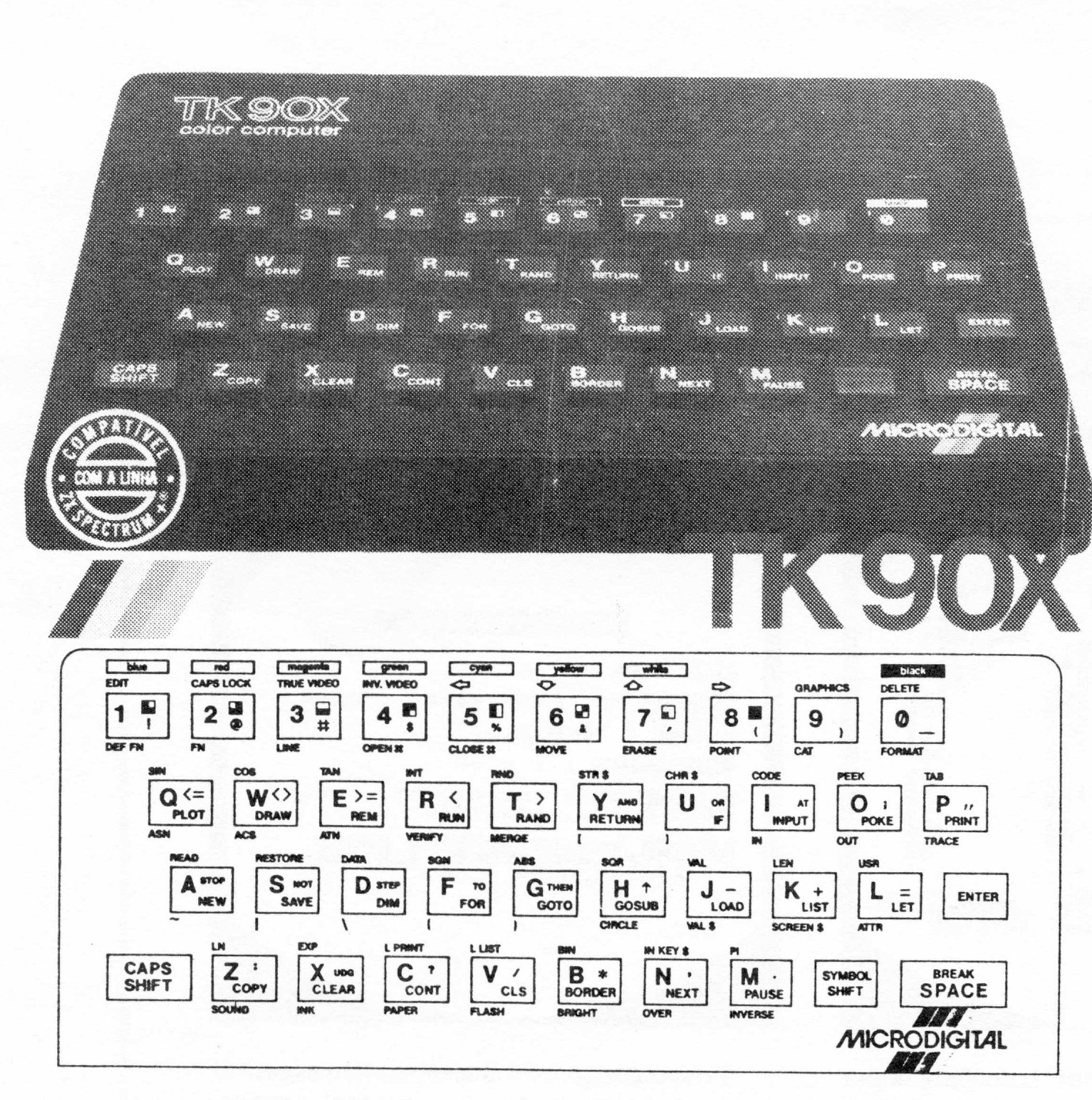
The Brazilian company MICRODIGITAL is the principal manufacturer and distributer of the TK90X. It is available in both 16K and 48K RAM configurations. Another model, the TK 95, has additional RAM and a full-sized, typewriter-style keyboard. Microdigital has revamped the standard Spectrum ROM, by offering a few bug corrections and features. Two additional character sets may be called with just a single command, both Spanish and Portuguese–the principal language of Brazil. BASIC commands are in English.
Several years ago, Sir Clive attempted to take some legal action against Microdigital for producing the unauthorized Spectrum clone. However, through immunity provided by the Brazilian government, Microdigital is protected against worldwide copyright laws. Many other cases of cloning and copyright violations exist throughout South America, including hardware add-ons and software packages.
Fred Nachbaur
Fred Nachbaur, is perhaps, best known for his continuing campaign for interest and support in the ZX81 (and TS1000/TS1500). But Fred also has developed some outstanding software for these machines, including the game DUNGEON OF YMIR, and his newest creation-ZX TERM*80 (see Tim Stoddard‘s report elsewhere in this issue). His most current software development utilizes machine code routines first introduced by Wilf Rigter, that give the user high resolution screen graphics on an otherwise low resolution computer.
Fred has been a public figure in our Sinclair community since the “early” days. He designed and sold a battery back-up system for the ZX (advertisements were ran in early SYNTAX magazines), he started SYNCWARE NEWS and after he gave up the title of publisher/editor, continues to advise and write for the newsletter. Fred has also penned some recent programs and articles in recent issues of TIME DESIGNS.

But Fred hasn’t seen exposure like he has in the last few months. Appearing on TV, Radio and in the local newspapers, Fred’s three year legal battle with Canada’s Immigration Service has created quite a stir here in the northwest, but most notably in British Columbia, Canada (his current homeland).
The Canadian government had been threatening with deportation because they did not consider Fred to be a citizen even though his parents are. Fred was born in West Germany in 1951, but his parents emigrated to Canada when he was 11 months. At a young age, the family once again moved for a short time to the U.S. Fred remained in the U.S. to attend college. His troubles began when he returned to Canada some years later.
The situation appears to be resolved now. Due to the tremendous press coverage the case had received, the Immigration Service has relented and will grant Fred “Landed Immigrant” status shortly.
We here at TIME DESIGNS wish the best for Fred and are happy that this situation may be over. Remember, you can get in touch with Fred through his company, Silicon Mountain Computers, C-12, Mtn. Stn. Group Box, Nelson, B.C., Canada V1L 5P1.
QL’s Price Hits Bottom: $99.00 for complete unit
A+ Plus Computer Response of Sullivan, New Hampshire, the company that purchased the remaining stock of Sinclair QL’s (U.S. Version), is apparently attempting to deplete their inventory of some two thousand QL’s. They have announced that the QL’s price until the end of the year will be $99.00, which includes the PSION suite of business programs.
Sharp’s, Inc. of Mechanicsville, Virginia, has also announced that they currently have units in stock for the new price of $99. Other QL dealers have similar deals available.
When the current stock of U.S. QLs is depleted, there will be no more units available. Unless Amstrad follows up on the rumor that has been circulating. Reports indicate that they may release a new computer model based on the Sinclair QL’s design.
More QL news from the U.K.
Dear Mr. Woods,
Thank you for publishing my letter in the May/June issue of TIME DESIGNS. Since the letter was written, time has moved on, and a few of the statements need to be updated.
1. The “QL compatible” 68000 based Sandy FUTURA machine was seen in prototype form at a recent U.K. Microfair. The machine was running OS9 and occasionally crashed. Rumor has it that the Futura will make its first working appearance with a QDOS compatible operating system as an IBM “plug-in” card rather than as a stand-alone machine. Unlike the THOR machine, the stand-alone Futura will not use existing QL circuit boards within its shell.
2. The THOR 20 prices in my last letter were relative to the standard THOR prices. In fact, all the prices have changed and they now start at £1179.00! The Thor 20 is regarded as a stop gap machine before CST move away from using the QL circuit board towards a more “pure” 68020 32 bit bus system. It’s performance is disappointing for a 68020 system, but it is faster than a QL.
3. QRAM Utilities (the Futura front end) did not originally work with programs compiled with the TURBO and SUPERCHARGE SuperBASIC compilers. After some heated discussion between QJump and Digital Precision, D.P. modified the extensions file, which apparently contained an incompatible “cursor on” command. Unfortunately, SuperBASIC programs compiled with earlier compilers than Turbo 1.42, will still not work with QRAM. Hopefully, software houses working in SuperBASIC will upgrade to the new systems.
4. QRAM contains code which effectively extends the operating system QDOS rather than SuperBASIC. The code provides a window/pointer system for re-sizeable/movable non-destructive windows. A main menu can be windowed on screen by hotkey (press ALT /) at any time. A pointer can then be moved over a vertical submenu (Files, Jobs, Channels, Print, Window dump, Options) and SPACE or ENTER pressed. A “grabber” utility which limits the memory a program can take, and an “Unlock” utility which makes windows destructive, are included. The programs you have in memory can then be flipped through with CTRL C. QRAM is best used with 640K or 896K QL systems.
5. The Miracle Systems TRUMP CARD, offering an additional 768K RAM (896K total), and a disk interface with Toolkit 2, is now available for under £200. It is rumored that Sandy are working on an answer to this card, but time will tell.
6. Digital Precision’s DESKTOP PUBLISHER 2.00 is much improved over version 1.00, though Thor owners should still check compatibility before purchase.
7. APT (Adventure Programming Tool) from Shadow Games has caused something of a stir in adventure circles. It supports graphics in mode 8 and text in mode 4 at the same time on screen. It also works in real time and uses multi-task fill routines. Some of the current adventures are being re-written using APT, because of its advantages over the Quill Adventure Writer. APT 1.50 is the latest version.
8. A few people in the U.K. have recently been tinkering with Transputers. A T800 Inmos floating point Transputer will comfortably out-perform a 68020/68881 Motorola combination on its own. One enthusiast is designing a QL/Transputer interface for £75 (Transputer not included). He has succeeded in linking a Transputer to a QL through a Medic interface, no software though.
9. New adventures to be released shortly include “The Prawn”, said to be a send up of its close name sake, and “Talisman”.
10. Having bought the QLiberator 3.11 SuperBASIC compiler, I thought a good test might be to compile a radio satellite location program written in BASIC for the Sinclair Spectrum (TS2068). The program, which was laced with GOSUB’s and GOTO’s compiled the first time with no errors, but a few warnings about incompatible BASIC commands did arise. On a bench test, a routine to draw the map of the world and then print the names of all available satellites and point to their locations, took 1 minute 55 seconds in SuperBASIC and 17 seconds compiled!
Sincerely,
Richard Howe
ARK DISTRIBUTION
Corve Farmhouse, Chale Green
Ventnor, United Kingdom
PO38 2LA
Sir Clive’s Z88 Update
Sir Clive’s latest microchip wonder is out now (for real), and the reports coming in, are that it does live up to expectations. Both Mark Steuber of Sharp’s Inc., and Rob Curry of Curry Computer have had Z88’s to test. Rob Curry reported to TIME DESIGNS that the resident software is very good, the display clear and readable, and overall an impressive machine. Drawbacks may be the lack of a data storage system other than RAM Cartridges (up to 128K), the choice by Sinclair to use BBC BASIC as a resident language (how about Sinclair BASIC or Super-BASIC?), lack of an internal modem, and the rather steep price tag…the retail price took a £100 jump to £399. Rob Curry also discussed the possibility of uploading and downloading data from a Sinclair QL via the Z88’s built-in RS232 port. I/O software for the IBM PC will be released shortly for this purpose on either 5¼ or 3½ inch disc. An external modem is being developed and is tentatively priced at £99.95.
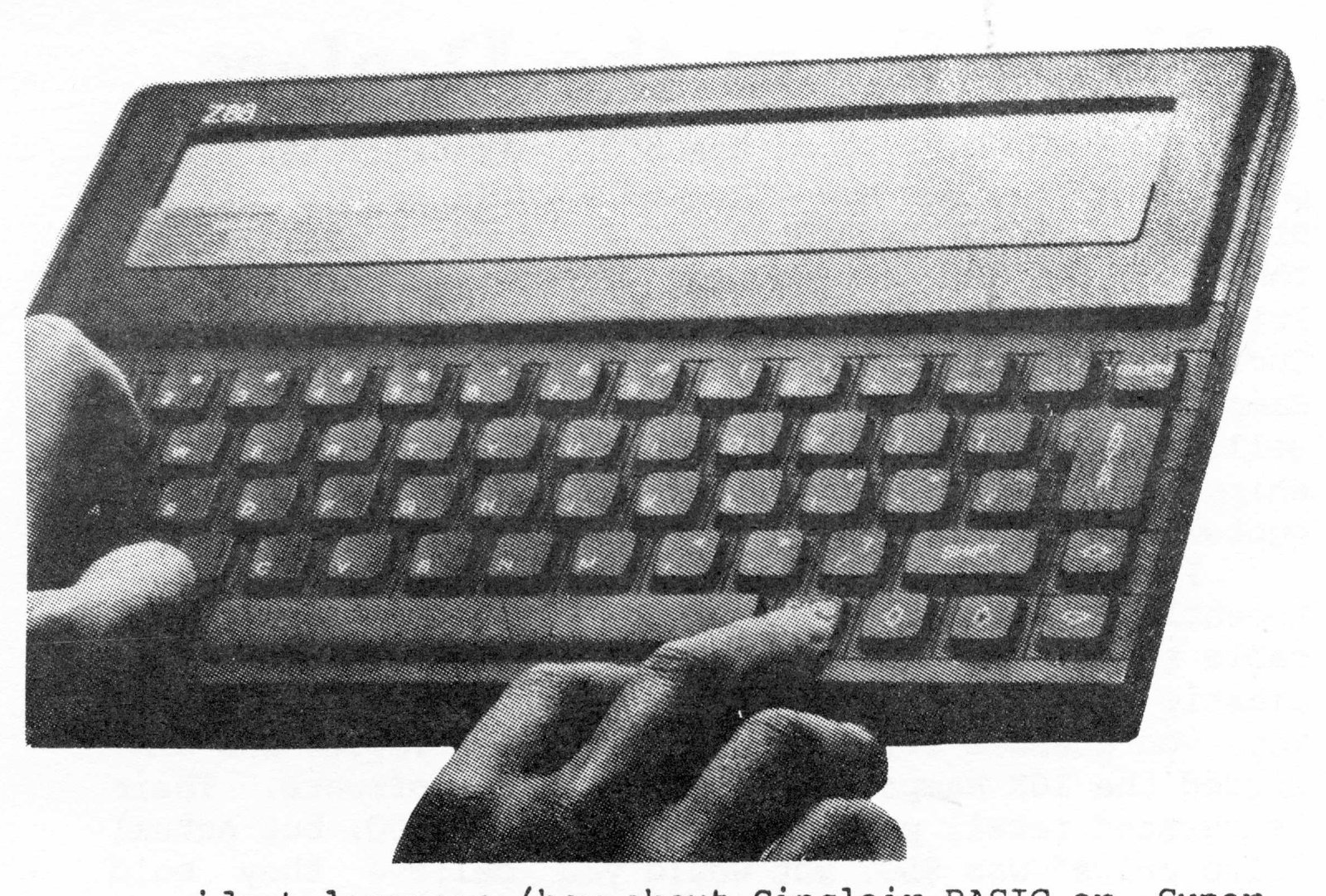
Negotiations are currently being conducted between a U.S. dealer and CAMBRIDGE COMPUTER LTD to obtain a U.S. dealership for the Z88. As of this writing, reps from Cambridge will not offer reasonable profit margins for the computer to be competively priced. The Z88 will need to compete with other battery-powered laptops like Tandy’s Model 100.
Interested readers can write to: Cambridge Computer Ltd., Cambridge, England CB4 1BR. Also, SECTOR SOFTWARE (39 Wray Crescent, Ulnes Walton, Leyland, Lancashire PR5 3NA) can obtain the Z88’s, and is a reliable company to deal with. Direct your correspondence to the attention of David Batty, and mention TIME DESIGNS.
Dates to remember:
* September 26, 1987 *
THE GREAT N.W. TIMEX SINCLAIR MINI-FAIR
Seattle Masonic Temple
801 E. Pine St.
Seattle, Washington 98122
9:00 am – 6:00 pm
$3 admission at the door.
For further info:
TDM
29722 Hult Road
Colton, OR 97017
(503) 824-2658
* March 7-9, 1988 *
SUNSTATE TIMEX SINCLAIR WINTERFEST
Orlando Marriott
8001 International Drive
Orlando, Florida 32819
For further info:
Mary-Lynn Johnson
[address omitted]
Orange City, FL
Sunstate BBS: (904) 775-0093 (7/1/E)
* June 23-26, 1988 *
SILICON VALLEY TIMEX SINCLAIR COMPUTER FEST
South Bay Area/Northern California
(Exact location un-confirmed at press time.)
For further info:
Bob Orrfelt
[address omitted]
Redwood City, CA