
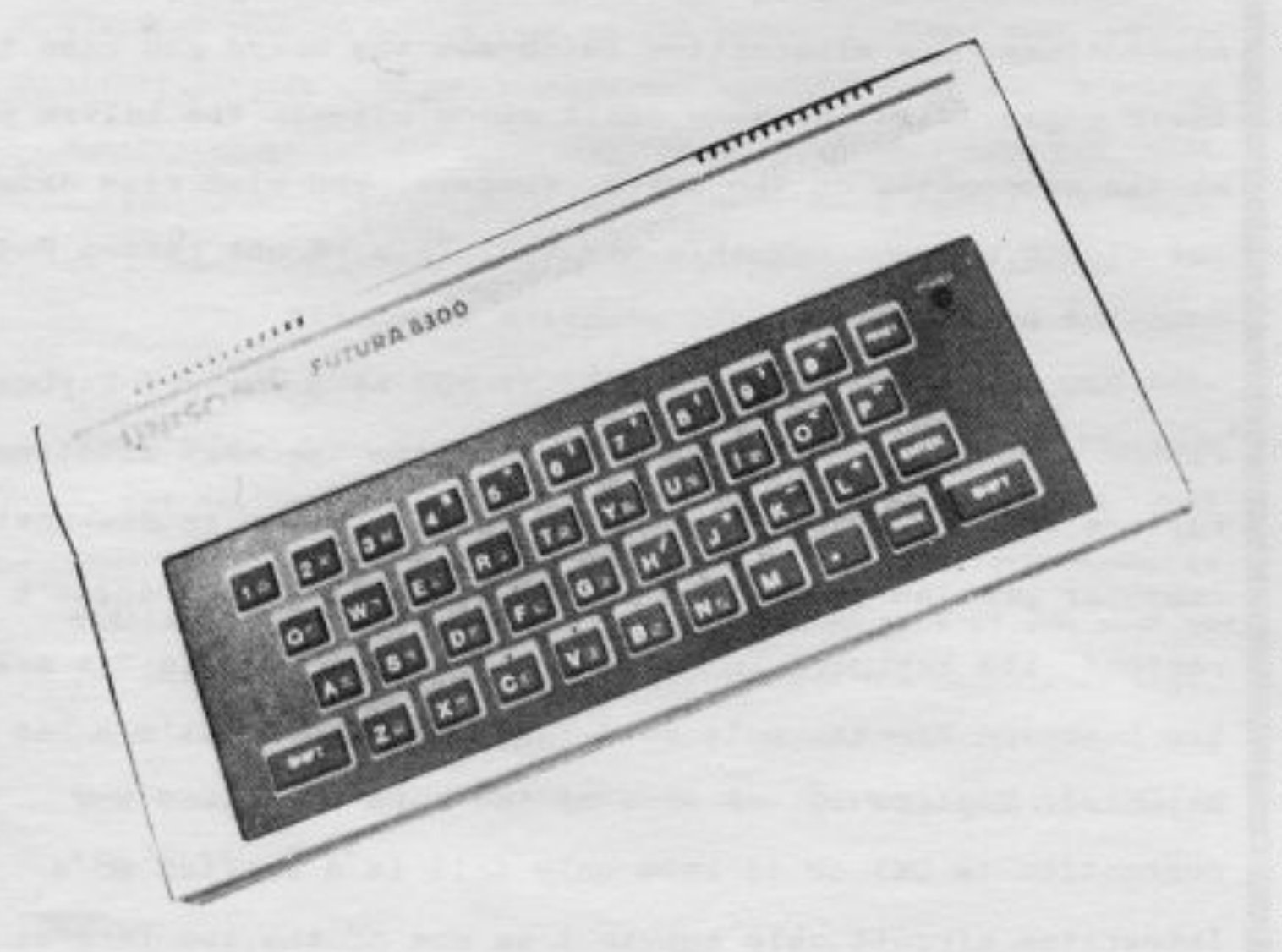
The first impression of the PC 8300, by anyone in love with the Sinclair ZX81/TS1000, has to be a good impression. After all, for only $30 you have in your hands a ZX81 ‘clone’. Actually, it’s quite flattering for any computer to be cloned, especially one that costs so little.
On the outside, the PC 8300 has some nice features (when compared with the ZX81/TS1000). These features include the LED power on indicator, the RESET button, the sound capability and the “almost real” keyboard.
Inside, the PC 8300 is quite different from its ancestors. I am always accused of “opening the case first” when I see a new product. I had to open the case when the display did not function correctly upon first turning on my new PC 8300. I removed the screws from the bottom half of the case and partially separated the two halves. I noticed there was a signal diode (1N914/1N4148 type) mounted on the circuit board near a ’50HZ’ marking. I took an educated guess that this diode was for operation in a 50HZ power line environment but not a 60HZ environment. My guess was correct as removal of the diode caused the computer display to work correctly both with TV and monitor. You may be saying, “Wait, the power to the computer is direct current (DC), rectified by the external power supply!” I can only speculate that the video output signal modification is for 50HZ power with and 60HZ power without the diode.
I quickly learned that the wires connecting the keyboard to the main circuit board were not properly soldered. I then had to resolder the wires in order to get the keyboard to properly respond.
I also noticed that the main circuit board was remarkably ‘clean’, meaning it didn’t have very many components present. Of particular note was the lack of clock components, normally consisting of a crystal and some capacitors and resistors. I noted no chips marked as a ‘Z80’ CPU. My conclusion was that the Central Processing Unit included the clock and possibly other components on the same chip.
Another disturbing feature of the computer is there is no manufacturer or place of origin marked anywhere. The box and manual also omit any identification. The PC 8300 is apparently an illegal or quasi legal copy of the Sinclair machine.
Anyone can solder together some components and call it a computer. However, the real inside of a computer is what is in the Read Only Memory or operating system. As those who have already used a PC 8300 know, the machine lacks exclusive use of single key entry BASIC words. I find this feature a real step backwards from the original. I have used many expensive desk top computers but none match the BASIC language keyboard entry speed achieved by Sinclair machines. On the other hand, the entry of PC 8300 BASIC statements can run together and the system sorts them out. For example, the operating system recognizes the entry “10FORN=1TO100” as “10 FOR N = 1 TO 100.”
The single most outstanding feature of the computer is the reset button which starts a ‘warm’ reset of the system. A ‘warm’ reset allows you to reset the computer without dumping the program from memory. This feature is especially good when testing the machine code routines I use in robot control. With an assembly code error on Sinclair computers the keyboard locks up and you have to remove power and reload the program. On the PC 8300, simply press ‘reset’ to exit the assembly routine and return to BASIC without dumping what is in memory.
The instruction manual is very thick and probably well written. However, I don’t read the Far East language the manual uses. There are a few charts and tables in the manual that are readable, because of their arabic numbering and english keystroke legends.
The operating system may have some improvements, but these improvements may cause problems. Comparing the character set/code chart of the PC 8300 with a Sinclair will show the two computers are not 100% compatible. For example, the code for THEN is 64 in the PC 8300 and 222 in the TS1000. Most of the ROM codes match but the few differences will prevent some basic programs running properly.
One of the biggest incompatibilities inside the PC 8300 is the way it assigns internal memory locations. This difference, surprisingly, does not prevent the Sinclair 16K RAM pack from being used on the PC 8300. The primary reason for the compatibility is because the external bus connector on the PC 8300 is pin compatible with the TS1000. This also allows use of the TS1000 printers and the Budget Robotics & computing RX81 input/output board on the PC 8300. However, even though the external connector is pin compatible, it is not 100% signal compatible. Either electrical characteristics of some PC 8300 signals are different or internal operating system handling of these signals differs from the TS1000. The result is that some peripherals will not work with the PC 8300 without hardware modification. The Budget Robotics Buffered Buss Expansion board is one example.
Now, back to the memory allocation incompatibilities. When writing machine code routines for the TS1000, you can POKE code directly into a 1 REM statement starting at address 16514. This will not work on the PC 8300. For some strange reason, on the PC 8300, this location moves up 793 bytes to 17307. Also, in preparing an empty 1 REM statement on the PC 8300 you can’t just enter blank spaces like on the TS1000. Instead, you must enter quotation marks at the beginning and end of the blank statement on the PC 8300.
The PC 8300 is a good machine with both advantages and disadvantages when compared to the Sinclair ZX81 and Timex/Sinclair 1000. Will parts be available if you want to repair a PC 8300? I doubt it. As most have handled the TS1000 repair problem, just toss it and get another. The price is right.