9/4/92
Mr. Jeff Taylor, Editor
Toronto TIMEX-SINCLAIR Users Club
335-75 Lemonwood Dr.
Islington, Ontario M9A 3L4
Dear Jeff,
I was happy to meet you at Dayton. You are the only Toronto members I can remember meeting except for Larry Crawford, but then, my memory is not that good anyway, as you might have noticed.
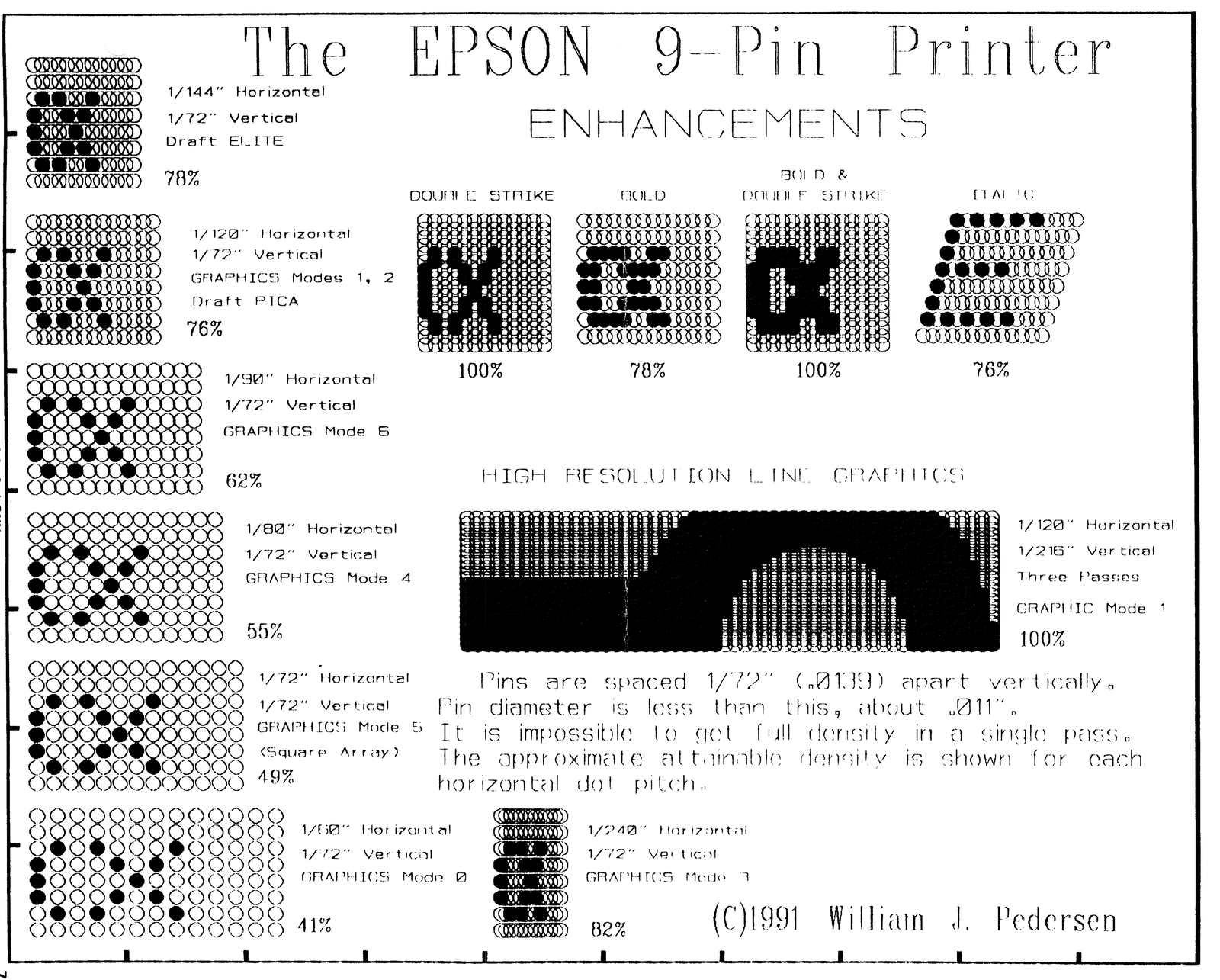
The (to scale) EPSON Printer graphic you could not XEROX was a XEROX, and a poor one at that. A direct hi-rez printout is enclosed.
Because the graphic uses very narrow lines, it might seem that they are too light to copy. Unlike DRAFT mode, individual dots are connected. Good XEROX copies can repeat this fine detail without darkening, though some can improve general appearance. (It was printed using a 24 pin printer and HP graphics language from ASCII files.)
I had meant to do the same for 24 pin printers, but doing an honest job requires six pages; and even then, organizing them in a clear manner requires quite a bit of supporting text.
In the same vein, it is actually possible to get 360 horizontal dots per inch on an FX80 using multiple passes and intermixing character and graphic modes. Explaining how this is done in print — forget it! It involves printing blanks using PICA, backspacing using ELITE, and then going to a graphic mode for one example. Because added resolution using six passes does not appreciably improve CAD, it was not used.
With a humungous amount of work I can capture screen images which happen to contain gray-scale windows from a multimedia encyclopaedia. Getting these onto a TIMEX-SINCLAIR disk isn’t easy, nor would copying a hex printout by hand. That is why I’m looking forward to getting a file from you containing A2D encoded pixel data along with a simple description of how the file is encoded and what it portays.
As with CAD, different printers work best with particular methods of “dithering” and gray levels. The same applies to screen video modes. The TS2068 is most amenable to 4×4 pixel “gixels” giving 17 shades. That requires a file 4 bits “deep”, that is, 4 bits per pixel usually packed two pixels per byte. An uncompressed TIFF file is often exactly this format.
TV pictures can be quantized in many different ways, but what is nearly universal is real-time sample intervals integrated and then converted to digital form as scanning continues. These digitized samples are usually blocked by scan line and field. Two fields comprise one frame. One full interlace frame contains 525 lines, only about 400 represent picture data. The rest are border, vertical retrace, color burst and sync pulse templates.
The TS2068 has 192 non-interlaced scan lines of data out of 262. The horizontal scan frequency is exact, but the vertical is fast by 525/524, not enough to bother.
A single field with 256 samples per line would supply enough data for 16 screens of panned dithered display or dot matrix dump output. It would also fill a landscape oriented printed page. Fewer samples per line could be used, but then dithering routines have to integrate samples from two or more scan lines for each gixel.
For best results, no fewer than 128 samples per line should be used with no less than four bit gray resolution. The absolute minimum is 64 samples per scan line at 3 bits per sample. Anything less yields strictly amateur results by comparison. More gives an opportunity to correct for factors like overexposure and printer “gamma”. Gamma is a correction factor which can make the screen and the printed page look identical viewed side by side.
Round dots, whether from pin impacts or ink droplets have difficulty in registering near-black detail. Dots overlap long before they completely cover the area. One common partial cure is to re-define a square array of four almost obliterating dots as a single pixel before creating gixels. A very few printers actually have square pins.
When round dots must be used, and only 17 gray levels (nonlinear) are used per gixel, samples 6 to 8 bits deep can be mapped using a pallet to correct for nonlinearity.
Other problems exist for printers with different sizes of pins, pin spacing, and dot pitches. Some laser printers operate like they have nearly square dots, too. A few special tests can determine that.
In spite of the complexity of visual presentation, the computer can do near miracles when given enough data. Programmers should never forget that taking convenience short-cuts is hazardous to results. This is especially true when learning about what is being done.
If I can, I plan to come out with my own DOS some time next year. This development will apply to all TS2068s and clones wherever they are. It all hinges on getting my ROM BYPASS to work like the TIMEX BEU without having to open the case for modifications.
In case LARKEN faithful are worried, just don’t change a thing. Of course they won’t be able to use expansion bus bankswitching because both LKDOS and JLO SAFE wrest priority from the operating system. I have not yet found a suitable way to negotiate this difficulty, descended from Interface 1. I surely don’t want to propagate that problem to still another tier. If others try to merge the systems I advise caution and realization of the consequences of good intentions.
Hangin’ in there, baby,
Bill Pedersen