
The computer chip manufacturing industry has spent millions in building specially designed facilities. They are 99.9% free from common static electricity, which can destroy certain IC chips that are static sensitive, in an Such a facility might have equipment that removes static from the environment, specially treated floor and work services, and the employees wear certain garments and shoes. While an electronic hobbyist connot afford such state of the art apparatus in his own home workshop, the hazards of static electricity discharge are every bit as real.
Zapped computer chips such as microprocessors and logic chips, ROM, EPROMs, CMOS and MOS chips are not much fun, and certainly quite costly to replace. Although seasoned experimenters may rarely come across many problems in this area, special handling procedures need to be observed. This usually entails one or more of the following:
1. Carefully open up the computer’s case, and use minimal handling around the circuit board, chips, and other internal parts. Power should always be off.
2. Right before removing or installing a computer chip, discharge the static electricity that has built up in your body by touching a grounded object (i.e. drain pipes, center screw of an electrical outlet, ect.).
3. Store all static sensitive chips in the special anti-static foam that they come packed in.
4. Take into consideration several situations that are more prone to static, such as low humidity (dry weather), lightning storms, body friction on synthetic materials, and electric forced fan heaters and clothes dryers.
With a good deal of interest in Spectrum ROM swapping with the Timex/Sinclair 2068, and EPROM packages, “do it yourself” computer servicing is on the rise. Most Spectrum ROM conversion kits come complete with precautionary instructions to use in avoiding static electricity damage, however, this does not necessarily remove the risks.
There is a device that many professional computer service technicians use to get around the problem of static safely. It is called a “static discharge bracelet”. The bracelet simply is a metal strip that is strapped around the wrist, with a long wire that is soldered to the band at one end, and attached to gound by means of an alligator clip at the other end. The person wearing the bracelet is securely grounded, rendering any static discharge harmless. You can make your own bracelet at home for a few dollars. All of the parts are easily obtained.
1. Strip of foam-type weatherstripping, 3/4″ to 1″ wide, and long enough to wrap comfortably around your wrist with an extra inch to spare.
2. 3/4″ wide strip of copper foil, approx. the same lenghth as the foam strip without the extra inch. (The copper foil can be found at hobby/craft stores or large plumbing shops.)
3. Two Velcro strips
4. 48″ or longer piece of insulated electrical wire.
5. One 1/4 watt megaohm resistor.
6. One medium-size alligator clip with a rubber boot.
7. A piece of vynl electrical tape.
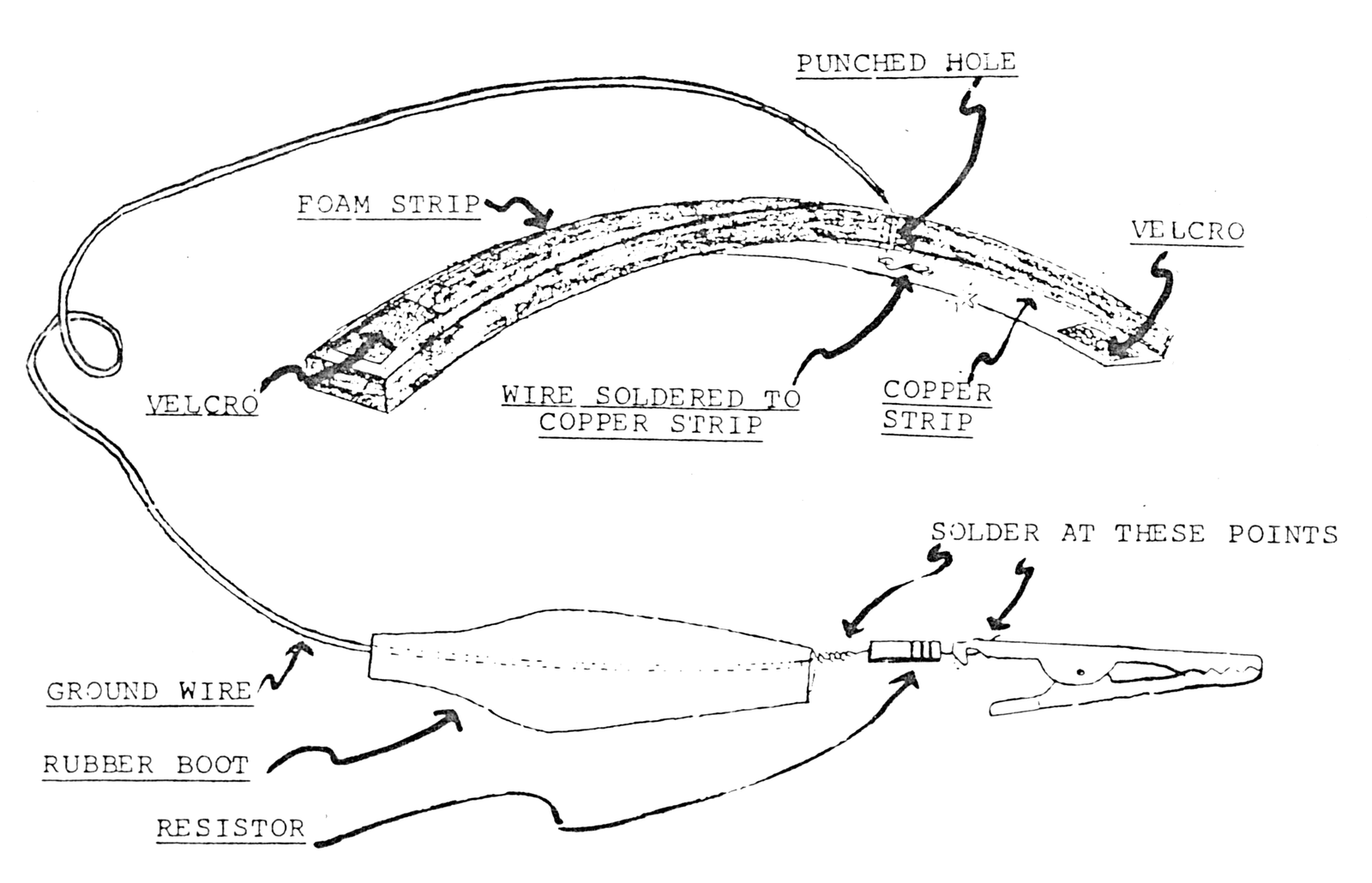
Peel off the paper backing of the foam weatherstrip and attach to the copper foil strip. Attach the Velcro strips to each end of the bracelet (either glue or sew a stitch), observe the illustration for proper placement. Punch a small hole thru the foam and copper strips and insert one end of the wire with 1/4″ of insulation stripped from the end. Solder the wire to the copper foil, and cover with a small piece of electrical tape, so that the solder joint won’t scratch a bare arm (it also acts as a strain relief). On the other end of the wire, strip 1/4″ of insulation and slip the boot of the alligator clip over the wire end. Solder the megaohm resistor to the wire, followed by soldering on the alligator clip itself. Slip the boot down over the clip, and inspect all the solder connections or places where there might be bare wire showing, and cover with more electrical tape if necessary.
When using your static discharge bracelet, strap it firmly to your wrist, with the copper foil contacting securely against your skin. Run the long piece of wire to a known ground and attach with the alligator clip. Now you can safely handle computer-related parts and chips as long as your bracelet is properly working for you. Wear your bracelet at all times when you are engaged in such activities…it could save you time and money in the long run.
Special Note: Use caution when cutting or handling the thin copper foil strip. The edges are extremely sharp and could cut you. Make sure all sharp edges of the foil are pointing away from your arm, or removed with a file.