
Battle Zone
This bit of news from our friends “down under”, may come as a surprise…yet will bring a sense of pride to anyone who possesses the mighty silver one…the TS2068.
The Australian Army uses the Timex Sinclair 2068 as part of an inexpensive simulator used to teach soldiers the skills of calling fire from an artillery battery or mortar platoon onto targets in the field.

According to Staff Officer J. Todd, the Timex computers used are standard production models (unmodified), and are interfaced to video projectors that accept the NTSC-type (U.S. standard) synchronization signals. Since the electricity supply in Australia is 240 volts AC, a different transformer is used than those supplied with the stock TS2068.
The Australian Army has made good use of a reliable, yet cost effective computer, as a battle field simulator. The software was developed in the Science Department of the 1st Division Headquarters. The Australian Army works with only a fraction of the budget that the U.S. Army does, but of course, one probably wouldn’t find a TS2068 driven simulator in the U.S. military…or would we?
Bath Boutique
David Lebowitz is very familiar with the use of a Timex/Sinclair computer in a business setting.
“I use a TS2068 equipped with Rotronics Wafadrive and an inexpensive dot matrix printer in almost every phase of running a retail business. In my case, the business is a Bath Botique that my wife and I have owned and operated for about twelve years. We sell accessories for the bath of every description, from shower curtains, rugs and towels to soaps, soap dishes, wastebaskets and upholstered toilet seats. It’s a small business that employs eight people, operates from about 3,000 square feet of space and remarkably purchases from a list of over 300 vendors. We are firm believers in offering a broad selection of merchandise and may have one of the most comprehensive inventories of its kind in the Nation.”
“Our TS2068 gets used all day long for all kinds of purposes; cash accounting, sales analysis, payroll, accounts receivable, accounts payable, inventory control, purchasing, and of course, word processing. I wrote all of the programs that we use in BASIC (mostly on the TS1000 originally) and continue to update and expand upon them as necessary.”
The Bath Botique uses five programs with the TS2068:
DAILY- This program provides the input for most of the bookkeeping needs. It is a daily compilation of many of the financial activities, like total cash sales, credit card sales, lay-a-way payments received, refunds and other kinds of cash payouts. The program prints out a daily sheet form and totals receipts and expenses, subtracting the latter from the former. It also performs other functions including a spreadsheet print out at the end of each month, detailing in column form (with monthly totals) each of the various categories.
CHARGES- Takes data from the DAILY program that concerns accounts receivable transactions and creates a printout of that month’s A/R activities. It also prints out statements for all active accounts that have other than a zero balance. The statements are produced on continuous forms and just have to be put into window envelopes for mailing.
CHECKS- This is the “input” program for accounts payable. Essentially, the program asks for all of the information required to prepare a check. Then it proceeds to actually print out the check using continuous check forms. Among other functions, it prints out a remittance stub that details the payment for the payee, and also maintains a running bank balance at all times and compares monthly deposits to date with withdrawals. Finally, at the end of each month, it performs a sort by account code and prints out a list of all accounts by name, number and total for each month.
PAYROLL- This program simply asks for the number of each employee and the number of hours worked. It then calculates gross pay, Federal Withholding Tax, State Tax, FICA deduction and net pay. The data can then be moved to CHECKS, to create payroll checks. PAYROLL also prints out quarterly reports listing each weeks’ payroll by employee, quarterly and year-to-date totals for each category mentioned above.
STOCK- The hardest working program of all, as it is a combination inventory/ordering program that starts as a pre-printed inventory sheet for all of the items normally carried from a particular supplier and ends up as a neatly printed, fully documented purchase order, extended and totalled (thus providing a comparison figure between invoice totals and purchase orders). The program can also be used to print retail price labels showing item number, name and price for each item ordered. Additionally, the program order data can be saved so that, if additional orders must be placed before this merchandise is received, items on order can be automatically added to the on-hand inventory before the new order is printed.
“I really believe that a computer like the TS2068 is capable of undertaking most of the essential tasks that a small business requires,” states Lebowitz. “It does take a lot of patient programming because to be really effective, the programs should be custom tailored to the individual task…of course, that’s part of the beauty of simple-to-program computers like ours!”
“I’d be glad to share any further information, including actual programs and/or printouts from them. And I almost forgot…if anyone out there needs any bathroom accessories, I’ll be happy to help with that, too!”
Write to: David Lebowitz, [address omitted], Flossmoor, Illinois, 60422.
Green Thumb
Out in rural, western Oregon, the climate and soil is ideal for raising an abundance of greenery, and the Independence Nursery (in Independence, Oregon), owned and operated by Marylou Matteo, is no exception.
“I use a TS2068 for my business,” states Matteo. “Using OMNICALC, I keep track of plants sold by amounts and dollars brought in from all sales, along with where it went to. During our season, spring, I update weekly or every other week. The ‘plants sold’ file has 72 customer accounts.”
“At the end of each month or so, I print a hard copy and erase the oldest entries so that the data will fit in the computer. The program totals, subtotals, etc., so that I know how much money came in daily, weekly, monthly and by the season. I also know how many dollars worth of any particular plant sold and when it moved.”
“Using MSCRIPT, I do ‘help sheets’ for customers on a variety of plants, to save time telling people how to grow them, where to plant, etc…which they will not remember when they leave the nursery. I also do a newsletter that goes out 5 times a year. The print shop prints the newsletter from my copy (created by MSCRIPT), and we put on the address labels made with VU FILE.”
Spring is coming around the bend, and Marylou will be busy again. Here’s to another successful season and a reliable 2068.
Engineering
Mel Routt is a familiar name among members of the TASBAM computer group in the west coast area of Florida, of which he was associated with in the early days of its inception. But Mel is also a businessman now president of H.E. Johnson & Associates, Inc. Their major product is power transformers.
“In 1980 I bought my first Sinclair computer, a ZX-80,” Mel related. “By 1985 I had learned enough about the little device to package it permanently in a distinctive metal cabinet along with a built in power supply, additional 16K of memory, an interface circuit for the cassette input (ZX-80’s were bad to work with most recorders), and a new keyboard by EZ-Key. I finally had a truely functional and ‘comfortable’ Sinclair computer.”
“It wasn’t long after that I evolved my first major program that has been used since 1985 to design our products. The program takes our client’s requirements in an input mode, churns them around against various calculations used in our industry as well as any special factors evolved from our company’s experience and then provides us with the necessary information to fabricate the device. The output has been both screen display as well as the remarkably utilitarian TS2040 thermal printer.”
“However, once I acquired a TS2068 computer, and spent some time learning its additional power, the program was upgraded to utilize the new capabilities. The software now provides an estimate of physical size and weight of the finished product. Since I became president of the company I have not had as much time to do the programming I would like to do, but at first opportunity I intend to have the program also compute a cost estimate…all in good time.”
Since Mel assumed leadership of the company, he has discovered a multitude of uses for the TS2068, including a calculator to monitor copper base fluctuations occurring almost weekly from all suppliers, and a data base to keep track of accounts, expenses and costs of material, payroll, etc.
“As my CPA says, ‘you have evolved the fundamentals of a general ledger’. It also became necessary to operate the program through a full size printer because the data tables are easier to handle on conventional 8 1/2 x 11 sheets as opposed to twenty miles of thermal printouts. Thus I upgraded my system with a daisy wheel printer using an Aerco interface.”
“The other major application is the use of the TS2068 with the MSCRIPT wordprocessing program to handle correspondence.”
As an update, Mel has had to turn over all accounting to his CPA, since the work load has increased. He is also contemplating on purchasing some PC equipment to meet larger memory requirements, and the Timex system, of which he is very satisfied with, will become a dedicated word processor in the office.
Stocks
George Mockridge is a friendly, down-to-earth type person, who doesn’t mind discussing Sinclair computers. He is active in TS user groups in the San Francisco bay area and former editor of the TIMELINEZ newsletter. And he also applies his Timex computer in a demanding business…the stock market.
George first started keeping track of statistics and stock market calculations using a programmable TI calculator. His next step was to purchase a Sinclair ZX81, mainly because of the price, and learned to program in BASIC on his own.
George’s specialty is the “technical and fundamental analysis of stock” from the data provided by some home-brew programs he has developed. The Value Line Investment Survey is his source of information.
Originally the programs were developed on the ZX81, which George fondly describes as “a good number crunching machine”. The main program he uses is for “data maintenance”, which keeps a year worth of stats on 100 stocks. The results of this program feeds a “graphing” program, so that the data can be viewed and summarized.
When George switched over to the TS2068 a few years ago, it gave the graphing program considerably more detail, and both programs were upgraded to make use of the new machine.
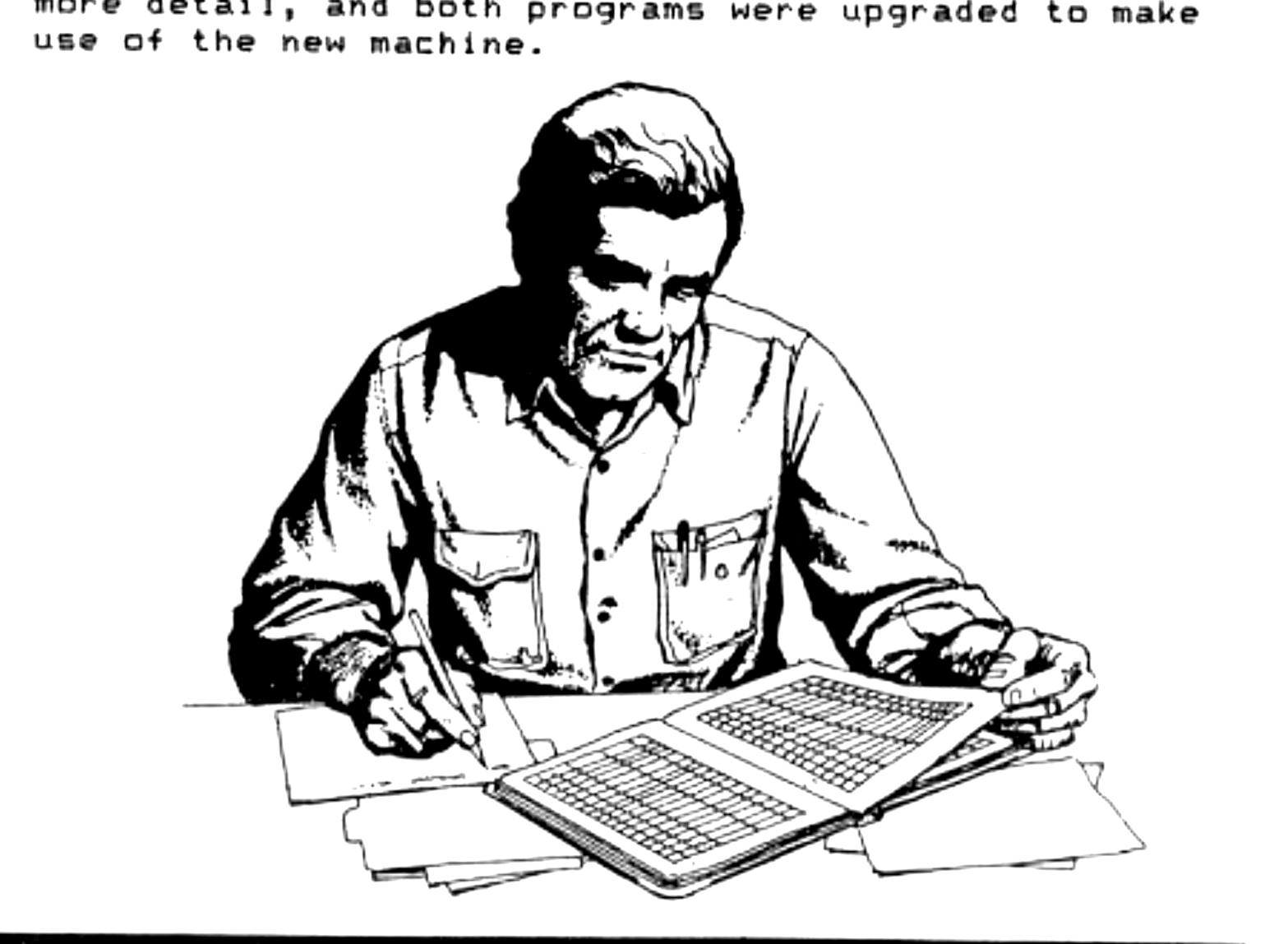
For the past eight years, George has worked out of his home. He deals a lot in options, and large NY Exchange stocks, such as (just off the top of his head), American Airlines and Etna Life. Along with the Timex computers, he also owns an IBM clone which he tinkered with for a while, but found the TS computers to be more suitable for his needs.
“I really enjoy programming in BASIC…I think the TS2068 is a fantastic little computer”, related George.
He is also willing to correspond with anyone interested in the same field. Write to: [address omitted], Daly City, CA 94015.
Sinclair Dealer
Rod Gowen, proprietor of RMG Enterprises has been a Sinclair computer dealer since 1981. Before that he was in the home electronics, auto sound, and CB radio retail business. The last two years he has been at it full time, working out of the basement of his Oregon City, Oregon, home. The business is primarily mail order, but Rod also has a large amount of equipment set up for demonstration to local walk-in business “by appointment”. He has also worked in to the business, generic computer items like printers, monitors, disk drives, floppy disks, cables, ribbon re-inkers, printer stands, and even other lines of computers besides the Sinclair. But the Timex Sinclair business has remained the mainstay and accounts for most of his business activities. Rod currently stocks over 500 items, with a total inventory value of $36,000 retail.
Several computer systems help Rod in running the business. The primary system is a Sinclair QL that runs three business software packages programmed by Vince Lyon of Executive Workshop, but highly modified and customized by Rod.
One program is actually a “two in one” package, which does the inventory and invoicing, another program stores the customer files, and there is a general accounting program. All data is stored on double density quad disk drives, and a Miracle System’s Trump Card is also used. Hard copy can be obtained from an Okidata 180 printer.
Rod extensively uses RAMdisk-ing with his business software, especially the inventory and invoicing program. One example, is a UPS shipping charge data file that can be called up and automatically calculates UPS charges.
For general correspondence, Rod uses a TS2068 with TASWORD and a Ramex disk drive system (running a Larken DOS cartridge). Printouts are done on either the Okidata or Blue Chip printers.
Another TS2068 system is dedicated to the RMG BBS which is online in the evenings until early morning (call 503-656-8072; setting 8/1/N). It is running CASBOARD software, with an Aerco disk drive system and dual quad 800K drives.
Rod stays very busy with a current customer base of over 1,032. He is also the treasurer of the local Timex Sinclair Users Group. You can write to him at: RMG Enterprises, 1419 1/2 7th St., Oregon City, OR 97045.