
The heart of all computer telecommunications is the modem. Modem stands for MOdulate/DEModulate. It works over the telephone line by sending special tones that are assigned to each 0 and 1 information bit (modulate), and a receiving modem converts the tones back to the original bits (demodulate). A hook up to the telephone line can be accomplished with two different designs. Either direct or acoustically (which is simply cradling the actual telephone handset in a sensitive pick-up device). The direct method is by far the preferred design, and all Timex/Sinclair compatible modems are direct connected.
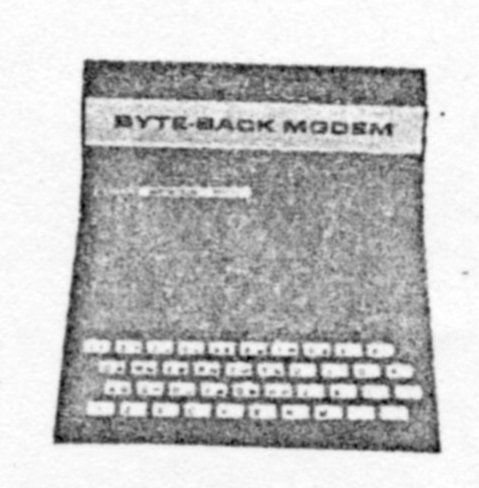
The Timex/Sinclair 1000 has for several years now had the opportunity to utilize the benefits of telecommunications, thanks to the efforts of the Byte-Back Company in Leesville, South Carolina. Their “MD” modem line has been available in both kit and fully assembled and tested forms. One unique feature all of their modems have, is a RS-232 port, which allows for the connection of a full size printer. This feature alone adds fine value to an already exceptional product. Today the Byte-Back Co. has upgraded the MD-2 modem to operate on the TS 2068. It is called the MD-68, and sells for $120 as a kit, and $150 fully assembled.
The Timex Computer Corporation had plans for a modem all their own. One that would be compatible with the TS 1000/1500 and the TS 2068. In fact, it was once said that the TS 2068 was designed around the idea of personal computer telecommunications. But pipe dreams suddenly faded when Timex pulled the plug on their computer line. All was not lost though. Westridge Communications, the company that Timex had contracted to produce their modem, decided to go ahead and release it under their name instead. Thus, the Westridge TS 2050 was finally born. The TS 2050 retails for $120.
If a modem is the heart of computer telecommunication, then the software that operates it is the brain of the modem. Most modem software is considered to be “smart” or intelligent. That is, it can perform several different operations and functions. Examples can include automatically dialing a phone number from the keyboard, auto-answer incoming calls from another terminal, printing capabilities off the screen, and even file storage of phone numbers and log-on data. Some sophisticated software like Byte-Back Co’s ZCOMM for the MD-68 and Westridge’s optional MTERM II for the TS 2050, can up-load or down-load information into a buffer for use later on. This feature is especially valuable for sending pre-prepared texts or obtaining files and programs from a data base.
Timex/Sinclair enthusiasts might have another option when contemplating a modem purchase. There are universal modem adaptors and interfaces that might be suitable for a TS computer. These devices can be found in the back of electronic and computer trade magazines, and in some of the larger computer retail stores. With such an adaptor, most modems on the market would be made accessible, including the popular and inexpensive Volksmodem, manufactured by Anchor Automation, the parent company of Westridge Communications. The Volksmodem has a retail list price of a mere $70.
Most modems on the market are powered by an external AC step down transformer, like the Westridge 2050 modem. However, some like the modems from Byte-Back Co. are designed to use the computers internal power supply via the rear card connector. The Volksmodem on the other hand is portable, and is powered by a nine volt battery that is reported to last a full year under normal useage.
Both the Westridge and the Byte-Back modems (and the Volksmodem) have a baud rate of 300, which explains their budget pricing. Baud rate is the speed that a modem sends data over the telephone line. A 300 rate figures out to be approximately 30 characters per second. For about twice the money, there are modems that transmit and receive at 1,200 baud. That’s four times faster than 300 baud. The 300 rate works just fine for most home applications, and won’t put a strain on your pocket book either.
It is good to know that TS users haven’t been left out in the cold when it comes to computer telecommunications, and a choice of modem equipment. Thanks to efforts from both Westridge and Byte-Back Co. Now a whole galaxy of special services and features are available at our fingertips. Almost any commercial data base or BBS can be accessed, because both modem companies have included parameters that are adjustable, such as full/half duplex, parity, and choice of stop bits and word lengths. If experimenting is your game, you may want to try adapting some other modem to your TS computer. Others have tried it, and have come up with some satisfactory results.
For further information write to:
Byte-Back Co.
Rt. 3, Box 147, Brodie Rd.
Leesville, S.C. 29070
Westridge Communications
6624 Valjean Ave.
Van Nuys, CA 91406