
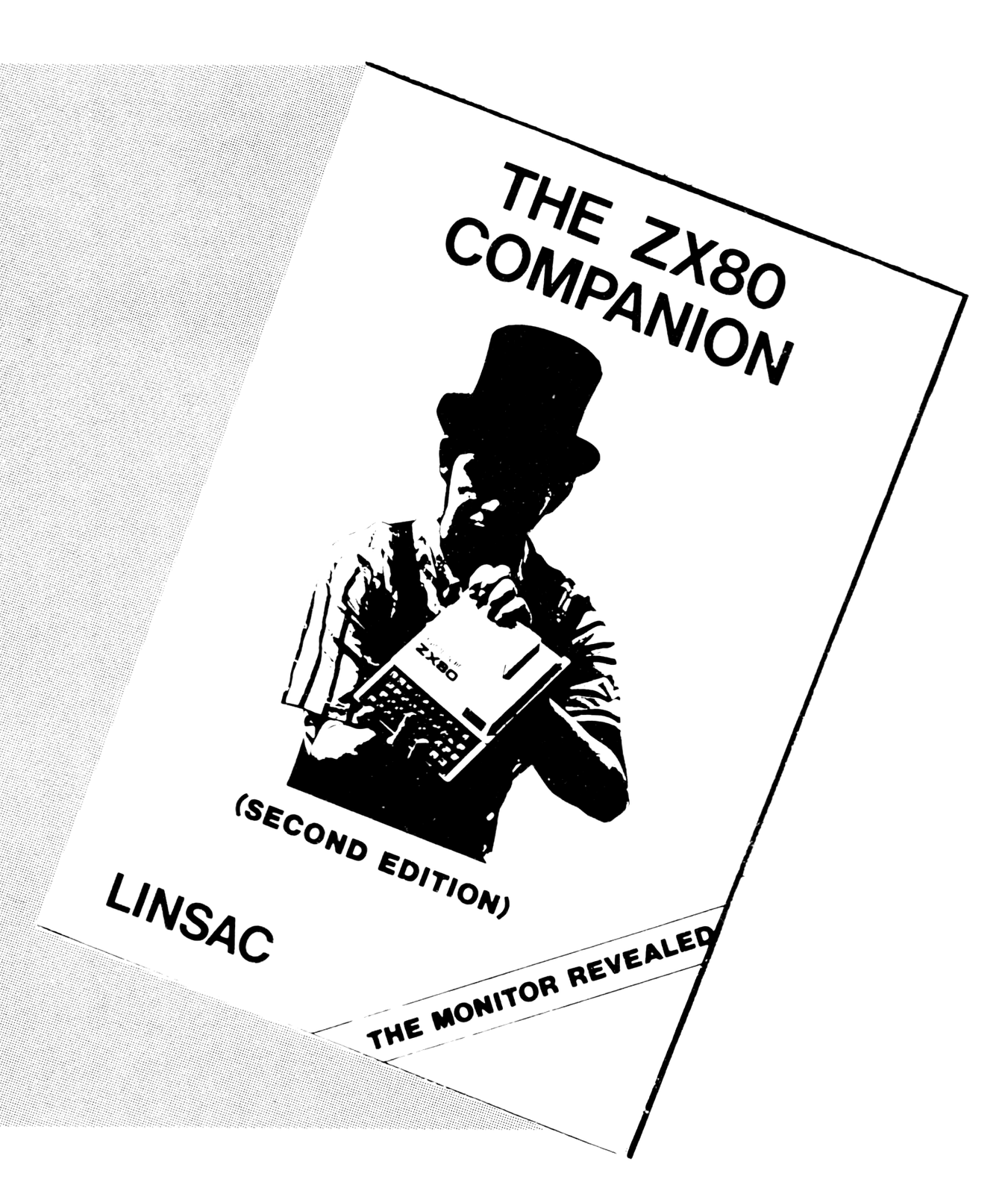
The ZX80 Companion, by Bob Maunder, Terry Trotter, and Ian Logan; Linsac, 68 Barker Road, Middlebrough TS5 5ES, England, 128 pages, softbound, £10. Available in The United States through Image Computer Products, 615 Academy Drive, Northbrook, Illinois 60062, $19.95.
This book is designed to supplement the original ZX-80 manual. It includes tips on the operation, assembly, and programming of the ZX80 for maximum effectiveness. Although the original manual is useful, and gives a beginner clear, concise directions on the operation and programming of the computer, The ZX80 Companion continues beyond the offerings of that manual.
The book is divided into six chapters, and has two appendices. Chapter One, “Operating the ZX80,” has five sections, explaining basic operating procedure for The ZX80. This section contains many of the tips contained within the authorized manual, although there are hints not found in the Sinclair booklet.
The second chapter, entitled “Theory of Computers,” is especially useful for computer novices, since it explains what computers do and how they function. This portion of the book also examines computer languages, and the components of a computer system.
Chapter three, “ZX80 Basic,” explains the particular language of this computer, and focuses on the individual functions and how they are used. This section includes the sub-headings: Assignments and Calculations, Input and Output, Conditional and Unconditional Jumps and Loops, Arrays, Character Handling, and Machine Code.
The fourth chapter, “The ZX80 Monitor,” looks at the monitor, and explains PEEKing, POKEing, and subroutines. It also contains sub-routine memory maps and monitor maps, as well as a cursor table and a discussion of ZX80 machine language. This portion of the book will be particularly helpful for the serious programmer.
Chapter five offers assistance in constructing the ZX80 kit, which is available in the UK, although some of the advice may apply to the construction of the MicroAce. The authors have presented some suggestions which augment the factory manual.
The final chapter of The ZX80 Companion contains programs from the Linsac tape collection. These programs are generally good, with The Maze game being one of my favorites. The Spelling Quiz program will be quite useful as a study aid for small children.
The final pages of the book contain two appendices, which include a comparison of Z80 instruction codes and the ZX80 character set, and a preview of the original Sinclair 8K ROM.
The ZX80 Companion will make a useful addition to most ZX80 libraries. There is much helpful and informative material in the volume, although some material covered in the owner’s manual is repeated. As useful as it is, the price seems high when one considers the undistinguished printing and binding.