
Second in a series on VCF Midwest 21. Part one is here.
Consider what a Timex Sinclair 1000 actually gives you out of the box in 2026. One kilobyte. A membrane keyboard. No sound. No storage but a cassette deck you no longer own. And an RF modulator built for a television that has not been manufactured in twenty years, which is the one that stops people cold, because a computer you cannot see is not a computer you can use. The standard answer has always been to open the case and solder in a composite modification. That is a reasonable afternoon’s work if you are comfortable with a soldering iron and a complete non-starter if you are not.
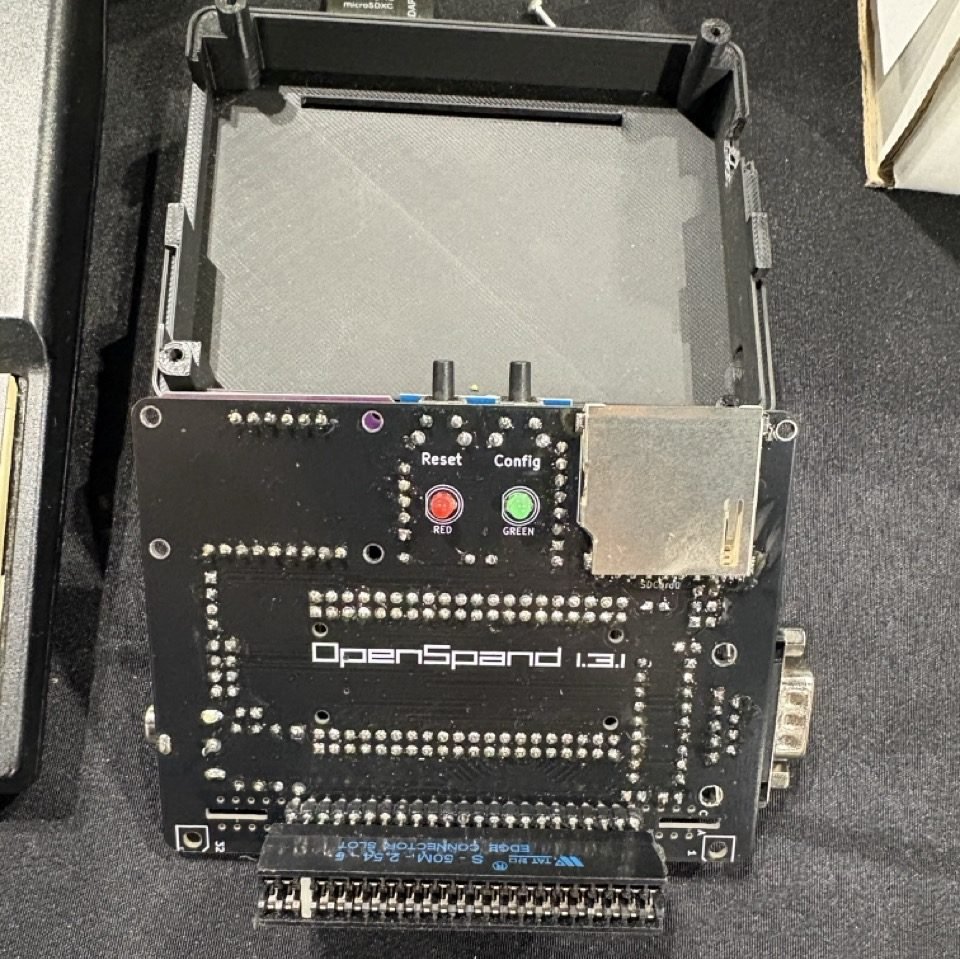
Stewart Newfeld brought several assembled OpenSpands to VCF Midwest, and this is the problem they solve.
What it is
The OpenSpand is Adam Klotblixt’s design, out of Sweden, and it descends from the ZXpand, the SD card interface that gave the ZX81 file storage, built around a CPLD and a handful of through-hole parts. The OpenSpand does that job and a good deal more, on an RP2350B microcontroller riding an Olimex Pico2-XL board. It is open source hardware and software; the files live in a Codeberg repository.
The specification: RAM from 1K to 56K, mapped under software control, and it is the OpenSpand’s own RAM; the board does not lean on whatever is inside the computer. An SD card slot for loading and saving. Selectable ROM modes: ZX80, ZX80 with ZXpand, ZX81, ZXpand+, and Big Bang X2. Pseudo and true high-resolution graphics to the WRX standard, and user-defined characters, 64 or 128 of them. Two emulated sound chips, AY-3-8910 or YM2149 as you prefer, through a stereo I2S digital-to-analog converter, plus sampled audio. A nine-pin Atari joystick port with several reading modes. A battery-backed real-time clock. Serial I/O on the extension connector. Two buttons on the top edge — one reset, with soft, hard and factory options, one for the configuration menu. Firmware updates over USB.
The part that matters
The OpenSpand reproduces most of the ULA’s display generation. It watches the /HALT signal and the machine’s sync behavior, rebuilds the picture with PIO state machines on the RP2350B, and puts out a composite signal with a proper backporch: a clean, stable picture that a modern display will accept without complaint. Getting there was not trivial. Adam’s first approach used two state machines coordinating through PIO interrupts, which worked in text mode and fell apart everywhere else; removing the synchronization entirely simplified the code and fixed every display mode at once.
What this means in practice is that any reasonably functional ZX81 or TS 1000 can be plugged into an OpenSpand and used, today, on the monitor already on your desk. No case opened, no iron heated, no forty-year-old traces lifted. For a machine whose surviving population is finite and whose owners are often not solderers, that is a larger thing than it sounds.
Stewart’s part
Stewart is assembling OpenSpands to sell through Zebra Systems, which he has been running since 1983 and which sold the light pen sitting on Joe VandeZande’s several feet away. He is adjusting the 3D-printed enclosure as he goes, and he is rewriting the documentation.
That last piece is worth explaining. Adam’s manual is written from Sweden, and it lists the TS 1000 and TS 1500 as as yet untested.
The first finding is mechanical and real: on a TS 1500 the OpenSpand’s joystick port protrudes far enough to block the machine’s power connector. A bus extender board is the likely fix. Electrically, the early news is good. Stewart’s units worked on Joe’s test 1500 across the handful of programs he had time to try. The 1500 does unusual things with its RAM signals — plug a 16K pack into one and you get 32K rather than 16K — and it is not yet clear how the OpenSpand behaves in the middle of that. Since it ignores the computer’s RAM entirely and supplies its own, it may turn out not to matter.
What “open” is already producing
On my own table sat the best argument for releasing the design. David Spinnett and Don Crawford took the OpenSpand and rebuilt it horizontally, specifically to get around the clearance problem: an edge connector in the middle of the board accepts a cartridge that carries the SD card, and the whole assembly sits in a 3D-printed case, in black filament, the exact size and shape of the Timex Sinclair 1510 Command Cartridge Player. Timex sold the 1510 in 1983 for $19.95 to let a 1000 or 1500 take Command Cartridges; the form factor was designed around that power connector in the first place, so adopting it makes the problem disappear rather than working around it. Spinnett and Crawford named theirs the Timex Sinclair 1526, a model number Timex never used. It offers ZXpand compatibility, up to 64K, multiple ROMs, SD loading, Zon-X sound, WRX high-resolution graphics, a joystick port, a built-in speaker and a 3.5mm output, and it ships with three of their own games.
Where it goes
Adam keeps a futures document alongside the manual, and it is more interesting than most road maps. The OpenSpand leaves an I²C interface exposed; there is an existing vintage computing project, not Sinclair-specific, that hangs an ESP32 off a bus like that one and uses its Bluetooth radio to talk to wireless keyboards and game controllers.
And then the item at the end, which is the one to watch: running the machine with no ULA at all. Adam has implemented a great deal of the ULA already but not all of it. If he finishes, the OpenSpand stops being an expansion for a working ZX81 and becomes a way to revive a dead one. Given how many of these machines are sitting in closets with a failed ULA and no path to repair, that would change the arithmetic for the entire platform.
It is also the clearest illustration of why the choice of an RP2350 matters as much as the open license does. The ZXpand was built on a CPLD. Contributing to a CPLD design means knowing a hardware description language and owning the toolchain and the will to learn both, which narrows the field of possible helpers to a handful of people. A Pico is a microcontroller that tens of thousands of people already program, with documentation, examples and a community that has nothing to do with Sinclair computers. Put the design in the open on a part like that and the futures list stops being one man’s ambition in Sweden and becomes something a stranger can pick a line off and finish.