
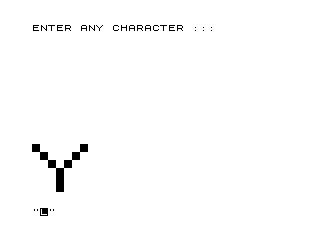
This program renders any typed character as a large 8×8 pixel block graphic on screen, scaled up by mapping each bit of the character’s ROM font data to a full character cell. It reads the font bitmap directly from memory starting at address 7688 (the ROM character set base), using PEEK to extract each byte. Bits are isolated using the classic modulo-2 / integer-division idiom: A-2*INT(A/2) extracts the least-significant bit, and a value of 1 is mapped to CHR$ 128 (a solid block graphic) while 0 produces a space. Characters are printed column by column from the bottom up, accumulating horizontally across the screen in groups of 8 columns; after four characters fill the 32-column display, the screen scrolls up 8 lines to make room for the next group.
Program Structure
The program is organised into four logical phases:
- Initialisation (line
10): resets the horizontal screen offsetSto 0. - Character input & rendering (lines
20–170): prompts for a character, locates its ROM bitmap, and prints each bit as a block character cell. - Advance & wrap check (lines
180–200): moves the horizontal cursor right by 8 columns; if it would exceed column 25 (effectively beyond column 31) the display is scrolled. - Scroll & restart (lines
300–330): issues 8SCROLLcommands to clear the 8-row glyph band, then restarts from10.
ROM Font Access
The character set in the ROM begins at address 7680 (0x1E00). The program uses the base address 7688 (= 7680 + 8), skipping the first character entry, which corresponds to the space character at code 32. The offset into the font is computed as:
F = CODE A$— ASCII/Spectrum character code of the input.F = 8*F - 8— byte offset: 8 bytes per glyph, minus 8 to compensate for the +8 base address bias, effectively giving7680 + 8*CODE(A$).- Lines
100–170then PEEK each of the 8 bytes in sequence.
Bit-Extraction Idiom
Each font byte encodes one row of 8 pixels. Bits are extracted LSB-first using the expression A - 2*INT(A/2), which is equivalent to A MOD 2 (BASIC on this platform lacks a MOD operator). The result (0 or 1) is multiplied by 128 to select either CHR$ 0 (space) or CHR$ 128 (solid block █). The byte is then halved with INT(A/2) to shift to the next bit. Because the inner loop runs I from 7 down to 0 and bits are extracted LSB-first, the glyph columns are printed in the correct left-to-right order within the 8-column band.
Screen Layout
| Variable | Role |
|---|---|
S | Horizontal column offset (0, 8, 16, 24…) |
P | Row countdown (7→0), controlling vertical position via AT 21-P, ... |
B | Loop variable iterating over 8 ROM bytes for the glyph |
I | Bit/column index within a glyph row (7 down to 0) |
A | Current ROM byte being processed |
F | Byte offset into the character ROM |
Each glyph occupies rows 14–21 (8 rows) and 8 columns starting at S. Up to four glyphs fit side-by-side before S exceeds 25 and the scroll routine is triggered.
Notable Techniques
- Reading directly from the ROM font with
PEEKavoids any need to store glyph data in the program itself. - The
CHR$ (bit * 128)trick neatly maps a binary digit to either a space or the solid block graphic (character 128) in a single expression. - Printing glyphs from the bottom row upward (
AT 21-PwithPdecrementing) means the glyph grows naturally as each font byte is processed in order. - The threshold check
IF S>25 THEN GOTO 300allows the last glyph to start at column 24, giving columns 24–31 for its 8 pixels, making full use of the 32-column display.
Image Gallery
Source Code
  10 LET S=0
  20 PRINT AT 0,0;"ENTER ANY CHARACTER :::"
  25 INPUT A$
  30 LET P=7
  40 LET F=CODE A$
  50 LET F=8*F-8
 100 FOR B=7688+F TO 7688+F+7
 110 LET A=PEEK B
 120 FOR I=7 TO 0 STEP -1
 130 PRINT AT 21-P,I+S;CHR$ ((A-2*INT (A/2))*128)
 140 LET A=INT (A/2)
 150 NEXT I
 160 LET P=P-1
 170 NEXT B
 180 LET S=S+8
 190 IF S>25 THEN GOTO 300
 200 GOTO 20
 300 FOR N=1 TO 8
 310 SCROLL
 320 NEXT N
 330 GOTO 10
 9998 SAVE "BIG/CHAR EXA%M"
 9999 RUN
Note: Type-in program listings on this website use ZMAKEBAS notation for graphics characters.