
TRACK is a combat-tracking utility for tabletop role-playing games, designed to manage hit points and status effects for multiple creatures simultaneously. It stores data in five parallel arrays (A through E) covering current HP, maximum HP, regeneration rate, regeneration delay, and bind status for up to Q creatures. The program implements D&D-style rules including troll regeneration (10 HP/round), general per-round regeneration, wound bleeding for creatures at negative HP, and a “bind wounds” mechanic that freezes HP loss. A dice-roller sub-mode accepts any die size and roll count, displaying results before returning to the main menu.
Program Analysis
Program Structure
The program is organized as a menu-driven application with a central dispatch at line 200 and subroutines branching out to labeled REM blocks. Execution begins at line 100 and jumps to the initialization section at line 210. After setup, control falls to line 130 (which is a missing line — a deliberate technique to fall through to 140). The main menu loop lives at lines 140–200, and each menu option jumps to a dedicated REM-labeled section.
Menu Dispatch Technique
Line 200 uses a compact arithmetic dispatch idiom common in Sinclair BASIC:
GOTO (360 AND J=1)+(590 AND J=2)+(1140 AND J=3)+...Because boolean expressions evaluate to 1 (true) or 0 (false), multiplying the target line number by the condition and summing them produces exactly one non-zero addend, acting as a computed GOTO. This avoids a cascade of IF/GOTO statements and is a well-known space-saving technique on memory-constrained systems.
Data Arrays
Five parallel arrays are dimensioned at lines 220–224, all of size Q (number of creatures):
| Array | Purpose |
|---|---|
A() | Current hit points (0 = dropped/dead) |
B() | Maximum (base) hit points, used as heal ceiling |
C() | Regeneration amount per round (10 = troll) |
D() | Round number when slow regeneration next fires |
E() | Bind/bleed state (1 = bleeding, 10 = bound) |
Game Mechanics Implementation
The regeneration/round loop (lines 690–870) encodes several layered rules:
- Bleeding: If
A(F) < 0andE(F)is not 10 (bound), the creature loses 1 HP per round. The first negative round setsE(F)=1as a bleed flag. - Fast regeneration (trolls): If
C(F)=10and current HP is below maximum, a 3-HP-per-round slow-regen schedule viaD(F)fires every 4 rounds (line790:D(F)=Z+3). There is an apparent bug here — troll fast regen (C(F)=10) actually routes to the slow-regen path at line780because the conditionC(F)<10is false, so trolls only regenerate 3 HP every 4 rounds rather than 10 HP/round. - Other regeneration: Creatures with
0 < C(F) < 10healC(F)HP every round (line850). - Bind wounds: Setting
E(F)=10(option 5, line1350) prevents both bleeding and regeneration checks.
Healing Special Case
At line 1210, entering N=1000 as the cure amount is treated as a “full heal” sentinel, restoring A(F) to B(F) (maximum HP). Any other value is added directly. This avoids a dedicated “full heal” menu option at the cost of an undocumented magic number.
Regeneration Base Reset
When the Regenerate option (J=4) is chosen, lines 900–904 iterate through all creatures and reset B(F)=A(F), making the current HP the new maximum before assigning regeneration rates. This means a creature’s heal ceiling is recalculated from its current (possibly damaged) state at the time regeneration is registered, not from its original full HP.
Display Layout
The status display (lines 370–580) prints creature numbers and HP in a grid across the screen, with 4-character column spacing (H=H+4) and 3-row vertical spacing. It handles up to 7 columns (H wraps at 28) before moving down. If more than 42 display rows’ worth of creatures are shown, a “CONTINUE PRINTOUT?” prompt appears via the subroutine at line 510.
Dice Roller
Lines 1380–1520 implement a general-purpose dice roller. The user inputs the die size F and number of rolls G; the result is INT(F*RND)+1 for each roll. A PAUSE 4E4 (approximately 27 minutes on a 50 Hz machine, effectively waiting for a keypress via key-interrupt or the user pressing a key) holds the display before looping back. Entering 0 for die size exits to the status display.
Utility Subroutine
The subroutine at line 1530 clears rows 20 and 21 by printing 31 spaces at each position, providing a clean input area before prompting. It is called before most input prompts throughout the program.
Notable Anomalies
- Line
350jumps toGOTO 130, which does not exist. This is a deliberate fall-through technique — execution continues at the next defined line, which is140(the main menu). - The round counter
Zis incremented inside the Damage routine (line600) rather than in a dedicated end-of-round handler, meaning rounds advance only when damage is applied. - Line
1600(STOP) is unreachable dead code, as is the commented-outRAND USR 14336at line1610, suggesting a machine-code helper was once planned or used in an earlier version. - The
PAUSE 4E4at line1495is effectively an indefinite pause on most hardware configurations; the program relies on the user pressing a key or waiting out the timer.
Image Gallery
Source Code
   0 REM       TRACK                      ****D £ D TRACK****                 BY JIM LANE                 MODIFIED FOR %T%I%M%E%X/             SINCLAIR BY ANTHONY             WILLING  (4/1984)               *******************
  70 REM
  80 CLS
 100 LET R=0
 110 LET Z=1
 120 GOTO 210
 140 REM ** CONTROL **
 150 PRINT AT 19,1;"########BEGINNING OF ROUND ";Z;"########"
 160 PRINT AT 20,1;"%1=STATUS %2=DAMAGE %3=HEAL %4=REG. %5=BIND %6=DROP %7= RAND "
 170 INPUT J
 180 IF J=0 THEN STOP
 190 IF J>7 THEN GOTO 170
 200 GOTO (360 AND J=1)+(590 AND J=2)+(1140 AND J=3)+(880 AND J=4)+(1320 AND J=5)+(1240 AND J=6)+(1380 AND J=7)
 210 REM ** BEGIN **
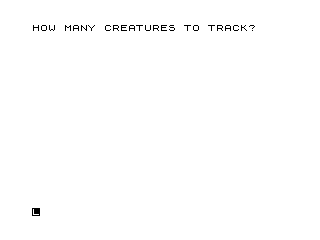
 215 PRINT AT 0,0;"HOW MANY CREATURES TO TRACK?"
 217 INPUT Q
 220 DIM A(Q)
 221 DIM B(Q)
 222 DIM C(Q)
 223 DIM D(Q)
 224 DIM E(Q)
 230 CLS
 240 PRINT AT 20,1;"MONSTER NUMBER?"
 250 INPUT F
 260 IF F=0 THEN GOTO 290
 270 LET A(F)=1
 280 GOTO 230
 290 FOR F=1 TO Q
 300 IF A(F)=0 THEN GOTO 340
 310 PRINT AT 20,1;"HIT POINTS FOR ";F
 320 INPUT H
 330 LET A(F)=H
 335 LET B(F)=H
 340 NEXT F
 350 GOTO 130
 360 REM ** DISPLAY STATUS **
 370 CLS
 380 LET G=1
 390 LET H=0
 400 FOR F=1 TO Q
 410 IF A(F)=0 THEN GOTO 490
 420 IF G>42 THEN GOSUB 510
 430 PRINT AT G-1,H;F
 440 PRINT AT G,H;A(F)
 450 LET H=H+4
 460 IF H<28 THEN GOTO 490
 470 LET H=1
 480 LET G=G+3
 490 NEXT F
 500 GOTO 580
 510 PRINT AT 21,1;"CONTINUE PRINTOUT?"
 520 INPUT A$
 530 IF A$="N" THEN GOTO 580
 540 LET G=3
 550 LET H=1
 560 CLS
 570 RETURN
 580 GOTO 140
 590 GOSUB 1530
 595 REM ** DAMAGE **
 600 LET Z=Z+1
 610 PRINT AT 21,1;"CHARACTER THAT TOOK DAMAGE? "
 620 INPUT F
 630 IF F=0 THEN GOTO 680
 640 PRINT AT 21,1;"AMOUNT OF DAMAGE?             "
 650 INPUT J
 660 LET A(F)=A(F)-J
 670 GOTO 610
 680 REM ** REGENERATE/ROUND **
 690 FOR F=1 TO Q
 700 IF A(F)>=0 THEN LET E(F)=0
 710 IF A(F)>=0 THEN GOTO 770
 720 IF E(F)=10 THEN GOTO 770
 730 IF E(F)=0 THEN GOTO 760
 740 LET A(F)=A(F)-1
 750 GOTO 770
 760 LET E(F)=1
 770 IF (C(F)=0 OR A(F)=B(F)) THEN GOTO 830
 780 IF (C(F)<10) AND (A(F)<B(F)) THEN GOTO 850
 790 IF D(F)=0 THEN LET D(F)=Z+3
 800 IF D(F)>Z THEN GOTO 830
 810 LET A(F)=A(F)+3
 820 IF A(F)>B(F) THEN LET A(F)=B(F)
 830 NEXT F
 840 GOTO 360
 850 LET A(F)=A(F)+C(F)
 860 IF A(F)>B(F) THEN LET A(F)=B(F)
 870 GOTO 830
 880 REM ** REGENERATE **
 890 LET R=1
 900 FOR F=1 TO Q
 902 LET B(F)=A(F)
 904 NEXT F
 910 REM ** TROLLS **
 920 GOSUB 1530
 930 PRINT AT 20,1;"FIRST TROLL NUMBER?"
 940 INPUT K
 950 IF K=0 THEN GOTO 1040
 960 PRINT AT 20,1;"LAST TROLL NUMBER? "
 970 INPUT L
 980 IF K>L THEN GOTO 1030
 990 IF A(K)<1 THEN GOTO 1010
 1000 LET C(K)=10
 1010 LET K=K+1
 1020 GOTO 980
 1030 GOTO 930
 1040 REM ** OTHER REGENERATE **
 1050 GOSUB 1530
 1060 PRINT AT 20,1;"OTHER REGENERATING CREATURE?"
 1070 INPUT F
 1080 IF F=0 THEN GOTO 1130
 1090 PRINT AT 20,1;"REGENERATION PER ROUND?     "
 1100 INPUT M
 1110 LET C(F)=M
 1120 GOTO 1060
 1130 GOTO 360
 1140 REM ** HEAL **
 1150 GOSUB 1530
 1160 PRINT AT 20,1;"CHARACTER THAT WAS HEALED?"
 1170 INPUT F
 1180 IF F=0 THEN GOTO 1230
 1190 PRINT AT 20,1;"AMOUNT OF CURE?           "
 1200 INPUT N
 1210 IF N=1000 THEN LET A(F)=B(F)
 1212 IF N<>1000 THEN LET A(F)=A(F)+N
 1220 GOTO 1160
 1230 GOTO 360
 1240 REM ** DROP CHARACTERS **
 1250 GOSUB 1530
 1260 PRINT AT 20,1;"CHARACTER TO DROP FROM STATUS?"
 1270 INPUT F
 1280 IF F=0 THEN GOTO 1310
 1290 LET A(F)=0
 1295 LET B(F)=0
 1300 GOTO 1260
 1310 GOTO 360
 1320 REM ** BIND **
 1330 PRINT AT 20,1;"CHARACTER NUMBER BOUND?"
 1332 INPUT F
 1340 IF F=0 THEN GOTO 1370
 1350 LET E(F)=10
 1360 GOTO 1330
 1370 GOTO 360
 1380 REM ** RANDOM ROLLS **
 1390 CLS
 1400 PRINT "WHAT SIDED DICE?"
 1410 INPUT F
 1420 IF F=0 THEN GOTO 1510
 1430 PRINT "NUMBER OF TIMES?"
 1440 INPUT G
 1445 CLS
 1450 FOR H=1 TO G
 1470 LET K=INT (F*RND)+1
 1480 PRINT K
 1490 NEXT H
 1492 PRINT "(PRESS %E%N%T%E%R TO GO ON)"
 1495 PAUSE 4E4
 1500 GOTO 1390
 1510 CLS
 1520 GOTO 360
 1530 PRINT AT 20,1;"                               "
 1540 PRINT AT 21,1;"                               "
 1570 RETURN
 1600 STOP
 1610 REM  RAND USR 14336
 1620 REM SAVE "TRACK.B1"
 1625 SAVE "1021%0"
 1630 RUN
Note: Type-in program listings on this website use ZMAKEBAS notation for graphics characters.