
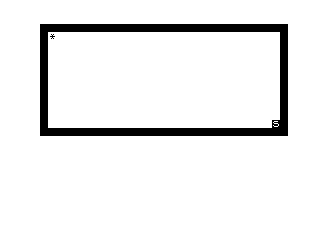
This program implements a simple Space Shuttle navigation game on the ZX81/TS1000, using direct POKE operations to manipulate the display file rather than PRINT statements for sprite movement. The opening loop (lines 10–50) draws a bordered playfield with inverse-video space characters forming top and bottom walls and a right-side wall using fractional AT row addressing. Lines 60–80 calculate the display file base address via PEEK 16397/16396 (D_FILE system variable) and place the shuttle character (char 23, an inverse-video block) at a starting position offset 392 bytes in. The movement routine (lines 90–180) reads the keyboard using CODE INKEY$, maps arrow-key codes 33–36 to a signed displacement D using a compact Boolean arithmetic expression, then checks whether the destination cell contains a character above code 127 (a wall or obstacle) and STOPs on collision. Line 160 randomly POKEs an inverse-space (char 128) ahead of the shuttle to create moving hazards, adding a procedural obstacle element to the game.
Program Analysis
Program Structure
The program divides into three clear phases:
- Playfield setup (lines 10–50): A
FORloop draws inverse-space borders along the top row, bottom row (row 13), and right column usingPRINT AT. - Initialisation (lines 60–80): The display file address is computed, and the shuttle sprite and a wall marker are POKEd into the display file directly.
- Game loop (lines 90–180): Keyboard input is polled, a displacement is calculated, collision is checked, the shuttle is moved, and a random obstacle may be placed.
Display File Addressing
Line 60 reads the ZX81 system variable D_FILE at addresses 16396–16397 to find where the display file begins in RAM:
LET P=35+256*PEEK 16397+PEEK 16396
The offset 35 skips past the initial HALT byte and the first line’s newline structure, landing the pointer somewhere inside the visible display area. Line 70 then POKEs offset +392 with value 184 (an inverse character used as a wall marker), and line 80 POKEs offset +1 with 23 (the shuttle sprite character).
Movement and Input Handling
Lines 90–100 poll INKEY$ via CODE INKEY$ into variable C, looping until a value in the range 33–36 is detected. These correspond to the ZX81 cursor keys (5/6/7/8 shifted). The displacement D is computed on a single line using Boolean arithmetic:
LET D=(33 AND C=34)-(1 AND C=33)-(33 AND C=35)+(1 AND C=36)
| Key code (C) | Direction | D value |
|---|---|---|
| 33 | Left (←) | −1 |
| 34 | Right (→) | +33 |
| 35 | Up (↑) | −33 |
| 36 | Down (↓) | +1 |
The values ±33 reflect the ZX81 display file row stride (32 character cells plus one newline byte = 33 bytes per row), making vertical movement jump by exactly one display row.
Collision Detection
Line 140 checks the destination cell before moving the shuttle:
IF PEEK P>127 THEN STOP
Any character with code above 127 is an inverse-video character — used here for walls (the border drawn in setup) and randomly placed obstacles (line 160). A collision immediately halts execution via STOP.
Procedural Obstacle Generation
Line 160 uses RND with a 50% probability to place an inverse-space (code 128) one step ahead of the shuttle in the direction of travel:
IF RND>0.5 THEN POKE P+D,128
This creates a trail of obstacles in the shuttle’s wake/path, increasing difficulty over time without requiring a separate data structure.
Key BASIC Idioms
- Boolean arithmetic for multi-way branching: The single-line displacement calculation at line 110 avoids four separate
IFstatements by exploiting the fact that ZX81 BASIC evaluates boolean expressions as 1 (true) or 0 (false). - Fractional AT row: Line 40 uses
AT I/2.5,31, so asIruns 1–31, the row ranges from 0.4 to 12.4. The ZX81 truncates fractional row values, effectively spacing wall segments down the right side. - Debounce loop: Line 170 waits for the key to be fully released before accepting the next input, preventing key repeat from causing unintended multi-cell moves.
Potential Anomalies
- The starting offset of 35 into the display file is hardcoded and may not reliably place the shuttle in a consistent on-screen cell across different memory configurations or after editing the program (which shifts
D_FILE). Line 9 (RAND) does not affect this. RANDon line 9 reseeds the random number generator — since it is called without an argument it uses a system-clock-derived seed, introducing slight randomness variation at startup but having no direct effect on the display initialisation.- Lines 190–200 (
SAVEandRUN) are utility lines appended to the program listing and are not part of the game execution path.
Image Gallery
Source Code
   1 REM SPACE SHUTTLE
   9 RAND
  10 FOR I=1 TO 31
  20 PRINT AT 0,I;"% "
  30 PRINT AT 13,I;"% "
  40 PRINT AT I/2.5,31;"%  % "
  50 NEXT I
  60 LET P=35+256*PEEK 16397+PEEK 16396
  70 POKE P+392,184
  80 POKE P+1,23
  90 LET C=CODE INKEY$
 100 IF C<33 OR C>36 THEN GOTO 90
 110 LET D=(33 AND C=34)-(1 AND C=33)-(33 AND C=35)+(1 AND C=36)
 120 POKE P,0
 130 LET P=P+D
 140 IF PEEK P>127 THEN STOP
 150 POKE P,23
 160 IF RND>0.5 THEN POKE P+D,128
 170 IF INKEY$<>"" THEN GOTO 170
 180 GOTO 90
 190 SAVE "1011%0"
 200 RUN
Note: Type-in program listings on this website use ZMAKEBAS notation for graphics characters.