
SpaceTrader is a space trading game in the spirit of the Traveller role-playing game. You own a free trader that is twenty thousand credits in debt to the bank that financed her; you start with a thousand credits, eight tons of fuel and a twenty-ton hold, and the aim is to clear the mortgage before the bank takes the ship back.
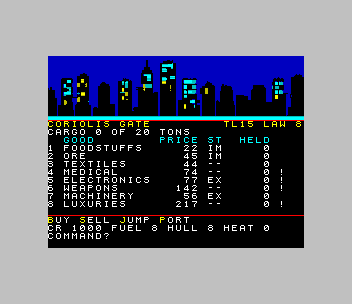
Twenty star systems lie on a grid that runs from the high-tech, high-law core to a lawless frontier. Each port prices eight goods (foodstuffs, ore, textiles, medical supplies, electronics, weapons, machinery and luxuries) according to what it exports and imports and its population and tech level, so the game is about finding runs that pay. Jumps reach any system within two rows and columns and cost one to three tons of fuel. In transit you may meet pirates, a customs patrol or a trade offer, and you are often inspected on arrival.
Weapons, luxuries, electronics and medical supplies are contraband on some worlds. Buying or being caught with them raises your heat, which makes inspections, pirates and bribes more likely and more expensive; a license makes a good legal everywhere. When customs find something you can comply, bribe, surrender or resist, and against pirates you can evade, fight, bribe or run. Port services sell fuel, hull repairs, licenses and payments on the principal. A payment of 800 credits falls due every eight jumps; miss two and the ship is repossessed.
The game is written in Sinclair BASIC with Z80 machine-code routines. Each system has its own picture across the top of the screen in the TS2068’s Extended Color Mode, converted from artwork made for the game, and the screens use a custom font. It is menu-driven rather than real-time: press the highlighted letter to choose. It runs in a TS2068 or TC2068 emulator and on real hardware through the TS-Pico.
The download contains the TAP file, the 16-page manual as a half-letter PDF and a duplex-print booklet, and the how-to-play guide. The source code and build tools are on GitHub under the MIT License.
Image Gallery


Note: Type-in program listings on this website use ZMAKEBAS notation for graphics characters.