
This program demonstrates a sprite animation engine for the Spectrum by loading a pre-drawn screen and a machine code routine, then repeatedly invoking it via RANDOMIZE USR. Before entering the animation loop, it patches six pairs of addresses in the machine code block (at addresses around 41516–41556) using DATA statements, writing 16-bit little-endian values split into low and high bytes via the two DEF FN functions. The core sprite engine, called SPRITES, is noted as public domain and originates from the Zeus Source Files Disk. A 60-frame pause between iterations provides a timed display cycle.
Program Structure
The program is organized into a short linear sequence: a decorative REM banner, two DEF FN helper definitions, two LOAD statements to bring in binary assets, setup code, and then an infinite animation loop. The main loop occupies lines 70–100, with supporting data at line 110.
- Lines 10: Multi-line REM banner (documentation only).
- Lines 20–30: Define byte-splitting functions.
- Lines 40–50: Load screen and machine code assets from tape/disk.
- Line 60: Set border to black.
- Lines 70–100: Patch machine code, pause, loop.
- Line 110: DATA for address/value pairs used in patching.
Asset Loading
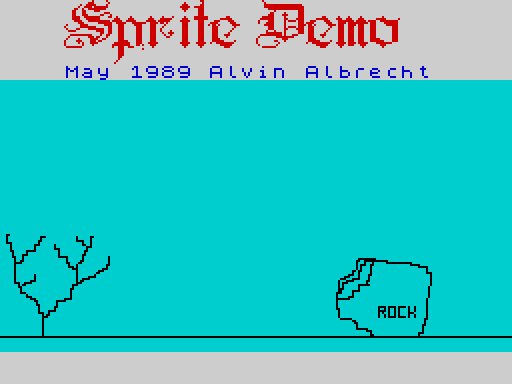
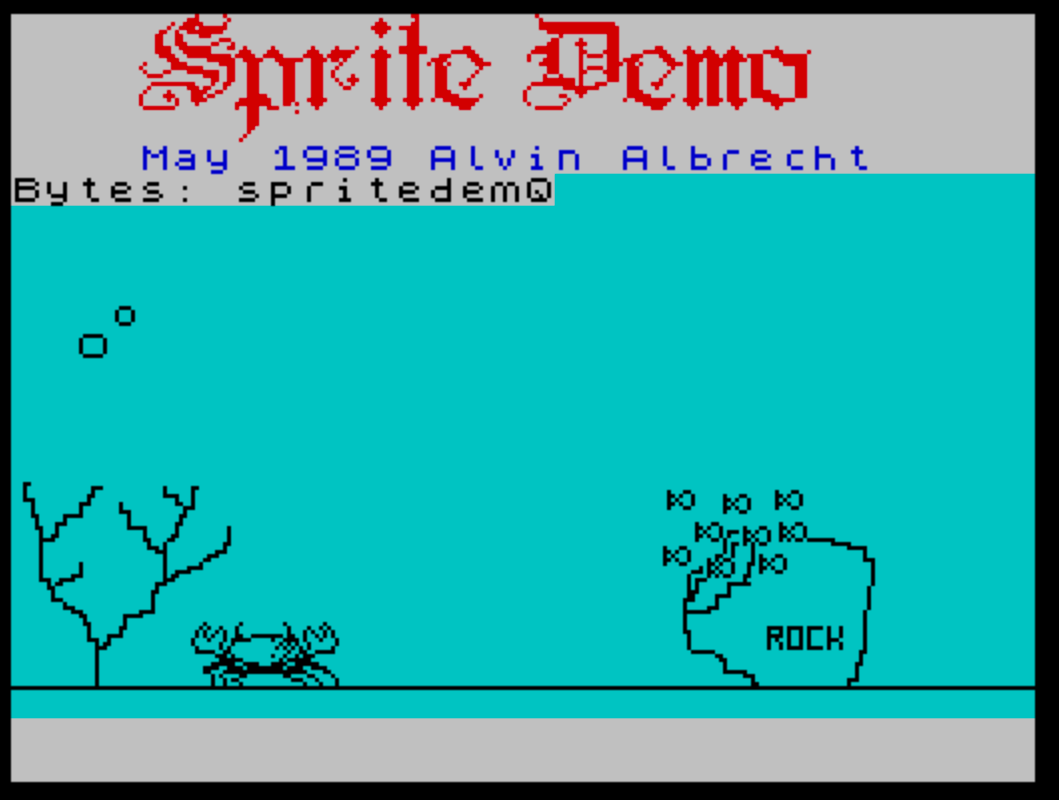
Line 40 loads a SCREEN$ file named spritedemP, filling the display file with a pre-drawn background. Line 50 loads a CODE block named spritedemQ at address 41000, placing the machine code sprite engine into RAM. The engine entry point is at 41568, invoked by RANDOMIZE USR 41568 on line 70.
DEF FN Byte-Splitting Idiom
Two DEF FN functions implement 16-bit little-endian decomposition:
FN a(x)— returns the high byte:INT(x/256)FN b(x)— returns the low byte:x - INT(x/256)*256, equivalent tox MOD 256
This is a standard Spectrum BASIC technique for writing 16-bit addresses or values into memory one byte at a time, since BASIC has no native word-POKE facility.
Runtime Machine Code Patching
Line 80 is the most technically significant section. After a RESTORE, it reads six address/value pairs from the DATA at line 110 and writes each 16-bit value into the machine code block as a little-endian word:
POKE a,   FN b(b)   ' low byte at address a
POKE a+1, FN a(b)   ' high byte at address a+1
This patches six consecutive word-sized locations spaced 8 bytes apart (41516, 41524, 41532, 41540, 41548, 41556), likely updating sprite data pointers or animation frame addresses within the SPRITES engine before each invocation. The target values (42623, 42926, 41723, 42027, 42331, 43226) are addresses within the loaded CODE block, suggesting a table of sprite descriptors or frame buffers.
Animation Loop
The loop on lines 70–100 is minimal: call the machine code routine, pause for 60 frames (approximately one second at 50 Hz), and repeat. The RESTORE on line 80 resets the DATA pointer each iteration so the same six pairs are re-patched on every cycle, which implies the machine code may modify those locations during execution and they must be restored to their initial state.
DATA Table
| Patch Address | 16-bit Value | Low Byte | High Byte |
|---|---|---|---|
| 41516 | 42623 | 127 | 166 |
| 41524 | 42926 | 110 | 167 |
| 41532 | 41723 | 187 | 162 |
| 41540 | 42027 | 235 | 163 |
| 41548 | 42331 | 27 | 165 |
| 41556 | 43226 | 154 | 168 |
Notable Observations
- The use of
RANDOMIZE USRrather thanPRINT USRor a direct call is the conventional Spectrum idiom for invoking machine code that does not need to return a value to BASIC. - The 8-byte spacing between patched addresses suggests a structured record layout within the sprite engine, possibly a sprite descriptor table with fields such as x, y, and data pointer.
- No error trapping is present; if the LOAD operations fail the program will halt rather than recover gracefully.
- The SPRITES engine is explicitly noted as public domain in the REM, suggesting it was intended for community reuse independent of this demo wrapper.
Image Gallery
Source Code
  10 REM \{8}\{8}\{8}\{8}\{20}\{1}>>>>>>>>>>>>><<<<<<<<<<\{20}\{0}       \{20}\{1}>>      SPRITE DEMO      <<\{20}\{0}  \{20}\{1}>> May 1989 albrecht calgary, <<>> canada.  The core  routine <<>> that drives this demo is   <<>> public domain and is called<<>> SPRITES, located on the    <<\{20}\{0}  \{20}\{1}>> Zeus Source Files Disk <<\{20}\{0}      \{20}\{1}>>>>>>>>>>>>><<<<<<<<<<<\{20}\{0}
  20 DEF FN a(x)= INT (x/256)
  30 DEF FN b(x)=x- INT (x/256)*256
  40 LOAD "spritedemP"SCREEN$
  50 LOAD "spritedemQ"CODE 41000
  60 BORDER 0
  70 RANDOMIZE USR 41568
  80 RESTORE :FOR z=1 TO 6:READ a,b:POKE a, FN b(b):POKE (a+1), FN a(b):NEXT z
  90 PAUSE 60
 100 GO TO 70
 110 DATA 41516,42623,41524,42926,41532,41723,41540,42027,41548,42331,41556,43226
Note: Type-in program listings on this website use ZMAKEBAS notation for graphics characters.