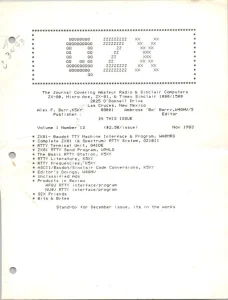
| A Complete RTTY Transceive System for the ZX81 and Spectrum | From the British Sinclair Amateur Radio User Group Newsletter done by Paul Newman, G4INP. (Reprinted with permission). Here’s a nice system, complete with TU, AFSK, and interface. We are only printing the ZX81 program, send SASE (to W4GHV) if interested in the Spectrum version. A PC board is available from G4INP. The British price is | Timex/Sinclair 1000, Type-in program |
| Bits and Bytes | | |
| Code Table | Here is a table which will be useful for those who are doing their own RTTY programing. As you know ASCIl is a standard code for the exchange of information. Baudot is an earlier incompatible standard. The ZX81 and T/S1000 use a completely non-standard coding (the T/S1500 uses the same coding as the T/S1000). Here | Timex/Sinclair 1000 |
| Editor's Doings | How many of you bought your Sinclair with intentions of putting it on RTTY? How many have successfully accomplished the task? Hopefully this issue will inspire the procrastinators into getting on RTTY, it is a lot of fun. I was first exposed to it in 1969, working a VK on my very first СО! I | Timex/Sinclair 1000 |
| Products in Review | In the April 1983 issue of QZX, Larry Willson presented his RTTY program, If you were like me, the prospect of rtty made normal life impossible. That version of rtty was admittedly primitive; after a full screen on either transmit or гесеіvе, the program stopped. Never the less, it did work. When his “more sophisticated” | Timex/Sinclair 1000 |
| QZX Friends | | |
| RTTY Frequencies | It is sometimes hard to keep all the frequencies used in RTTY work straight. There are four main types of frequencies; word frequencies, shift frequencies, mark and space frequencies, and transceiver frequencies. The most important frequency is that at which the data is sent. The most common frequency is 60 words per minute. It is | |
| RTTY Literature | Most hams, unless they are already active in RTTY, will need to read up on this operating mode before they know what equipment is required to operate. One of the best sources of information is described here in some detail. and some are mentioned at the end. | |
| RTTY Send Program & Interface for the Sinclair/Timex ZX81 | One of the things in operating RTTY with non-electronic gear has been the nuisance of identifying. here is a lot or repetition such as the other station’s call, my call, my name and QTH. I often envied tnose that had the new fancy “glass TTY” units that had all of that built in. Well that | Timex/Sinclair 1000, Type-in program |
| The Basic RTTY Station | A block diagram for a basic RTTY computer controlled station would look like the following diagram. | |
| The G4IDE RTTY Terminal Unit | This terminal unit was, of course, designed to be used with my ZX81 RTTY program. However it is equally suitable for use with any micro-computer with a TTL compatible I/O port. | Timex/Sinclair 1000, Type-in program |
| ZX81 Baudot Interface | Here’s a nice article telling how to interface an ol’ Teletype machine to the Sinclair. Be sure to follow his tips on using an optocoupler, the voltages in a teletype would fry the Sinclair! | Timex/Sinclair 1000, Type-in program |