
At a recent minister’s forum of the local jurisdiction of my denomination, I was asked to write a short article for our newsletter on the subject of the computer and its use in the church. This article is an outgrowth of the sketchy report I did for that publication.
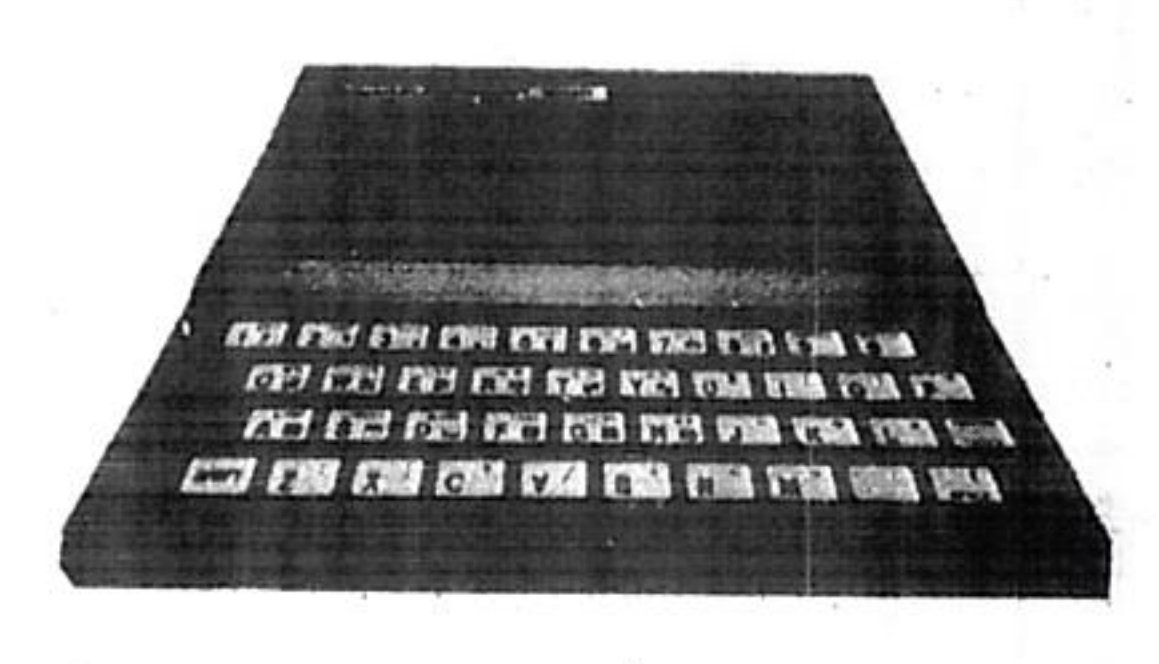
As an avid Timex/Sinclair “computerist” and pastor, I am convinced that the computer does indeed have a bright future in the church, and that every church can reap enormous benefits from owning its own system. I am, moreover, completely biased toward the Timex/Sinclair 1000 computer, which is the core of the system I own. This system underscores my belief that a church does NOT have to spend “megabucks” in order to acquire a versatile computer which meets its needs. For the price I paid for my system, even the smallest congregation can obtain quality equipment.
This article will be divided into three major sections, Why?, What?, and How?, with a few concluding remarks.
I. A Computer in the Congregation: Why?
Even in this electronic day and age, it is still by no means a foregone conclusion that everybody is rushing out to buy a computer.
The church is no exception. It is a notoriously conservative institution, which is to say that “new-fangled” things generally only tend to become acceptable in the church long after they have ceased to be “new-fangled” in society at large. The tendency to adhere to the “tried-and-true” is probably nowhere as strong as in the church. Thus, although a growing number of churches have been seeing fit to purchase one of these electronic marvels, most have not.
Among the first questions, then, that a church might ask when confronted with the idea of buying a computer is, quite simply, Why? “Our church has been doing fine all these years without one; why should we get one now?”
A computer can aid a church in countless ways, but perhaps we could boil all of them down into two words: Time and Efficiency. A computer can give the pastor and his/her entire church program more of that precious commodity of time, and increase the efficiency of output in the process. The many organizational, pastoral, and financial operations of any given parish almost always entail great amount of time and effort. The computer can cut these expenditures down to size.
Organizational. As in any organization, there are in a local church reports to prepare, files to keep up to date, and various records to keep track of. If a computer is employed for record-keeping, files can be kept to a much more manageable level. For example, I am currently employing my Timex/Sinclair “Organizer” software to create a current list of the members of my parish, with the pertinent data regarding each member in individual data-fields. This software can also be used to keep running files on stewardship, visitations, and so on. When these files need to be updated, it is a simple matter to do so using the “Organizer’s” built-in “search” routine. With my printer, I can also take the information in the program and make as many “hard copies” as I want, with whatever revisions and deletions are necessary, without having to redo everything on a typewriter or by hand. Filing is made much simpler, faster, and more efficient.
Pastoral. “Saving time” and “increasing efficiency” are terms which cannot help but be music to a pastor’s ears. In the administration of the pastoral office, saving oneself time form the toil of repetition and completing important tasks more easily and efficiently certainly can contribute to greater effectiveness.
Pastors are the original wordsmiths. There probably no other profession or calling which demands its members to work with words and concepts more than the ministry. Creeds, theological exegesis, hermeneutics, doctrines: All these are the typical pastor’s stock in trade. It is precisely here that the computer can truly be a Godsend for a minister. In its application as a word processor, not just data processor, the computer can radically reduce the amount of time it takes to, for example, write the Sunday sermon. Some clergy computerists claim that they work up to 40% faster on a computer than a typewriter.
This is partly due to the standard word processing feature called “automatic wrap,” by which the computer automatically starts a new line on the screen when the right margin has been reached. Inputting data into the machine is also much faster than its counterpart in regular typing. There are no moving parts on a computer; when one presses a key, the character is transmitted literally at the speed of light onto the monitor and into the computer’s memory. Making corrections is just as fast; one simply moves the cursor back to the mistake and either deletes it or just types over it. Margins can be automatically justified (my word processor give me the choice), and the computer will also automatically paginate one’s pages, regardless of how many insertions and deletions one makes in the text. Moving large blocks of text around in the work is also no problem whatsoever. And, of course, all this can be done while the text is still on the screen; when the text is as it should be, the user dumps it to the printer, which creates a flawless copy. Imagine what this means for those many pulpiteers who rewrite their sermons! In addition, one can crank out professional-looking form letters using the computer, and even “personalize” them by coupling the text file with data files.
If one wants to write for publication, the computer can also be of enormous help. Articles, book ideas, and other publishable material can be stored on tape and manipulated any way one wants without a great deal of rewriting. However, there is one drawback; most editors and publishers, even those of computer magazines, prefer that articles be submitted in a standard format of 1½” margins, on clean white paper, with double-spaced lines. Only the best daisy-wheel printers can give on letter-quality copy, and I know of no word-processor which easily allows the user to program in double-spaced lines. This is, however, no reason not to invest in a computer system; I have found that writing texts on the computer and then typing out a final copy on the typewriter still greatly reduces time expenditures.
Financial. With the many spreadsheet-analysis software programs available on the market, getting a grip on a church’s finances can be done with ease. The Timex/Sinclair “VuCalc” software can be applied to church finances, as can the Timex/Sinclair “Budgeter” program. I have personally not tried this as yet, but I see no reason why such software could not be used in a church context. “VuCalc”, for example, allows the user to input data in many different fields, and will automatically recalculate totals when information is added or deleted. This should be good news to church treasurers! Such software also enables the user to make projections with data, just by changing numbers here and there! For those who want to see whether their church will meet its budget and other financial obligations, a computer would prove to be a useful ally.
II. The Computer in the Congregation: What?
Now that we have laid the groundwork, so to speak, and seen what wonders the computer is capable of achieving in the church, the question is, What system should the church buy?
None of the major magazines for clergy, nor any of the larger publishers of church software, make any mention of the Timex/Sinclair 1000 computer. Church-oriented software for the T/S 1000 is all but nonexistent. Nonetheless, I would like to go on record that no church needs to spend more on its computer system than I did no mine, which was nowhere near the $2,500.00 — $3,000.00 that have been suggested by various authors and firms.
The integral component of my computer system is, of course, the Timex/Sinclair 1000 computer and the Timex/Sinclair 1016 16K memory module. I received them in December of 1982, when their combined cost was around $150.00. In March of 1983, I made the first major change to my system when I invested $75.00 (including tax) in a Suntronics KD-81 keyboard. The people at Suntronics, which is located out here in the Los Angeles area, were extremely helpful, and even installed my computer into the keyboard at no charge. And, just a couple of weeks ago, I received my order of a Seikosha GX-100 printer, a Memotech Centronics Parallel Printer Interface, the printer cable, and a Memotech Memotext Word Processor. These items were all ordered through the E. Arthur Brown Co., of Alexandria, MN. They even went so far as to throw in their Memosha software, for obtaining graphics characters, high-speed paper feed, and space-skipping to avoid perforations on fan-fold paper, for nothing. I also had to buy a portable black-and-white television set and cassette recorder, but I am not counting them in the price of my system. All together, then, I spent a total of $557.80 for an extremely reliable, versatile and flexible computer system which gives me word and data processing capabilities as good as one can find on a TRS-80, an Apple, a Commodore 64, or any other computer system. Clearly, I would recommend to any church the purchase of such a system. There is even an attachment on the market now, called the “Timebox,” which upgrades the T/S 1000 into a system capable of accessing “thousands of CP/M based programs”, according to their advertisements. Price: $199.00. Something to think about.
III. A Computer in the Congregation: How?
So, how does one go about assembling such a system? I recommend the following companies with which I have had successful dealings. By the way, the price of the T/S 1000 computer is now so low as to make buying one extremely practical; one discount drug store out here has been selling the T/S 1000 for $29.99, and the 16K module for $9.99!
Seikosha Printer Package $294.00
   GX-100 printer, Memotech Interface
Memotech Memotext Word Processor     $39.95
E. Arthur Brown Co.    612-762-8847
        1702 Oak Knoll Dr.
        Alexandria, MN  56308

KD-81 keyboard          $59.95
Suntronics Co., Inc.
   12621 Crenshaw Blvd.
   Hawthorne, CA  90250
   1-800-421-5775  213-644-1149  (inside CA)
IV. A Computer in the Congregation: Some Concluding Remarks.
I am wildly delighted with my Timex/Sinclair-based computer system; it works absolutely flawlessly and does everything it is supposed to. I have used it for, among other things, sermons, voluminous correspondence, and confirmation notes. The more I use it, the more I agree with E. Arthur Brown that the T/S 1000 is all the computer one will ever need. And, in the area of church work, I am convinced that a system such as I have just described presents a very real alternative to high-priced machines.
The Rev. William R. Colby-Newton
[address omitted]