
Best of Sync, Volumn 1
Creative Computing Press
39 E. Hanover Ave.
Morris Plains, NJ 07950
$9.95
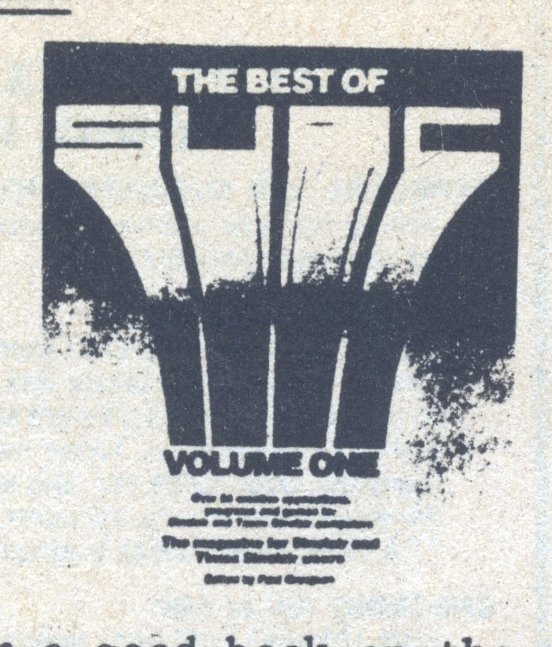
Recently I was looking for a good book on the TS-1000/ZX81. I wanted something that was strong on programming skills and featured a lot of program listings. When I came across “The Best of Sync”, Volume 1, thinking this was what I’d been looking for, I quickly bought it. After all it was filled with game listings, articles about things like graphics, programming techniques, machine language, and hardware projects. Plus it had about twenty pages of product reviews thrown in for good measure. Here was a chance to buy a whole years worth of Sync magazine for just $9.95. I couldn’t go wrong! Right?
Well, maybe half-right. What I didn’t realize but should have was that in 1981, the year that Sync began publishing, the magazine was written mostly for users of the ZX80 computer. The more advanced ZX81 was not introduced until October 1981. Thus most of the contents of The Best of Sync, Volume 1, refer to the ZX80 and its applicability is severely limited for ZX81 and TS-1000 users.
Most people who ordered the ZX81 from Sinclair when it first came on the market received a special issue of Sync which contained reprints of articles from the first year specifically applying to the ZX81. Those articles listed below that were featured in that special insert are indicated by an asterisk (*).
One of the best features of The Best of Sync is the games section (Chapter 1). Most were written for the ZX80 but have been converted by the editors to run on either the ZX80 or ZX81. All games are for 1K to 2K. The assortment is nice. It has widgets and herkles, detectives and masterminds, chessmen and taxmen, Tic Tac Toe, hangman, and a wordsearch puzzle generator. However the games are all simplified. For instance, in one game, motorcycles are represented by a black square and a grey square.
The mathematical applications chapter (#2) does have some utility. It tells you how to use your computer to set up bar charts*, factor to prime numbers, score tests, plus some others that are not-so-hot. One is an 18-line program to calculate square roots on the ZX80, which does not have the SQR function (or trig functions, or EXP, or LN, etc.)
The graphics chapter (#3) was a bright spot. It includes tutorials on game-creating, on-screen picture drawing, and high-resolution graphics simulation.
Also of interest is Chapter 4 (Useful Programs). “An Inventory System” * is a very usable program and probably compares with programs sold by software companies. The remaining articles are of limited interest. (Two on music generation using the ZX80 and a radio, and a “Billboard” program).
Chapter 5 on programming techniques is about 75% material that is of no use to ZX81 owners. The concepts behind “Using Key and Token Expression,” * “Expression Evaluators”, * and “PEEK and POKE,” are probably already familiar to most Sinclair users.
Personally, the most disappointing chapter was the sixth one, on program conversions. I have been doing some research on converting BASIC programs written for other computers to Sinclair BASIC. I had hoped to find some useful information in this section. However all of the articles deal with the ZX80 version of BASIC, except one which discusses converting ZX80 programs to run on the ZX81.
Chapter 7, Machine Language, was another sore spot. “An Introduction to Machine Code” was edited to apply to the ZX81, but most of the other articles in the chapter applied solely to the ZX80.
Chapter 8, Hardware Theory and Projects, included several good projects for the ZX80 and MicroAce computers. In most cases applying the instructions to the ZX81 and TS-1000 shouldn’t be too difficult.
I am still trying to figure out why Sync included Chapters 9 and 10. Chapter 9 is a compilation of all the product reviews from the first year. I don’t think any of these items, except one book are still available. The others apply strictly to ZX80 related products. “Resources,” Chapter 10 is another dubious section. At least half of the marketers listed here are no longer in business and the rest are no longer offering the products listed.
If you own a Sinclair ZX80 and you plan to use it quite a bit, then I recommend you buy this book (unless you have the first six issues of SYNC). It may be the last book ever published on the ZX80.
But if you own the ZX81 or TS-1000, I warn you that The Best of SYNC, Volume 1, is not as good a deal as it first appears. Maybe you just ought to wait for The Best of SYNC, Volume 2.