Authors
Publication
Pub Details
Date
Pages
The July issue of Sinclair User has the most momentous news as far as the 2068 users are concerned. It seems that two weeks before the Sinclair sellout to Amstrad, TIMEX Corp. had bagged the complete rights to the Sinclair line of computers Eastern Europe. Timex (Portugal) has just completed a deal with Poland (see page 1) to sell 800,000 of the 2068 computers, plus 200,000 FDD disk drive systems. The deal is worth $70M. A similar deal with Czeckoslovakia is either in the works or already concluded. The news is heartening that not only is the 2068 alive and well but such large production will probably make the computer the 3rd or 4th computer with the biggest user base. Frankly, though, I am not very much optimistic about much expanded software base for though the the computer, because of the peculiar attitude toward software in Communist countries. We will keep our fingers crossed and hope. By the way I am grateful to LIST member Andy K. (editor, THE RAMTOP) for sending me the info. See also P. 1.
In the pages to follow reference material as well as some other tidbits about our favorite computers is provided.
- CP/M: I have been using the Zebra CP/M system with my 2068 for the two months. CP/M (Control Program for Microcomputers) is an early (vintage ’73) disk operating system with a very large public domain and low cost excellent software base. The Zebra’s Portugese CP/M system is basically a low cost upgrade to your existing Zebra Disk Drive System. The system will still run your Timex or Spectrum software. Note that to run Spectrum software you need to equip your 2068 with the Spectrum emulator as well as the interface to the disk drive must be Spectrumized. The CP/M (version 2.2) system comes with its standard suite of system utilities. We will probably publish a review in the future. Presently I am exploring the compatibility of Zebra’s CP/M with any U.S. CP/M machines. After some investigation 1 found out that a 5 1/4″ diskette prepared under the Timex CP/M can be read and written to by Televideo TS802/803/806, though the reverse is not true. At the present the only way to run CP/M software would be by serial transfer of files between another CP/M based computer and the Zebra CP/M system.
- More than three months ago I delivered a working and tested prototype for a dual personality module, so that Zebra’s disk drives will run both TS2068 and Spectrum software. At the time Zebra issued a bulletin announcing the availability of the product. The present catalog does not mention the product. After talking with Zebra Systems, I was assured that the product will be available in the fall. Note that with the CP/M upgrade and this module you literally have three computers under your finger tips. If you have any inquiries please direct them to Zebra Systems.
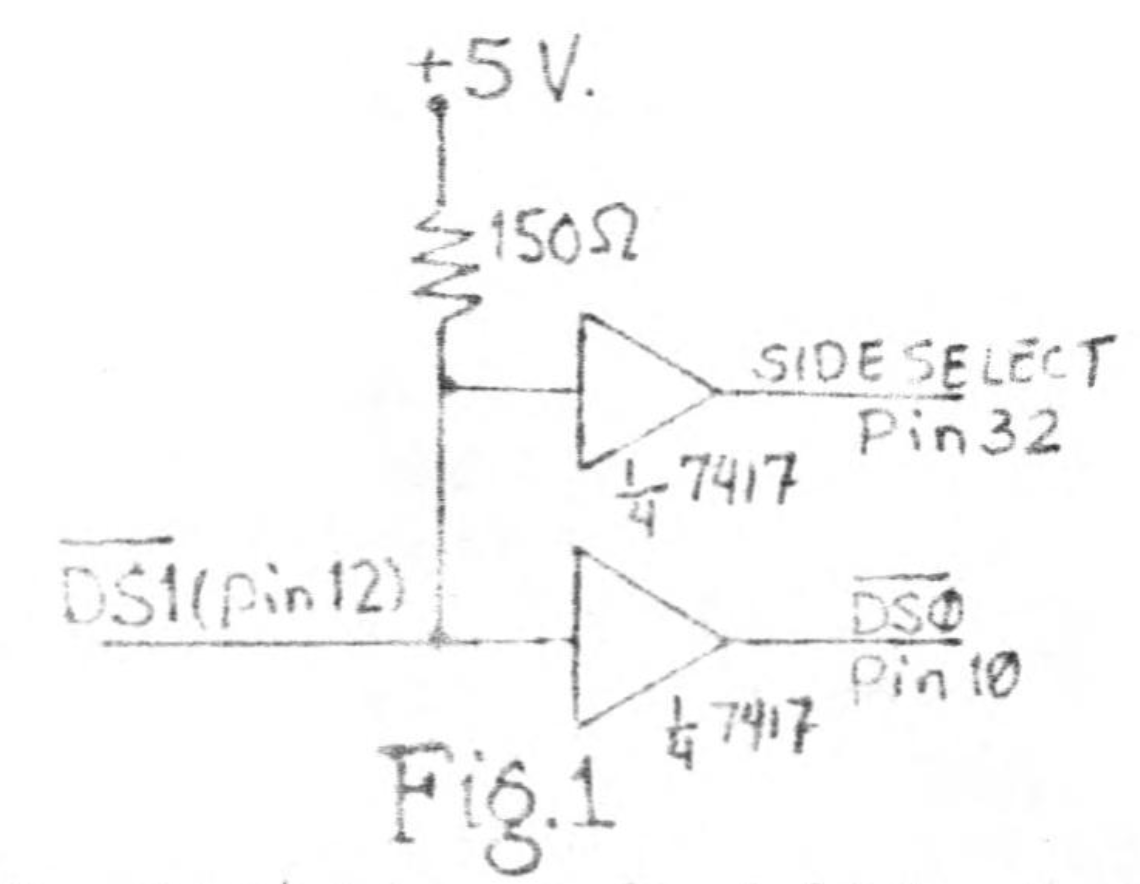
- On Page 13 of this issue of LIST John Bell has a circuit for running double-sided disk drives with the Zebra Disk Controller. As can be seen he uses 74LS08 which has a totem pole output stage. If you are in the habit of connecting and disconnecting your cables every ten minutes like me, you can at least burn the chip by installing the cable upside down. The remedy is to use open collector sourced logic with proper pull up resistors. An example is the circuit shown in Fig.1 (from a British source) which makes the second side of a double sided disk drive appear as though it was an independent second drive. The pin numbers shown are for standard 5 1/4″ drive edge connector. Decouple the 7417 close to the power supply pin. Connect unused inputs through a 1K pullup resistor to the 5v supply.
- While on the subject of 5 1/4″ disk drives, members of LIST have operated successfully the following drives with their Zebra controller. Both Bob G. and John B. are using the Remex drives which were advertised for $39.95. I have used for many months two TEAC FD54 drives without any problems. Please note that the drives must be separately powered. The rule of thumb is that any 40 track 5 1/4″ drive with a Shugart standard edge connector and a maximum access time of 6 milliseconds would work with the Zebra controller.
- ROM-BASED EMULATION: In the June issue of LIST Paul Donnelly had mentioned a problem users were having with a new batch of NEC ROMs when used with Wes B.’s ROM emulation circuit. (See also earlier issues of LIST). To cure the problem just swap the connections for pins 20 and 27 of the ROM chip. With this connection both the NEC as well as the AMD ROM chips will work. For those of you who had fully populated the Zebra interface board (twister and emulator+RGB), or are planning to do so in the future there is no need to worry. The circuit which was developed Dec. ’84 (reported in February ’85 LIST) does work with any Spectrum ROM.
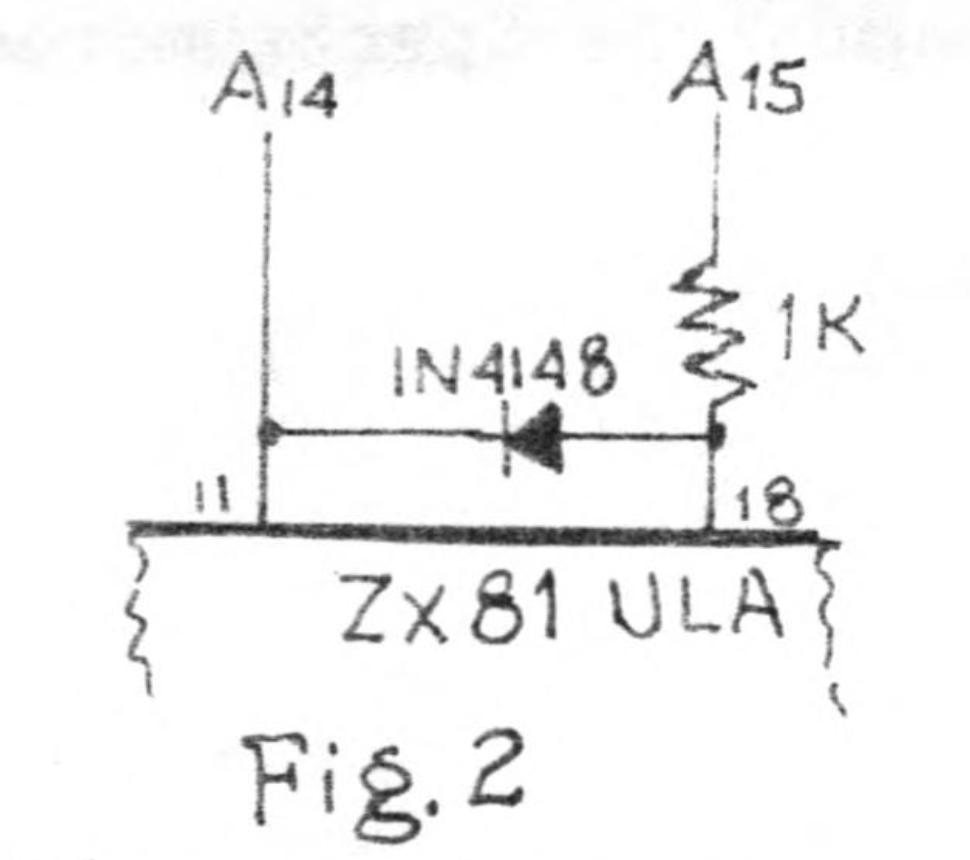
- ZX81 MEMORY EXPANSION: For those of you who have equipped your ZX81 with 64K of memory and are bugged by the display file jumping all over the place the nifty circuit to the right (Fig. 2) will totally free up the 32K to 48K area for any of your machine code routines. Note that one trace to the ULA is broken so that the 1K resistor can be installed. The source of the tip is Swedish.
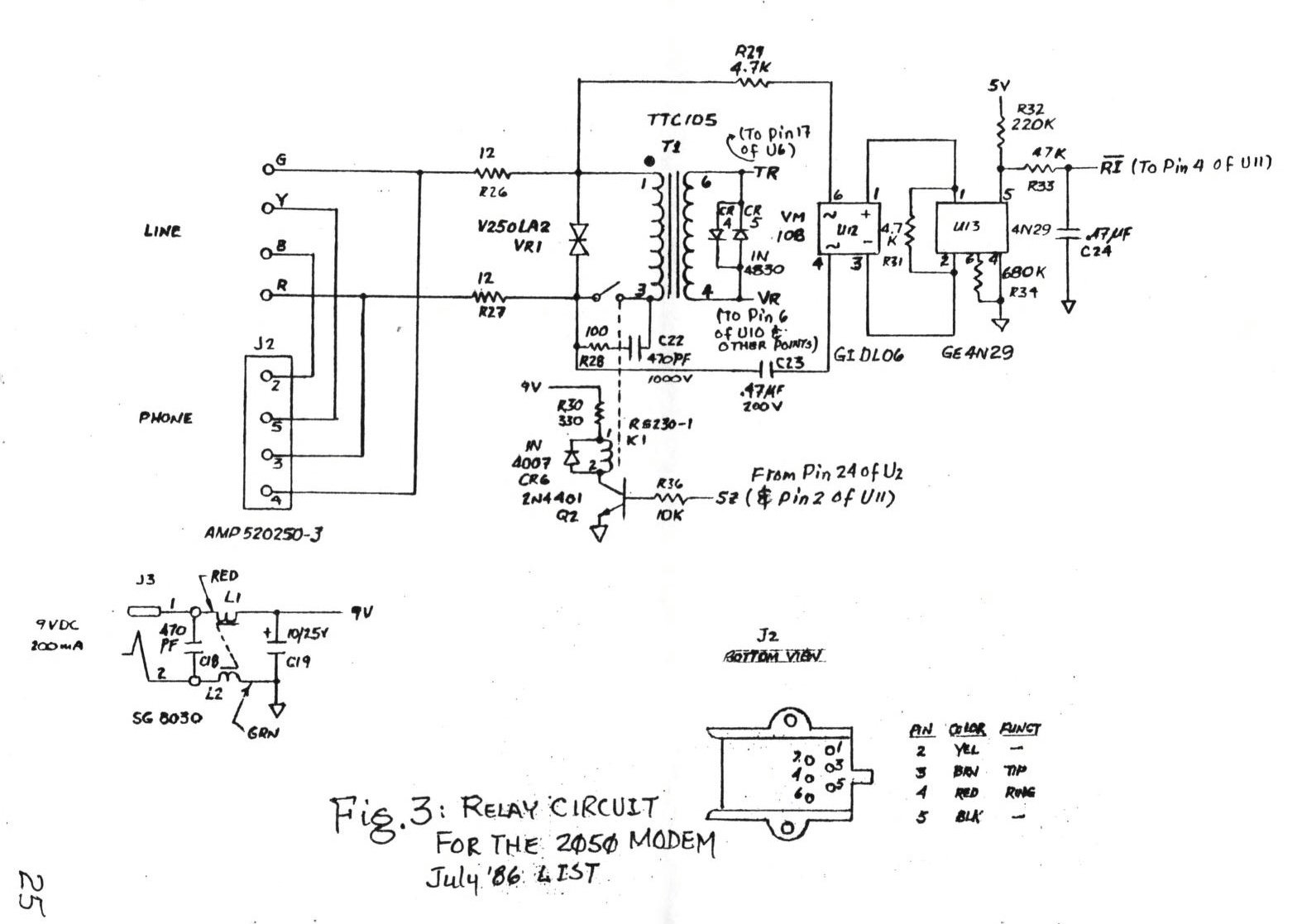
- 2050 MODEM CIRCUIT: In the Feb ’86 LIST the major portion of the 2050 modem circuit was published. As the time we did not have the relay portion of the circuit. In Fig. 3 the remainder of the modem circuit is provided.
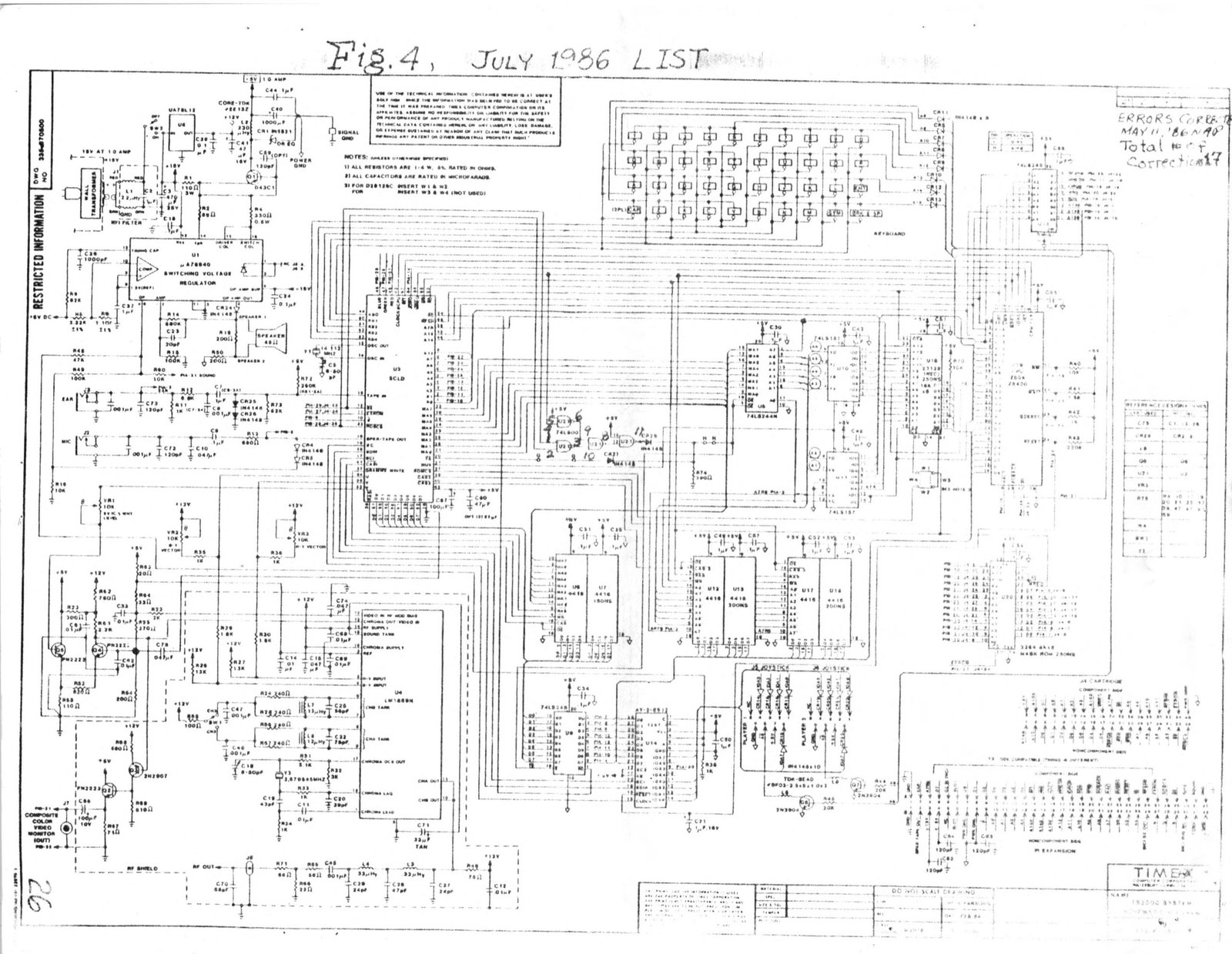
- TS2068 Circuit Diagram: Working with the TS2068 for the last three years and from time to time tracing the circuit board while repairing, I encountered errors on the schematic provided in the technical manual. In Fig. 4 an updated schematic is presented in which a total of 17 errors were corrected. I cannot confirm the assertion in a recent issue of THE RAMTOP that the W1 and W2 links are the reverse of what they are indicated on the schematic.
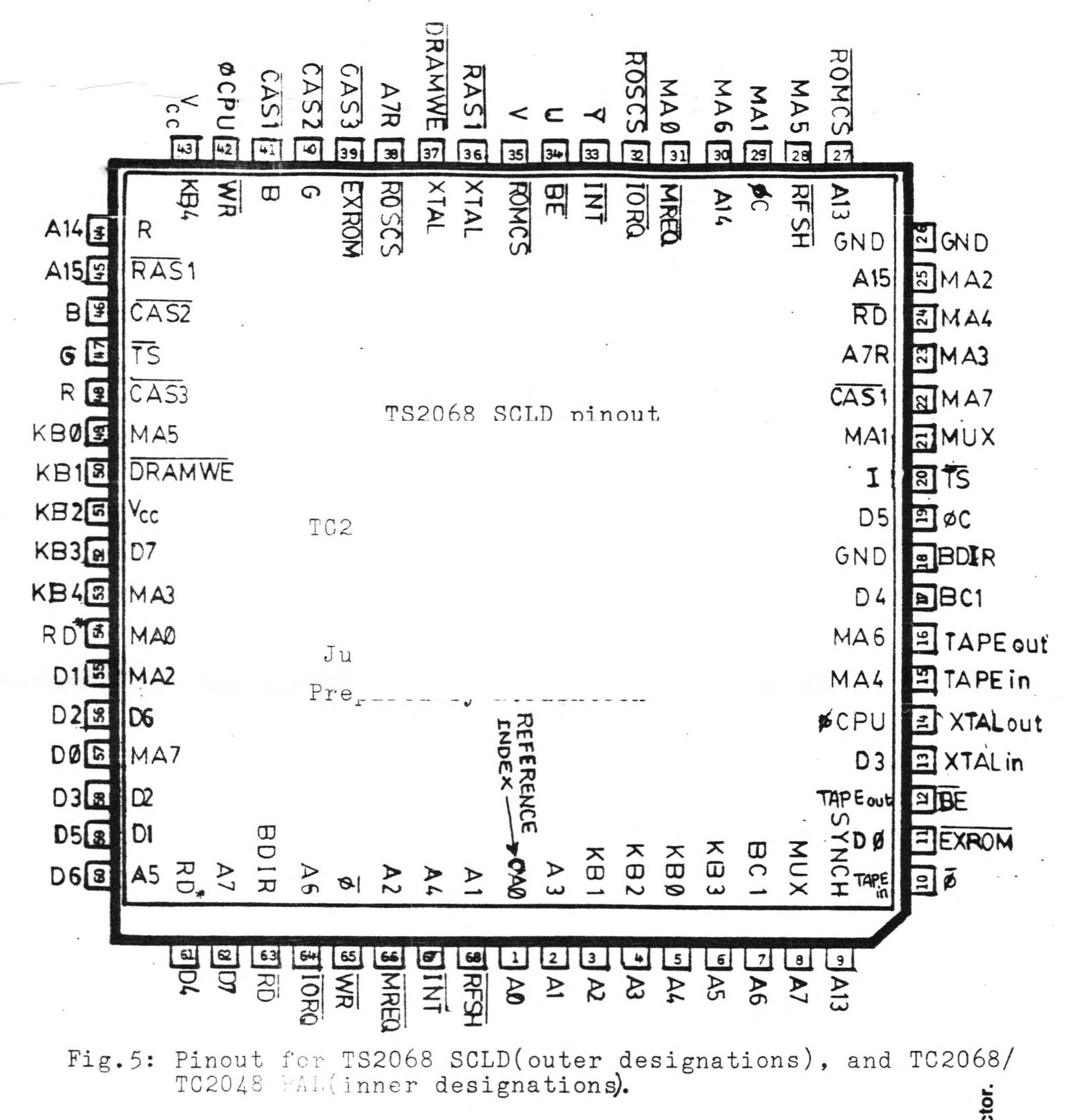
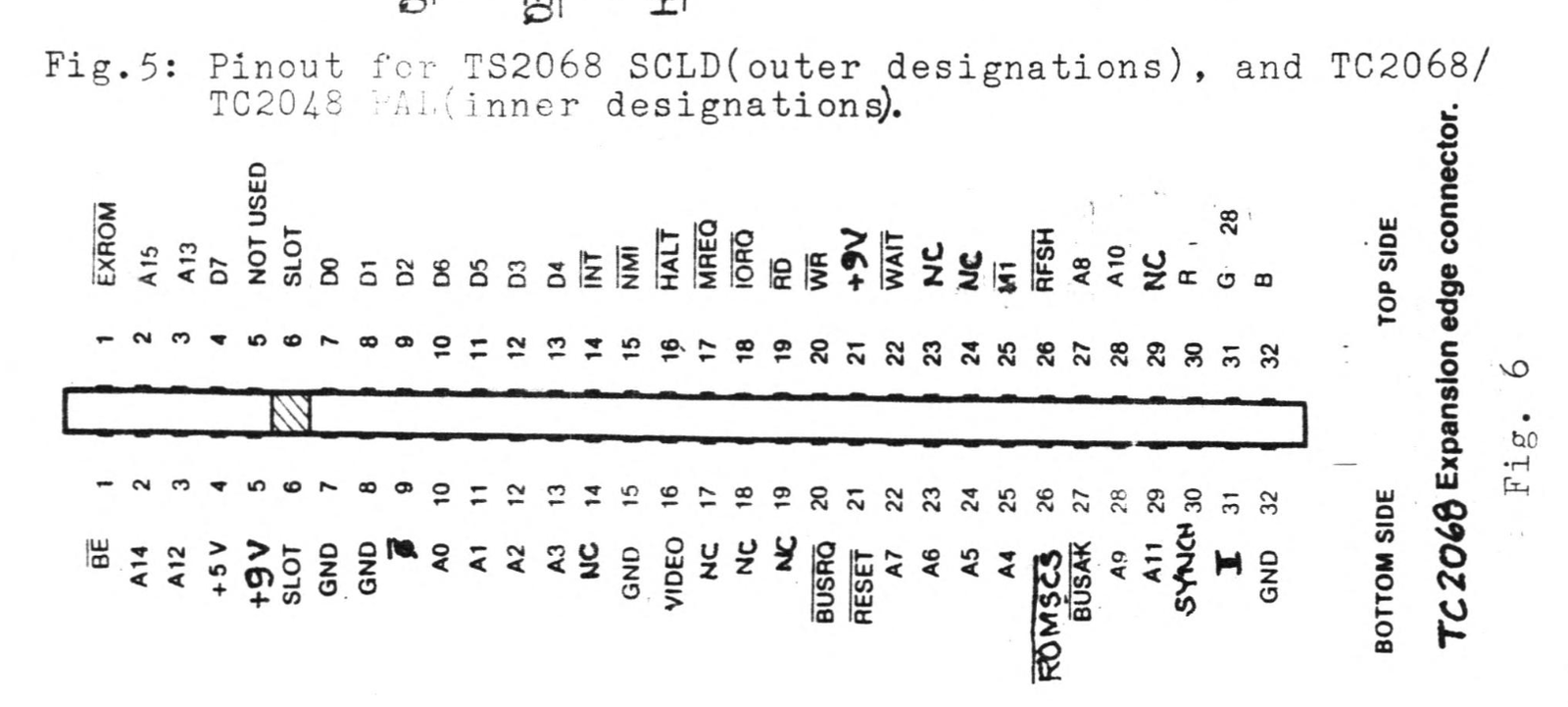
- TS2058 SCLD and TC2068/2048 PAL PINOUTS: Recently another user group as a service to the TIMEX community ordered the SCLD chips from Portugal. Portugal mistakenly sent them the TC series PALS. Since we might be seeing more of these (via Mexico or Canada) I decided to dusk off my notes of the TC2068 review (May-June ’85 LIST), and complete the tracing of the machine. In Fig 5 the pinout of both the TS-SCLD and the TC-PAL are super-imposed. As you can see they are not the same. The 68 pin chips are in PLCC package with the outline conforming to the variation AE of JEDEC registered outline MO-047. Sockets for the chips are manufactured by ITT (LCS-68-03SMT), AMP (6401345-1 or 2), METHOD (213-068-002). I have made timing measurements on the two chips. From a timing point of view it is not possible to distinguish the two chips. One pleasant surprise with the PAL chip was that it provides RGBI, so you can display 16 colors with RGB monitors. This necessitated updating the TC2068 expansion bus connector. The update is shown in Fig. 6.
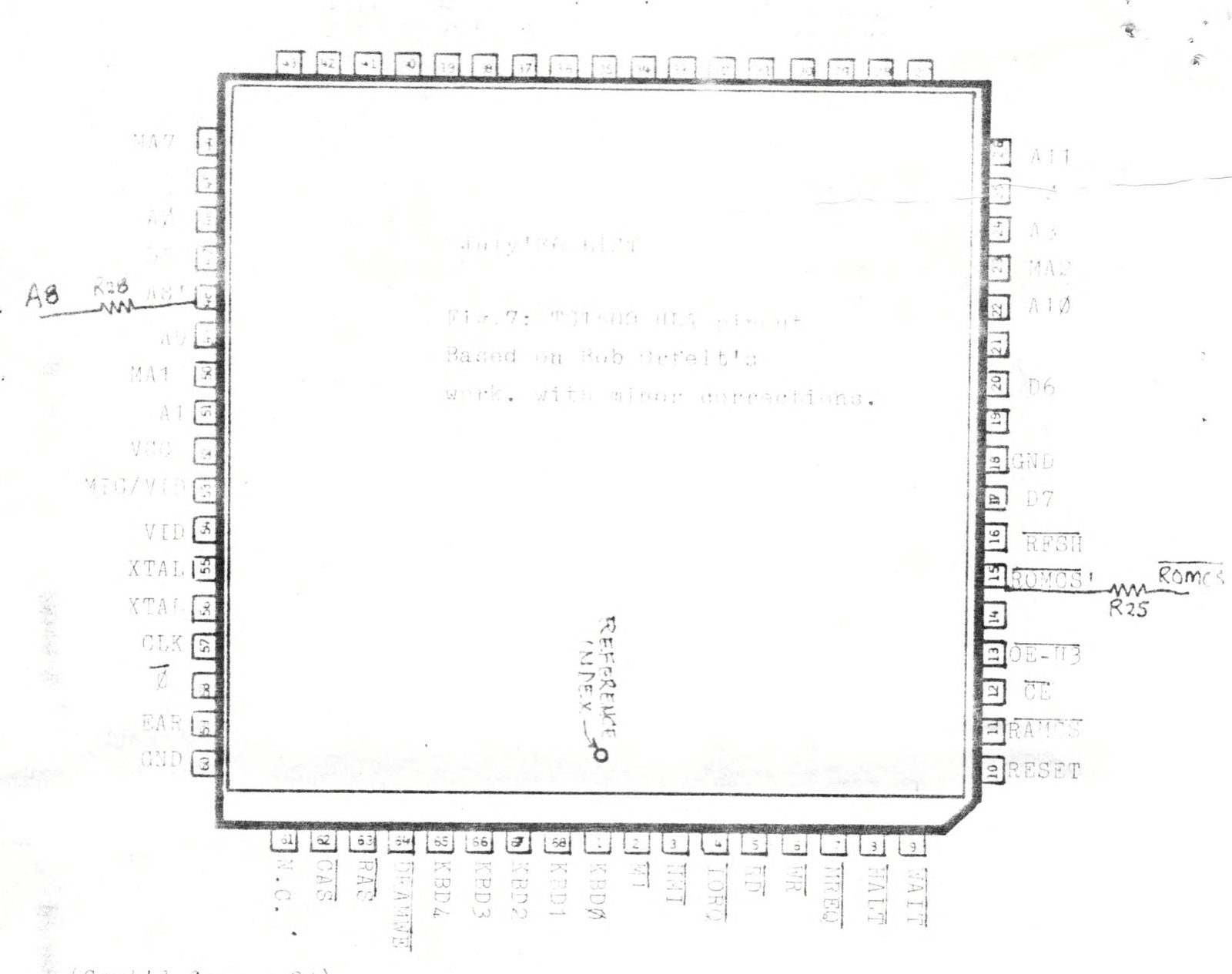
- TS1500 ULA: Recently I purchased the TS1500 schematic diagram from SUNSET ELECTRONICS. The schematic was prepared by Bob Orrfelt, a Timex enthusiast and developer. The pin numbering of the ULA was in error. I took the liberty of renaming some pins to make it correspond to the standard TIMEX nomenclature (Sorry about that Bob!). If you need the complete diagram order it from SUNSET ELECTRONICS.
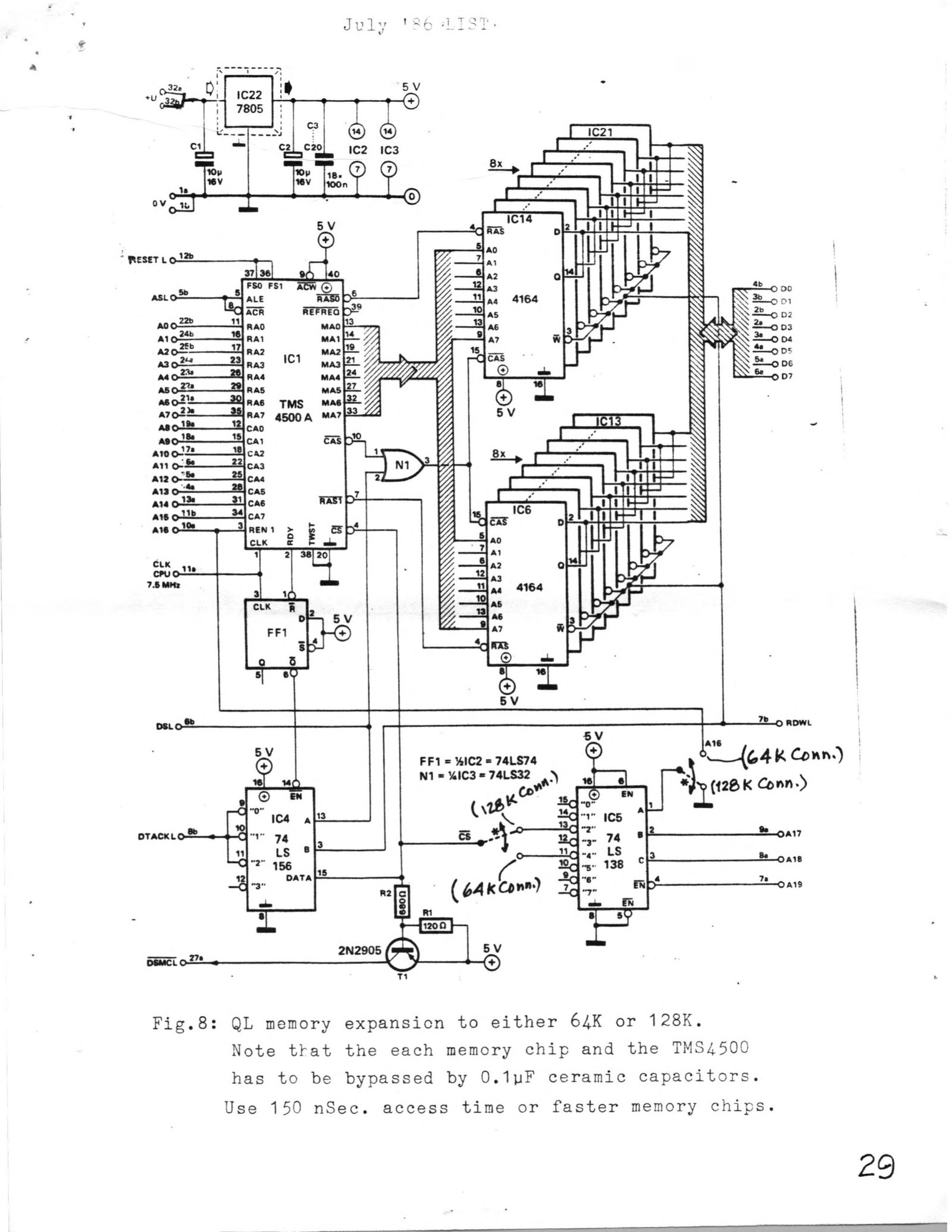
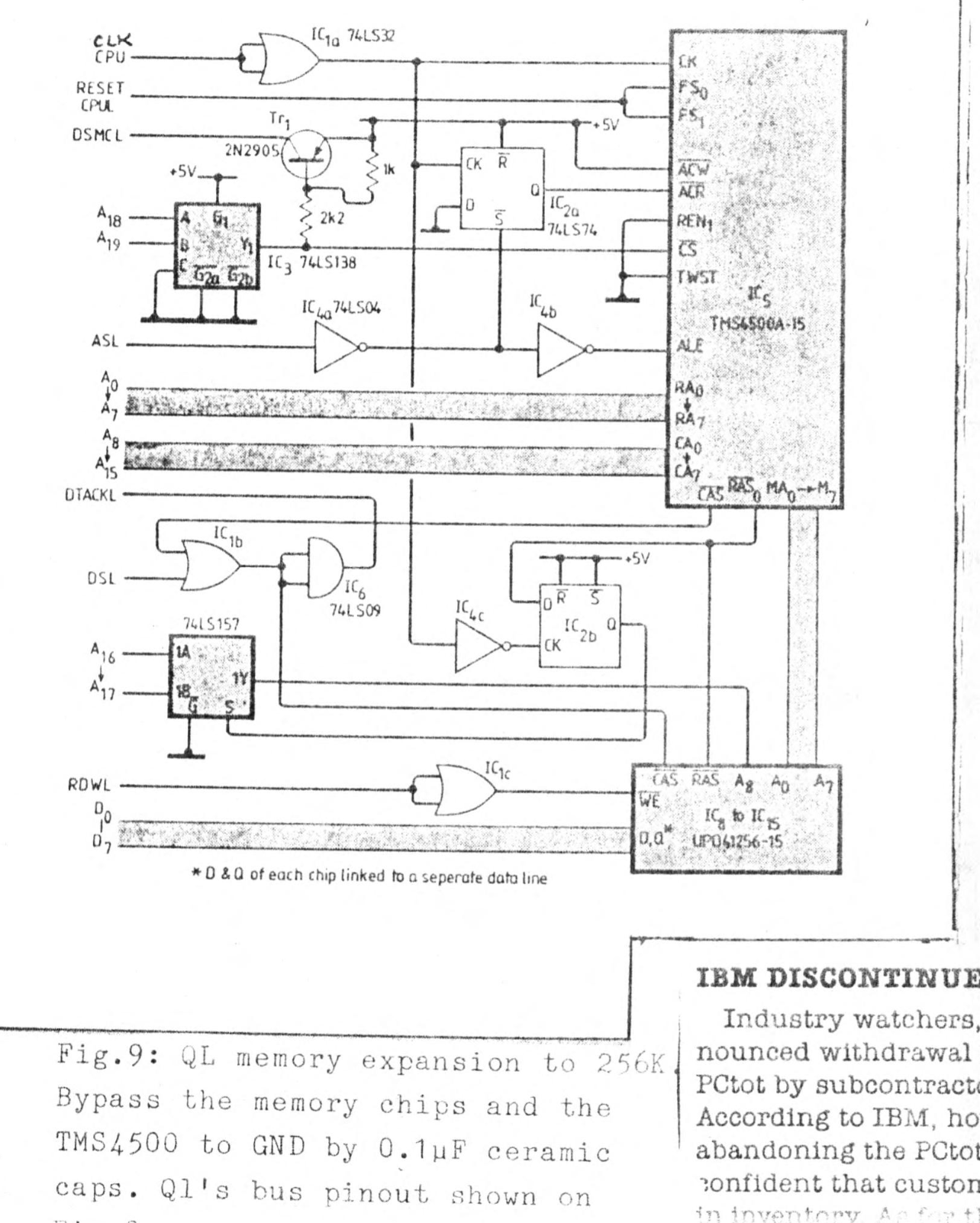
- QL MEMORY EXPANSIONS: Fig. 8 and Fig. 9 show memory expansions for the QL. In Fig. 8 memory expansion to 64K or 128K is shown using the 4164 chips. Fig. 9 shows memory expansion to 256K using the 41256 chips. Both circuits utilize the TI TMS4500 memory controller. I saw the TMS4500 in a recent flyer from Jameco for $19.95.
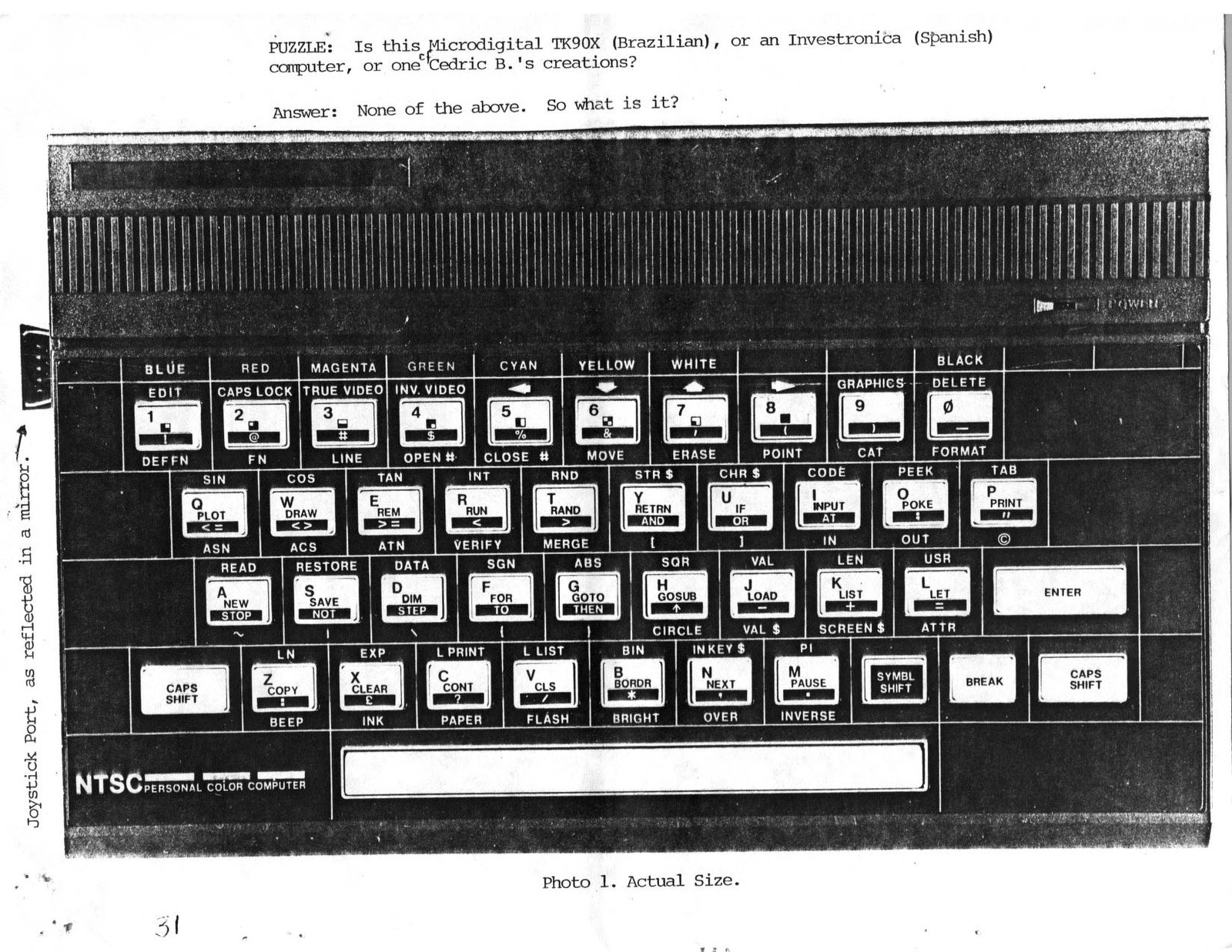
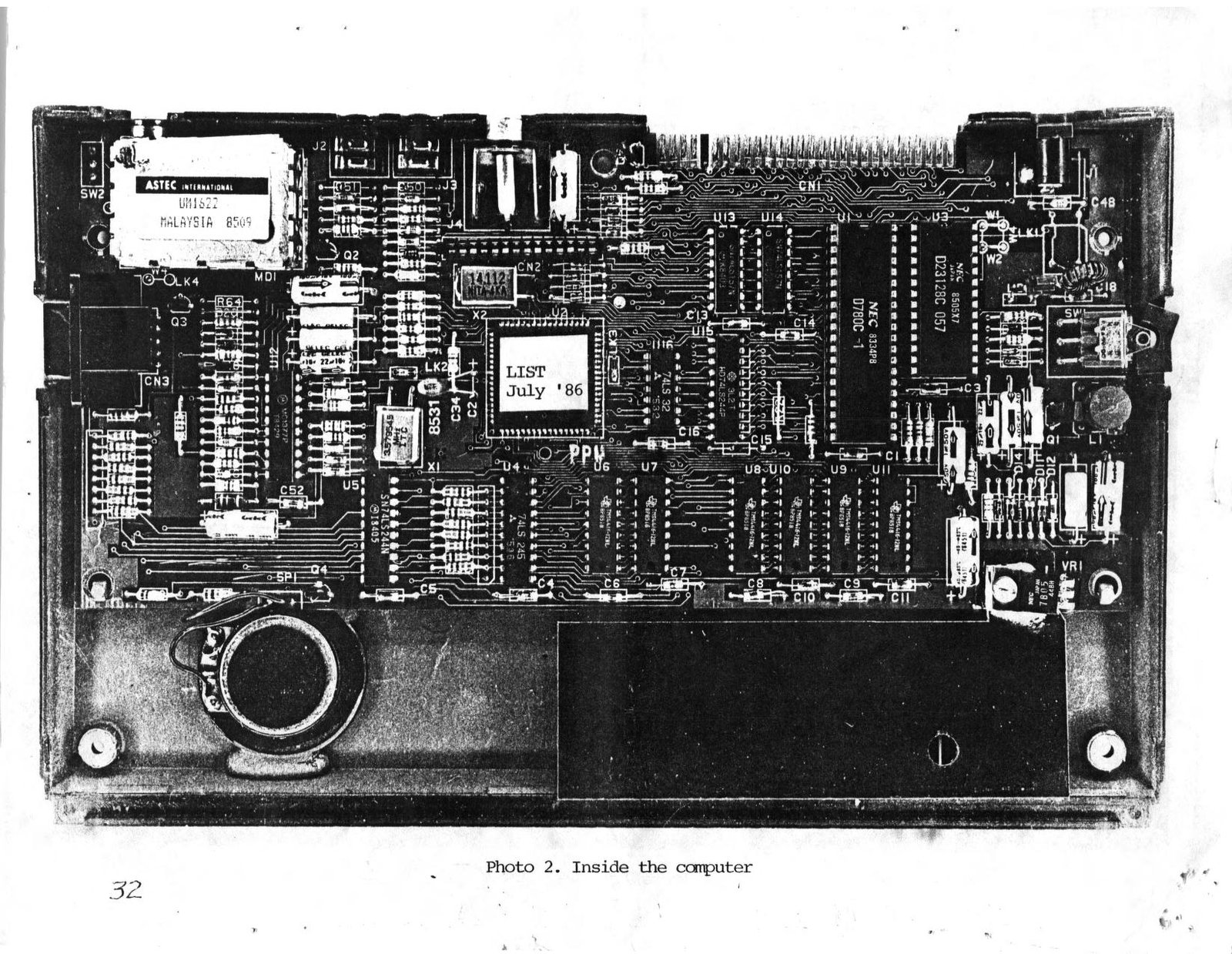
- PUZZLE: Photo 1 and Photo 2 show a mystery computer, actual size. I am going to be nasty and leave you guessing about which computer it is. Just a word of advice: if you encounter this computer anywhere and have spare cash with you BUY IT! Guaranteed you will be pleasantly surprised.
- After reading the ads in British magazines, if you had wondered where you can get the low cost Babani series of paperback books, the answer is here on the Island. The books are supplied by Electronic Technology Today, Inc, PO Box 240, Massapequa Park, NY 11762. Their catalog lists hundreds of titles in electronics.
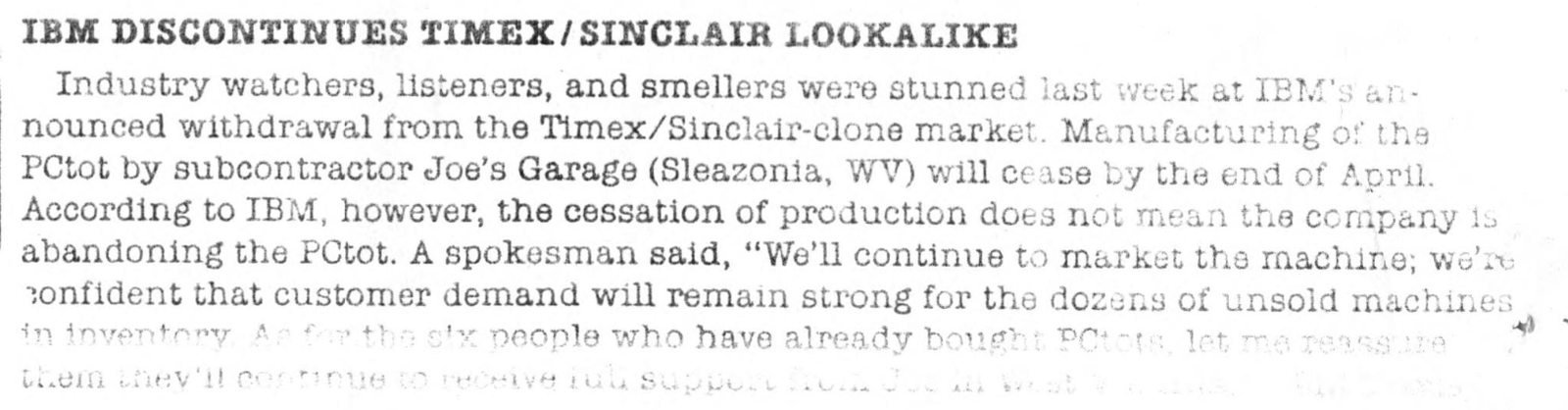
- A curious note about our computers appeared in an important trade journal (Electronic Design News), which I am reproducing in its entirety below. You are supposed to guess the month of publication.
Have a nice summer.
Image Gallery