
The editor has asked me to write a short historical note about a little-known device, the original Sinclair computer, actually the Sinclair scientific programmable calculator. While today we take calculators for granted, and, in particular, even programmable calculators are selling in the range of $35. Ten years or so ago this was a major event. To give you an idea of the magnitude of the bargain about the same time Hewlett-Packard had just come out with their programmable calculator. The ad I have is dated 10/74. The HP calculator sold for $795 plus state and local tax and from looking at the description it did not perform significantly better than the $35 programmables of today. It did have one advantage and that was one could insert a program card about 1/2 x 3 inches which would contain a 100 step program. One could either write ones’ own programs onto the card or one could buy a group of cards from Hewlett-Packard covering finance, weights, measures, mathematical functions, statistics, or medical applications.
This same calculator is still currently being used in intensive care units for repetitive calculations such as cardiac output where it is usually mounted on a small printer. In fact, it has had some facilities even beyond the present day computers going from 10 exponent – 99 to 10 to the 99th which is somewhat greater than the range of the Sinclair ZX81. Thus, while a powerful unit, $800 plus $45 for each package of programs was a bit more than most of us can afford for personal use.
It was thus gratifying to see the Sinclair selling for about $60, even though it had a few less features. The number range was the same, 10 to the -99 to 10 to the99 but the programs were limited to 24 steps. Available mathematical functions, log, trig, etc., were comparable and while it did not have magnetic cards that could be inserted it did have a feature that was almost as good. There were 50 pages of formulae to roughly cover the same data and presented in a form so that one could easily enter them into the “computer” without even having to translate into the reverse Polish notation of the instrument. I estimate that such a device would have saved the average science major in college 300 hours of repetitive calculation over the old slide rule. For this type of work it is probably simpler to use this device than programming a computer if only a few iterations are contemplated. To the best of my knowledge it was never sold in this country as the Sinclair, but I did see it at Radio Shack under their name for at least a brief time. Personally, I never felt that it received the publicity it should have had to compete with HP. At less than 10% of the price it was clearly the better buy. The sleek black case that was the forerunner of the ZX81 with the famous Sinclair logo also meant that it was much better looking and easier to read than the HP. Another interesting feature was that all numbers were displayed in exponential form which may be one reason why it never caught on with the general public, but then again most people aren’t looking for such a powerful calculator.
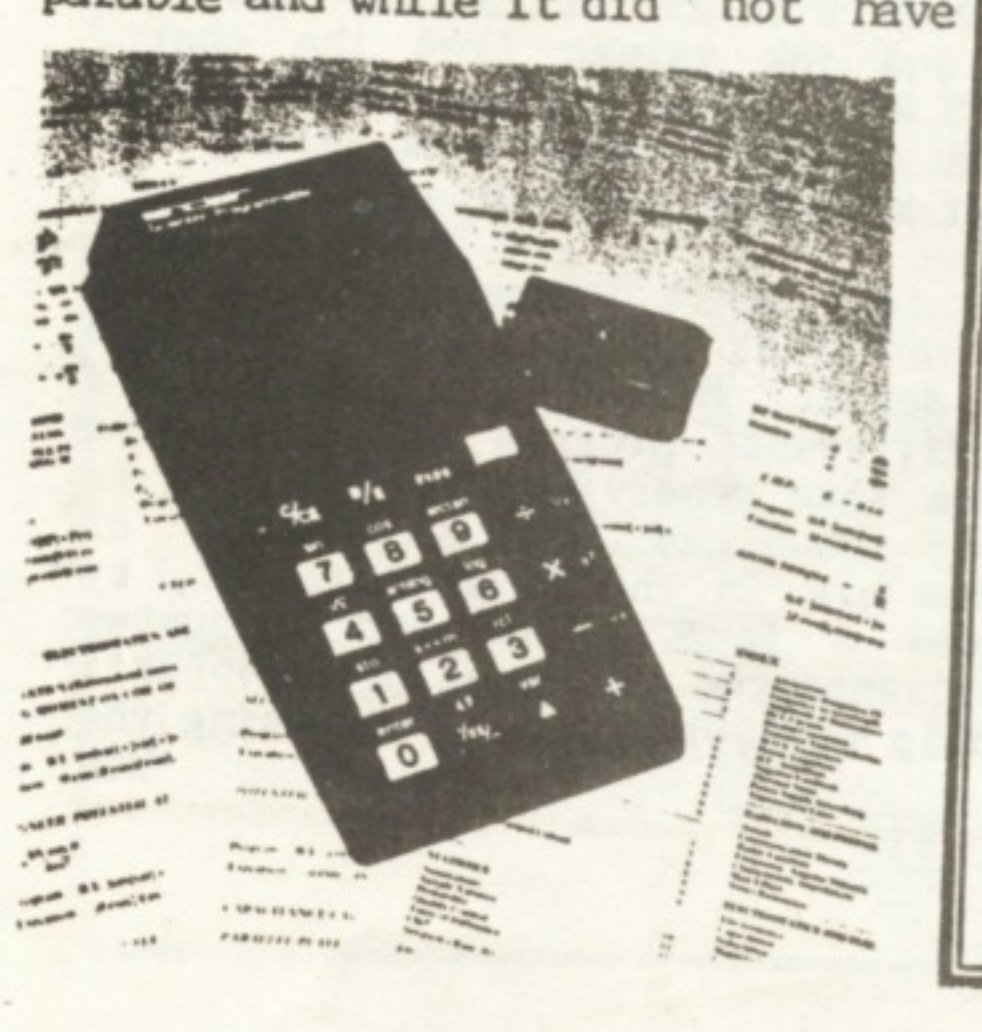
A second Sinclair programmable, the Sinclair Cambridge programmable was available at least through the mail for $29.95 plus $3 postage with a 294 program library at an additional $10. This was styled slightly differently measuring 4 1/2 x 2 inches and weighing only two ounces, whereas the original was 6 x 3 inches. Soon Sinclair will do it again with the QL which will have all the capabilities of the Mac at only $500. Now if we could just hire Sinclair to design for the pentagon we could probably eliminate the national deficit in about one year.