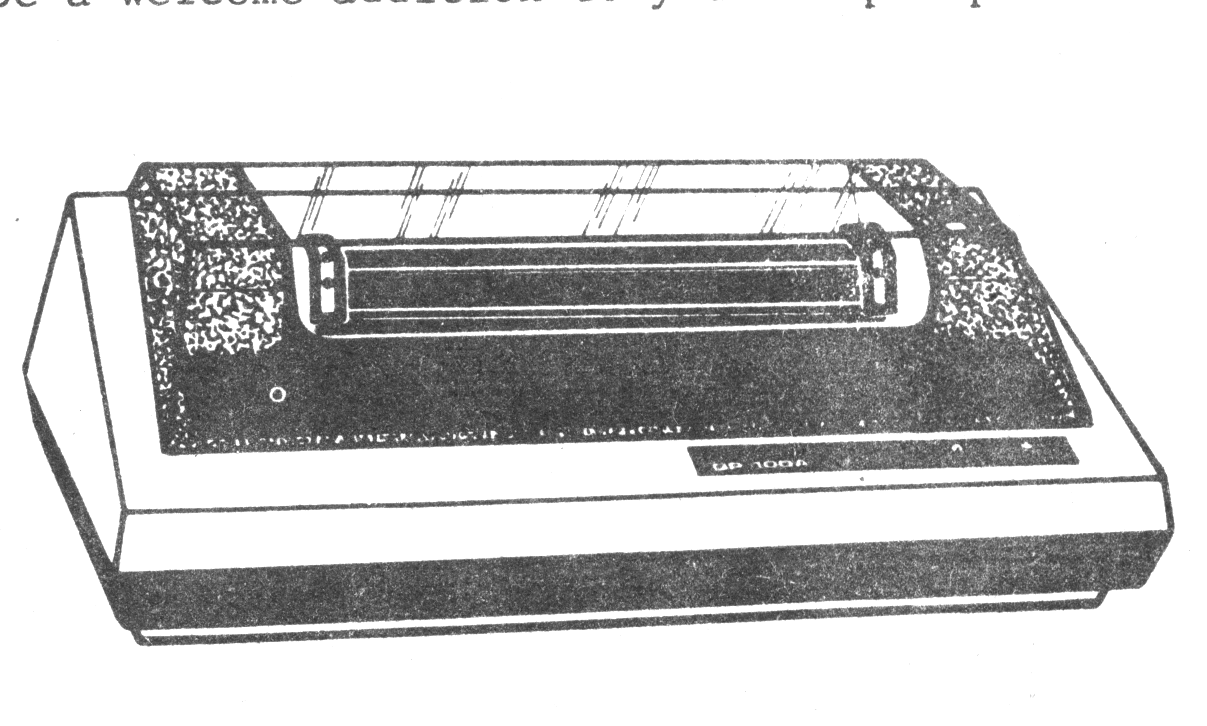
Memotech Centronics Parallel Interface and the Seibosha GP 100A Printer.
$339.00 + $4.95 plus shipping and handling from:
E. Arthur Brown Co., 1702 Oak Knoll Drive, Alexandria, MN 56308.
Six months ago, after a two month wait due (ostensibly) to delays in shipments of printers arriving from overseas, the dot-matrix printer and parallel interface I had ordered form Memotech arrived on my desk at work. Opening the box (I didn’t wait until I got home) I found the type of professional – looking products that I expected from Memotech: the Centronics-type parallel interface, in a black aluminum case that fits between the computer and my 64K RAM pack (also Memotech), and the dot-matrix printer, a simple but dependable-looking import from our Japanese friends. Hook-up of the components (when I got home) to the ZX-81 was simple. As long as you can locate the right plugs, the assembly of RAM pack-to-interface-to-computer and interface-to-printer is easy. But now it becomes necessary to open the user manual, which is very tiny and contains a bewildering assortment of information. A quick perusal of the manual reveals that approximately half of it is devoted to an assortment of information unusable by four-fifths of its end users plus a few Memotech ads. Not much left for the actual software instructions that will drive the printer. So the instructions must be few and simple, right? Wrong. There are actually no different commands required other than the same LPRINT, LLIST and COPY commands that send information to the ZX-81 printer, but a full-size dot matrix printer (as opposed to either of the ZX/TIMEX printers) requires more instructions, called “control codes,” and lack of thorough documentation and a sufficient number of examples at this point in the manual leave the user to much frustrating experimentation in trying to get his control codes right.
If you can work out the control code bugs and finally get the printer to do what you want, it has several very useful features to allow you to dress-up your output. It has a double-width, bold•print as well as its “normal” 10 characters per inch, and it will also “overprint” a word or words (make several printing passes) to make them stand out darker than the rest of the copy. These features, and the 80 character output width you have to work with (as opposed to the Sinclair’s 32 characters), give you a much-improved capability to make the printed output from your ZX/TIMEX look professional and readable. The control code problems are manageable, and keep in mind that once you have formatted your output, you need never (well, seldom) fool with it again. And as a program-development tool the Memotech interface/Seikosha printer performs well, cranking out wide, readable listings of programs at a faster rate than the ZX/TIMEX printers. A problem though. Nowhere in the manual is it mentioned that if you attempt to LLIST lines that contain some of the computers’ graphic symbols, the interface causes NEW to be executed, wiping out any program material you have in RAM.
Aside from the glitches that I’ve mentioned here (some of which may have been corrected by now) the printer and interface have turned out to be very dependable and have needed no repairs. They have turned out good copy on 8½” x 11″ fanfold paper for over six months now, and show no signs of wear. If you’re willing to spend the time required, it will be a welcome addition to your ZX periphenals.