
Byteing Deeping Into Your Timex Sinclair 1000, by Mark Harrison (John Wiley & Sons, Inc., $12.95)
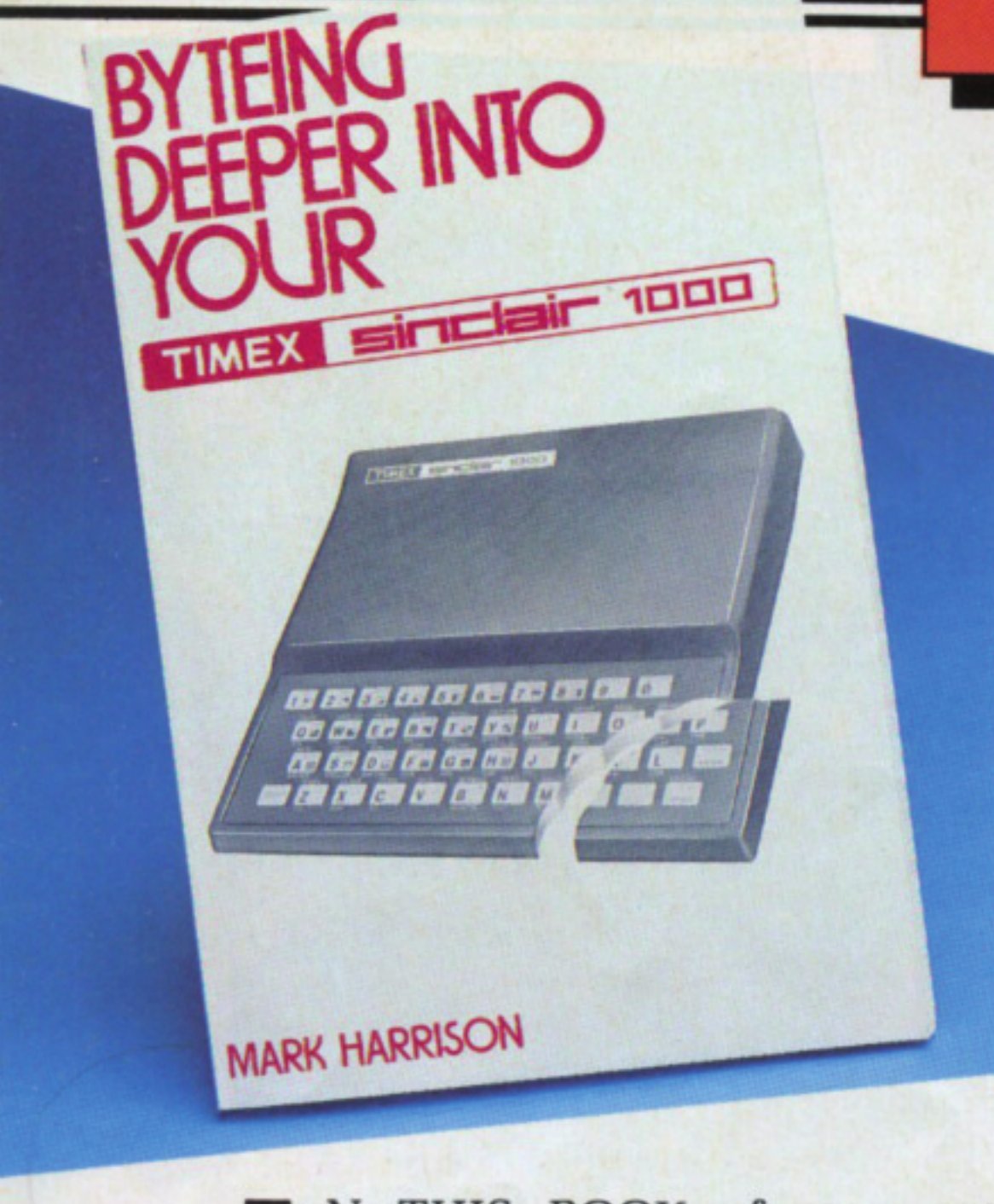
IN THIS BOOK of over 160 pages with 37 programs of varying difficulty, Mark Harrison begins with a one page listing of the ZX80 and ZX81. The object of the book is to teach BASIC. This is handled in a rather difficult manner.
If, like most people, you bought a T/S1000 or ZX81 first, the first chapters on the principles of computer systems and the formation of algorithms will leave you wondering just what is going on here. The language, style and purposes are more suitable for a university-level text than a home instruction book.
The language remains difficult throughout, but the explanations of BASIC, specifically ZX81 BASIC, are well thought out and divided into logical groups under such headings as Statements, Functions, Character Sets and String Functions, Graphics, Logic and INKEY$.
It is in these areas that this book has its greatest use. These are the sections that any book about a computer and BASIC must cover, and they are handled very competently.
Harrison then discusses the memory of the T/S1000,ZX81 and PEEKing and POKEing. The explanations and illustrative figures serve their purpose, but a strong background in mathematics is required to fully grasp the discussion in the text. If such phrases or topics as “exponent byte” and “mantissa byte” and “pushing and popping” leave you with a worried expression, this is not the book for you.
However, it is in this section (just past the mid-point) that the most original and useful programs are found. If you’ve tried programming arcade games, you may have discovered a need for a timer — in real units. There it is — an elegant, concise listing (six lines) that can be adapted to your own needs.
This section also includes an overview on machine code programs. If you don’t know much about this language form and would like to, this is an overview “. . . not really intended to teach the writing of machine code programs but to show the ZX81 (T/S1000) user how to execute and possibly understand other people’s machine code programs.”
This may work for you, but it didn’t for me. If I hadn’t known anything about it before I had read this section I would have hit the frustration point. Machine code programming cannot be covered in ten pages and accomplish the goals set by Harrison.
The remaining few chapters cover loading and saving, crashing and programs. In summary, I believe that this is a book to look at very carefully before you buy it. Other books do a better job in terms we can all understand. Now don’t get me wrong — this is not a bad book. The tips and programming devices are excellent, but — and it’s a big but — I wouldn’t buy it. The last thing my bookshelf needs is another book whose title implies I can really get into my computer and whose purpose is to help me learn BASIC but whose contents break the promise of the title and whose language forces me to reread to make sure I really don’t understand what I don’t understand. This one’s not for me.