
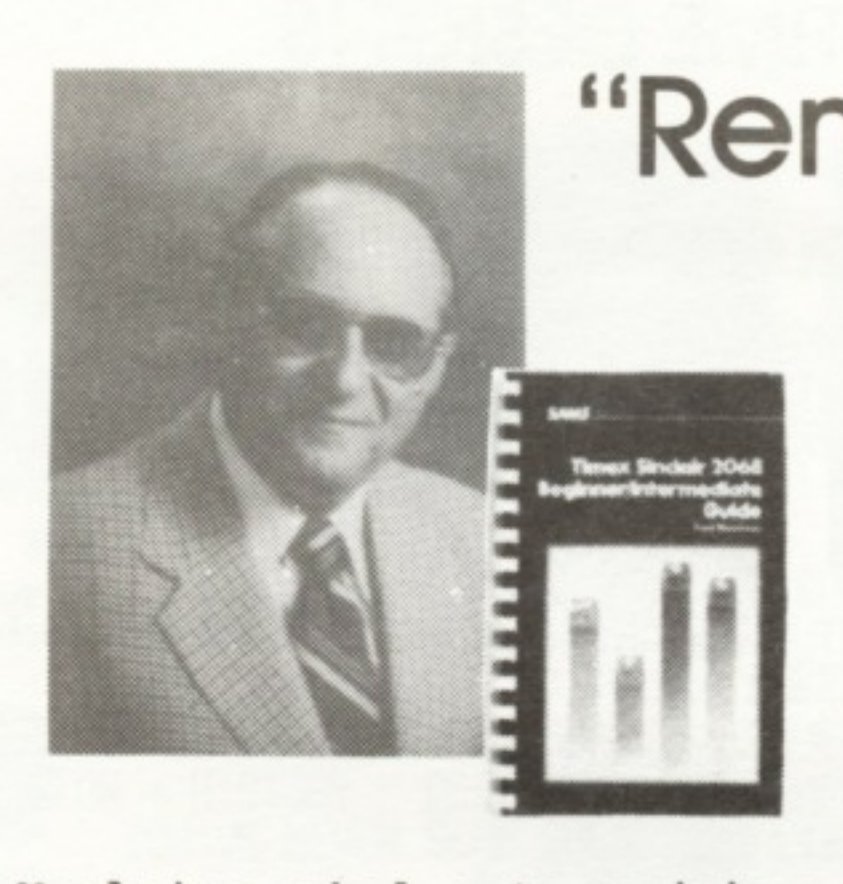
Tim Woods has asked me to reminisce about the early days of the Timex Sinclair microcomputers. Ah, nostalgia time! The good ol’ days…or were they?
When you think about it, the “good ol’ days” of the Timex computers only go back to April 1982. That was when Timex Computer Corporation, a wholly-owned subsidiary of the Timex Watch Company, announced to a stunned press that it had made an agreement with Sinclair Research Ltd. (England) to produce and market the Timex Sinclair 1000, Timex’s version of Sinclair’s ZX81…and it was going to sell at 150,000 Timex North American retail outlets for only $99! That didn’t happen, since most stores that sold Timex watches decided not to try to sell computers…but it was sure exciting to think about!
But the genesis of the TS 1000 goes somewhat further back to when “Uncle Clive” Sinclair shocked the computer world in early 1980 by announcing the first under-$200 computer, the ZX80. This was an immediate hit in England and came to the U.S., mail-order only, in late 1980. This was followed by the ZX81, which was actually manufactured in Scotland by Timex. It sold for $150 assembled, or $100 in kit form. The ZX81 quickly became the largest-selling computer in the world.
I got my first ZX81 in early 1982. I ordered a kit for $100, but they had more assembled units than kits, so they apologized for sending me an assembled unit!
I had already cut my computing teeth on a Radio Shack TRS-80 Model I 4k with Level I BASIC, which I had upgraded to 16k with Level II BASIC language. I had written one book for Hayden Publishing (“Programs For Beginners On The TRS-80”) and many magazine articles, so the ZX81 was not my first micro…but it quickly got my attention.
It was FUN to program the ZX81 in Sinclair BASIC, which was much more powerful than the TRS-80 Level I BASIC. Because there was only 1k of RAM, and much of that was devoted to the screen, there was not much memory left for a program…making the challenge much greater. The graphics were limited, but easy to use.
I started writing articles about the ZX81 and the Timex Sinclair 1000. Since they were identical, except that the TS 1000 had a 2k RAM instead of 1k, everything I did with the ZX81 worked on the TS1000. Furthermore, by adding the 16k RAMpack to a ZX81, it was the same as a TS 1000 with a RAMpack. In fact, I never did get a TS 1000. By the time they were available, I had two ZX81s with RAMpacks!
I recall the difficulty in getting a printer in the early days, before the Timex Sinclair 2040. Sinclair put one out in England for about $100. I don’t even remember what they called it, but it put out so much radio-frequency interference that the FCC banned it in this country. It used an electrostatic process that vaporized a thin aluminum coating to expose the black surface on a carbon-coated paper roll. I ordered one of these little printers from Gladstone Electronics, via Canada. The import paperwork, shipping and tariff cost about $35! It was strange, but gave an acceptable 32-column printout that duplicated every dot on the screen. To do that on many of today’s micros takes special graphic screen dump programs!
My first ZX/TS-oriented article was in the Sept/Oct 1982 issue of SYNC Magazine. I subsequently wrote 20 other articles covering the ZX81, TS 1000, TS 1500, TS 2068, Spectrum, and QL for other magazines…Electronic Fun, CES Daily, Microcomputing, TODAY (CompuServe), Timex Sinclair User, Computer Shopper, Computers & Electronics, Computer Trader and Modern Electronics. My last “Timex” article was a 7-page hands-on review of the Sinclair QL in the June 1985 issue of Modern Electronics.
Along the way, I wrote the book, “Timex Sinclair 2068 Beginner/Intermediate Guide” for Howard W. Sams. It is now out of print, but available from the E. Arthur Brown Company. They also sell my friend Jeff Mazur‘s book, “Timex Sinclair 2068 Intermediate/Advanced Guide“, also published by Sams, which picks up where mine leaves off. Writing that book was a real challenge, since I didn’t have a TS 2068 Personal Color Computer! Dan Ross, the man running Timex Computer at the time, made an arrangement for Jeff and me to each have a Sinclair Spectrum, on which the TS 2068 was based. We also got some advance information, but had to make some educated guesses. Sue Mahoney and George Grimm at Timex were very helpful…thanks, wherever you are today…
The real irony was that my completed book manuscript went to the publisher in early August of 1983… and later that same day Federal Express delivered the first TS 2068 I had ever seen! Luckily, after checking out the actual 2068, I only had to change one paragraph in my manuscript.
As it turned out, the computer had been delayed so long my book hit the streets before the computer…and Timex closed down the computer division just a few months later. What a shame! A great little computer caught in a web of bad engineering and marketing decisions.
In their defense, Timex management had a host of problems with the real value of a “home computer” being challenged, and price wars created by the competition forcing profits too low. Add the unreality of trying to effectively sell a device as complex and unfriendly as a computer in drug stores, and the stage was set for repercussion. Timex was not the only micro manufacturer to fall on bad times. It just seems, however, that if they had “hung in there” about another six months, the superior features of the TS 2068 would have become known.
What have I done since? Well, I’ve had other computers in my collection…TRS-80 Model III (two of those), TRS-80 Model 4P (two of those), Coleco ADAM, Radio Shack MC-10 Microcolor Computer, Sanyo MBC 555-2, Apple IIc, and just recently got an IBM PC/XT clone.
I’ve written three more books since my Timex 2068 book, and over 200 computer-related magazine articles. “The ADAM Beginner & Intermediate Guide”, a book written for Sams, was cancelled after acceptance and editing, due to the fall of the ADAM. My “Sanyo Beginner & Intermediate Guide” and “Apple IIc – An Intelligent Guide” were published by CBS Computer Books, just before they abandoned the computer book market. I’ve personally sold over 1000 copies of the Sanyo book, since like the Timex machines…it has many devoted users.
I hated the Apple IIc, the ADAM was “unspeakable”, but I love the Sanyo! It offers the ease and power of programming remindful of the TS 2068, but with two built-in disk drives and 48,000 pixels on the screen (640 x 200), each in any of eight colors! Wow!
Thank goodness I’ve got my Amway Emerald Direct Distributorship to support my computerholic tendency! Also, well over 1000 Amway Product Distributors have purchased my $100 “AMBIZ-PAK” of 10 programs for the IBM PC/Clones, TRS-80 Models III/4/4P/4D, and the Sanyo MBC 550 series.
I’m pretty much out of the Timex environment now, and will not be writing about the QL. However, I can well understand the fascination and dedication many of you hold for the Sinclair and Timex machines. As I recall, at one time Timex used ads with the slogan “The POWER is in your hands!” May the POWER be with you…