
ZXAD, Version 2 / Scientific Software, 16K
ZXAD is an assembler program that includes basic debugging/editing capabilities. It allows the use of eight pseudo-ops (ORG, REL, END, DEFB, DEFW, DEFC, DEFS and EQU) and six-character symbols/labels, something few available assemblers permit.
For those who are unfamiliar with the term, an assembler is a program which aids the user in writing machine code programs. It does this by taking a listing written in assembly mnemonics, called the source code, and translating it into machine code. For example, an assembler takes the source statement “LD A,B” and translates it into the number 78hex, which the Z-80 microprocessor can understand. Using labels, an assembler can automatically calculate addresses, freeing the user from that tedious and error prone task. Programs can be written using statements like “CALL NEXT” or “LS HL, (COUNT)” without worrying about the exact addresses of NEXT and COUNT. Labels make it simple to shift a program about in memory, making it a snap to insert or delete instructions to correct a bug.
A pseudo-op is an instruction included in the source code that tells the assembler what to do, but does not get translated into machine code. The ORG pseudo-op instructs the assembler where in memory to store the machine code as it is being assembled. REL tells where in memory the machine code will be executed. (This is not necessarily the same place that the machine code is stored. The code may get moved.) END signals the end of the source code. DEFB and DEFW indicate that the numbers immediately following them are to be directly included in the machine code. DEFB assumes the numbers are single bytes and DEFW assumes the numbers are two-byte words. These two pseudo-ops are useful in setting up data tables.DEFC causes the character codes of the immediately following string to be stored in the machine code. For example, DEFC “ABC” causes the bytes 26, 27 and 28 (all in hexadecimal) to be included. DEFS leaves open a certain number of bytes which can then be used for temporary storage. EQU assigns a numerical value to a symbol or label.
Symbols are strings of up to six characters used in the source code to represent constant numbers. For example, the symbol LINES can be used in place of the number 16hex in the instruction LD A,LINES. Symbols make the source code easier to understand while also providing a way to change the value of a constant throughout the program (by changing one EQU statement).
The number of symbols/labels that can be used in the source code is only limited by the size of free memory.
The first line of ZXAD is a REM statement that contains the machine code that actually handles the conversion from source code to machine code and the debugging/editing. The 102 remaining lines of BASIC create the display and gather input from the user. Including the display file, ZXAD occupies just over 8K bytes of memory.
The user’s source code statements are stored in REM statements above ZXAD’s 103 lines. One source statement plus a comment are allowed per REM. ZXAD has a line renumber function which makes it simple to insert new lines of source code.
ZXAD offers three assembly options. One simply assembles the code and displays any error messages; the others, assemble the code and either display or print out addresses, machine code, source code, and error messages (see Figure 1).
Figure 1. Sample of assemble and print option.
570  53F8 115D40   INPUT LD DE,$
405D
600  53FB D5       INPLP PUSH DE
610  53FC CD3B54    CALL KEY
620  53FF D1        POP DE
625  5400 E1        POP HL
630  5401 FEE3      CP $E3
640  5403 CABF53    JP Z,MENDIS
650  5406 E5        PUSH HL
660  5407 FE77      CP $77
670  5409 281A      JR Z,DEL
680  540B FE76      CP $76
690  540D 2829      JR Z,ENT
700  540F FE40      CP $40
710  5411 30E8      JR NC,INPLP
720  5413 EB        EX DE,HL
730  5414 77        LD (HL),A
740  5415 23        INC HL
750  5416 117B40    LD DE,$407B
760  5419 B7        OR A
770  541A ED52      SBC HL,DE
780  541C 2817      JR Z,WSFULL
ZXAD provides simple debugging features. Memory can be examined and edited in hex. Also a breakpoint address can be selected. When this address is reached during a run of the machine code, a branch is made to a routine that displays the values of all the registers. The machine code program does not stop after the breakpoint — it continues on leaving a snapshot of the Z-80’s state at that address. ZXAD does not provide the single-step or disassembly capabilities found in other debugging programs such as Sinware‘s HOT Z.
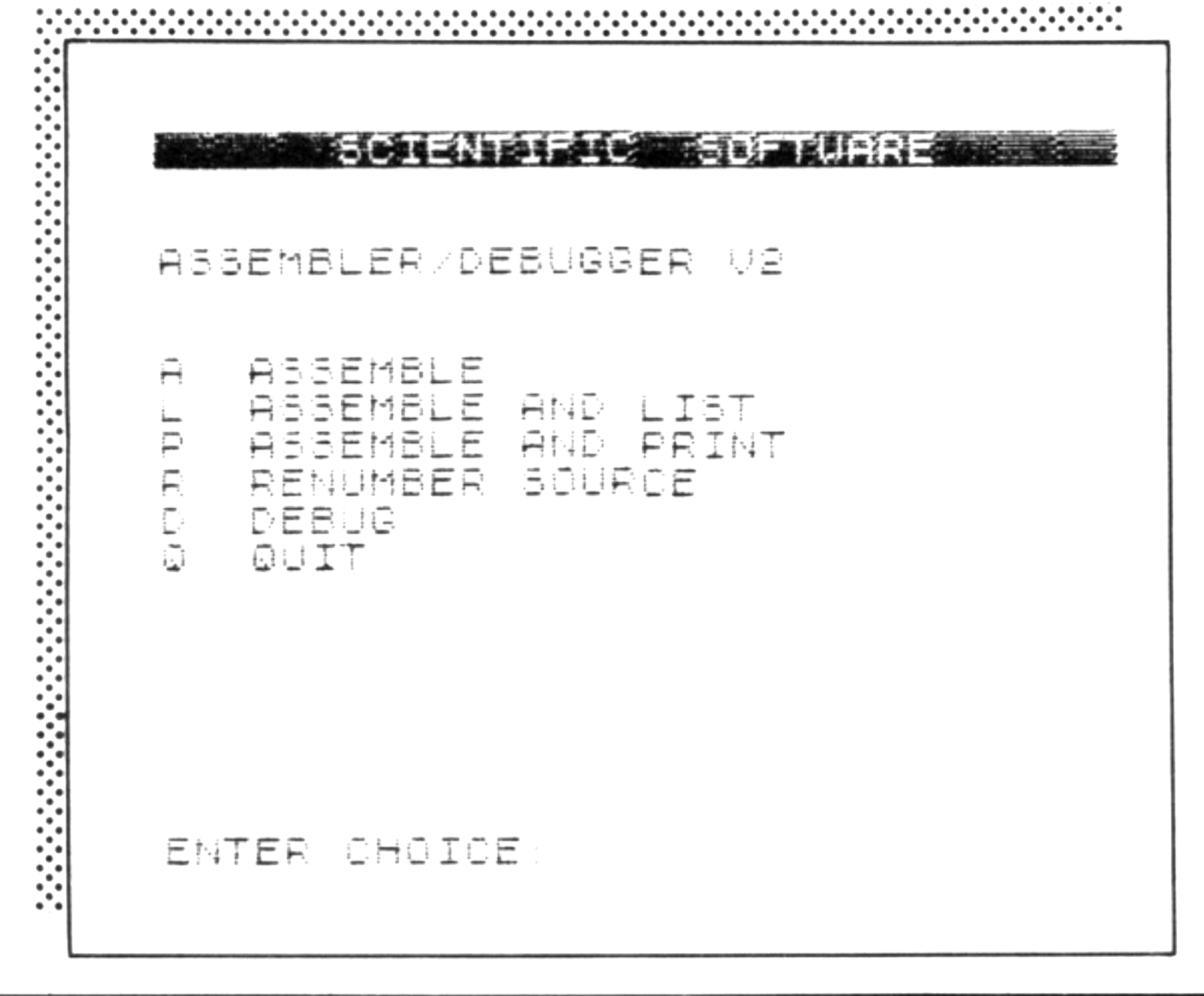
ZXAD is very easy to use. Source code is standard Z-80 mnemonics, but uses only hexadecimal numbers. Functions are selected from a menu (see Figure 2). The instruction booklet is very well written, though it assumes a familiarity with machine language programming. It includes tips about the most common programming mistakes and contains a list of all the mnemonics in the form that ZXAD recognizes.
My only complaint about ZXAD concerns the five error messages: they are not specific enough. “BAD OP-CODE” can mean everything from a missing space to an incorrect number. This vagueness can be frustrating until you become familiar with ZXAD’s syntax.
Overall, the ZXAD assembler is very useful, full-featured, and easy to use. Its instructions are clear and complete. It has some debugging/editing capabilities, but it is not a complete debugger/disassembler.
For more information, circle 8 on reader service card.