
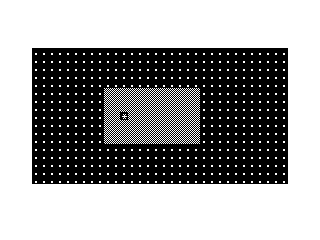
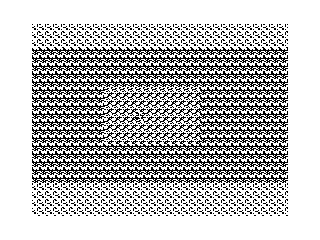
This ZX81/TS1000 program implements a reaction-timing game called “FRENZY” in which a moving cursor travels back and forth across the screen and the player must press “Z” at the right moment. A small machine-code routine is embedded in REM line 1 (opcodes LD A,#1E / LD I,A / RETN, five bytes at address 16514), called via USR to handle timing or interrupt control, with its result stored back via POKE 16515. The playing field is drawn with inverse-video border characters filling rows 3–19 and a highlighted window region at rows 8–14. Scoring tracks both the number of presses (A) and a positional bonus (B) awarded only when the special “NOW” target (K=30) is hit; the game ends after 10 presses and displays the final B score.
Program Analysis
Program Structure
The program is divided into several functional blocks:
- Initialisation (lines 1–3): REM line holds machine code;
B$is set to a 12-character blank string; the title subroutine is called. - Screen setup (lines 4–95): Border rows are drawn with inverse-video dots; a central window is filled with
B$. - Main loop (lines 96–150): Variables
A(press count) andB(score) are initialised; the machine-code routine is called, a random columnKis chosen, and a bounce subroutine is triggered. - Bounce subroutine (lines 500–570): A marker sweeps left-to-right then right-to-left; pressing “Z” during the sweep calls the scoring subroutine.
- Scoring subroutine (lines 600–640): Updates and displays
A,C(random extent), andB; ends the game after 10 presses. - Title animation (lines 1000–1070): Scrolls “FRENZY” in plain and inverse video from column 24 to 13, then flickers it 30 times.
- End game (lines 2010–2040): Displays score, waits for
INPUT, then restarts withRUN. - Save/autorun (lines 9998–9999):
SAVEwith an inverse-Y in the filename sets the autorun flag.
Machine Code in REM Line
Line 1 contains five bytes at address 16514 (the byte after the REM token at the start of the program area):
| Offset | Hex | Z80 Mnemonic | Notes |
|---|---|---|---|
| 0 | 3E 1E | LD A, #1E | Load accumulator with 30 |
| 2 | ED 47 | LD I, A | Set interrupt vector register to 30 |
| 4 | C9 | RET | Return to BASIC |
The routine is called with LET L=USR 16514 (line 100). Setting the I register to 30 (#1E) on the ZX81 is a known technique to enable IM 2 style interrupt handling or to manipulate the display; however, the ZX81 does not use I for its standard display driver. The result of USR is stored in L (unused) and the side-effect of POKEing address 16515 with K (line 140) overwrites the second byte of the REM data — effectively self-modifying the machine code’s operand each iteration.
Key BASIC Idioms
- Self-modifying machine code via POKE:
POKE 16515,Koverwrites the immediate operand ofLD A,n, so each USR call loads a different value into A and subsequently into I. - Inverse-video flicker for title: Lines 1020–1050 rapidly print the plain string
C$and inverse stringD$over each other at the same position, creating a flashing effect without FLASH attributes. - Clearing a window with a string:
B$(12\@@pairs — space characters) is PRINTed across rows 8–14 to blank the play area without a full CLS. - K=30 as a special “NOW” trigger: When the random value K would be less than 10 it is forced to 30 (line 120). K=30 causes the “NOW” flash (line 505) and awards positional bonus
B=B+N(line 600) only on that target. - CLEAR without argument (line 95): On ZX81 BASIC, bare
CLEARclears all variables; here it is used mid-program after the screen is drawn but before the game variables are set.
Notable Techniques
The bouncing cursor in the subroutine at line 500 uses two sequential FOR…NEXT loops (510–530 sweeping right, 540–560 sweeping left) and polls INKEY$ inside each loop without pausing. This gives a continuous sweep with immediate key detection at each step. The \@@%*\@@ print sequence places a space, an inverse asterisk (UDG or inverse *), and another space to form the visible cursor marker.
The game end is triggered at line 630 with IF A>9 THEN GOTO 2000; however, the end-game code starts at line 2010, so line 2000 is non-existent — the interpreter will fall through to the next available line (2010), which is a deliberate ZX81 technique to skip directly into the block.
Bugs and Anomalies
- Variable
LinLET L=USR 16514is assigned but never read; the USR call is made purely for its side-effects on the I register and to permit the subsequent POKE. CLEARat line 95 destroys all variables including any set before it;AandBare therefore correctly re-initialised immediately after at lines 96–97.- The variable
C$andD$set in the title subroutine (lines 1005–1006) will also be erased by theCLEARat line 95, which is harmless since the subroutine has already returned by then. - After 10 presses the program jumps to line 2000 (non-existent), falling through to line 2010 which prints the score but uses variable
BwithoutCorAlabelling — onlyBis described as the score, even thoughAis always exactly 10 at that point.
Image Gallery
Source Code
   1 REM 3E1EED47C9
   2 LET B$="@@@@@@@@@@@@@@@@@@@@@@@@"
   3 GOSUB 1000
   4 CLS
  40 FOR N=3 TO 19
  50 PRINT AT N,0;"%.%.%.%.%.%.%.%.%.%.%.%.%.%.%.%.%.%.%.%.%.%.%.%.%.%.%.%.%.%.%.%.";
  60 NEXT N
  70 FOR Y=8 TO 14
  80 PRINT AT Y,9;B$
  90 NEXT Y
  95 CLEAR
  96 LET A=0
  97 LET B=0
 100 LET L=USR 16514
 110 LET K=INT (RND*29)+1
 120 IF K<10 THEN LET K=30
 130 GOSUB 500
 140 POKE 16515,K
 150 GOTO 100
 500 LET C=INT (10*RND)+1
 502 PRINT AT 8,18;"@@@@@@"
 505 IF K=30 THEN PRINT AT 8,18;"%N%O%W";AT 8,18;"NOW";AT 8,18;"%N%O%W"
 510 FOR N=1 TO C
 520 PRINT AT 11,8+N;"@@%*@@"
 525 IF INKEY$="Z" THEN GOSUB 600
 530 NEXT N
 540 FOR N=C TO 1 STEP -1
 550 PRINT AT 11,8+N;"@@%*@@"
 555 IF INKEY$="Z" THEN GOSUB 600
 560 NEXT N
 570 RETURN
 600 IF K=30 THEN LET B=B+N
 610 LET A=A+1
 620 PRINT AT 8,9;"A";A;AT 14,9;"C";C;"@@";AT 14,19;"B";B
 630 IF A>9 THEN GOTO 2000
 640 RETURN
 1000 CLS
 1005 LET C$="FRENZY "
 1006 LET D$="%F%R%E%N%Z%Y "
 1010 FOR N=24 TO 13 STEP -1
 1020 PRINT AT 11,N;C$;AT 11,N;D$;AT 11,N;C$;AT 11,N;D$
 1030 NEXT N
 1040 FOR I=1 TO 30
 1050 PRINT AT 11,N;C$;AT 11,N;D$
 1060 NEXT I
 1070 RETURN
 2010 PRINT AT 11,0;"YOUR SCORE IS ";B
 2030 INPUT A$
 2040 RUN
 9998 SAVE "FRENZ%Y"
 9999 RUN
Note: Type-in program listings on this website use ZMAKEBAS notation for graphics characters.