
This program implements Conway’s Game of Life cellular automaton, using a machine-code routine loaded from tape (via LOAD “”CODE at line 2) stored from address 30000 onward and occupying 410 bytes. The BASIC shell provides a menu for random or programmed colony starts, with a cursor-driven cell editor that allows placing or erasing cells using numeric keys mapped to directions and actions. Screen memory is directly manipulated via POKEs to address 22527+(32*r)+c for cursor display, and system variable 23659 (REPDEL) is toggled to control keyboard repeat behaviour. The machine-code entry points at USR 30088, USR 30139, and USR 30351 handle the random initialisation, Life evolution loop, and a third function respectively. Line 9998 saves both the BASIC and machine-code segments back to tape with LINE 1 autostart.
Program Structure
The program is divided into clearly demarcated sections:
- Lines 1–80: Initialisation — clears memory to 29999, loads machine code from tape, sets colours, and shows an introduction screen.
- Lines 90–180: Main menu — offers random start, programmed start, or end.
- Lines 190–320: Cursor-driven cell editor for programmed starts, using numeric keypad-style input.
- Lines 400–610: Action handlers for returning to menu (400), placing a live cell (500), and erasing a cell (600).
- Line 700: Clean exit restoring REPDEL and stopping.
- Lines 1000–1020: Subroutines for screen/system setup and status-bar printing.
- Lines 9998–9999: Save/verify routines for both BASIC and machine-code segments.
Machine Code Usage
The machine-code block is loaded to address 30000 and is 410 bytes long. Three distinct entry points are used:
| Address | Call site | Inferred function |
|---|---|---|
USR 30088 | Line 170 | Random colony initialisation |
USR 30139 | Line 410 | Life evolution loop (run simulation) |
USR 30351 | Line 190 | Programmed-start evolution / entry point |
The result of each USR call is assigned to a variable (l or x) but the return values are unused; the calls are purely for their side effects on the display.
Screen and System Variable Manipulation
The cursor is tracked with row r and column c variables. The display-file address is computed with a DEF FN at line 210:
DEF FN p()=22527+(32*r)+c
This gives the address of character cell (r,c) in the Spectrum display file. The cursor character is written as POKE 30 (char code 18, a Spectrum block graphic), and the original cell value z is saved and restored on cursor movement.
System variable 23659 (REPDEL) is set to 2 during menus to enable key repeat, and to 0 during the cell editor to suppress it. System variables 23684–23687 are poked in subroutine 1000; these correspond to ATTR_P, MASK_P, P_FLAG, and the start of the print buffer area — effectively resetting permanent paper/ink attributes and cursor state.
Cell Editor Key Mapping
The editor reads INKEY$ and converts to a numeric digit with CODE INKEY$-48, valid range 1–9:
| Key | Action |
|---|---|
5 | Move cursor left |
8 | Move cursor right |
6 | Move cursor down |
7 | Move cursor up |
4 | Place live cell (POKE p,170; z=48) |
9 | Erase cell (POKE p,170; z=54) |
3 | Return to menu |
Movement uses the idiom c+(d=8)-(d=5), exploiting Boolean expressions evaluating to 1 or 0 to add or subtract without IF statements. Wrap-around at screen edges is handled by lines 310–313, providing a toroidal grid in the editor.
Notable Techniques and Anomalies
- The cursor display writes char code 18 (
POKE p,18) directly to display RAM — a fast but attribute-ignorant method. - Lines 500 and 600 branch back to line 245 (
GO TO 245), but line 245 does not exist; the interpreter will fall through to line 250. This is a minor anomaly that works correctly in practice because Spectrum BASIC performs a sequential search and executes the next available line. - The
OVER 1print at lines 20 and 100 draws underscores over the title text to simulate an underline effect. POKE 23659,2sets REPDEL to 2 frames (very fast repeat) at menus;POKE 23659,0disables repeat in the editor — a deliberate and correct use.- The save routine at line 9998 uses
SAVE "Life" LINE 1to autostart the program, and saves the machine code separately as a CODE file starting at 30000, length 410. CLEAR 29999at line 1 sets RAMTOP just below the machine-code load address, protecting the routine from being overwritten by BASIC’s memory management.
Image Gallery
Source Code
    1 CLEAR 29999
    2 PRINT AT 10,2;"Leave recorder running","   life data now loading": BEEP .4,15: LOAD ""CODE
    3 INK 9: PAPER 3: BORDER 4: CLS
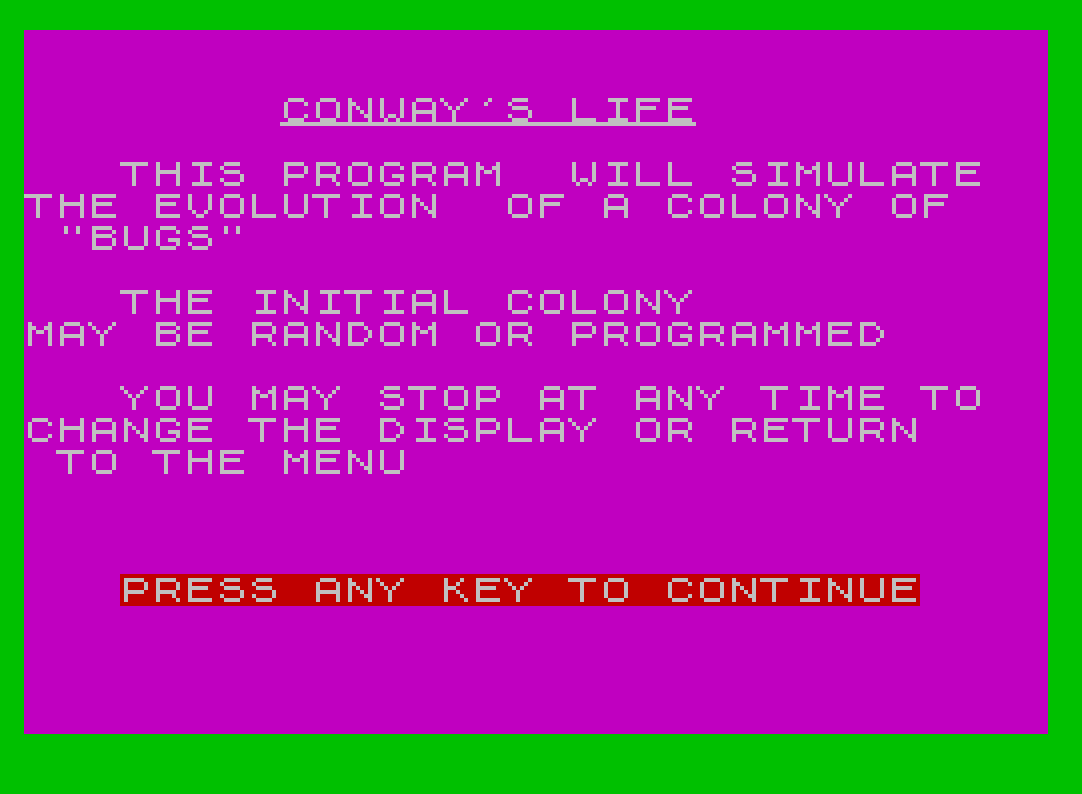
   10 PRINT AT 2,8;"CONWAY'S LIFE"
   20 PRINT OVER 1;AT 2,8;"_____________"
   30 PRINT AT 4,3;"THIS PROGRAM  WILL SIMULATE"';"THE EVOLUTION  OF A COLONY OF"';" ""BUGS"""
   40 PRINT AT 8,3;"THE INITIAL COLONY "'"MAY BE RANDOM OR PROGRAMMED"
   50 PRINT AT 11,3;"YOU MAY STOP AT ANY TIME TO"'"CHANGE THE DISPLAY OR RETURN"'" TO THE MENU"
   60 PRINT PAPER 2; INK 9;AT 17,3;"PRESS ANY KEY TO CONTINUE"
   70 IF INKEY$="" THEN GO TO 70
   80 BEEP .2,15: POKE 23659,2: CLS
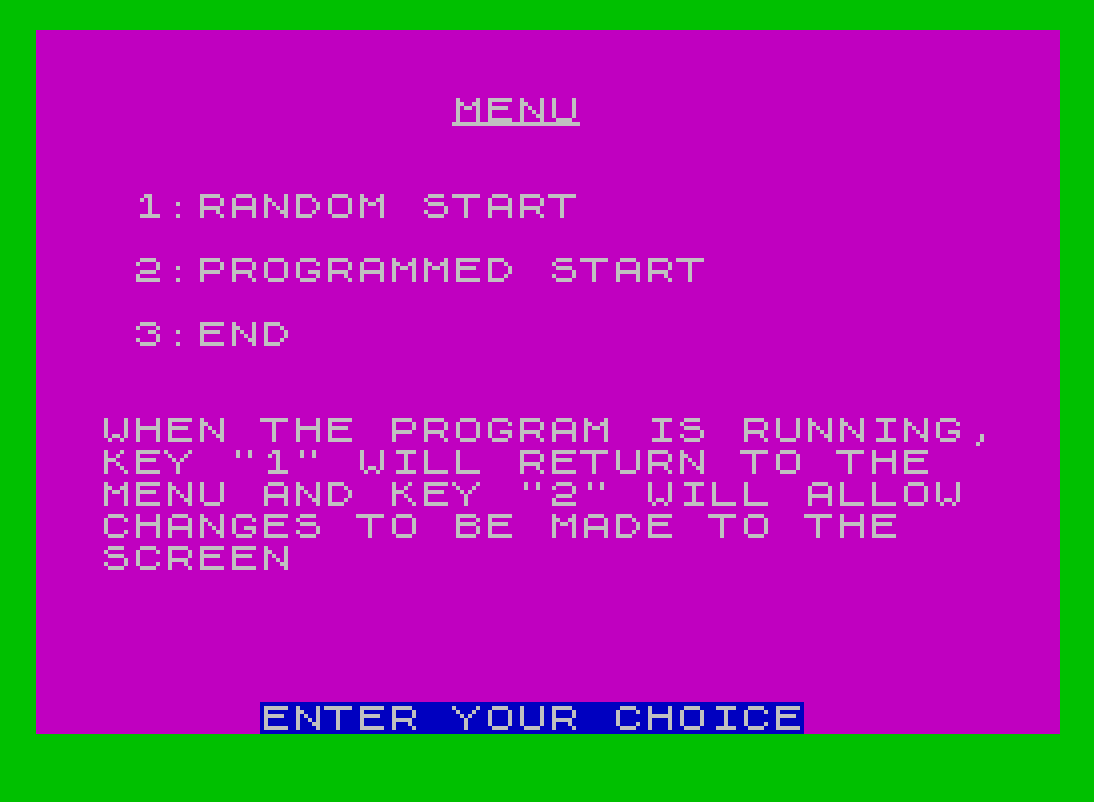
   90 PRINT AT 2,13;"MENU"
  100 PRINT OVER 1;AT 2,13;"____"
  110 PRINT AT 5,3;"1:RANDOM START"
  120 PRINT AT 7,3;"2:PROGRAMMED START"
  125 PRINT AT 9,3;"3:END"
  130 PRINT AT 12,2;"WHEN THE PROGRAM IS RUNNING,    KEY ""1"" WILL RETURN TO THE      MENU AND KEY ""2"" WILL ALLOW     CHANGES TO BE MADE TO THE       SCREEN"
  140 PRINT FLASH 1; INK 1; PAPER 9;AT 21,7;"ENTER YOUR CHOICE"
  150 LET a$=INKEY$
  160 IF CODE a$<49 OR CODE a$>51 THEN GO TO 150
  170 IF a$="1" THEN GO SUB 1000: GO SUB 1010: LET l=USR 30088
  180 IF a$="3" THEN GO TO 700
  190 LET l=USR 30351
  200 BEEP .2,15: LET c=16: LET r=11
  205 GO SUB 1000: POKE 23659,0: PRINT PAPER 4; INK 9;AT 22,0;"use cursors to move,3 to return,  4 to enter,9 to erase"
  210 DEF FN p()=22527+(32*r)+c
  220 LET p=FN p()
  230 LET z=PEEK p
  240 POKE p,18
  250 LET d=CODE INKEY$-48: IF d<1 OR d>9 THEN GO TO 250
  260 IF d=3 THEN GO TO 400
  270 IF d=4 THEN GO TO 500
  280 IF d=9 THEN GO TO 600
  285 POKE p,z
  286 BEEP .1,10
  290 LET c=c+(d=8)-(d=5): LET r=r+(d=6)-(d=7)
  310 IF c=33 THEN LET c=1
  311 IF c=0 THEN LET c=32
  312 IF r=22 THEN LET r=0
  313 IF r=-1 THEN LET r=21
  320 GO TO 220
  400 POKE 23659,2: POKE p,z
  405 GO SUB 1000: GO SUB 1010
  410 LET x=USR 30139
  500 LET z=48
  505 BEEP .2,20
  510 POKE p,170: GO TO 245
  600 LET z=54
  605 BEEP .2,0
  610 POKE p,170: GO TO 245
  700 POKE 23659,2: STOP
 1000 POKE 23684,128: POKE 23685,80: POKE 23686,33: POKE 23687,2: POKE 23659,0: RETURN
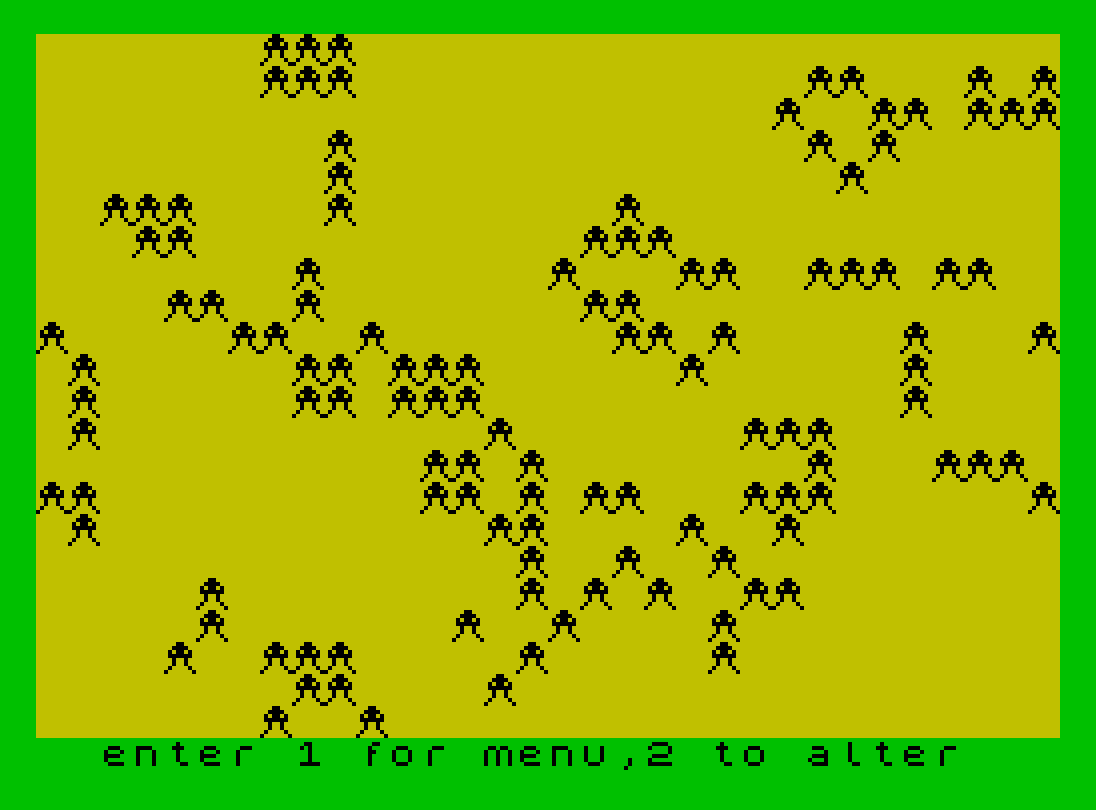
 1010 PRINT PAPER 4; INK 9;AT 22,0;"  enter 1 for menu,2 to alter                             "
 1020 RETURN
 9998 SAVE "Life" LINE 1: BEEP .4,15: SAVE "Life M/C"CODE 30000,410
 9999 VERIFY "Life": BEEP .4,15: VERIFY "Life M/C"CODE 30000,410: GO TO 1
Note: Type-in program listings on this website use ZMAKEBAS notation for graphics characters.