
This program implements a text-based slot machine game using block graphics characters to draw the reels. The player bets between $1 and $5 per spin, with winnings multiplied by a payout factor that depends on which symbols align. Two constants, E=2 and F=3, are used throughout as arithmetic building blocks to encode key values (e.g., E-E=0, F-E=1, E+F=5, D=20, D*D=400, D+D=40) rather than using those literals directly. The slot reel subroutine at line 400 picks a random value from 0–4, loops briefly (possibly for a spin animation delay), then prints a block-graphic character using CHR$(128+A*2). Payout logic awards a multiplier of 2 for a partial match involving symbol 3, 5 for three-of-a-kind with symbol 3, and 20 for any other three-of-a-kind.
Program Analysis
Program Structure
The program is organized into three logical sections:
- Initialization (lines 1–45): Sets up constants, displays title, randomizes, shows a lucky/unlucky message, and initializes the money variable.
- Main game loop (lines 50–320): Prompts for a bet, draws the slot machine frame, calls the reel subroutine three times, evaluates the result, and applies winnings.
- Reel subroutine (lines 400–440): Picks a random symbol, performs a short FOR loop (possibly for timing), and prints a block graphic character.
Constant Encoding with E and F
Rather than using numeric literals, the program defines E=2 and F=3 at lines 5–10 and then builds all needed values from arithmetic on these two constants. This is a well-known memory-saving idiom on Sinclair machines, where storing a small integer in a variable and reusing it can be more compact than repeating multi-digit numeric tokens.
| Expression | Value | Used for |
|---|---|---|
E-E | 0 | Zero / AT row 0 / loop start |
F-E | 1 | Minimum bet check, condition threshold |
E | 2 | Column offset, multiplier in CHR$ calculation |
F | 3 | Symbol number for special payout |
E+F | 5 | Maximum bet |
D | 20 | Line number target, maximum payout multiplier |
D*F | 60 | GOTO target for invalid bet (line 60 = INPUT) |
D*D | 400 | GOSUB target = reel subroutine |
D/E | 10 | TAB column for third reel |
D+D | 40 | GOTO target line 40 (start of next round) |
Slot Machine Frame
Lines 80–130 draw a simple three-reel frame using block graphic characters. Line 80 uses \''\''\'' sequences (▀ top-half block) for the top border of each reel, and line 100 uses \..\..\..) sequences (▄ bottom-half block) for the bottom border. The middle row (line 90) is blank spaces padded with % column separators, leaving room for the reel symbols to be printed by the subroutine calls.
Reel Subroutine (Lines 400–440)
The subroutine at line 400 generates a random integer A in the range 0–4 via INT(RND*(E*F)) — i.e., INT(RND*6), giving values 0–5, though only 0–4 are meaningful given the five block graphic characters starting at CHR$(128). The FOR Z=0 TO 15 loop at lines 410–420 introduces a brief delay to simulate spinning. Line 430 prints CHR$(128+A*2), selecting every other block graphic from the set at character codes 128, 130, 132, 134, 136.
Payout Logic
Lines 250–310 handle the win condition and payout multiplier:
- If
X(first reel) is not symbol 3 (F), AND not all three reels match, the game jumps to line 20 (next round, no win). - Default multiplier
C=2(line 270) — a partial win whenX=3. - If the second reel
Y=3, multiplier becomesC=5(line 280). - If all three reels match (
X=Y=Z), multiplier becomesC=20(line 290). - Winnings paid =
C*Badded to running totalM.
Notable Bugs and Anomalies
- Win condition logic (line 250): The condition
IF X<>F THEN IF X<>Y OR X<>Z THEN GOTO Dis ambiguous. It skips the win if X is not 3 AND (X≠Y or X≠Z), meaning a non-symbol-3 three-of-a-kind can still reach the win block only if X=Y=Z, but the inner OR makes it hard to win with other symbols. In practice, any non-3 three-of-a-kind slips through because both conditions are false when X=Y=Z. - RND range (line 400):
INT(RND*(E*F))=INT(RND*6)can produce 0–5, giving six possible values, but the payout code only specially handles symbolF=3. Symbol 5 would displayCHR$(138)and could still match for the generic three-of-a-kind payout. - TAB column line 170:
PRINT TAB E*F;=TAB 6for the second reel position. Combined with the AT on line 140 (AT F-E,E= AT 1,2), this sequences the three reel outputs horizontally across row 1. - Line 460
RUN: After SAVE, a bareRUNrestarts the program, which is normal for a SAVE/autostart pattern.
Image Gallery
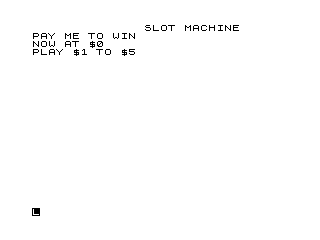
Source Code
   1 PRINT AT 0,14;"SLOT MACHINE"
   5 LET E=2
  10 LET F=3
  15 LET M=E-E
  20 RAND
  25 LET D=RND*E
  30 IF D>=F-E THEN PRINT "TRY YOUR LUCK"
  35 IF D<F-E THEN PRINT "PAY ME TO WIN"
  40 LET D=20
  45 PRINT "NOW AT $";M
  50 PRINT "PLAY $1 TO $5"
  60 INPUT B
  70 IF B<F-E OR B>E+F THEN GOTO D*F
  80 PRINT AT E-E,E-E;"% \''\''\''% \''\''\''% \''\''\''% "
  90 PRINT "%    %    %    % "
 100 PRINT "% \..\..\..% \..\..\..% \..\..\..% "
 110 PRINT "             "
 120 PRINT "             "
 130 PRINT "             "
 140 PRINT AT F-E,E;
 150 GOSUB D*D
 160 LET X=A
 170 PRINT TAB E*F;
 180 GOSUB D*D
 190 LET Y=A
 200 PRINT TAB D/E;
 210 GOSUB D*D
 220 LET Z=A
 230 PRINT AT F,E-E;
 240 LET M=M-B
 250 IF X<>F THEN IF X<>Y OR X<>Z THEN GOTO D
 260 PRINT "YOU WIN $";
 270 LET C=E
 280 IF Y=F THEN LET C=E+F
 290 IF X=Y AND X=Z THEN LET C=D
 300 LET M=M+C*B
 310 PRINT C*B
 320 GOTO D+D
 400 LET A=INT (RND*(E*F))
 410 FOR Z=E-E TO 15
 420 NEXT Z
 430 PRINT CHR$ (128+A*E);
 440 RETURN
 450 SAVE "1015%2"
 460 RUN
Note: Type-in program listings on this website use ZMAKEBAS notation for graphics characters.