
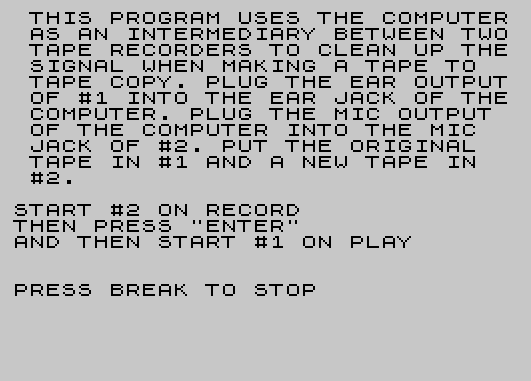
Tape2Tape uses a short machine code routine to relay a tape signal through the computer, acting as an intermediary between two cassette recorders to produce a cleaner copy. The BASIC loader POKEs 26 bytes of Z80 machine code into memory starting at address 23296, then prompts the user to connect the EAR output of the source deck to the computer’s EAR jack and the computer’s MIC output to the destination deck’s MIC jack. The machine code reads the EAR port and writes the conditioned signal back out through the MIC port in a tight loop, with the Z80’s interrupt flag manipulated (DI/EI via bytes 243 and 251) to prevent interference during the relay. Execution begins via RANDOMIZE USR after the user presses ENTER, and BREAK is used to halt the process.
Program Structure
The program is compact at just five active lines plus a SAVE statement:
10— REM header (title and authorship)20— Sets base addressA=23296for the machine code block30— POKEs 26 bytes of Z80 machine code and contains theDATAstatement inline40–50— User instructions printed to screen60— Waits for ENTER (PAUSE 0) then launches the routine withRANDOMIZE USR A70— Saves the program withLINE 1auto-run
Machine Code Routine
The 26 bytes POKEd starting at address 23296 disassemble as a tight Z80 loop. The DATA values are:
243,1,254,127,17,2,14,237,120,31,48,12,230,32,40,4,237,81,24,243,237,89,24,239,251,201
| Bytes (hex) | Mnemonic | Notes |
|---|---|---|
| F3 | DI | Disable interrupts for clean timing |
| 01 FE 7F | LD BC, 7FFEh | Load EAR port address into BC |
| 11 02 0E | LD DE, 0E02h | MIC bit pattern preloaded into DE |
| ED 78 | IN A, (C) | Read EAR port (port 0x7FFE) |
| 1F | RRA | Rotate right — moves EAR bit into carry |
| 30 0C | JR NC, +12 | Branch if EAR bit was 0 |
| E6 20 | AND 20h | Isolate MIC bit |
| 28 04 | JR Z, +4 | Conditional branch on MIC state |
| ED 51 | OUT (C), D | Output MIC high via D register |
| 18 F3 | JR -13 | Loop back |
| ED 59 | OUT (C), E | Output MIC low via E register |
| 18 EF | JR -17 | Loop back |
| FB | EI | Re-enable interrupts (only on clean exit) |
| C9 | RET | Return to BASIC |
The routine reads the EAR input bit continuously, conditions it, and drives the MIC output bit accordingly. Because it runs in a tight loop with interrupts disabled (DI at entry), there is no interrupt-induced jitter to corrupt the relay timing. The EI/RET tail is effectively unreachable in normal operation — the loop is exited only by pressing BREAK, which causes an NMI or maskable interrupt depending on hardware, returning control to BASIC.
Address Choice
Address 23296 (0x5B00) is noted in the REM comment as arbitrary. This region falls in the ZX81/TS1000 system RAM area above the display file but below typical BASIC program space, making it a reasonable scratchpad for short machine code. The comment explicitly acknowledges the address can be relocated, which is good practice since the routine contains no absolute addresses — all branches are relative (JR).
Notable BASIC Techniques
DATAis placed on the same line as theFOR/READ/POKEloop (30), minimizing line overhead and keeping the loader self-contained.PAUSE 0followed byRANDOMIZE USR Aon line60is the standard idiom for waiting for ENTER before launching machine code.- The
SAVE "tape2tape" LINE 1on line70saves the program so that it auto-runs from line 1 on next load, though line 1 is aREM— effective auto-run will fall through to line 20.
Potential Anomalies
- The
EIandRETbytes at the end of the machine code are only reached if the loop exits cleanly, which it does not under normal BREAK conditions. They are harmless but essentially dead code in practice. - The machine code loop does not implement any hysteresis or debounce beyond the single-bit EAR read, so the quality improvement over a direct cable connection depends on the digital thresholding inherent in the EAR input circuitry rather than any additional filtering in the routine itself.
Image Gallery
Source Code
 10 REM            TAPE2TAPE   © 1985  Cameron Hayne
 20 LET A=23296:REM  this address can be anything
 30 FOR I=A TO A+25:READ B:POKE I,B:NEXT I:DATA 243,1,254,127,17,2,14,237,120,31,48,12,230,32,40,4,237,81,24,243,237,89,24,239,251,201
 40 CLS :PRINT " THIS PROGRAM USES THE COMPUTER  AS AN INTERMEDIARY BETWEEN TWO  TAPE RECORDERS TO CLEAN UP THE  SIGNAL WHEN MAKING A TAPE TO    TAPE COPY. PLUG THE EAR OUTPUT  OF #1 INTO THE EAR JACK OF THE  COMPUTER. PLUG THE MIC OUTPUT   OF THE COMPUTER INTO THE MIC    JACK OF #2. PUT THE ORIGINAL    TAPE IN #1 AND A NEW TAPE IN    #2."''
 50 PRINT "START #2 ON RECORD"'"THEN PRESS ""ENTER"""'"AND THEN START #1 ON PLAY"'''"PRESS BREAK TO STOP "
 60 PAUSE 0:RANDOMIZE USR A
 70 SAVE "tape2tape" LINE 1
Note: Type-in program listings on this website use ZMAKEBAS notation for graphics characters.