
ZTalker 1.2 is a phoneme-based text-to-speech editor designed to drive the Zebra-Talker 2068 speech synthesizer hardware via I/O port 191.
The program maintains a buffer of up to 100 phoneme codes starting at memory address 60016, storing each as a single byte index into a 68-entry phoneme table encoded in the string P$, where each entry occupies exactly three characters (e.g., “EH3”, “AH2”, “SH “, “NG “).
An operator navigates the phoneme sequence using a cursor-based interface controlled by single-key commands (5/6/7/8 for directional movement, A/D/I/K/R/X for edit operations), with the display arranged in rows of eight phonemes each.
The SPEAK routine at line 3400 sends phonemes to the hardware using OUT 191 combined with an INF (inflection) value derived from phonemes with codes above 63, followed by a terminating OUT 191,3. The program supports printing the phoneme list to both screen (LIST) and printer (LPRINT/COPY), and can save itself to tape with auto-run via SAVE “ZPE” LINE 0.
Program Analysis
Program Structure
The program is organized into clearly delineated subroutines and named sections, entered from a main loop at line 2000. Execution flows as follows:
- Lines 10–50: REM headers, uppercase lock (
POKE 23658,8), display setup, andCLEAR 59999to protect the phoneme buffer above that address. - Line 110:
GO TO 2000— skips all subroutines to reach the main routine. - Lines 1230–1255: Display buffer contents on screen.
- Lines 1400–1460: Cursor erase and redraw logic.
- Lines 1500–1530: Key dispatch table (single-letter commands).
- Lines 1550–1720: Cursor movement handlers (up/down/left/right, beginning/end).
- Lines 1800–1830: On-screen help/legend display.
- Lines 2000–2060: Main initialization and event loop.
- Lines 2110–2200: Append (ADD) phoneme operation.
- Lines 2300–2325: Single-cell display update subroutine.
- Lines 2500–2540: Delete last phoneme.
- Lines 2600–2670: Kill (clear all phonemes).
- Lines 2700–2760: Replace phoneme at cursor.
- Lines 2800–2865: Excise (delete at cursor, shift remaining left).
- Lines 2900–2998: Insert phoneme at cursor (shift right).
- Lines 3005–3025, 3050–3060: Phoneme lookup and invalid-input handler.
- Lines 3100–3110: Print (screen copy via
COPY). - Lines 3200–3265: LIST — paginated on-screen phoneme listing.
- Lines 3300–3325: LLIST — printer output of phoneme listing.
- Lines 3400–3440: SPEAK — send phonemes to hardware via
OUT 191. - Lines 9900–9920: Tape SAVE with
LINE 0.
Phoneme Table Encoding
The entire phoneme dictionary is packed into a single string P$ at line 2008, initialized to a 204-character literal (68 phonemes × 3 characters each). Examples of entries include EH3, PA0, DT , AH2, NG , OO1, TH , VTH, ER , PA1, ST , PIN, IN0–IN3. Lookup is performed by iterating I from 0 to 67 and comparing T$ to P$((I*3)+1 TO (I*3)+3) (lines 3005–3025). Display uses the same arithmetic: P$(W*3-2 TO W*3), where W is 1-based. Note that there is a minor index inconsistency between the lookup (1-based slice starting at I*3+1) and the display (slice W*3-2 where W=I+1); both are equivalent and correct.
Phoneme Buffer and Memory Layout
The phoneme buffer begins at address BUF = 60016 (set at line 2003), safely above the CLEAR 59999 boundary. Each phoneme is stored as a single byte: its 0-based index into P$. Up to MAXL = 100 phonemes can be held. The buffer is accessed directly with PEEK and POKE throughout.
Cursor and Display Model
The display arranges phonemes in rows of 8, with each cell occupying 4 character columns. Screen position is computed as AT INT(I/8)+1, 4*(I - 8*INT(I/8)). The cursor is represented by a ">" character printed in the cell to the left of the phoneme (the cell column is offset by one space before the 3-character phoneme code). The cursor is 1-based and initialized to -8 before the first render, which combined with NCURSOR=CURSOR at line 2015 means the initial cursor draw call at 2021 references position -8 — a potential off-screen print, though it is harmless in practice since the AT calculation produces a large negative column that wraps or is ignored.
Hardware Speech Output
The SPEAK routine (lines 3400–3440) iterates over the buffer and sends bytes to the Zebra-Talker 2068 via OUT 191, value. Bytes with value ≥ 64 are treated as inflection prefix codes: INF = (X-64)*64. Bytes below 64 are phoneme codes, sent as OUT 191, INF+X, followed immediately by IN 191 to handshake with the hardware. The sequence is terminated by OUT 191, 3 plus a final IN 191. The variable p (lowercase) holds the IN result and is otherwise unused — it serves purely as a hardware synchronization read.
Edit Operations
| Key | Operation | Entry Point |
|---|---|---|
| A | Add (append) phoneme | 2100 |
| D | Delete last phoneme | 2500 |
| I | Insert at cursor (shift right) | 2900 |
| K | Kill all phonemes | 2600 |
| R | Replace phoneme at cursor | 2700 |
| X | Excise phoneme at cursor (shift left) | 2800 |
| 5/6/7/8 | Move cursor left/down/up/right | 1610/1570/1550/1590 |
| B | Move to beginning | 1630 |
| E | Move to end | 1645 |
| L | List phonemes (screen, paginated) | 3200 |
| P | Print (COPY to printer) | 3100 |
| S | Speak via hardware | 3400 |
| W | Save to tape | 9900 |
| Q | Quit (STOP) | — |
Key BASIC Idioms
- The main event loop (lines 2030–2060) polls
INKEY$in a tight loop, jumping back if the result is empty — a standard keypress-wait pattern. - The key dispatch at lines 1505–1521 is a chain of
IF D$="x" THEN GO TOstatements rather than a computed jump, which is typical for Sinclair BASIC where noON ... GO TOwith string keys is available. DIM P$(68*3)at line 2007 pre-allocates the phoneme table with a computed size, keeping the code self-documenting.- The LIST routine uses a line counter
Jto pause every 18 lines, a standard pagination technique.
Bugs and Anomalies
- Line 2300–2325 subroutine structure: Lines 2300–2325 contain both a
FORloop and aRETURNstatement. TheRETURNat line 2325 is inside theFORloop body; it exits the subroutine on the first iteration. The loop itself is never completed as a loop — this is effectively dead code for iterations beyond 1. The actual single-cell update use (from line 2195 viaGO SUB 2315) jumps directly into line 2315, bypassing theFORat 2300, so that path works correctly. However, line 2310 references an undefined variableE, meaning any call that enters at line 2300 would error. - Initial cursor value of -8:
CURSORis set to-8at line 2001, and the cursor draw at line 2021 uses this value, producingAT INT(-8/8)+1 = AT 0,...which prints in row 0 — likely harmless but unintentional. - Append loop re-entry: The ADD routine (line 2110) uses
GO TO 2120at line 2200 to loop for additional phonemes, but the entry point from the key dispatch isGO TO 2100(line 1512), which falls through to line 2115 — these are consistent. - Line 3265 GO TO 2990: After the LIST routine finishes, it jumps to line 2990 (
CLS/ redraw), effectively re-entering the tail of the INSERT routine’s cleanup. This is a deliberate reuse of the redraw sequence rather than a bug.
Image Gallery
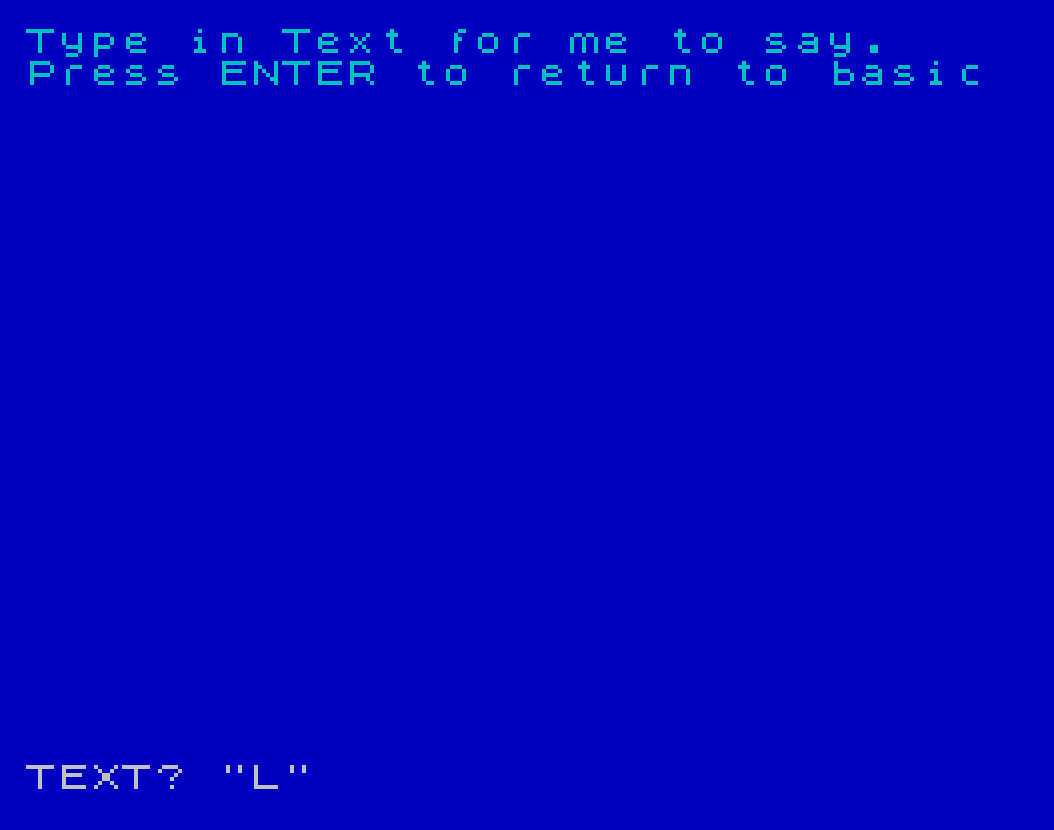
Source Code
   10 REM \:: COPYRIGHT (C) 1984 \::
   20 REM \:: ZEBRA SYSTEMS, INC.\::
   30 REM \:: ALL RIGHTS RESERVED\::
   40 REM \:: ZPE VER. 1.2 FEB.84\::
   45 POKE 23658,8: REM UPPERCASE
   47 INK 7: PAPER 1: BORDER 1: CLS
   50 CLEAR 59999
  110 GO TO 2000
 1230 IF LENGTH=0 THEN RETURN
 1231 FOR I=1 TO LENGTH
 1234 LET W=1+(PEEK (I+BUF-1))
 1235 IF W<0 THEN RETURN
 1236 LET D$=P$(W*3-2 TO W*3)
 1240 PRINT AT INT (I/8)+1,4*(I-8*INT (I/8));" ";D$;
 1250 NEXT I
 1255 RETURN
 1400 REM ERASE OLD CURSOR
 1405 LET D$=" "
 1410 LET C=CURSOR
 1415 GO SUB 1450
 1430 REM SHOW NEW CURSOR
 1435 LET D$=">"
 1440 LET C=NCURSOR
 1445 GO SUB 1450
 1447 RETURN
 1450 REM CURSOR
 1455 PRINT AT INT (C/8)+1,4*(C-8*INT (C/8));D$;
 1460 RETURN
 1500 REM KEY SCAN
 1505 IF D$="5" THEN GO TO 1610
 1506 IF D$="6" THEN GO TO 1570
 1507 IF D$="7" THEN GO TO 1550
 1508 IF D$="8" THEN GO TO 1590
 1509 IF D$="B" THEN GO TO 1630
 1510 IF D$="E" THEN GO TO 1645
 1511 IF D$="Q" THEN STOP
 1512 IF D$="A" THEN GO TO 2100
 1513 IF D$="D" THEN GO TO 2500
 1514 IF D$="K" THEN GO TO 2600
 1515 IF D$="R" THEN GO TO 2700
 1516 IF D$="X" THEN GO TO 2800
 1517 IF D$="I" THEN GO TO 2900
 1518 IF D$="P" THEN GO TO 3100
 1519 IF D$="S" THEN GO TO 3400
 1520 IF D$="L" THEN GO TO 3200
 1521 IF D$="W" THEN GO TO 9900
 1530 RETURN
 1550 REM UP
 1555 IF CURSOR<9 THEN GO TO 1700
 1560 LET NCURSOR=CURSOR-8
 1565 GO TO 1720
 1570 REM DOWN
 1575 IF CURSOR>=LENGTH-8 THEN GO TO 1700
 1580 LET NCURSOR=CURSOR+8
 1585 GO TO 1720
 1590 REM RIGHT
 1595 IF CURSOR=LENGTH THEN GO TO 1700
 1600 LET NCURSOR=CURSOR+1
 1605 GO TO 1720
 1610 REM LEFT
 1615 IF CURSOR=1 THEN GO TO 1720
 1620 LET NCURSOR=CURSOR-1
 1625 GO TO 1720
 1630 REM BEGINNING
 1635 LET NCURSOR=1
 1640 GO TO 1720
 1645 REM END
 1650 LET NCURSOR=LENGTH
 1655 GO TO 1720
 1700 REM INVALID REQUEST
 1710 LET NCURSOR=CURSOR
 1720 RETURN
 1800 REM SCREEN HELP
 1810 PRINT AT 15,0;"(5)LEFT (6)DOWN (7)UP (8)RIGHT"
 1815 PRINT AT 16,0;"(B)EGINNING (E)ND (P)RINT";
 1816 PRINT AT 17,0;"(A)DD (D)ELETE (I)NSERT (K)ILL";
 1817 PRINT AT 18,0;"(R)EPLACE E(X)CISE (Q)UIT";
 1818 PRINT AT 19,0;"(L)IST (S)PEAK ";
 1830 RETURN
 1900 STOP
 2000 REM MAIN
 2001 LET CURSOR=-8
 2002 LET LENGTH=0
 2003 LET BUF=60016
 2005 DIM T$(3)
 2007 DIM P$(68*3)
 2008 LET P$="EH3EH2EH1PA0DT A2 A1 ZH AH2I3 I2 I1 M  N  B  V  CH SH Z  AW1NG AH1OO1OO L  K  J  H  G  F  D  S  A  AY Y1 UH3AH P  O  I  U  Y  T  R  E  W  AE AE1AW2UH2UH1UH O2 O1 IU U1 THVTH ER EH E1 AW PA1STPIN0IN1IN2IN3"
 2010 REM SOFTSTART
 2011 LET MAXL=100
 2012 GO SUB 1230
 2014 GO SUB 1800
 2015 LET NCURSOR=CURSOR
 2021 GO SUB 1430
 2030 LET D$=INKEY$
 2035 IF D$="" THEN GO TO 2030
 2040 GO SUB 1500
 2043 GO SUB 1400
 2050 LET CURSOR=NCURSOR
 2060 GO TO 2030
 2110 REM APPEND
 2115 IF LENGTH=MAXL THEN GO TO 2180
 2120 PRINT AT 20,0;"ENTER PHONEME CODE       "
 2125 INPUT T$
 2126 IF T$="   " THEN GO TO 2185
 2130 GO SUB 3000
 2150 IF I<68 THEN GO TO 2190
 2155 GO SUB 3050
 2160 GO TO 2120
 2180 PRINT AT 20,0;"BUFFER FULL. HIT ENTER     ";
 2182 INPUT T$
 2183 RETURN
 2185 PRINT AT 20,0;"                              ";
 2186 RETURN
 2190 POKE BUF+CURSOR,I
 2191 LET LENGTH=LENGTH+1
 2192 LET NCURSOR=LENGTH
 2193 LET W=I+1
 2194 LET I=NCURSOR
 2195 GO SUB 2315
 2196 GO SUB 1400
 2197 LET CURSOR=NCURSOR
 2200 GO TO 2120
 2300 FOR I=1 TO LENGTH
 2310 LET W=PEEK (E+I)
 2315 LET D$=P$(W*3-2 TO W*3)
 2320 PRINT AT INT (I/8)+1,4*(I-8*INT (I/8));" ";D$;
 2325 RETURN
 2500 REM DELETE
 2505 IF LENGTH=0 THEN RETURN
 2510 LET D$="   "
 2515 LET I=LENGTH
 2520 GO SUB 2320
 2525 LET LENGTH=LENGTH-1
 2530 LET NCURSOR=LENGTH
 2535 GO SUB 1400
 2540 RETURN
 2600 REM KILL
 2605 PRINT AT 20,0;"DELETE ALL PHONEMES (Y/N)"
 2610 INPUT D$
 2615 IF D$="Y" THEN GO TO 2650
 2620 GO SUB 2185
 2625 RETURN
 2650 LET LENGTH=0
 2655 LET NCURSOR=LENGTH
 2660 CLS
 2665 GO SUB 1800
 2670 RETURN
 2700 REM REPLACE
 2705 IF LENGTH=0 THEN RETURN
 2710 LET W=1+PEEK (BUF-1+CURSOR)
 2712 LET D$=P$(W*3-2 TO W*3)
 2715 PRINT AT 20,0;"REPLACE > ";D$;" < WITH? ";
 2720 INPUT T$
 2722 GO SUB 3000
 2735 IF I=68 THEN GO TO 2715
 2737 POKE BUF+CURSOR-1,I
 2740 LET D$=T$
 2745 GO SUB 2185
 2747 LET I=CURSOR
 2750 GO SUB 2320
 2755 GO SUB 1400
 2760 RETURN
 2800 REM EXCISE
 2805 IF LENGTH=0 THEN RETURN
 2810 LET BUF=60016
 2815 FOR I=BUF+CURSOR-1 TO BUF+LENGTH-1
 2820 POKE I,PEEK (I+1)
 2825 NEXT I
 2830 LET LENGTH=LENGTH-1
 2835 CLS
 2840 GO SUB 1800
 2845 GO SUB 1230
 2850 IF CURSOR>LENGTH THEN LET CURSOR=LENGTH
 2855 LET NCURSOR=CURSOR
 2860 GO SUB 1400
 2865 RETURN
 2900 REM INSERT
 2910 IF LENGTH<MAXL THEN GO TO 2930
 2915 PRINT AT 20,0;"BUFFER FULL. HIT ENTER";
 2920 INPUT T$
 2925 RETURN
 2930 PRINT AT 20,0;"ENTER 3 LETTER CODE";
 2932 INPUT T$
 2935 IF T$="" THEN GO TO 2185
 2940 GO SUB 3000
 2945 IF I<68 THEN GO TO 2960
 2950 GO SUB 3050
 2952 GO SUB 2185
 2955 GO TO 2930
 2960 LET PHONEME=I
 2965 FOR I=BUF+LENGTH-1 TO BUF+CURSOR-1 STEP -1
 2970 POKE I+1,PEEK I
 2975 NEXT I
 2980 POKE I+1,PHONEME
 2985 LET LENGTH=LENGTH+1
 2990 CLS
 2992 GO SUB 1800
 2994 GO SUB 1230
 2996 GO SUB 1400
 2998 RETURN
 3005 FOR I=0 TO 67
 3010 IF T$=P$((I*3)+1 TO (I*3)+3) THEN GO TO 3020
 3015 NEXT I
 3025 RETURN
 3050 PRINT AT 20,0;"INVALID PHONEME. HIT ENTER.";
 3055 INPUT T$
 3060 RETURN
 3100 REM PRINT
 3105 COPY
 3110 GO TO 3300
 3200 REM LIST
 3205 LET INF=0
 3210 CLS
 3211 PRINT "REF-SYM-CHR-DEC-+INF"
 3212 LET J=0
 3215 FOR I=1 TO LENGTH
 3220 LET W=PEEK (BUF+I-1)
 3222 IF W>63 THEN LET INF=(W-65)*64
 3225 LET D$=P$(W*3+1 TO W*3+3)
 3227 LET W1=W: IF W<32 THEN LET W1=63
 3230 PRINT I;"  ";D$;"   ";CHR$ W1;"   ";W;"   ";W+INF
 3235 LET J=J+1
 3240 IF J<>18 THEN GO TO 3260
 3243 LET J=0
 3245 PRINT "HIT ENTER TO CONTINUE.";
 3250 INPUT T$
 3255 CLS
 3260 NEXT I
 3262 PRINT "HIT ENTER TO CONTINUE.";
 3263 INPUT T$
 3265 GO TO 2990
 3300 REM LLIST
 3302 LPRINT "REF-SYM-CHR-DEC-+INF"
 3303 LET INF=0
 3305 FOR I=1 TO LENGTH
 3310 LET W=PEEK (BUF+I-1)
 3311 IF W>63 THEN LET INF=(W-65)*64
 3312 LET D$=P$(W*3+1 TO W*3+3)
 3313 LET W1=W: IF W<32 THEN LET W1=63
 3315 LPRINT I;"  ";D$;"   ";CHR$ W1;"   ";W;"   ";W+INF
 3320 NEXT I
 3325 RETURN
 3400 REM SPEAK
 3402 LET INF=0
 3405 FOR I=(BUF) TO (BUF+LENGTH)
 3410 LET X=PEEK (I)
 3415 IF X<64 THEN GO TO 3425
 3420 LET INF=(X-64)*64
 3422 GO TO 3430
 3425 OUT 191,INF+X
 3426 LET p=IN 191
 3430 NEXT I
 3433 OUT 191,3
 3434 LET p=IN 191
 3440 RETURN
 9900 REM TAPE SAVE
 9910 SAVE "ZPE" LINE 0
 9920 RETURN
Note: Type-in program listings on this website use ZMAKEBAS notation for graphics characters.