
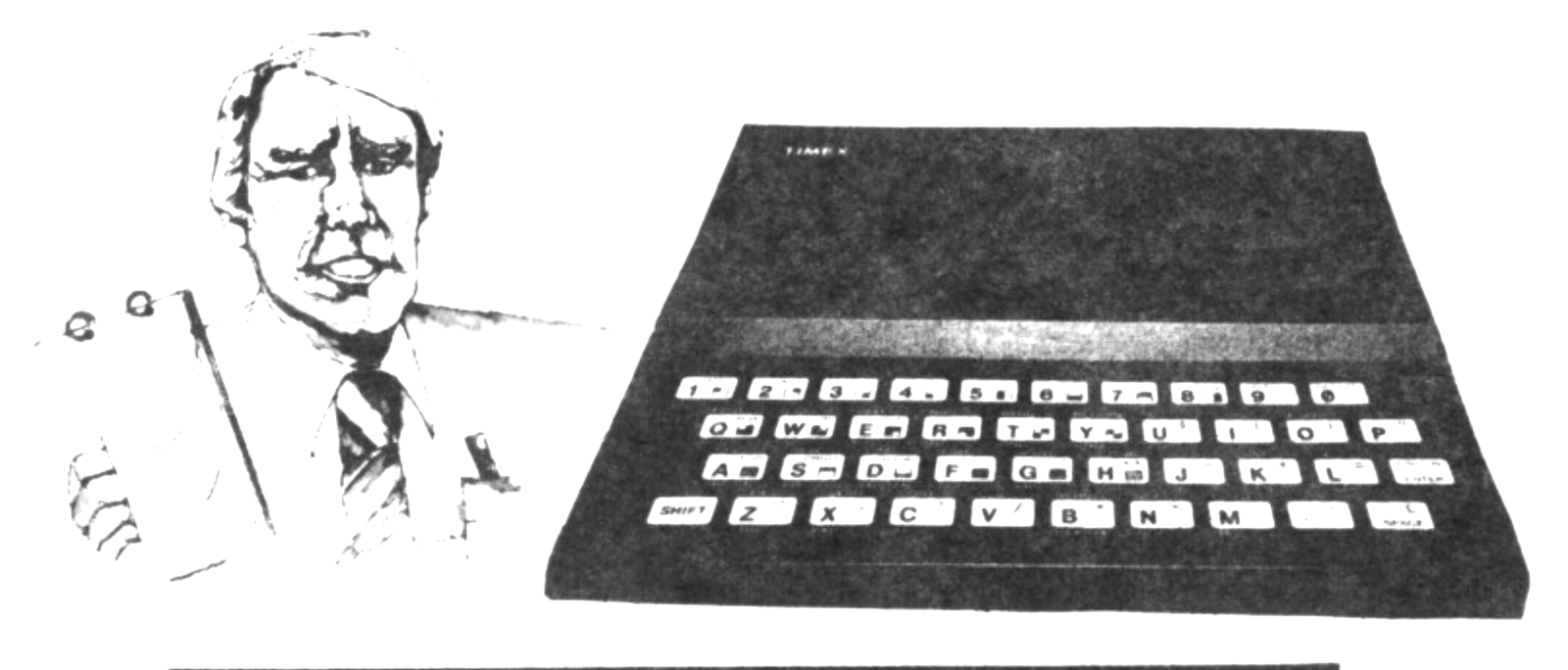
GROWTH OF SYNCHRO-SETTE
We, like many supporting companies for the Sinclair computers, are suffering from growing pains. We have increased our staff and still are having problems meeting deadlines. The most obvious result of this is how late our issues keep coming out. Our goal is to have all of our customers receive their current issues by the first week of the month. The old adage, THE HURRIEDER I GO, THE BEHINDER I GET has never been more applicable. I used to think that it wasn’t much more work to prepare a magazine for 1000 subscribers than it was for 100. Boy was I wrong. The phones ring constantly and most calls are long distance. People are asking us for information in every possible area besides our own products. The most common inquiry regards printers.
We feel since these people are investing in a long distance call, we should try to give them as much information as possible. We also receive many inquiries by mail, currently over 4000 per month and growing all the time. This means that the staff and myself cannot dedicate the time each day that is necessary to meet our deadlines and commitments. I, myself am spending on the average between 12 to 14 hours per day, six days a week trying to keep pace. We are trying desperately to get the next issue out so that you will receive the magazine and cassette before the holidays. Please bear with us for the late issues because we feel that we are finding ways and means to improve this situation.
AMATEUR RADIO AND THE SINCLAIR COMPUTER
QZX is a journal covering amateur radio and the Sinclair family of computers, e.g. ZX-80, Micro-Ace, ZX-81 and the T/S-1000 and is designed for owners of these computers who are licensed radio amateurs.
The subscribers to this publication talk to the entire world using their computers to perform some facet of the communication.
The newsletter is a continuation of the one that was started by Marty Irons, was published 4 times a year and was sent to about 250 subscribers. The new management estimates present membership at over 300.
To find out more information about this exciting new field of communications, contact:
QXZ
2025 O’Donnell Drive
Las Cruces, N. Mexico, 88001
Ambrose ‘Bo’ Barry, W4GHV/5
Editor
Alex F. Burr, K5xy
Publisher
COMPUTERS IN SCHOOLS
Many schools are wondering what computers are the best for teaching first timers. The T/S-1000 and ZX-81 is usually at the top of the list because of price. The drawbacks, however, fall mainly into two catagories:
A – The Sinclair machines are not taken seriously because of their size and the membrane keyboard. The competition has propagated the myth that they are just toys and the users will soon outgrow their capabilities.
B – They do not have many of the frills their more expensive counterparts have, such as color, high resolution graphics and sound, all of which are important to the development of user’s computer literacy.
Bunk – nothing could be further from the truth! The size and membrane keyboard is actually an advantage in that the computer is less susceptible to damage from key contacts being exposed to the atomosphere, dirt and spillage such as in the non-membrane competitors. If damage does occur, the repair or replacement bill will be much smaller than for the competitor’s models.
The frills such as sound, color and high-resolution graphics have little place in the real world, except in arcade games and maybe fancy business graphs.
This little computer is actually a very powerful and dynamite little machine.
But putting all that aside, one area that has been almost completely overlooked is the teaching of computer science to that age group that should be the youngest to be exposed to it, mainly the 5th thru 8th grades of grammer school.
This group has been demonstrated to have problems with certain motor responses, that is, hand to eye co-ordination using a typewriter keyboard more so than their older peers. It has been shown that when groups of the same age level were given the use of Sinclair computers versus other more expensive and elaborate computers with all the bells and whistles, the Sinclair group of users learned faster and retained more EVEN IF THEY HAD TAKEN A PREVIOUS CLASS WITH THE OTHER COMPUTERS.
Why? What was this magic that Uncle Clive was able to weave?
Think of it logically. What is the one thing that the T/S-1000 and the ZX-81 have, that the competition doesn’t?
Single key-stroke command input! That’s right. Put yourself in the place of a 10 or 11 year old. You probably never touched a typewriter before for any serious reason and now you are placed in front of a computer and expected to type in programs. You are constantly reading a list of program lines, hunting for the proper keys to press and then checking the screen to see if the input was correct. Heaven help you if it didn’t. You would have to backspace, again the eyes constantly flitting between the screen and the keyboard while the fingers are trying to do the right thing.
To put in a command such as PRINT requires 5 keystrokes. The same with the command INPUT. On the Sinclair machines it only requires 1 keystroke, not just for these commands but all commands, functions and logical operators. The end result is that the youngster has less to do and is rewarded sooner for his or her efforts. This means that impressions are made in the child’s mind within a shorter time from the initiation of the effort to the keyboard and the attention span time required is shorter.
The child retains more of what’s happening.
Isn’t this our goal, whether we be a responsible parent or teacher? Would not the same principles apply to the teaching of adults?
When Radio Shack first introduced the TRS-80, it had a short-hand BASIC language that abbreviated almost all of the commands. It was a simple language to understand and could accomplish many things.
They later introduced their Level II BASIC conversion kit, which promised to turn that computer into a very powerful machine – which it did. This language even today in my opinion is still the most powerful BASIC language there is.
The only problem was that the difference between the two languages was like night and day. It was like graduating from grammer school and going directly into a university.
The manual that came with the kit wasn’t much help to the uninitiated, either. There was no index. Some people even made money simply by writing an index for the manual and selling it through classified ads.
The manual was termed a User’s Manual. This meant that users were expected to read it cover to cover and correlate the information to previously learned languages from other computers.
The buying public that converted their machines was for the most part unaware of what they were in store for. Many of them wanted the old ROMs put back in the computers or simply sold them.
Many, though, were irreversibly bitten by the computer bug and trudged on, forcing themselves to learn the new language through trial and error, not to mention excessive phone calls to the more learned and/or purchase of anything they could get their hands on that would help their cause.
In those days there was very little help. Thank God those days are behind us now. Books, publications, places to call, etc. all exist now, at least more so than they did then, and we’re only talking 6 years ago. The Sinclair computer’s BASIC language is very similiar to the TRS-80’s.
I have used and taught programming classes on almost all the popular computers until 1981 and I firmly believe the quickest way to achieve computer literacy is on a machine that has single keystroke entry of all the multi-character commands, functions and logical operaters and the only computers that I am aware of that have these features are the ones from Uncle Clive.
WATCHMAKER’S GUIDEBOOK
TSG Enterprises has just released a resource book for the T/S-1000 computer. The book is called “The Watchmaker’s Guidebook to the TIMEX/SINCLAIR Computers” and is available by mail-order from:
TSG Enterprises, Guidebook
54 Richwood Place
Denville, NJ, 07834
for 3.95 plus 1.00 postage & handling. The book is 44 pages and contains a directory of suppliers with a brief description of their wares. About 120 software suppliers, 50 hardware suppliers and 20 ancillary suppliers are included. In addition, the Guidebook contains directories of user groups, of TIMEX/SINCLAIR specific magazines and books and an index to articles appearing in general personal computer magazines about the TIMEX/SINCLAIR computer. Also included in the Guidebook is an introductory chapter about writing a program in BASIC.
INDIANA USERS’ GROUP
Robert DeLisle has started a Sinclair computer club. For further information contact:
CCC Users’ Group
The Calumet Computer Club
1580 Beverly St.
Hammond, IN, 46324