no.3 in a series Aug./85
Howdy, folks. Many of us just don’t have much time for hacking around with our computers in the summer months, but that doesn’t mean everything stops! I’ve heard several people say “the ZX81 market is dead” lately. Upon examining the current selection of ZX81/TS1000 software & hardware ads in T-S HORIZONS, SYNCWARE NEWS, TIME DESIGNS, and other magazines & newsletters, I’d say the aforementioned people must have their heads up some dark hole. The pickings are still rich: I’ve never seen a livelier “dead” computer!
ERROR REPORTS:
Last issue, I printed a “correction” regarding interrupts & the John Oliger Video Upgrade– but I was right the first time! My apologies to John Oliger, who sent me the correct information just a day too late to include it last time.
John says:
“…Regarding vectored Mode 2 interrupts and the Video Project: The Video Project DOES INDEED open up the use of Mode 2 interrupts. This hardware uses only the NMI interrupt and RST38H as a restart. No use is made of the maskable interrupts, so they CAN be used with the Video Project IF:
1) A6 is cut from the Z80 INT line inside your computer.
2) A pullup resistor is installed on the INT line (1K-10K ok)
3) The MODE 2 instruction is executed, & proper vectors & handlers (along with the EI instruction) are loaded in…”
So there it is. ZX81/TS1000 users with the Video Project should take note of the COMPUTUS INTERRUPTUS series by Wes Brzozowski, in SINCUS NEWS. Although it’s 2068 oriented, this series gives a good insight into the use of interrupts, and is well written.
RUNNING MC IN HIGH MEMORY:
John Oliger has twice published a circuit for 64K users which permits you to run machine code in the 32-48K block ($8000-$BFFF): in SQ, VOL.2 No.2, and SyncWare News, VOL.2 No.5. This circuit consists of 1 IC, a 74LS10, which is used to decode M1, A14, and A15 between the Z80 & the ULA. A trace must be cut on the ZX81 board to install the decoder, but installation is quite simple.
If you are running the Oliger Video Upgrade, you can take this a step further, and actually run MC above $C000- all the way to $FFFF! This requires a slight circuit modification as well, this time to the RAM pack. Most 64K RAMs have the A15 line gated by M1. The required modification is to defeat the M1 gating of A15, so that A15 gets treated like any other address line. There are several ways this can be done, depending on the RAM pack, but it must be done on the memory card. You may want to make this switchable, so the RAM will be usable with a regular-video computer. Placing an ON-OFF switch in series with the M1 line from the edge connector trace to the memory circuits, and a 4.7K resistor from the memory side of the switch to +5V. should do the trick. Check next issue’s ERROR REPORTS in case of any updates on this mod.
ZX81 DISK SYSTEMS:
If you’re a serious ZX user, the thought of getting a disk interface must have crossed your mind at some point. You can pick up perfectly good (used) SSDD floppy drives these days for $90.00 or less, and new slimline DSDD drives can often be had for under $169.00. Cases, often with power supplies intact, can be picked up at ridiculously cheap prices from several surplus parts suppliers.
I recently picked up a used TEAC drive with case & power supply, and decided to take the plunge.
LARKEN:
Larken Electronics
R.R.#2
Navan, ONT.
Canada K4B 1H9
…has been advertising a disk controller card and DOS for the ZX81 and 2068, supporting standard Shugart SA455 compatible drives, for the incredible price of $119.00 CAN.
I promptly phoned Larken, only to find that while the 2068 version is indeed available from stock, the ZX81 version has not yet been completely debugged. It could be ready in a few weeks, or months. If you send a stamped SAE to Larken, they’ll notify you when the ZX version is ready to deliver. It stands as the least expensive disk controller being offered for the ZX- when it becomes available!
Severely bitten by the “disk bug”, I decided “Hang the budget… I want a disk system NOW!”. A phone call to COMPUSA revealed that they are no longer manufacturing their ZX81 Floppy Disk system, although Tom Bent tells me that E-Z KEY, in Quincy, Mass., still has COMPUSA systems available for $430.00 (Complete System). The Compusa DOS is noted for its friendliness, but it is an expensive system. After ruling out the Compusa choice, I got in touch with…
AERCO:
AERCO
7606 Robalo Road,
Austin, TX 78757
U.S.A.
(512) 451-5874
Aerco is the “pioneer” producer of disk systems for Sinclair computers. A phone call to Jerry at Aerco answered all my questions, and made a very positive impression. The Aerco system is sold as modular components, which is great for someone who already has floppy drives & power supplies. The Controller card & DOS is $179.00 U.S., and an AUTOBOOT ROM card is $59.00 U.S., or $99.00 U.S. with Centronics interface built in. Add $5.00 per order for shipping.
After all this research, I decided to order the AERCO system. I expect it to arrive any day, and will have a detailed report on my initial adventures with the Aerco system in my next column. I haven’t forgotten the LARKEN system, in fact I intend to get one when they’re ready, and print a comparative review of the AERCO & LARKEN products.
OLIGER/KINGSLEY:
While on the disk subject, it is worth noting that John Oliger is nearing completion of his disk system for the 2068, with Ray Kingsley of SINWARE writing the DOS. 2068’ers are awaiting this one with bated breath: the results of the Oliger/Kingsley team-up are bound to be top-notch. John has indicated that his disk controller card will work on the ZX81, and that Ray “might write a DOS for it if there is a big enough demand.“. If you are prepared to wait for a while, but would like to see an Oliger/Kingsley disk system for the ZX81, then write to Ray Kingsley, c/o SINWARE SOFTWARE, P.O. Box 8032, Santa Fe, NM 87504, U.S.A., and give Ray your encouragement!
CP/M ?
A couple of years ago, AERCO was advertising a “full-blown CP/M 2.2” for the ZX. In my conversation with Jerry, I asked him what ever happened to this. His answer, in a nutshell, was yes, the CP/M setup does exist, and is available if you want it. However, it was considered impractical because very little CP/M software could be run on the 32-column screen.
Recently I have heard suggestions that at least one company was planning an 80-col. video card for the ZX just prior to the TIMEX dropout. If ANYONE has ANY info about an 80 col. video card that might be married to the AERCO ZX-CP/M machine, please drop me a line and let me know.
SINC-ARTIST 1.3:
CALLISTO SOFTWARE
924 2nd Street East
Saskatoon, SASK.
Canada S7H 1R1
…has some incredible software available these days. Sinc-Artist 1.3 is a program which is very similar to Zebra Systems‘ Tech-Draw for the 2068. S-A lets you create pictures with 256*192 resolution, for output on a 2040 printer. The screen is a 48*64 pixel window on the hi-res picture, and scrolls around freely over the picture. The program has 40 different (redefinable) fill patterns, pencil and brush “draw” modes, a complete selection of shapes and filled shapes, including circles, rectangles, triangles, quadrilaterals; lines, rays, automatic horizontal or vertical area filling, and opaque or transparent draw modes. The picture can be printed out as normal COPY size, or in 4 strips which make a 11.5″x13″ poster. The program has a friendly, interactive menu system, and is written completely in machine code. Pictures can be SAVEd.
Sinc-Artist is $11.95 CAN. + $2.00 shipping from Callisto.
I was so knocked out by Sinc-Artist, I really wanted to be able to print the pictures out via Centronics interface, to my 80-col. dot matrix printer. The author of S-A, James Hastings-Trew, has supplied me with all the info required to do this. I am planning to write fullsize printer routines for S-A, for use with any printer I/F and fullsize dot matrix printer. The 2040 will still be supported, but those with big printers will be able to print pictures out in 3 different sizes, from 4″x5″ to 21″x30″. This will take awhile- maybe in time for Christmas.
ZX HI-RES:
Callisto also sent me a sample/demo of a very impressive software Hi-Res for the ZX81. ZX Hi-Res gives you upper & lower case on screen, very credible 128*192 plotting resolution, and a toolkit of graphics routines nearly comparable to those provided by Sinc-Artist. The program is not yet commercially available, and user documentation has not been written. If you’re interested, write to Callisto & let James know.
James Hastings-Trew mentioned that he has also written some neat graphics-toolkit stuff for the TMS9918 VDP, which will surely be of interest to JLO Video Upgrade owners. James has a Kolorworks board for his ZX, which also uses the TMS9918. The VDP port addresses (and perhaps some other details) would have to be modified for the Oliger system, but based on the quality of the other Callisto offerings, I suspect it will be well worth the effort.
TIDBITS:
…Paul Hunter‘s series on BANK SWITCHING, originally published in T-S HORIZONS, is now being carried in revised form by the Triangle Sinclair User’s Group Newsletter. Never a better time to join the Triangle group- write c/o Doug Dewey, [address omitted]. Subscription/Dues are $10.00 U.S. per year, and well worth it.
…You can virtually eliminate crashes due to connector wobble, just by keeping those contacts CLEAN! Use pure Freon TF (sold as “professional” tape head cleaner at Radio Shack) with a Q-Tip to clean all contact surfaces periodically. A good (NON-SILICONE!!) contact cleaner/preservative, such as CRAMOLIN, mixed with the Freon, works miracles. I use this stuff, and haven’t had a connector-related crash in months. Sources for good contact treatments will be printed next issue.
…This article was printed as you see it using Word Sinc II.5 (and a ZX81, of course).
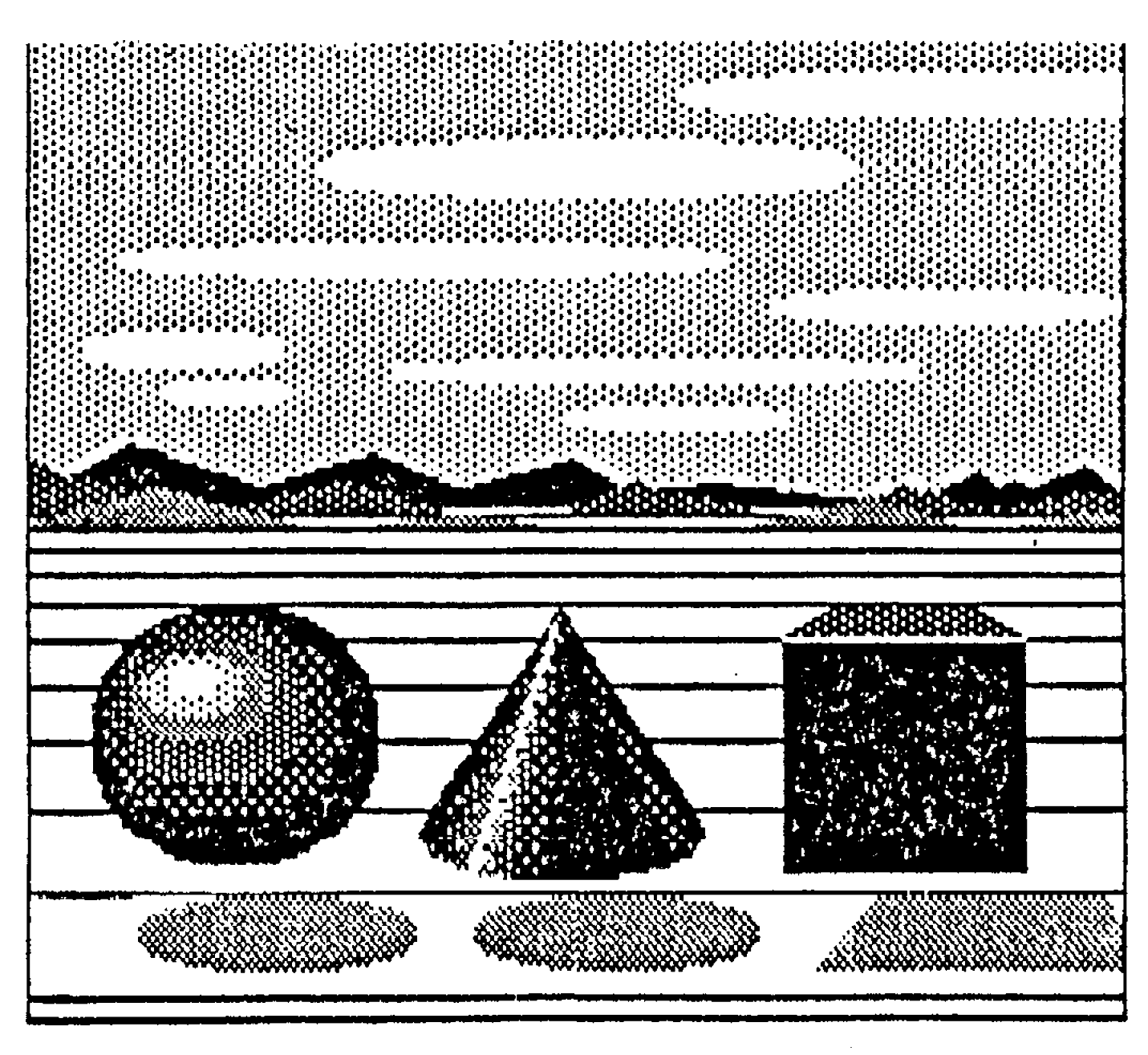
…I leave you with a sample picture created using SINC-ARTIST 1.3. This picture was originally printed out on a 2040 printer in poster size, then photographically reduced to what you see here. See you again in the Sept-Oct issue.