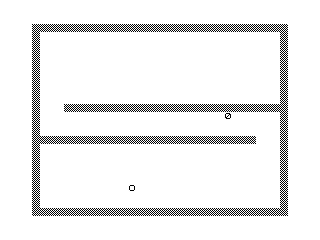
This program implements a bouncing ball animation entirely in Z80 machine code, embedded in REM statements and executed via RAND USR 16908. The machine code manipulates display memory directly, using 16-bit address arithmetic to move a ball sprite around the screen and handle boundary collisions. Two REM lines carry the full binary payload: the first (line 0) contains the primary routine, and the second also line 0 (a known multi-line-zero trick) stores additional data tables and vectors. Line 2 contains patching notes for the developer, listing key addresses and byte values used to redirect execution flow. The program loops continuously via GOTO 1, re-entering the machine code on each pass.
Program Analysis
Program Structure
The listing is minimal at the BASIC level, with almost all logic residing in Z80 machine code stored in REM statements:
- Line 0 (first) — REM with an inverse-video title “BOUNCE”.
- Line 0 (second) — REM containing the full machine code payload (approximately 280+ bytes of Z80 opcodes encoded as hex escapes).
- Line 1 —
RAND USR 16908transfers control to the machine code at address 16908 (0x420C), which falls inside the second REM line’s data area. - Line 2 — Developer commentary listing patch addresses and byte values needed to relocate or hook the routine.
- Lines 3–4 —
SAVEfollowed byGOTO 1to continuously re-run the animation.
Machine Code Entry and Memory Layout
RAND USR 16908 (decimal) equals USR 0x420C. On a TS2068/ZX Spectrum, the system variables area ends well below this, so 0x420C lands squarely in the second REM line’s payload. The code sets up its own internal pointers using absolute 16-bit addresses (22 xx xx = LD (nnnn),HL; 2A xx xx = LD HL,(nnnn)), making the routine position-dependent at these fixed addresses.
Display Memory Access
The machine code accesses display RAM directly. Several instruction sequences load HL or DE with addresses in the 0x4000–0x5AFF range (the Spectrum/TS2068 display file and attribute area). The pattern 19 (ADD HL,DE) combined with 71 (LD (HL),C) and short DJNZ loops (10 Fx) is a classic tight sprite-drawing idiom, writing pixels row by row across display lines.
Key Z80 Idioms Identified
11 xx xx/19— Load DE with a stride value and repeatedly add to HL to step through display memory rows.10 Fx—DJNZshort loops for pixel/attribute row iteration.ED 5B xx xx—LD DE,(nnnn)to fetch ball position from a workspace variable.22 xx xx/2A xx xx— Store/recall 16-bit ball coordinates in fixed workspace locations.7E B7—LD A,(HL); OR Ato test a display cell for non-zero content (collision detection).C3 xx xx— UnconditionalJPused for main loop branches and dispatch.18 xx— RelativeJRfor short local branches.E5/E1—PUSH HL/POP HLused to preserve the ball’s address across sub-operations.
Bounce / Collision Logic
The routine reads the ball’s current screen address from a workspace cell, draws the ball, then tests the target cell’s content. When OR A finds the cell non-zero (another pixel already present, i.e., a wall or boundary), the velocity component is negated by branching to an alternate delta-add path. The direction vectors appear to be stored as signed 16-bit offsets (e.g., 0x004D, 0xFF B0) applied via ADD HL,DE to the current display address, giving horizontal and vertical movement independently.
Data Tables
Near the end of the second REM block, a sequence of values 21 22 23 24 25 1C 1D 1E 1F 20 21 22 23 24 25 1C appears to be a lookup table, likely encoding the ball sprite shape or a cyclic animation frame table, referenced by an index that increments on each frame.
Developer Patch Notes (Line 2)
Line 2 is a plain-text memo to the programmer listing addresses and patch bytes:
| Label | Address | Value/Note |
|---|---|---|
| CDE702 | — | Opcode bytes for a JP 0x02E7-style hook |
| Q 217D40 | 0x407D | Workspace pointer (ball position low byte?) |
| 222940 | 0x4029 | LD (0x4029),HL — stores a vector |
| C3FC02 | — | JP 0x02FC — likely a BASIC interpreter re-entry |
GOTO Loop
GOTO 1 at line 4 creates an infinite BASIC loop that re-executes RAND USR 16908 on each iteration. In practice the machine code itself contains an internal loop (18 C8, 18 C1, C3 91 40, etc.) and never returns to BASIC during normal animation; the GOTO serves as a safety net if the routine ever exits cleanly.
Potential Anomalies
- Two lines both numbered
0— the second silently shadows or appends to the first depending on the interpreter’s line-lookup behaviour; this is intentional to pack the code before line 1. - The routine uses absolute addresses throughout, so it is not relocatable without the patches documented in line 2.
- The
SAVE "1023%7"on line 3 is reached via fall-through from line 1 only ifRAND USRreturns, which under normal operation it does not.
Content
Source Code
0 REM % %B%O%U%N%C%E%
0 REM
Skip to content
Bounce
This file is part of and Timex Sinclair Public Domain Library Tape 1005. Download the collection to get this file.
This program implements a bouncing ball animation entirely in Z80 machine code, embedded in REM statements and executed via RAND USR 16908. The machine code manipulates display memory directly, using 16-bit address arithmetic to move a ball sprite around the screen and handle boundary collisions. Two REM lines carry the full binary payload: the first (line 0) contains the primary routine, and the second also line 0 (a known multi-line-zero trick) stores additional data tables and vectors. Line 2 contains patching notes for the developer, listing key addresses and byte values used to redirect execution flow. The program loops continuously via GOTO 1, re-entering the machine code on each pass.
Program Analysis
Program Structure
The listing is minimal at the BASIC level, with almost all logic residing in Z80 machine code stored in REM statements:
- Line 0 (first) — REM with an inverse-video title “BOUNCE”.
- Line 0 (second) — REM containing the full machine code payload (approximately 280+ bytes of Z80 opcodes encoded as hex escapes).
- Line 1 —
RAND USR 16908 transfers control to the machine code at address 16908 (0x420C), which falls inside the second REM line’s data area.
- Line 2 — Developer commentary listing patch addresses and byte values needed to relocate or hook the routine.
- Lines 3–4 —
SAVE followed by GOTO 1 to continuously re-run the animation.
Machine Code Entry and Memory Layout
RAND USR 16908 (decimal) equals USR 0x420C. On a TS2068/ZX Spectrum, the system variables area ends well below this, so 0x420C lands squarely in the second REM line’s payload. The code sets up its own internal pointers using absolute 16-bit addresses (22 xx xx = LD (nnnn),HL; 2A xx xx = LD HL,(nnnn)), making the routine position-dependent at these fixed addresses.
Display Memory Access
The machine code accesses display RAM directly. Several instruction sequences load HL or DE with addresses in the 0x4000–0x5AFF range (the Spectrum/TS2068 display file and attribute area). The pattern 19 (ADD HL,DE) combined with 71 (LD (HL),C) and short DJNZ loops (10 Fx) is a classic tight sprite-drawing idiom, writing pixels row by row across display lines.
Key Z80 Idioms Identified
11 xx xx / 19 — Load DE with a stride value and repeatedly add to HL to step through display memory rows.
10 Fx — DJNZ short loops for pixel/attribute row iteration.
ED 5B xx xx — LD DE,(nnnn) to fetch ball position from a workspace variable.
22 xx xx / 2A xx xx — Store/recall 16-bit ball coordinates in fixed workspace locations.
7E B7 — LD A,(HL); OR A to test a display cell for non-zero content (collision detection).
C3 xx xx — Unconditional JP used for main loop branches and dispatch.
18 xx — Relative JR for short local branches.
E5/E1 — PUSH HL/POP HL used to preserve the ball’s address across sub-operations.
Bounce / Collision Logic
The routine reads the ball’s current screen address from a workspace cell, draws the ball, then tests the target cell’s content. When OR A finds the cell non-zero (another pixel already present, i.e., a wall or boundary), the velocity component is negated by branching to an alternate delta-add path. The direction vectors appear to be stored as signed 16-bit offsets (e.g., 0x004D, 0xFF B0) applied via ADD HL,DE to the current display address, giving horizontal and vertical movement independently.
Data Tables
Near the end of the second REM block, a sequence of values 21 22 23 24 25 1C 1D 1E 1F 20 21 22 23 24 25 1C appears to be a lookup table, likely encoding the ball sprite shape or a cyclic animation frame table, referenced by an index that increments on each frame.
Developer Patch Notes (Line 2)
Line 2 is a plain-text memo to the programmer listing addresses and patch bytes:
Label Address Value/Note CDE702 — Opcode bytes for a JP 0x02E7-style hook Q 217D40 0x407D Workspace pointer (ball position low byte?) 222940 0x4029 LD (0x4029),HL — stores a vectorC3FC02 — JP 0x02FC — likely a BASIC interpreter re-entry
GOTO Loop
GOTO 1 at line 4 creates an infinite BASIC loop that re-executes RAND USR 16908 on each iteration. In practice the machine code itself contains an internal loop (18 C8, 18 C1, C3 91 40, etc.) and never returns to BASIC during normal animation; the GOTO serves as a safety net if the routine ever exits cleanly.
Potential Anomalies
- Two lines both numbered
0 — the second silently shadows or appends to the first depending on the interpreter’s line-lookup behaviour; this is intentional to pack the code before line 1.
- The routine uses absolute addresses throughout, so it is not relocatable without the patches documented in line 2.
- The
SAVE "1023%7" on line 3 is reached via fall-through from line 1 only if RAND USR returns, which under normal operation it does not.
Content
Source Code
0 REM % %B%O%U%N%C%E%
0 REM \0E\08\06\20\11\F7\02\2A\0C\40\E5\23\E5\71\19\71\E1\10\F8\23\23\06\16\11\1F\00\71\19\71\23\23\10\F9\E1\11\4B\01\19\E5\11\84\00\06\20\E5\71\19\71\E1\23\10\F8\E1\23\0E\00\11\9F\00\06\03\E5\71\19\71\E1\23\10\F8\E5\11\C8\00\19\22\40\40\36\34\21\00\04\22\46\40\E1\E5\11\B0\FF\19\22\48\40\36\36\21\DE\FE\22\50\40\E1\11\4D\00\19\22\3E\40\36\1C\21\E0\FF\22\42\40\21\DE\FF\22\44\40\18\09\2A\34\40\22\32\40\2A\46\40\2B\7C\B5\20\FB\3A\26\40\FE\FE\C8\06\21\2A\48\40\36\00\ED\5B\50\40\19\7E\B7\20\05\36\36\22\48\40\B7\28\22\05\28\FB\E5\2A\32\40\54\5D\29\29\19\29\22\32\40\7C\E6\06\C6\95\6F\26\41\5E\23\56\ED\53\50\40\E1\18\C8\E5\2A\7B\40\7E\32\26\41\32\36\41\23\7E\32\2C\41\32\58\41\23\7E\32\34\41\FE\36\28\07\23\22\7B\40\E1\18\A3\21\8A\41\22\7B\40\E1\18\86\00\40\44\34\3E\42\1C\48\50\36\00\00\DE\FF\20\00\E0\FF\22\00\00\21\8D\41\22\7B\40\C3\91\40\00\00\00\00\00\00\56\ED\53\42\40\E1\18\C2\06\35\2A\48\40\36\00\ED\5B\50\40\19\7E\4F\E6\F7\20\05\36\36\22\48\40\B1\CA\22\41\05\28\FA\00\E5\2A\32\40\54\5D\29\29\19\29\29\29\19\22\32\40\7C\E6\06\C6\91\6F\26\40\5E\23\56\ED\53\50\40\E1\18\C1\21\12\42\22\29\40\C3\FC\02\21\00\60\22\04\40\21\1C\42\22\29\40\C9\CD\2B\0F\C3\9E\41\00\00\06\00\F9\D4\C5\26\0D\76\00\00\02\00\FB\76\00\00\06\00\F9\D4\C5\27\0D\76\00\27\3E\00\27\34\27\00\32\2E\3D\00\00\21\22\23\24\25\1C\1D\1E\1F\20\21\22\23\24\25\1C
1 RAND USR 16908
2 REM STICK THIS SOMEWHERE AND CALL IT: CDE702 Q 217D40 222940 C3FC02
3 SAVE "1023%7"
4 GOTO 1
Note: Type-in program listings on this website use ZMAKEBAS notation for graphics characters.
People
No people associated with this content.
E\F7
Skip to content
Bounce
This file is part of and Timex Sinclair Public Domain Library Tape 1005. Download the collection to get this file.
This program implements a bouncing ball animation entirely in Z80 machine code, embedded in REM statements and executed via RAND USR 16908. The machine code manipulates display memory directly, using 16-bit address arithmetic to move a ball sprite around the screen and handle boundary collisions. Two REM lines carry the full binary payload: the first (line 0) contains the primary routine, and the second also line 0 (a known multi-line-zero trick) stores additional data tables and vectors. Line 2 contains patching notes for the developer, listing key addresses and byte values used to redirect execution flow. The program loops continuously via GOTO 1, re-entering the machine code on each pass.
Program Analysis
Program Structure
The listing is minimal at the BASIC level, with almost all logic residing in Z80 machine code stored in REM statements:
- Line 0 (first) — REM with an inverse-video title “BOUNCE”.
- Line 0 (second) — REM containing the full machine code payload (approximately 280+ bytes of Z80 opcodes encoded as hex escapes).
- Line 1 —
RAND USR 16908 transfers control to the machine code at address 16908 (0x420C), which falls inside the second REM line’s data area.
- Line 2 — Developer commentary listing patch addresses and byte values needed to relocate or hook the routine.
- Lines 3–4 —
SAVE followed by GOTO 1 to continuously re-run the animation.
Machine Code Entry and Memory Layout
RAND USR 16908 (decimal) equals USR 0x420C. On a TS2068/ZX Spectrum, the system variables area ends well below this, so 0x420C lands squarely in the second REM line’s payload. The code sets up its own internal pointers using absolute 16-bit addresses (22 xx xx = LD (nnnn),HL; 2A xx xx = LD HL,(nnnn)), making the routine position-dependent at these fixed addresses.
Display Memory Access
The machine code accesses display RAM directly. Several instruction sequences load HL or DE with addresses in the 0x4000–0x5AFF range (the Spectrum/TS2068 display file and attribute area). The pattern 19 (ADD HL,DE) combined with 71 (LD (HL),C) and short DJNZ loops (10 Fx) is a classic tight sprite-drawing idiom, writing pixels row by row across display lines.
Key Z80 Idioms Identified
11 xx xx / 19 — Load DE with a stride value and repeatedly add to HL to step through display memory rows.
10 Fx — DJNZ short loops for pixel/attribute row iteration.
ED 5B xx xx — LD DE,(nnnn) to fetch ball position from a workspace variable.
22 xx xx / 2A xx xx — Store/recall 16-bit ball coordinates in fixed workspace locations.
7E B7 — LD A,(HL); OR A to test a display cell for non-zero content (collision detection).
C3 xx xx — Unconditional JP used for main loop branches and dispatch.
18 xx — Relative JR for short local branches.
E5/E1 — PUSH HL/POP HL used to preserve the ball’s address across sub-operations.
Bounce / Collision Logic
The routine reads the ball’s current screen address from a workspace cell, draws the ball, then tests the target cell’s content. When OR A finds the cell non-zero (another pixel already present, i.e., a wall or boundary), the velocity component is negated by branching to an alternate delta-add path. The direction vectors appear to be stored as signed 16-bit offsets (e.g., 0x004D, 0xFF B0) applied via ADD HL,DE to the current display address, giving horizontal and vertical movement independently.
Data Tables
Near the end of the second REM block, a sequence of values 21 22 23 24 25 1C 1D 1E 1F 20 21 22 23 24 25 1C appears to be a lookup table, likely encoding the ball sprite shape or a cyclic animation frame table, referenced by an index that increments on each frame.
Developer Patch Notes (Line 2)
Line 2 is a plain-text memo to the programmer listing addresses and patch bytes:
Label Address Value/Note CDE702 — Opcode bytes for a JP 0x02E7-style hook Q 217D40 0x407D Workspace pointer (ball position low byte?) 222940 0x4029 LD (0x4029),HL — stores a vectorC3FC02 — JP 0x02FC — likely a BASIC interpreter re-entry
GOTO Loop
GOTO 1 at line 4 creates an infinite BASIC loop that re-executes RAND USR 16908 on each iteration. In practice the machine code itself contains an internal loop (18 C8, 18 C1, C3 91 40, etc.) and never returns to BASIC during normal animation; the GOTO serves as a safety net if the routine ever exits cleanly.
Potential Anomalies
- Two lines both numbered
0 — the second silently shadows or appends to the first depending on the interpreter’s line-lookup behaviour; this is intentional to pack the code before line 1.
- The routine uses absolute addresses throughout, so it is not relocatable without the patches documented in line 2.
- The
SAVE "1023%7" on line 3 is reached via fall-through from line 1 only if RAND USR returns, which under normal operation it does not.
Content
Source Code
0 REM % %B%O%U%N%C%E%
0 REM \0E\08\06\20\11\F7\02\2A\0C\40\E5\23\E5\71\19\71\E1\10\F8\23\23\06\16\11\1F\00\71\19\71\23\23\10\F9\E1\11\4B\01\19\E5\11\84\00\06\20\E5\71\19\71\E1\23\10\F8\E1\23\0E\00\11\9F\00\06\03\E5\71\19\71\E1\23\10\F8\E5\11\C8\00\19\22\40\40\36\34\21\00\04\22\46\40\E1\E5\11\B0\FF\19\22\48\40\36\36\21\DE\FE\22\50\40\E1\11\4D\00\19\22\3E\40\36\1C\21\E0\FF\22\42\40\21\DE\FF\22\44\40\18\09\2A\34\40\22\32\40\2A\46\40\2B\7C\B5\20\FB\3A\26\40\FE\FE\C8\06\21\2A\48\40\36\00\ED\5B\50\40\19\7E\B7\20\05\36\36\22\48\40\B7\28\22\05\28\FB\E5\2A\32\40\54\5D\29\29\19\29\22\32\40\7C\E6\06\C6\95\6F\26\41\5E\23\56\ED\53\50\40\E1\18\C8\E5\2A\7B\40\7E\32\26\41\32\36\41\23\7E\32\2C\41\32\58\41\23\7E\32\34\41\FE\36\28\07\23\22\7B\40\E1\18\A3\21\8A\41\22\7B\40\E1\18\86\00\40\44\34\3E\42\1C\48\50\36\00\00\DE\FF\20\00\E0\FF\22\00\00\21\8D\41\22\7B\40\C3\91\40\00\00\00\00\00\00\56\ED\53\42\40\E1\18\C2\06\35\2A\48\40\36\00\ED\5B\50\40\19\7E\4F\E6\F7\20\05\36\36\22\48\40\B1\CA\22\41\05\28\FA\00\E5\2A\32\40\54\5D\29\29\19\29\29\29\19\22\32\40\7C\E6\06\C6\91\6F\26\40\5E\23\56\ED\53\50\40\E1\18\C1\21\12\42\22\29\40\C3\FC\02\21\00\60\22\04\40\21\1C\42\22\29\40\C9\CD\2B\0F\C3\9E\41\00\00\06\00\F9\D4\C5\26\0D\76\00\00\02\00\FB\76\00\00\06\00\F9\D4\C5\27\0D\76\00\27\3E\00\27\34\27\00\32\2E\3D\00\00\21\22\23\24\25\1C\1D\1E\1F\20\21\22\23\24\25\1C
1 RAND USR 16908
2 REM STICK THIS SOMEWHERE AND CALL IT: CDE702 Q 217D40 222940 C3FC02
3 SAVE "1023%7"
4 GOTO 1
Note: Type-in program listings on this website use ZMAKEBAS notation for graphics characters.
People
No people associated with this content.
Skip to content
Bounce
This file is part of and Timex Sinclair Public Domain Library Tape 1005. Download the collection to get this file.
This program implements a bouncing ball animation entirely in Z80 machine code, embedded in REM statements and executed via RAND USR 16908. The machine code manipulates display memory directly, using 16-bit address arithmetic to move a ball sprite around the screen and handle boundary collisions. Two REM lines carry the full binary payload: the first (line 0) contains the primary routine, and the second also line 0 (a known multi-line-zero trick) stores additional data tables and vectors. Line 2 contains patching notes for the developer, listing key addresses and byte values used to redirect execution flow. The program loops continuously via GOTO 1, re-entering the machine code on each pass.
Program Analysis
Program Structure
The listing is minimal at the BASIC level, with almost all logic residing in Z80 machine code stored in REM statements:
- Line 0 (first) — REM with an inverse-video title “BOUNCE”.
- Line 0 (second) — REM containing the full machine code payload (approximately 280+ bytes of Z80 opcodes encoded as hex escapes).
- Line 1 —
RAND USR 16908 transfers control to the machine code at address 16908 (0x420C), which falls inside the second REM line’s data area.
- Line 2 — Developer commentary listing patch addresses and byte values needed to relocate or hook the routine.
- Lines 3–4 —
SAVE followed by GOTO 1 to continuously re-run the animation.
Machine Code Entry and Memory Layout
RAND USR 16908 (decimal) equals USR 0x420C. On a TS2068/ZX Spectrum, the system variables area ends well below this, so 0x420C lands squarely in the second REM line’s payload. The code sets up its own internal pointers using absolute 16-bit addresses (22 xx xx = LD (nnnn),HL; 2A xx xx = LD HL,(nnnn)), making the routine position-dependent at these fixed addresses.
Display Memory Access
The machine code accesses display RAM directly. Several instruction sequences load HL or DE with addresses in the 0x4000–0x5AFF range (the Spectrum/TS2068 display file and attribute area). The pattern 19 (ADD HL,DE) combined with 71 (LD (HL),C) and short DJNZ loops (10 Fx) is a classic tight sprite-drawing idiom, writing pixels row by row across display lines.
Key Z80 Idioms Identified
11 xx xx / 19 — Load DE with a stride value and repeatedly add to HL to step through display memory rows.
10 Fx — DJNZ short loops for pixel/attribute row iteration.
ED 5B xx xx — LD DE,(nnnn) to fetch ball position from a workspace variable.
22 xx xx / 2A xx xx — Store/recall 16-bit ball coordinates in fixed workspace locations.
7E B7 — LD A,(HL); OR A to test a display cell for non-zero content (collision detection).
C3 xx xx — Unconditional JP used for main loop branches and dispatch.
18 xx — Relative JR for short local branches.
E5/E1 — PUSH HL/POP HL used to preserve the ball’s address across sub-operations.
Bounce / Collision Logic
The routine reads the ball’s current screen address from a workspace cell, draws the ball, then tests the target cell’s content. When OR A finds the cell non-zero (another pixel already present, i.e., a wall or boundary), the velocity component is negated by branching to an alternate delta-add path. The direction vectors appear to be stored as signed 16-bit offsets (e.g., 0x004D, 0xFF B0) applied via ADD HL,DE to the current display address, giving horizontal and vertical movement independently.
Data Tables
Near the end of the second REM block, a sequence of values 21 22 23 24 25 1C 1D 1E 1F 20 21 22 23 24 25 1C appears to be a lookup table, likely encoding the ball sprite shape or a cyclic animation frame table, referenced by an index that increments on each frame.
Developer Patch Notes (Line 2)
Line 2 is a plain-text memo to the programmer listing addresses and patch bytes:
Label Address Value/Note CDE702 — Opcode bytes for a JP 0x02E7-style hook Q 217D40 0x407D Workspace pointer (ball position low byte?) 222940 0x4029 LD (0x4029),HL — stores a vectorC3FC02 — JP 0x02FC — likely a BASIC interpreter re-entry
GOTO Loop
GOTO 1 at line 4 creates an infinite BASIC loop that re-executes RAND USR 16908 on each iteration. In practice the machine code itself contains an internal loop (18 C8, 18 C1, C3 91 40, etc.) and never returns to BASIC during normal animation; the GOTO serves as a safety net if the routine ever exits cleanly.
Potential Anomalies
- Two lines both numbered
0 — the second silently shadows or appends to the first depending on the interpreter’s line-lookup behaviour; this is intentional to pack the code before line 1.
- The routine uses absolute addresses throughout, so it is not relocatable without the patches documented in line 2.
- The
SAVE "1023%7" on line 3 is reached via fall-through from line 1 only if RAND USR returns, which under normal operation it does not.
Content
Source Code
0 REM % %B%O%U%N%C%E%
0 REM \0E\08\06\20\11\F7\02\2A\0C\40\E5\23\E5\71\19\71\E1\10\F8\23\23\06\16\11\1F\00\71\19\71\23\23\10\F9\E1\11\4B\01\19\E5\11\84\00\06\20\E5\71\19\71\E1\23\10\F8\E1\23\0E\00\11\9F\00\06\03\E5\71\19\71\E1\23\10\F8\E5\11\C8\00\19\22\40\40\36\34\21\00\04\22\46\40\E1\E5\11\B0\FF\19\22\48\40\36\36\21\DE\FE\22\50\40\E1\11\4D\00\19\22\3E\40\36\1C\21\E0\FF\22\42\40\21\DE\FF\22\44\40\18\09\2A\34\40\22\32\40\2A\46\40\2B\7C\B5\20\FB\3A\26\40\FE\FE\C8\06\21\2A\48\40\36\00\ED\5B\50\40\19\7E\B7\20\05\36\36\22\48\40\B7\28\22\05\28\FB\E5\2A\32\40\54\5D\29\29\19\29\22\32\40\7C\E6\06\C6\95\6F\26\41\5E\23\56\ED\53\50\40\E1\18\C8\E5\2A\7B\40\7E\32\26\41\32\36\41\23\7E\32\2C\41\32\58\41\23\7E\32\34\41\FE\36\28\07\23\22\7B\40\E1\18\A3\21\8A\41\22\7B\40\E1\18\86\00\40\44\34\3E\42\1C\48\50\36\00\00\DE\FF\20\00\E0\FF\22\00\00\21\8D\41\22\7B\40\C3\91\40\00\00\00\00\00\00\56\ED\53\42\40\E1\18\C2\06\35\2A\48\40\36\00\ED\5B\50\40\19\7E\4F\E6\F7\20\05\36\36\22\48\40\B1\CA\22\41\05\28\FA\00\E5\2A\32\40\54\5D\29\29\19\29\29\29\19\22\32\40\7C\E6\06\C6\91\6F\26\40\5E\23\56\ED\53\50\40\E1\18\C1\21\12\42\22\29\40\C3\FC\02\21\00\60\22\04\40\21\1C\42\22\29\40\C9\CD\2B\0F\C3\9E\41\00\00\06\00\F9\D4\C5\26\0D\76\00\00\02\00\FB\76\00\00\06\00\F9\D4\C5\27\0D\76\00\27\3E\00\27\34\27\00\32\2E\3D\00\00\21\22\23\24\25\1C\1D\1E\1F\20\21\22\23\24\25\1C
1 RAND USR 16908
2 REM STICK THIS SOMEWHERE AND CALL IT: CDE702 Q 217D40 222940 C3FC02
3 SAVE "1023%7"
4 GOTO 1
Note: Type-in program listings on this website use ZMAKEBAS notation for graphics characters.
People
No people associated with this content.
A
Skip to content
Bounce
This file is part of and Timex Sinclair Public Domain Library Tape 1005. Download the collection to get this file.
This program implements a bouncing ball animation entirely in Z80 machine code, embedded in REM statements and executed via RAND USR 16908. The machine code manipulates display memory directly, using 16-bit address arithmetic to move a ball sprite around the screen and handle boundary collisions. Two REM lines carry the full binary payload: the first (line 0) contains the primary routine, and the second also line 0 (a known multi-line-zero trick) stores additional data tables and vectors. Line 2 contains patching notes for the developer, listing key addresses and byte values used to redirect execution flow. The program loops continuously via GOTO 1, re-entering the machine code on each pass.
Program Analysis
Program Structure
The listing is minimal at the BASIC level, with almost all logic residing in Z80 machine code stored in REM statements:
- Line 0 (first) — REM with an inverse-video title “BOUNCE”.
- Line 0 (second) — REM containing the full machine code payload (approximately 280+ bytes of Z80 opcodes encoded as hex escapes).
- Line 1 —
RAND USR 16908 transfers control to the machine code at address 16908 (0x420C), which falls inside the second REM line’s data area.
- Line 2 — Developer commentary listing patch addresses and byte values needed to relocate or hook the routine.
- Lines 3–4 —
SAVE followed by GOTO 1 to continuously re-run the animation.
Machine Code Entry and Memory Layout
RAND USR 16908 (decimal) equals USR 0x420C. On a TS2068/ZX Spectrum, the system variables area ends well below this, so 0x420C lands squarely in the second REM line’s payload. The code sets up its own internal pointers using absolute 16-bit addresses (22 xx xx = LD (nnnn),HL; 2A xx xx = LD HL,(nnnn)), making the routine position-dependent at these fixed addresses.
Display Memory Access
The machine code accesses display RAM directly. Several instruction sequences load HL or DE with addresses in the 0x4000–0x5AFF range (the Spectrum/TS2068 display file and attribute area). The pattern 19 (ADD HL,DE) combined with 71 (LD (HL),C) and short DJNZ loops (10 Fx) is a classic tight sprite-drawing idiom, writing pixels row by row across display lines.
Key Z80 Idioms Identified
11 xx xx / 19 — Load DE with a stride value and repeatedly add to HL to step through display memory rows.
10 Fx — DJNZ short loops for pixel/attribute row iteration.
ED 5B xx xx — LD DE,(nnnn) to fetch ball position from a workspace variable.
22 xx xx / 2A xx xx — Store/recall 16-bit ball coordinates in fixed workspace locations.
7E B7 — LD A,(HL); OR A to test a display cell for non-zero content (collision detection).
C3 xx xx — Unconditional JP used for main loop branches and dispatch.
18 xx — Relative JR for short local branches.
E5/E1 — PUSH HL/POP HL used to preserve the ball’s address across sub-operations.
Bounce / Collision Logic
The routine reads the ball’s current screen address from a workspace cell, draws the ball, then tests the target cell’s content. When OR A finds the cell non-zero (another pixel already present, i.e., a wall or boundary), the velocity component is negated by branching to an alternate delta-add path. The direction vectors appear to be stored as signed 16-bit offsets (e.g., 0x004D, 0xFF B0) applied via ADD HL,DE to the current display address, giving horizontal and vertical movement independently.
Data Tables
Near the end of the second REM block, a sequence of values 21 22 23 24 25 1C 1D 1E 1F 20 21 22 23 24 25 1C appears to be a lookup table, likely encoding the ball sprite shape or a cyclic animation frame table, referenced by an index that increments on each frame.
Developer Patch Notes (Line 2)
Line 2 is a plain-text memo to the programmer listing addresses and patch bytes:
Label Address Value/Note CDE702 — Opcode bytes for a JP 0x02E7-style hook Q 217D40 0x407D Workspace pointer (ball position low byte?) 222940 0x4029 LD (0x4029),HL — stores a vectorC3FC02 — JP 0x02FC — likely a BASIC interpreter re-entry
GOTO Loop
GOTO 1 at line 4 creates an infinite BASIC loop that re-executes RAND USR 16908 on each iteration. In practice the machine code itself contains an internal loop (18 C8, 18 C1, C3 91 40, etc.) and never returns to BASIC during normal animation; the GOTO serves as a safety net if the routine ever exits cleanly.
Potential Anomalies
- Two lines both numbered
0 — the second silently shadows or appends to the first depending on the interpreter’s line-lookup behaviour; this is intentional to pack the code before line 1.
- The routine uses absolute addresses throughout, so it is not relocatable without the patches documented in line 2.
- The
SAVE "1023%7" on line 3 is reached via fall-through from line 1 only if RAND USR returns, which under normal operation it does not.
Content
Source Code
0 REM % %B%O%U%N%C%E%
0 REM \0E\08\06\20\11\F7\02\2A\0C\40\E5\23\E5\71\19\71\E1\10\F8\23\23\06\16\11\1F\00\71\19\71\23\23\10\F9\E1\11\4B\01\19\E5\11\84\00\06\20\E5\71\19\71\E1\23\10\F8\E1\23\0E\00\11\9F\00\06\03\E5\71\19\71\E1\23\10\F8\E5\11\C8\00\19\22\40\40\36\34\21\00\04\22\46\40\E1\E5\11\B0\FF\19\22\48\40\36\36\21\DE\FE\22\50\40\E1\11\4D\00\19\22\3E\40\36\1C\21\E0\FF\22\42\40\21\DE\FF\22\44\40\18\09\2A\34\40\22\32\40\2A\46\40\2B\7C\B5\20\FB\3A\26\40\FE\FE\C8\06\21\2A\48\40\36\00\ED\5B\50\40\19\7E\B7\20\05\36\36\22\48\40\B7\28\22\05\28\FB\E5\2A\32\40\54\5D\29\29\19\29\22\32\40\7C\E6\06\C6\95\6F\26\41\5E\23\56\ED\53\50\40\E1\18\C8\E5\2A\7B\40\7E\32\26\41\32\36\41\23\7E\32\2C\41\32\58\41\23\7E\32\34\41\FE\36\28\07\23\22\7B\40\E1\18\A3\21\8A\41\22\7B\40\E1\18\86\00\40\44\34\3E\42\1C\48\50\36\00\00\DE\FF\20\00\E0\FF\22\00\00\21\8D\41\22\7B\40\C3\91\40\00\00\00\00\00\00\56\ED\53\42\40\E1\18\C2\06\35\2A\48\40\36\00\ED\5B\50\40\19\7E\4F\E6\F7\20\05\36\36\22\48\40\B1\CA\22\41\05\28\FA\00\E5\2A\32\40\54\5D\29\29\19\29\29\29\19\22\32\40\7C\E6\06\C6\91\6F\26\40\5E\23\56\ED\53\50\40\E1\18\C1\21\12\42\22\29\40\C3\FC\02\21\00\60\22\04\40\21\1C\42\22\29\40\C9\CD\2B\0F\C3\9E\41\00\00\06\00\F9\D4\C5\26\0D\76\00\00\02\00\FB\76\00\00\06\00\F9\D4\C5\27\0D\76\00\27\3E\00\27\34\27\00\32\2E\3D\00\00\21\22\23\24\25\1C\1D\1E\1F\20\21\22\23\24\25\1C
1 RAND USR 16908
2 REM STICK THIS SOMEWHERE AND CALL IT: CDE702 Q 217D40 222940 C3FC02
3 SAVE "1023%7"
4 GOTO 1
Note: Type-in program listings on this website use ZMAKEBAS notation for graphics characters.
People
No people associated with this content.
C\E5\E5\E1\F8 itemtype='https://schema.org/Blog' itemscope='itemscope' class="wp-singular computer_media-template-default single single-computer_media postid-57436 wp-custom-logo wp-embed-responsive wp-theme-astra wp-child-theme-astra-child ast-desktop ast-separate-container ast-left-sidebar astra-4.12.7 group-blog ast-blog-single-style-1 ast-custom-post-type ast-single-post ast-inherit-site-logo-transparent ast-hfb-header ast-full-width-primary-header ast-box-layout ast-normal-title-enabled astra-addon-4.12.5"F
Skip to content
Bounce
This file is part of and Timex Sinclair Public Domain Library Tape 1005. Download the collection to get this file.
This program implements a bouncing ball animation entirely in Z80 machine code, embedded in REM statements and executed via RAND USR 16908. The machine code manipulates display memory directly, using 16-bit address arithmetic to move a ball sprite around the screen and handle boundary collisions. Two REM lines carry the full binary payload: the first (line 0) contains the primary routine, and the second also line 0 (a known multi-line-zero trick) stores additional data tables and vectors. Line 2 contains patching notes for the developer, listing key addresses and byte values used to redirect execution flow. The program loops continuously via GOTO 1, re-entering the machine code on each pass.
Program Analysis
Program Structure
The listing is minimal at the BASIC level, with almost all logic residing in Z80 machine code stored in REM statements:
- Line 0 (first) — REM with an inverse-video title “BOUNCE”.
- Line 0 (second) — REM containing the full machine code payload (approximately 280+ bytes of Z80 opcodes encoded as hex escapes).
- Line 1 —
RAND USR 16908 transfers control to the machine code at address 16908 (0x420C), which falls inside the second REM line’s data area.
- Line 2 — Developer commentary listing patch addresses and byte values needed to relocate or hook the routine.
- Lines 3–4 —
SAVE followed by GOTO 1 to continuously re-run the animation.
Machine Code Entry and Memory Layout
RAND USR 16908 (decimal) equals USR 0x420C. On a TS2068/ZX Spectrum, the system variables area ends well below this, so 0x420C lands squarely in the second REM line’s payload. The code sets up its own internal pointers using absolute 16-bit addresses (22 xx xx = LD (nnnn),HL; 2A xx xx = LD HL,(nnnn)), making the routine position-dependent at these fixed addresses.
Display Memory Access
The machine code accesses display RAM directly. Several instruction sequences load HL or DE with addresses in the 0x4000–0x5AFF range (the Spectrum/TS2068 display file and attribute area). The pattern 19 (ADD HL,DE) combined with 71 (LD (HL),C) and short DJNZ loops (10 Fx) is a classic tight sprite-drawing idiom, writing pixels row by row across display lines.
Key Z80 Idioms Identified
11 xx xx / 19 — Load DE with a stride value and repeatedly add to HL to step through display memory rows.
10 Fx — DJNZ short loops for pixel/attribute row iteration.
ED 5B xx xx — LD DE,(nnnn) to fetch ball position from a workspace variable.
22 xx xx / 2A xx xx — Store/recall 16-bit ball coordinates in fixed workspace locations.
7E B7 — LD A,(HL); OR A to test a display cell for non-zero content (collision detection).
C3 xx xx — Unconditional JP used for main loop branches and dispatch.
18 xx — Relative JR for short local branches.
E5/E1 — PUSH HL/POP HL used to preserve the ball’s address across sub-operations.
Bounce / Collision Logic
The routine reads the ball’s current screen address from a workspace cell, draws the ball, then tests the target cell’s content. When OR A finds the cell non-zero (another pixel already present, i.e., a wall or boundary), the velocity component is negated by branching to an alternate delta-add path. The direction vectors appear to be stored as signed 16-bit offsets (e.g., 0x004D, 0xFF B0) applied via ADD HL,DE to the current display address, giving horizontal and vertical movement independently.
Data Tables
Near the end of the second REM block, a sequence of values 21 22 23 24 25 1C 1D 1E 1F 20 21 22 23 24 25 1C appears to be a lookup table, likely encoding the ball sprite shape or a cyclic animation frame table, referenced by an index that increments on each frame.
Developer Patch Notes (Line 2)
Line 2 is a plain-text memo to the programmer listing addresses and patch bytes:
Label Address Value/Note CDE702 — Opcode bytes for a JP 0x02E7-style hook Q 217D40 0x407D Workspace pointer (ball position low byte?) 222940 0x4029 LD (0x4029),HL — stores a vectorC3FC02 — JP 0x02FC — likely a BASIC interpreter re-entry
GOTO Loop
GOTO 1 at line 4 creates an infinite BASIC loop that re-executes RAND USR 16908 on each iteration. In practice the machine code itself contains an internal loop (18 C8, 18 C1, C3 91 40, etc.) and never returns to BASIC during normal animation; the GOTO serves as a safety net if the routine ever exits cleanly.
Potential Anomalies
- Two lines both numbered
0 — the second silently shadows or appends to the first depending on the interpreter’s line-lookup behaviour; this is intentional to pack the code before line 1.
- The routine uses absolute addresses throughout, so it is not relocatable without the patches documented in line 2.
- The
SAVE "1023%7" on line 3 is reached via fall-through from line 1 only if RAND USR returns, which under normal operation it does not.
Content
Source Code
0 REM % %B%O%U%N%C%E%
0 REM \0E\08\06\20\11\F7\02\2A\0C\40\E5\23\E5\71\19\71\E1\10\F8\23\23\06\16\11\1F\00\71\19\71\23\23\10\F9\E1\11\4B\01\19\E5\11\84\00\06\20\E5\71\19\71\E1\23\10\F8\E1\23\0E\00\11\9F\00\06\03\E5\71\19\71\E1\23\10\F8\E5\11\C8\00\19\22\40\40\36\34\21\00\04\22\46\40\E1\E5\11\B0\FF\19\22\48\40\36\36\21\DE\FE\22\50\40\E1\11\4D\00\19\22\3E\40\36\1C\21\E0\FF\22\42\40\21\DE\FF\22\44\40\18\09\2A\34\40\22\32\40\2A\46\40\2B\7C\B5\20\FB\3A\26\40\FE\FE\C8\06\21\2A\48\40\36\00\ED\5B\50\40\19\7E\B7\20\05\36\36\22\48\40\B7\28\22\05\28\FB\E5\2A\32\40\54\5D\29\29\19\29\22\32\40\7C\E6\06\C6\95\6F\26\41\5E\23\56\ED\53\50\40\E1\18\C8\E5\2A\7B\40\7E\32\26\41\32\36\41\23\7E\32\2C\41\32\58\41\23\7E\32\34\41\FE\36\28\07\23\22\7B\40\E1\18\A3\21\8A\41\22\7B\40\E1\18\86\00\40\44\34\3E\42\1C\48\50\36\00\00\DE\FF\20\00\E0\FF\22\00\00\21\8D\41\22\7B\40\C3\91\40\00\00\00\00\00\00\56\ED\53\42\40\E1\18\C2\06\35\2A\48\40\36\00\ED\5B\50\40\19\7E\4F\E6\F7\20\05\36\36\22\48\40\B1\CA\22\41\05\28\FA\00\E5\2A\32\40\54\5D\29\29\19\29\29\29\19\22\32\40\7C\E6\06\C6\91\6F\26\40\5E\23\56\ED\53\50\40\E1\18\C1\21\12\42\22\29\40\C3\FC\02\21\00\60\22\04\40\21\1C\42\22\29\40\C9\CD\2B\0F\C3\9E\41\00\00\06\00\F9\D4\C5\26\0D\76\00\00\02\00\FB\76\00\00\06\00\F9\D4\C5\27\0D\76\00\27\3E\00\27\34\27\00\32\2E\3D\00\00\21\22\23\24\25\1C\1D\1E\1F\20\21\22\23\24\25\1C
1 RAND USR 16908
2 REM STICK THIS SOMEWHERE AND CALL IT: CDE702 Q 217D40 222940 C3FC02
3 SAVE "1023%7"
4 GOTO 1
Note: Type-in program listings on this website use ZMAKEBAS notation for graphics characters.
People
No people associated with this content.
\F9\E1B itemtype='https://schema.org/Blog' itemscope='itemscope' class="wp-singular computer_media-template-default single single-computer_media postid-57436 wp-custom-logo wp-embed-responsive wp-theme-astra wp-child-theme-astra-child ast-desktop ast-separate-container ast-left-sidebar astra-4.12.7 group-blog ast-blog-single-style-1 ast-custom-post-type ast-single-post ast-inherit-site-logo-transparent ast-hfb-header ast-full-width-primary-header ast-box-layout ast-normal-title-enabled astra-addon-4.12.5"\E5
Skip to content
Bounce
This file is part of and Timex Sinclair Public Domain Library Tape 1005. Download the collection to get this file.
This program implements a bouncing ball animation entirely in Z80 machine code, embedded in REM statements and executed via RAND USR 16908. The machine code manipulates display memory directly, using 16-bit address arithmetic to move a ball sprite around the screen and handle boundary collisions. Two REM lines carry the full binary payload: the first (line 0) contains the primary routine, and the second also line 0 (a known multi-line-zero trick) stores additional data tables and vectors. Line 2 contains patching notes for the developer, listing key addresses and byte values used to redirect execution flow. The program loops continuously via GOTO 1, re-entering the machine code on each pass.
Program Analysis
Program Structure
The listing is minimal at the BASIC level, with almost all logic residing in Z80 machine code stored in REM statements:
- Line 0 (first) — REM with an inverse-video title “BOUNCE”.
- Line 0 (second) — REM containing the full machine code payload (approximately 280+ bytes of Z80 opcodes encoded as hex escapes).
- Line 1 —
RAND USR 16908 transfers control to the machine code at address 16908 (0x420C), which falls inside the second REM line’s data area.
- Line 2 — Developer commentary listing patch addresses and byte values needed to relocate or hook the routine.
- Lines 3–4 —
SAVE followed by GOTO 1 to continuously re-run the animation.
Machine Code Entry and Memory Layout
RAND USR 16908 (decimal) equals USR 0x420C. On a TS2068/ZX Spectrum, the system variables area ends well below this, so 0x420C lands squarely in the second REM line’s payload. The code sets up its own internal pointers using absolute 16-bit addresses (22 xx xx = LD (nnnn),HL; 2A xx xx = LD HL,(nnnn)), making the routine position-dependent at these fixed addresses.
Display Memory Access
The machine code accesses display RAM directly. Several instruction sequences load HL or DE with addresses in the 0x4000–0x5AFF range (the Spectrum/TS2068 display file and attribute area). The pattern 19 (ADD HL,DE) combined with 71 (LD (HL),C) and short DJNZ loops (10 Fx) is a classic tight sprite-drawing idiom, writing pixels row by row across display lines.
Key Z80 Idioms Identified
11 xx xx / 19 — Load DE with a stride value and repeatedly add to HL to step through display memory rows.
10 Fx — DJNZ short loops for pixel/attribute row iteration.
ED 5B xx xx — LD DE,(nnnn) to fetch ball position from a workspace variable.
22 xx xx / 2A xx xx — Store/recall 16-bit ball coordinates in fixed workspace locations.
7E B7 — LD A,(HL); OR A to test a display cell for non-zero content (collision detection).
C3 xx xx — Unconditional JP used for main loop branches and dispatch.
18 xx — Relative JR for short local branches.
E5/E1 — PUSH HL/POP HL used to preserve the ball’s address across sub-operations.
Bounce / Collision Logic
The routine reads the ball’s current screen address from a workspace cell, draws the ball, then tests the target cell’s content. When OR A finds the cell non-zero (another pixel already present, i.e., a wall or boundary), the velocity component is negated by branching to an alternate delta-add path. The direction vectors appear to be stored as signed 16-bit offsets (e.g., 0x004D, 0xFF B0) applied via ADD HL,DE to the current display address, giving horizontal and vertical movement independently.
Data Tables
Near the end of the second REM block, a sequence of values 21 22 23 24 25 1C 1D 1E 1F 20 21 22 23 24 25 1C appears to be a lookup table, likely encoding the ball sprite shape or a cyclic animation frame table, referenced by an index that increments on each frame.
Developer Patch Notes (Line 2)
Line 2 is a plain-text memo to the programmer listing addresses and patch bytes:
Label Address Value/Note CDE702 — Opcode bytes for a JP 0x02E7-style hook Q 217D40 0x407D Workspace pointer (ball position low byte?) 222940 0x4029 LD (0x4029),HL — stores a vectorC3FC02 — JP 0x02FC — likely a BASIC interpreter re-entry
GOTO Loop
GOTO 1 at line 4 creates an infinite BASIC loop that re-executes RAND USR 16908 on each iteration. In practice the machine code itself contains an internal loop (18 C8, 18 C1, C3 91 40, etc.) and never returns to BASIC during normal animation; the GOTO serves as a safety net if the routine ever exits cleanly.
Potential Anomalies
- Two lines both numbered
0 — the second silently shadows or appends to the first depending on the interpreter’s line-lookup behaviour; this is intentional to pack the code before line 1.
- The routine uses absolute addresses throughout, so it is not relocatable without the patches documented in line 2.
- The
SAVE "1023%7" on line 3 is reached via fall-through from line 1 only if RAND USR returns, which under normal operation it does not.
Content
Source Code
0 REM % %B%O%U%N%C%E%
0 REM \0E\08\06\20\11\F7\02\2A\0C\40\E5\23\E5\71\19\71\E1\10\F8\23\23\06\16\11\1F\00\71\19\71\23\23\10\F9\E1\11\4B\01\19\E5\11\84\00\06\20\E5\71\19\71\E1\23\10\F8\E1\23\0E\00\11\9F\00\06\03\E5\71\19\71\E1\23\10\F8\E5\11\C8\00\19\22\40\40\36\34\21\00\04\22\46\40\E1\E5\11\B0\FF\19\22\48\40\36\36\21\DE\FE\22\50\40\E1\11\4D\00\19\22\3E\40\36\1C\21\E0\FF\22\42\40\21\DE\FF\22\44\40\18\09\2A\34\40\22\32\40\2A\46\40\2B\7C\B5\20\FB\3A\26\40\FE\FE\C8\06\21\2A\48\40\36\00\ED\5B\50\40\19\7E\B7\20\05\36\36\22\48\40\B7\28\22\05\28\FB\E5\2A\32\40\54\5D\29\29\19\29\22\32\40\7C\E6\06\C6\95\6F\26\41\5E\23\56\ED\53\50\40\E1\18\C8\E5\2A\7B\40\7E\32\26\41\32\36\41\23\7E\32\2C\41\32\58\41\23\7E\32\34\41\FE\36\28\07\23\22\7B\40\E1\18\A3\21\8A\41\22\7B\40\E1\18\86\00\40\44\34\3E\42\1C\48\50\36\00\00\DE\FF\20\00\E0\FF\22\00\00\21\8D\41\22\7B\40\C3\91\40\00\00\00\00\00\00\56\ED\53\42\40\E1\18\C2\06\35\2A\48\40\36\00\ED\5B\50\40\19\7E\4F\E6\F7\20\05\36\36\22\48\40\B1\CA\22\41\05\28\FA\00\E5\2A\32\40\54\5D\29\29\19\29\29\29\19\22\32\40\7C\E6\06\C6\91\6F\26\40\5E\23\56\ED\53\50\40\E1\18\C1\21\12\42\22\29\40\C3\FC\02\21\00\60\22\04\40\21\1C\42\22\29\40\C9\CD\2B\0F\C3\9E\41\00\00\06\00\F9\D4\C5\26\0D\76\00\00\02\00\FB\76\00\00\06\00\F9\D4\C5\27\0D\76\00\27\3E\00\27\34\27\00\32\2E\3D\00\00\21\22\23\24\25\1C\1D\1E\1F\20\21\22\23\24\25\1C
1 RAND USR 16908
2 REM STICK THIS SOMEWHERE AND CALL IT: CDE702 Q 217D40 222940 C3FC02
3 SAVE "1023%7"
4 GOTO 1
Note: Type-in program listings on this website use ZMAKEBAS notation for graphics characters.
People
No people associated with this content.
\E5\E1\F8\E1
Skip to content
Bounce
This file is part of and Timex Sinclair Public Domain Library Tape 1005. Download the collection to get this file.
This program implements a bouncing ball animation entirely in Z80 machine code, embedded in REM statements and executed via RAND USR 16908. The machine code manipulates display memory directly, using 16-bit address arithmetic to move a ball sprite around the screen and handle boundary collisions. Two REM lines carry the full binary payload: the first (line 0) contains the primary routine, and the second also line 0 (a known multi-line-zero trick) stores additional data tables and vectors. Line 2 contains patching notes for the developer, listing key addresses and byte values used to redirect execution flow. The program loops continuously via GOTO 1, re-entering the machine code on each pass.
Program Analysis
Program Structure
The listing is minimal at the BASIC level, with almost all logic residing in Z80 machine code stored in REM statements:
- Line 0 (first) — REM with an inverse-video title “BOUNCE”.
- Line 0 (second) — REM containing the full machine code payload (approximately 280+ bytes of Z80 opcodes encoded as hex escapes).
- Line 1 —
RAND USR 16908 transfers control to the machine code at address 16908 (0x420C), which falls inside the second REM line’s data area.
- Line 2 — Developer commentary listing patch addresses and byte values needed to relocate or hook the routine.
- Lines 3–4 —
SAVE followed by GOTO 1 to continuously re-run the animation.
Machine Code Entry and Memory Layout
RAND USR 16908 (decimal) equals USR 0x420C. On a TS2068/ZX Spectrum, the system variables area ends well below this, so 0x420C lands squarely in the second REM line’s payload. The code sets up its own internal pointers using absolute 16-bit addresses (22 xx xx = LD (nnnn),HL; 2A xx xx = LD HL,(nnnn)), making the routine position-dependent at these fixed addresses.
Display Memory Access
The machine code accesses display RAM directly. Several instruction sequences load HL or DE with addresses in the 0x4000–0x5AFF range (the Spectrum/TS2068 display file and attribute area). The pattern 19 (ADD HL,DE) combined with 71 (LD (HL),C) and short DJNZ loops (10 Fx) is a classic tight sprite-drawing idiom, writing pixels row by row across display lines.
Key Z80 Idioms Identified
11 xx xx / 19 — Load DE with a stride value and repeatedly add to HL to step through display memory rows.
10 Fx — DJNZ short loops for pixel/attribute row iteration.
ED 5B xx xx — LD DE,(nnnn) to fetch ball position from a workspace variable.
22 xx xx / 2A xx xx — Store/recall 16-bit ball coordinates in fixed workspace locations.
7E B7 — LD A,(HL); OR A to test a display cell for non-zero content (collision detection).
C3 xx xx — Unconditional JP used for main loop branches and dispatch.
18 xx — Relative JR for short local branches.
E5/E1 — PUSH HL/POP HL used to preserve the ball’s address across sub-operations.
Bounce / Collision Logic
The routine reads the ball’s current screen address from a workspace cell, draws the ball, then tests the target cell’s content. When OR A finds the cell non-zero (another pixel already present, i.e., a wall or boundary), the velocity component is negated by branching to an alternate delta-add path. The direction vectors appear to be stored as signed 16-bit offsets (e.g., 0x004D, 0xFF B0) applied via ADD HL,DE to the current display address, giving horizontal and vertical movement independently.
Data Tables
Near the end of the second REM block, a sequence of values 21 22 23 24 25 1C 1D 1E 1F 20 21 22 23 24 25 1C appears to be a lookup table, likely encoding the ball sprite shape or a cyclic animation frame table, referenced by an index that increments on each frame.
Developer Patch Notes (Line 2)
Line 2 is a plain-text memo to the programmer listing addresses and patch bytes:
Label Address Value/Note CDE702 — Opcode bytes for a JP 0x02E7-style hook Q 217D40 0x407D Workspace pointer (ball position low byte?) 222940 0x4029 LD (0x4029),HL — stores a vectorC3FC02 — JP 0x02FC — likely a BASIC interpreter re-entry
GOTO Loop
GOTO 1 at line 4 creates an infinite BASIC loop that re-executes RAND USR 16908 on each iteration. In practice the machine code itself contains an internal loop (18 C8, 18 C1, C3 91 40, etc.) and never returns to BASIC during normal animation; the GOTO serves as a safety net if the routine ever exits cleanly.
Potential Anomalies
- Two lines both numbered
0 — the second silently shadows or appends to the first depending on the interpreter’s line-lookup behaviour; this is intentional to pack the code before line 1.
- The routine uses absolute addresses throughout, so it is not relocatable without the patches documented in line 2.
- The
SAVE "1023%7" on line 3 is reached via fall-through from line 1 only if RAND USR returns, which under normal operation it does not.
Content
Source Code
0 REM % %B%O%U%N%C%E%
0 REM \0E\08\06\20\11\F7\02\2A\0C\40\E5\23\E5\71\19\71\E1\10\F8\23\23\06\16\11\1F\00\71\19\71\23\23\10\F9\E1\11\4B\01\19\E5\11\84\00\06\20\E5\71\19\71\E1\23\10\F8\E1\23\0E\00\11\9F\00\06\03\E5\71\19\71\E1\23\10\F8\E5\11\C8\00\19\22\40\40\36\34\21\00\04\22\46\40\E1\E5\11\B0\FF\19\22\48\40\36\36\21\DE\FE\22\50\40\E1\11\4D\00\19\22\3E\40\36\1C\21\E0\FF\22\42\40\21\DE\FF\22\44\40\18\09\2A\34\40\22\32\40\2A\46\40\2B\7C\B5\20\FB\3A\26\40\FE\FE\C8\06\21\2A\48\40\36\00\ED\5B\50\40\19\7E\B7\20\05\36\36\22\48\40\B7\28\22\05\28\FB\E5\2A\32\40\54\5D\29\29\19\29\22\32\40\7C\E6\06\C6\95\6F\26\41\5E\23\56\ED\53\50\40\E1\18\C8\E5\2A\7B\40\7E\32\26\41\32\36\41\23\7E\32\2C\41\32\58\41\23\7E\32\34\41\FE\36\28\07\23\22\7B\40\E1\18\A3\21\8A\41\22\7B\40\E1\18\86\00\40\44\34\3E\42\1C\48\50\36\00\00\DE\FF\20\00\E0\FF\22\00\00\21\8D\41\22\7B\40\C3\91\40\00\00\00\00\00\00\56\ED\53\42\40\E1\18\C2\06\35\2A\48\40\36\00\ED\5B\50\40\19\7E\4F\E6\F7\20\05\36\36\22\48\40\B1\CA\22\41\05\28\FA\00\E5\2A\32\40\54\5D\29\29\19\29\29\29\19\22\32\40\7C\E6\06\C6\91\6F\26\40\5E\23\56\ED\53\50\40\E1\18\C1\21\12\42\22\29\40\C3\FC\02\21\00\60\22\04\40\21\1C\42\22\29\40\C9\CD\2B\0F\C3\9E\41\00\00\06\00\F9\D4\C5\26\0D\76\00\00\02\00\FB\76\00\00\06\00\F9\D4\C5\27\0D\76\00\27\3E\00\27\34\27\00\32\2E\3D\00\00\21\22\23\24\25\1C\1D\1E\1F\20\21\22\23\24\25\1C
1 RAND USR 16908
2 REM STICK THIS SOMEWHERE AND CALL IT: CDE702 Q 217D40 222940 C3FC02
3 SAVE "1023%7"
4 GOTO 1
Note: Type-in program listings on this website use ZMAKEBAS notation for graphics characters.
People
No people associated with this content.
E
Skip to content
Bounce
This file is part of and Timex Sinclair Public Domain Library Tape 1005. Download the collection to get this file.
This program implements a bouncing ball animation entirely in Z80 machine code, embedded in REM statements and executed via RAND USR 16908. The machine code manipulates display memory directly, using 16-bit address arithmetic to move a ball sprite around the screen and handle boundary collisions. Two REM lines carry the full binary payload: the first (line 0) contains the primary routine, and the second also line 0 (a known multi-line-zero trick) stores additional data tables and vectors. Line 2 contains patching notes for the developer, listing key addresses and byte values used to redirect execution flow. The program loops continuously via GOTO 1, re-entering the machine code on each pass.
Program Analysis
Program Structure
The listing is minimal at the BASIC level, with almost all logic residing in Z80 machine code stored in REM statements:
- Line 0 (first) — REM with an inverse-video title “BOUNCE”.
- Line 0 (second) — REM containing the full machine code payload (approximately 280+ bytes of Z80 opcodes encoded as hex escapes).
- Line 1 —
RAND USR 16908 transfers control to the machine code at address 16908 (0x420C), which falls inside the second REM line’s data area.
- Line 2 — Developer commentary listing patch addresses and byte values needed to relocate or hook the routine.
- Lines 3–4 —
SAVE followed by GOTO 1 to continuously re-run the animation.
Machine Code Entry and Memory Layout
RAND USR 16908 (decimal) equals USR 0x420C. On a TS2068/ZX Spectrum, the system variables area ends well below this, so 0x420C lands squarely in the second REM line’s payload. The code sets up its own internal pointers using absolute 16-bit addresses (22 xx xx = LD (nnnn),HL; 2A xx xx = LD HL,(nnnn)), making the routine position-dependent at these fixed addresses.
Display Memory Access
The machine code accesses display RAM directly. Several instruction sequences load HL or DE with addresses in the 0x4000–0x5AFF range (the Spectrum/TS2068 display file and attribute area). The pattern 19 (ADD HL,DE) combined with 71 (LD (HL),C) and short DJNZ loops (10 Fx) is a classic tight sprite-drawing idiom, writing pixels row by row across display lines.
Key Z80 Idioms Identified
11 xx xx / 19 — Load DE with a stride value and repeatedly add to HL to step through display memory rows.
10 Fx — DJNZ short loops for pixel/attribute row iteration.
ED 5B xx xx — LD DE,(nnnn) to fetch ball position from a workspace variable.
22 xx xx / 2A xx xx — Store/recall 16-bit ball coordinates in fixed workspace locations.
7E B7 — LD A,(HL); OR A to test a display cell for non-zero content (collision detection).
C3 xx xx — Unconditional JP used for main loop branches and dispatch.
18 xx — Relative JR for short local branches.
E5/E1 — PUSH HL/POP HL used to preserve the ball’s address across sub-operations.
Bounce / Collision Logic
The routine reads the ball’s current screen address from a workspace cell, draws the ball, then tests the target cell’s content. When OR A finds the cell non-zero (another pixel already present, i.e., a wall or boundary), the velocity component is negated by branching to an alternate delta-add path. The direction vectors appear to be stored as signed 16-bit offsets (e.g., 0x004D, 0xFF B0) applied via ADD HL,DE to the current display address, giving horizontal and vertical movement independently.
Data Tables
Near the end of the second REM block, a sequence of values 21 22 23 24 25 1C 1D 1E 1F 20 21 22 23 24 25 1C appears to be a lookup table, likely encoding the ball sprite shape or a cyclic animation frame table, referenced by an index that increments on each frame.
Developer Patch Notes (Line 2)
Line 2 is a plain-text memo to the programmer listing addresses and patch bytes:
Label Address Value/Note CDE702 — Opcode bytes for a JP 0x02E7-style hook Q 217D40 0x407D Workspace pointer (ball position low byte?) 222940 0x4029 LD (0x4029),HL — stores a vectorC3FC02 — JP 0x02FC — likely a BASIC interpreter re-entry
GOTO Loop
GOTO 1 at line 4 creates an infinite BASIC loop that re-executes RAND USR 16908 on each iteration. In practice the machine code itself contains an internal loop (18 C8, 18 C1, C3 91 40, etc.) and never returns to BASIC during normal animation; the GOTO serves as a safety net if the routine ever exits cleanly.
Potential Anomalies
- Two lines both numbered
0 — the second silently shadows or appends to the first depending on the interpreter’s line-lookup behaviour; this is intentional to pack the code before line 1.
- The routine uses absolute addresses throughout, so it is not relocatable without the patches documented in line 2.
- The
SAVE "1023%7" on line 3 is reached via fall-through from line 1 only if RAND USR returns, which under normal operation it does not.
Content
Source Code
0 REM % %B%O%U%N%C%E%
0 REM \0E\08\06\20\11\F7\02\2A\0C\40\E5\23\E5\71\19\71\E1\10\F8\23\23\06\16\11\1F\00\71\19\71\23\23\10\F9\E1\11\4B\01\19\E5\11\84\00\06\20\E5\71\19\71\E1\23\10\F8\E1\23\0E\00\11\9F\00\06\03\E5\71\19\71\E1\23\10\F8\E5\11\C8\00\19\22\40\40\36\34\21\00\04\22\46\40\E1\E5\11\B0\FF\19\22\48\40\36\36\21\DE\FE\22\50\40\E1\11\4D\00\19\22\3E\40\36\1C\21\E0\FF\22\42\40\21\DE\FF\22\44\40\18\09\2A\34\40\22\32\40\2A\46\40\2B\7C\B5\20\FB\3A\26\40\FE\FE\C8\06\21\2A\48\40\36\00\ED\5B\50\40\19\7E\B7\20\05\36\36\22\48\40\B7\28\22\05\28\FB\E5\2A\32\40\54\5D\29\29\19\29\22\32\40\7C\E6\06\C6\95\6F\26\41\5E\23\56\ED\53\50\40\E1\18\C8\E5\2A\7B\40\7E\32\26\41\32\36\41\23\7E\32\2C\41\32\58\41\23\7E\32\34\41\FE\36\28\07\23\22\7B\40\E1\18\A3\21\8A\41\22\7B\40\E1\18\86\00\40\44\34\3E\42\1C\48\50\36\00\00\DE\FF\20\00\E0\FF\22\00\00\21\8D\41\22\7B\40\C3\91\40\00\00\00\00\00\00\56\ED\53\42\40\E1\18\C2\06\35\2A\48\40\36\00\ED\5B\50\40\19\7E\4F\E6\F7\20\05\36\36\22\48\40\B1\CA\22\41\05\28\FA\00\E5\2A\32\40\54\5D\29\29\19\29\29\29\19\22\32\40\7C\E6\06\C6\91\6F\26\40\5E\23\56\ED\53\50\40\E1\18\C1\21\12\42\22\29\40\C3\FC\02\21\00\60\22\04\40\21\1C\42\22\29\40\C9\CD\2B\0F\C3\9E\41\00\00\06\00\F9\D4\C5\26\0D\76\00\00\02\00\FB\76\00\00\06\00\F9\D4\C5\27\0D\76\00\27\3E\00\27\34\27\00\32\2E\3D\00\00\21\22\23\24\25\1C\1D\1E\1F\20\21\22\23\24\25\1C
1 RAND USR 16908
2 REM STICK THIS SOMEWHERE AND CALL IT: CDE702 Q 217D40 222940 C3FC02
3 SAVE "1023%7"
4 GOTO 1
Note: Type-in program listings on this website use ZMAKEBAS notation for graphics characters.
People
No people associated with this content.
F
Skip to content
Bounce
This file is part of and Timex Sinclair Public Domain Library Tape 1005. Download the collection to get this file.
This program implements a bouncing ball animation entirely in Z80 machine code, embedded in REM statements and executed via RAND USR 16908. The machine code manipulates display memory directly, using 16-bit address arithmetic to move a ball sprite around the screen and handle boundary collisions. Two REM lines carry the full binary payload: the first (line 0) contains the primary routine, and the second also line 0 (a known multi-line-zero trick) stores additional data tables and vectors. Line 2 contains patching notes for the developer, listing key addresses and byte values used to redirect execution flow. The program loops continuously via GOTO 1, re-entering the machine code on each pass.
Program Analysis
Program Structure
The listing is minimal at the BASIC level, with almost all logic residing in Z80 machine code stored in REM statements:
- Line 0 (first) — REM with an inverse-video title “BOUNCE”.
- Line 0 (second) — REM containing the full machine code payload (approximately 280+ bytes of Z80 opcodes encoded as hex escapes).
- Line 1 —
RAND USR 16908 transfers control to the machine code at address 16908 (0x420C), which falls inside the second REM line’s data area.
- Line 2 — Developer commentary listing patch addresses and byte values needed to relocate or hook the routine.
- Lines 3–4 —
SAVE followed by GOTO 1 to continuously re-run the animation.
Machine Code Entry and Memory Layout
RAND USR 16908 (decimal) equals USR 0x420C. On a TS2068/ZX Spectrum, the system variables area ends well below this, so 0x420C lands squarely in the second REM line’s payload. The code sets up its own internal pointers using absolute 16-bit addresses (22 xx xx = LD (nnnn),HL; 2A xx xx = LD HL,(nnnn)), making the routine position-dependent at these fixed addresses.
Display Memory Access
The machine code accesses display RAM directly. Several instruction sequences load HL or DE with addresses in the 0x4000–0x5AFF range (the Spectrum/TS2068 display file and attribute area). The pattern 19 (ADD HL,DE) combined with 71 (LD (HL),C) and short DJNZ loops (10 Fx) is a classic tight sprite-drawing idiom, writing pixels row by row across display lines.
Key Z80 Idioms Identified
11 xx xx / 19 — Load DE with a stride value and repeatedly add to HL to step through display memory rows.
10 Fx — DJNZ short loops for pixel/attribute row iteration.
ED 5B xx xx — LD DE,(nnnn) to fetch ball position from a workspace variable.
22 xx xx / 2A xx xx — Store/recall 16-bit ball coordinates in fixed workspace locations.
7E B7 — LD A,(HL); OR A to test a display cell for non-zero content (collision detection).
C3 xx xx — Unconditional JP used for main loop branches and dispatch.
18 xx — Relative JR for short local branches.
E5/E1 — PUSH HL/POP HL used to preserve the ball’s address across sub-operations.
Bounce / Collision Logic
The routine reads the ball’s current screen address from a workspace cell, draws the ball, then tests the target cell’s content. When OR A finds the cell non-zero (another pixel already present, i.e., a wall or boundary), the velocity component is negated by branching to an alternate delta-add path. The direction vectors appear to be stored as signed 16-bit offsets (e.g., 0x004D, 0xFF B0) applied via ADD HL,DE to the current display address, giving horizontal and vertical movement independently.
Data Tables
Near the end of the second REM block, a sequence of values 21 22 23 24 25 1C 1D 1E 1F 20 21 22 23 24 25 1C appears to be a lookup table, likely encoding the ball sprite shape or a cyclic animation frame table, referenced by an index that increments on each frame.
Developer Patch Notes (Line 2)
Line 2 is a plain-text memo to the programmer listing addresses and patch bytes:
Label Address Value/Note CDE702 — Opcode bytes for a JP 0x02E7-style hook Q 217D40 0x407D Workspace pointer (ball position low byte?) 222940 0x4029 LD (0x4029),HL — stores a vectorC3FC02 — JP 0x02FC — likely a BASIC interpreter re-entry
GOTO Loop
GOTO 1 at line 4 creates an infinite BASIC loop that re-executes RAND USR 16908 on each iteration. In practice the machine code itself contains an internal loop (18 C8, 18 C1, C3 91 40, etc.) and never returns to BASIC during normal animation; the GOTO serves as a safety net if the routine ever exits cleanly.
Potential Anomalies
- Two lines both numbered
0 — the second silently shadows or appends to the first depending on the interpreter’s line-lookup behaviour; this is intentional to pack the code before line 1.
- The routine uses absolute addresses throughout, so it is not relocatable without the patches documented in line 2.
- The
SAVE "1023%7" on line 3 is reached via fall-through from line 1 only if RAND USR returns, which under normal operation it does not.
Content
Source Code
0 REM % %B%O%U%N%C%E%
0 REM \0E\08\06\20\11\F7\02\2A\0C\40\E5\23\E5\71\19\71\E1\10\F8\23\23\06\16\11\1F\00\71\19\71\23\23\10\F9\E1\11\4B\01\19\E5\11\84\00\06\20\E5\71\19\71\E1\23\10\F8\E1\23\0E\00\11\9F\00\06\03\E5\71\19\71\E1\23\10\F8\E5\11\C8\00\19\22\40\40\36\34\21\00\04\22\46\40\E1\E5\11\B0\FF\19\22\48\40\36\36\21\DE\FE\22\50\40\E1\11\4D\00\19\22\3E\40\36\1C\21\E0\FF\22\42\40\21\DE\FF\22\44\40\18\09\2A\34\40\22\32\40\2A\46\40\2B\7C\B5\20\FB\3A\26\40\FE\FE\C8\06\21\2A\48\40\36\00\ED\5B\50\40\19\7E\B7\20\05\36\36\22\48\40\B7\28\22\05\28\FB\E5\2A\32\40\54\5D\29\29\19\29\22\32\40\7C\E6\06\C6\95\6F\26\41\5E\23\56\ED\53\50\40\E1\18\C8\E5\2A\7B\40\7E\32\26\41\32\36\41\23\7E\32\2C\41\32\58\41\23\7E\32\34\41\FE\36\28\07\23\22\7B\40\E1\18\A3\21\8A\41\22\7B\40\E1\18\86\00\40\44\34\3E\42\1C\48\50\36\00\00\DE\FF\20\00\E0\FF\22\00\00\21\8D\41\22\7B\40\C3\91\40\00\00\00\00\00\00\56\ED\53\42\40\E1\18\C2\06\35\2A\48\40\36\00\ED\5B\50\40\19\7E\4F\E6\F7\20\05\36\36\22\48\40\B1\CA\22\41\05\28\FA\00\E5\2A\32\40\54\5D\29\29\19\29\29\29\19\22\32\40\7C\E6\06\C6\91\6F\26\40\5E\23\56\ED\53\50\40\E1\18\C1\21\12\42\22\29\40\C3\FC\02\21\00\60\22\04\40\21\1C\42\22\29\40\C9\CD\2B\0F\C3\9E\41\00\00\06\00\F9\D4\C5\26\0D\76\00\00\02\00\FB\76\00\00\06\00\F9\D4\C5\27\0D\76\00\27\3E\00\27\34\27\00\32\2E\3D\00\00\21\22\23\24\25\1C\1D\1E\1F\20\21\22\23\24\25\1C
1 RAND USR 16908
2 REM STICK THIS SOMEWHERE AND CALL IT: CDE702 Q 217D40 222940 C3FC02
3 SAVE "1023%7"
4 GOTO 1
Note: Type-in program listings on this website use ZMAKEBAS notation for graphics characters.
People
No people associated with this content.
\E5\E1\F8\E5\C8
Skip to content
Bounce
This file is part of and Timex Sinclair Public Domain Library Tape 1005. Download the collection to get this file.
This program implements a bouncing ball animation entirely in Z80 machine code, embedded in REM statements and executed via RAND USR 16908. The machine code manipulates display memory directly, using 16-bit address arithmetic to move a ball sprite around the screen and handle boundary collisions. Two REM lines carry the full binary payload: the first (line 0) contains the primary routine, and the second also line 0 (a known multi-line-zero trick) stores additional data tables and vectors. Line 2 contains patching notes for the developer, listing key addresses and byte values used to redirect execution flow. The program loops continuously via GOTO 1, re-entering the machine code on each pass.
Program Analysis
Program Structure
The listing is minimal at the BASIC level, with almost all logic residing in Z80 machine code stored in REM statements:
- Line 0 (first) — REM with an inverse-video title “BOUNCE”.
- Line 0 (second) — REM containing the full machine code payload (approximately 280+ bytes of Z80 opcodes encoded as hex escapes).
- Line 1 —
RAND USR 16908 transfers control to the machine code at address 16908 (0x420C), which falls inside the second REM line’s data area.
- Line 2 — Developer commentary listing patch addresses and byte values needed to relocate or hook the routine.
- Lines 3–4 —
SAVE followed by GOTO 1 to continuously re-run the animation.
Machine Code Entry and Memory Layout
RAND USR 16908 (decimal) equals USR 0x420C. On a TS2068/ZX Spectrum, the system variables area ends well below this, so 0x420C lands squarely in the second REM line’s payload. The code sets up its own internal pointers using absolute 16-bit addresses (22 xx xx = LD (nnnn),HL; 2A xx xx = LD HL,(nnnn)), making the routine position-dependent at these fixed addresses.
Display Memory Access
The machine code accesses display RAM directly. Several instruction sequences load HL or DE with addresses in the 0x4000–0x5AFF range (the Spectrum/TS2068 display file and attribute area). The pattern 19 (ADD HL,DE) combined with 71 (LD (HL),C) and short DJNZ loops (10 Fx) is a classic tight sprite-drawing idiom, writing pixels row by row across display lines.
Key Z80 Idioms Identified
11 xx xx / 19 — Load DE with a stride value and repeatedly add to HL to step through display memory rows.
10 Fx — DJNZ short loops for pixel/attribute row iteration.
ED 5B xx xx — LD DE,(nnnn) to fetch ball position from a workspace variable.
22 xx xx / 2A xx xx — Store/recall 16-bit ball coordinates in fixed workspace locations.
7E B7 — LD A,(HL); OR A to test a display cell for non-zero content (collision detection).
C3 xx xx — Unconditional JP used for main loop branches and dispatch.
18 xx — Relative JR for short local branches.
E5/E1 — PUSH HL/POP HL used to preserve the ball’s address across sub-operations.
Bounce / Collision Logic
The routine reads the ball’s current screen address from a workspace cell, draws the ball, then tests the target cell’s content. When OR A finds the cell non-zero (another pixel already present, i.e., a wall or boundary), the velocity component is negated by branching to an alternate delta-add path. The direction vectors appear to be stored as signed 16-bit offsets (e.g., 0x004D, 0xFF B0) applied via ADD HL,DE to the current display address, giving horizontal and vertical movement independently.
Data Tables
Near the end of the second REM block, a sequence of values 21 22 23 24 25 1C 1D 1E 1F 20 21 22 23 24 25 1C appears to be a lookup table, likely encoding the ball sprite shape or a cyclic animation frame table, referenced by an index that increments on each frame.
Developer Patch Notes (Line 2)
Line 2 is a plain-text memo to the programmer listing addresses and patch bytes:
Label Address Value/Note CDE702 — Opcode bytes for a JP 0x02E7-style hook Q 217D40 0x407D Workspace pointer (ball position low byte?) 222940 0x4029 LD (0x4029),HL — stores a vectorC3FC02 — JP 0x02FC — likely a BASIC interpreter re-entry
GOTO Loop
GOTO 1 at line 4 creates an infinite BASIC loop that re-executes RAND USR 16908 on each iteration. In practice the machine code itself contains an internal loop (18 C8, 18 C1, C3 91 40, etc.) and never returns to BASIC during normal animation; the GOTO serves as a safety net if the routine ever exits cleanly.
Potential Anomalies
- Two lines both numbered
0 — the second silently shadows or appends to the first depending on the interpreter’s line-lookup behaviour; this is intentional to pack the code before line 1.
- The routine uses absolute addresses throughout, so it is not relocatable without the patches documented in line 2.
- The
SAVE "1023%7" on line 3 is reached via fall-through from line 1 only if RAND USR returns, which under normal operation it does not.
Content
Source Code
0 REM % %B%O%U%N%C%E%
0 REM \0E\08\06\20\11\F7\02\2A\0C\40\E5\23\E5\71\19\71\E1\10\F8\23\23\06\16\11\1F\00\71\19\71\23\23\10\F9\E1\11\4B\01\19\E5\11\84\00\06\20\E5\71\19\71\E1\23\10\F8\E1\23\0E\00\11\9F\00\06\03\E5\71\19\71\E1\23\10\F8\E5\11\C8\00\19\22\40\40\36\34\21\00\04\22\46\40\E1\E5\11\B0\FF\19\22\48\40\36\36\21\DE\FE\22\50\40\E1\11\4D\00\19\22\3E\40\36\1C\21\E0\FF\22\42\40\21\DE\FF\22\44\40\18\09\2A\34\40\22\32\40\2A\46\40\2B\7C\B5\20\FB\3A\26\40\FE\FE\C8\06\21\2A\48\40\36\00\ED\5B\50\40\19\7E\B7\20\05\36\36\22\48\40\B7\28\22\05\28\FB\E5\2A\32\40\54\5D\29\29\19\29\22\32\40\7C\E6\06\C6\95\6F\26\41\5E\23\56\ED\53\50\40\E1\18\C8\E5\2A\7B\40\7E\32\26\41\32\36\41\23\7E\32\2C\41\32\58\41\23\7E\32\34\41\FE\36\28\07\23\22\7B\40\E1\18\A3\21\8A\41\22\7B\40\E1\18\86\00\40\44\34\3E\42\1C\48\50\36\00\00\DE\FF\20\00\E0\FF\22\00\00\21\8D\41\22\7B\40\C3\91\40\00\00\00\00\00\00\56\ED\53\42\40\E1\18\C2\06\35\2A\48\40\36\00\ED\5B\50\40\19\7E\4F\E6\F7\20\05\36\36\22\48\40\B1\CA\22\41\05\28\FA\00\E5\2A\32\40\54\5D\29\29\19\29\29\29\19\22\32\40\7C\E6\06\C6\91\6F\26\40\5E\23\56\ED\53\50\40\E1\18\C1\21\12\42\22\29\40\C3\FC\02\21\00\60\22\04\40\21\1C\42\22\29\40\C9\CD\2B\0F\C3\9E\41\00\00\06\00\F9\D4\C5\26\0D\76\00\00\02\00\FB\76\00\00\06\00\F9\D4\C5\27\0D\76\00\27\3E\00\27\34\27\00\32\2E\3D\00\00\21\22\23\24\25\1C\1D\1E\1F\20\21\22\23\24\25\1C
1 RAND USR 16908
2 REM STICK THIS SOMEWHERE AND CALL IT: CDE702 Q 217D40 222940 C3FC02
3 SAVE "1023%7"
4 GOTO 1
Note: Type-in program listings on this website use ZMAKEBAS notation for graphics characters.
People
No people associated with this content.
Skip to content
Bounce
This file is part of and Timex Sinclair Public Domain Library Tape 1005. Download the collection to get this file.
This program implements a bouncing ball animation entirely in Z80 machine code, embedded in REM statements and executed via RAND USR 16908. The machine code manipulates display memory directly, using 16-bit address arithmetic to move a ball sprite around the screen and handle boundary collisions. Two REM lines carry the full binary payload: the first (line 0) contains the primary routine, and the second also line 0 (a known multi-line-zero trick) stores additional data tables and vectors. Line 2 contains patching notes for the developer, listing key addresses and byte values used to redirect execution flow. The program loops continuously via GOTO 1, re-entering the machine code on each pass.
Program Analysis
Program Structure
The listing is minimal at the BASIC level, with almost all logic residing in Z80 machine code stored in REM statements:
- Line 0 (first) — REM with an inverse-video title “BOUNCE”.
- Line 0 (second) — REM containing the full machine code payload (approximately 280+ bytes of Z80 opcodes encoded as hex escapes).
- Line 1 —
RAND USR 16908 transfers control to the machine code at address 16908 (0x420C), which falls inside the second REM line’s data area.
- Line 2 — Developer commentary listing patch addresses and byte values needed to relocate or hook the routine.
- Lines 3–4 —
SAVE followed by GOTO 1 to continuously re-run the animation.
Machine Code Entry and Memory Layout
RAND USR 16908 (decimal) equals USR 0x420C. On a TS2068/ZX Spectrum, the system variables area ends well below this, so 0x420C lands squarely in the second REM line’s payload. The code sets up its own internal pointers using absolute 16-bit addresses (22 xx xx = LD (nnnn),HL; 2A xx xx = LD HL,(nnnn)), making the routine position-dependent at these fixed addresses.
Display Memory Access
The machine code accesses display RAM directly. Several instruction sequences load HL or DE with addresses in the 0x4000–0x5AFF range (the Spectrum/TS2068 display file and attribute area). The pattern 19 (ADD HL,DE) combined with 71 (LD (HL),C) and short DJNZ loops (10 Fx) is a classic tight sprite-drawing idiom, writing pixels row by row across display lines.
Key Z80 Idioms Identified
11 xx xx / 19 — Load DE with a stride value and repeatedly add to HL to step through display memory rows.
10 Fx — DJNZ short loops for pixel/attribute row iteration.
ED 5B xx xx — LD DE,(nnnn) to fetch ball position from a workspace variable.
22 xx xx / 2A xx xx — Store/recall 16-bit ball coordinates in fixed workspace locations.
7E B7 — LD A,(HL); OR A to test a display cell for non-zero content (collision detection).
C3 xx xx — Unconditional JP used for main loop branches and dispatch.
18 xx — Relative JR for short local branches.
E5/E1 — PUSH HL/POP HL used to preserve the ball’s address across sub-operations.
Bounce / Collision Logic
The routine reads the ball’s current screen address from a workspace cell, draws the ball, then tests the target cell’s content. When OR A finds the cell non-zero (another pixel already present, i.e., a wall or boundary), the velocity component is negated by branching to an alternate delta-add path. The direction vectors appear to be stored as signed 16-bit offsets (e.g., 0x004D, 0xFF B0) applied via ADD HL,DE to the current display address, giving horizontal and vertical movement independently.
Data Tables
Near the end of the second REM block, a sequence of values 21 22 23 24 25 1C 1D 1E 1F 20 21 22 23 24 25 1C appears to be a lookup table, likely encoding the ball sprite shape or a cyclic animation frame table, referenced by an index that increments on each frame.
Developer Patch Notes (Line 2)
Line 2 is a plain-text memo to the programmer listing addresses and patch bytes:
Label Address Value/Note CDE702 — Opcode bytes for a JP 0x02E7-style hook Q 217D40 0x407D Workspace pointer (ball position low byte?) 222940 0x4029 LD (0x4029),HL — stores a vectorC3FC02 — JP 0x02FC — likely a BASIC interpreter re-entry
GOTO Loop
GOTO 1 at line 4 creates an infinite BASIC loop that re-executes RAND USR 16908 on each iteration. In practice the machine code itself contains an internal loop (18 C8, 18 C1, C3 91 40, etc.) and never returns to BASIC during normal animation; the GOTO serves as a safety net if the routine ever exits cleanly.
Potential Anomalies
- Two lines both numbered
0 — the second silently shadows or appends to the first depending on the interpreter’s line-lookup behaviour; this is intentional to pack the code before line 1.
- The routine uses absolute addresses throughout, so it is not relocatable without the patches documented in line 2.
- The
SAVE "1023%7" on line 3 is reached via fall-through from line 1 only if RAND USR returns, which under normal operation it does not.
Content
Source Code
0 REM % %B%O%U%N%C%E%
0 REM \0E\08\06\20\11\F7\02\2A\0C\40\E5\23\E5\71\19\71\E1\10\F8\23\23\06\16\11\1F\00\71\19\71\23\23\10\F9\E1\11\4B\01\19\E5\11\84\00\06\20\E5\71\19\71\E1\23\10\F8\E1\23\0E\00\11\9F\00\06\03\E5\71\19\71\E1\23\10\F8\E5\11\C8\00\19\22\40\40\36\34\21\00\04\22\46\40\E1\E5\11\B0\FF\19\22\48\40\36\36\21\DE\FE\22\50\40\E1\11\4D\00\19\22\3E\40\36\1C\21\E0\FF\22\42\40\21\DE\FF\22\44\40\18\09\2A\34\40\22\32\40\2A\46\40\2B\7C\B5\20\FB\3A\26\40\FE\FE\C8\06\21\2A\48\40\36\00\ED\5B\50\40\19\7E\B7\20\05\36\36\22\48\40\B7\28\22\05\28\FB\E5\2A\32\40\54\5D\29\29\19\29\22\32\40\7C\E6\06\C6\95\6F\26\41\5E\23\56\ED\53\50\40\E1\18\C8\E5\2A\7B\40\7E\32\26\41\32\36\41\23\7E\32\2C\41\32\58\41\23\7E\32\34\41\FE\36\28\07\23\22\7B\40\E1\18\A3\21\8A\41\22\7B\40\E1\18\86\00\40\44\34\3E\42\1C\48\50\36\00\00\DE\FF\20\00\E0\FF\22\00\00\21\8D\41\22\7B\40\C3\91\40\00\00\00\00\00\00\56\ED\53\42\40\E1\18\C2\06\35\2A\48\40\36\00\ED\5B\50\40\19\7E\4F\E6\F7\20\05\36\36\22\48\40\B1\CA\22\41\05\28\FA\00\E5\2A\32\40\54\5D\29\29\19\29\29\29\19\22\32\40\7C\E6\06\C6\91\6F\26\40\5E\23\56\ED\53\50\40\E1\18\C1\21\12\42\22\29\40\C3\FC\02\21\00\60\22\04\40\21\1C\42\22\29\40\C9\CD\2B\0F\C3\9E\41\00\00\06\00\F9\D4\C5\26\0D\76\00\00\02\00\FB\76\00\00\06\00\F9\D4\C5\27\0D\76\00\27\3E\00\27\34\27\00\32\2E\3D\00\00\21\22\23\24\25\1C\1D\1E\1F\20\21\22\23\24\25\1C
1 RAND USR 16908
2 REM STICK THIS SOMEWHERE AND CALL IT: CDE702 Q 217D40 222940 C3FC02
3 SAVE "1023%7"
4 GOTO 1
Note: Type-in program listings on this website use ZMAKEBAS notation for graphics characters.
People
No people associated with this content.
\E1\E5\B0\FF\DE\FE\E1D
Skip to content
Bounce
This file is part of and Timex Sinclair Public Domain Library Tape 1005. Download the collection to get this file.
This program implements a bouncing ball animation entirely in Z80 machine code, embedded in REM statements and executed via RAND USR 16908. The machine code manipulates display memory directly, using 16-bit address arithmetic to move a ball sprite around the screen and handle boundary collisions. Two REM lines carry the full binary payload: the first (line 0) contains the primary routine, and the second also line 0 (a known multi-line-zero trick) stores additional data tables and vectors. Line 2 contains patching notes for the developer, listing key addresses and byte values used to redirect execution flow. The program loops continuously via GOTO 1, re-entering the machine code on each pass.
Program Analysis
Program Structure
The listing is minimal at the BASIC level, with almost all logic residing in Z80 machine code stored in REM statements:
- Line 0 (first) — REM with an inverse-video title “BOUNCE”.
- Line 0 (second) — REM containing the full machine code payload (approximately 280+ bytes of Z80 opcodes encoded as hex escapes).
- Line 1 —
RAND USR 16908 transfers control to the machine code at address 16908 (0x420C), which falls inside the second REM line’s data area.
- Line 2 — Developer commentary listing patch addresses and byte values needed to relocate or hook the routine.
- Lines 3–4 —
SAVE followed by GOTO 1 to continuously re-run the animation.
Machine Code Entry and Memory Layout
RAND USR 16908 (decimal) equals USR 0x420C. On a TS2068/ZX Spectrum, the system variables area ends well below this, so 0x420C lands squarely in the second REM line’s payload. The code sets up its own internal pointers using absolute 16-bit addresses (22 xx xx = LD (nnnn),HL; 2A xx xx = LD HL,(nnnn)), making the routine position-dependent at these fixed addresses.
Display Memory Access
The machine code accesses display RAM directly. Several instruction sequences load HL or DE with addresses in the 0x4000–0x5AFF range (the Spectrum/TS2068 display file and attribute area). The pattern 19 (ADD HL,DE) combined with 71 (LD (HL),C) and short DJNZ loops (10 Fx) is a classic tight sprite-drawing idiom, writing pixels row by row across display lines.
Key Z80 Idioms Identified
11 xx xx / 19 — Load DE with a stride value and repeatedly add to HL to step through display memory rows.
10 Fx — DJNZ short loops for pixel/attribute row iteration.
ED 5B xx xx — LD DE,(nnnn) to fetch ball position from a workspace variable.
22 xx xx / 2A xx xx — Store/recall 16-bit ball coordinates in fixed workspace locations.
7E B7 — LD A,(HL); OR A to test a display cell for non-zero content (collision detection).
C3 xx xx — Unconditional JP used for main loop branches and dispatch.
18 xx — Relative JR for short local branches.
E5/E1 — PUSH HL/POP HL used to preserve the ball’s address across sub-operations.
Bounce / Collision Logic
The routine reads the ball’s current screen address from a workspace cell, draws the ball, then tests the target cell’s content. When OR A finds the cell non-zero (another pixel already present, i.e., a wall or boundary), the velocity component is negated by branching to an alternate delta-add path. The direction vectors appear to be stored as signed 16-bit offsets (e.g., 0x004D, 0xFF B0) applied via ADD HL,DE to the current display address, giving horizontal and vertical movement independently.
Data Tables
Near the end of the second REM block, a sequence of values 21 22 23 24 25 1C 1D 1E 1F 20 21 22 23 24 25 1C appears to be a lookup table, likely encoding the ball sprite shape or a cyclic animation frame table, referenced by an index that increments on each frame.
Developer Patch Notes (Line 2)
Line 2 is a plain-text memo to the programmer listing addresses and patch bytes:
Label Address Value/Note CDE702 — Opcode bytes for a JP 0x02E7-style hook Q 217D40 0x407D Workspace pointer (ball position low byte?) 222940 0x4029 LD (0x4029),HL — stores a vectorC3FC02 — JP 0x02FC — likely a BASIC interpreter re-entry
GOTO Loop
GOTO 1 at line 4 creates an infinite BASIC loop that re-executes RAND USR 16908 on each iteration. In practice the machine code itself contains an internal loop (18 C8, 18 C1, C3 91 40, etc.) and never returns to BASIC during normal animation; the GOTO serves as a safety net if the routine ever exits cleanly.
Potential Anomalies
- Two lines both numbered
0 — the second silently shadows or appends to the first depending on the interpreter’s line-lookup behaviour; this is intentional to pack the code before line 1.
- The routine uses absolute addresses throughout, so it is not relocatable without the patches documented in line 2.
- The
SAVE "1023%7" on line 3 is reached via fall-through from line 1 only if RAND USR returns, which under normal operation it does not.
Content
Source Code
0 REM % %B%O%U%N%C%E%
0 REM \0E\08\06\20\11\F7\02\2A\0C\40\E5\23\E5\71\19\71\E1\10\F8\23\23\06\16\11\1F\00\71\19\71\23\23\10\F9\E1\11\4B\01\19\E5\11\84\00\06\20\E5\71\19\71\E1\23\10\F8\E1\23\0E\00\11\9F\00\06\03\E5\71\19\71\E1\23\10\F8\E5\11\C8\00\19\22\40\40\36\34\21\00\04\22\46\40\E1\E5\11\B0\FF\19\22\48\40\36\36\21\DE\FE\22\50\40\E1\11\4D\00\19\22\3E\40\36\1C\21\E0\FF\22\42\40\21\DE\FF\22\44\40\18\09\2A\34\40\22\32\40\2A\46\40\2B\7C\B5\20\FB\3A\26\40\FE\FE\C8\06\21\2A\48\40\36\00\ED\5B\50\40\19\7E\B7\20\05\36\36\22\48\40\B7\28\22\05\28\FB\E5\2A\32\40\54\5D\29\29\19\29\22\32\40\7C\E6\06\C6\95\6F\26\41\5E\23\56\ED\53\50\40\E1\18\C8\E5\2A\7B\40\7E\32\26\41\32\36\41\23\7E\32\2C\41\32\58\41\23\7E\32\34\41\FE\36\28\07\23\22\7B\40\E1\18\A3\21\8A\41\22\7B\40\E1\18\86\00\40\44\34\3E\42\1C\48\50\36\00\00\DE\FF\20\00\E0\FF\22\00\00\21\8D\41\22\7B\40\C3\91\40\00\00\00\00\00\00\56\ED\53\42\40\E1\18\C2\06\35\2A\48\40\36\00\ED\5B\50\40\19\7E\4F\E6\F7\20\05\36\36\22\48\40\B1\CA\22\41\05\28\FA\00\E5\2A\32\40\54\5D\29\29\19\29\29\29\19\22\32\40\7C\E6\06\C6\91\6F\26\40\5E\23\56\ED\53\50\40\E1\18\C1\21\12\42\22\29\40\C3\FC\02\21\00\60\22\04\40\21\1C\42\22\29\40\C9\CD\2B\0F\C3\9E\41\00\00\06\00\F9\D4\C5\26\0D\76\00\00\02\00\FB\76\00\00\06\00\F9\D4\C5\27\0D\76\00\27\3E\00\27\34\27\00\32\2E\3D\00\00\21\22\23\24\25\1C\1D\1E\1F\20\21\22\23\24\25\1C
1 RAND USR 16908
2 REM STICK THIS SOMEWHERE AND CALL IT: CDE702 Q 217D40 222940 C3FC02
3 SAVE "1023%7"
4 GOTO 1
Note: Type-in program listings on this website use ZMAKEBAS notation for graphics characters.
People
No people associated with this content.
E itemtype='https://schema.org/Blog' itemscope='itemscope' class="wp-singular computer_media-template-default single single-computer_media postid-57436 wp-custom-logo wp-embed-responsive wp-theme-astra wp-child-theme-astra-child ast-desktop ast-separate-container ast-left-sidebar astra-4.12.7 group-blog ast-blog-single-style-1 ast-custom-post-type ast-single-post ast-inherit-site-logo-transparent ast-hfb-header ast-full-width-primary-header ast-box-layout ast-normal-title-enabled astra-addon-4.12.5"C\E0\FF\DE\FF
Skip to content
Bounce
This file is part of and Timex Sinclair Public Domain Library Tape 1005. Download the collection to get this file.
This program implements a bouncing ball animation entirely in Z80 machine code, embedded in REM statements and executed via RAND USR 16908. The machine code manipulates display memory directly, using 16-bit address arithmetic to move a ball sprite around the screen and handle boundary collisions. Two REM lines carry the full binary payload: the first (line 0) contains the primary routine, and the second also line 0 (a known multi-line-zero trick) stores additional data tables and vectors. Line 2 contains patching notes for the developer, listing key addresses and byte values used to redirect execution flow. The program loops continuously via GOTO 1, re-entering the machine code on each pass.
Program Analysis
Program Structure
The listing is minimal at the BASIC level, with almost all logic residing in Z80 machine code stored in REM statements:
- Line 0 (first) — REM with an inverse-video title “BOUNCE”.
- Line 0 (second) — REM containing the full machine code payload (approximately 280+ bytes of Z80 opcodes encoded as hex escapes).
- Line 1 —
RAND USR 16908 transfers control to the machine code at address 16908 (0x420C), which falls inside the second REM line’s data area.
- Line 2 — Developer commentary listing patch addresses and byte values needed to relocate or hook the routine.
- Lines 3–4 —
SAVE followed by GOTO 1 to continuously re-run the animation.
Machine Code Entry and Memory Layout
RAND USR 16908 (decimal) equals USR 0x420C. On a TS2068/ZX Spectrum, the system variables area ends well below this, so 0x420C lands squarely in the second REM line’s payload. The code sets up its own internal pointers using absolute 16-bit addresses (22 xx xx = LD (nnnn),HL; 2A xx xx = LD HL,(nnnn)), making the routine position-dependent at these fixed addresses.
Display Memory Access
The machine code accesses display RAM directly. Several instruction sequences load HL or DE with addresses in the 0x4000–0x5AFF range (the Spectrum/TS2068 display file and attribute area). The pattern 19 (ADD HL,DE) combined with 71 (LD (HL),C) and short DJNZ loops (10 Fx) is a classic tight sprite-drawing idiom, writing pixels row by row across display lines.
Key Z80 Idioms Identified
11 xx xx / 19 — Load DE with a stride value and repeatedly add to HL to step through display memory rows.
10 Fx — DJNZ short loops for pixel/attribute row iteration.
ED 5B xx xx — LD DE,(nnnn) to fetch ball position from a workspace variable.
22 xx xx / 2A xx xx — Store/recall 16-bit ball coordinates in fixed workspace locations.
7E B7 — LD A,(HL); OR A to test a display cell for non-zero content (collision detection).
C3 xx xx — Unconditional JP used for main loop branches and dispatch.
18 xx — Relative JR for short local branches.
E5/E1 — PUSH HL/POP HL used to preserve the ball’s address across sub-operations.
Bounce / Collision Logic
The routine reads the ball’s current screen address from a workspace cell, draws the ball, then tests the target cell’s content. When OR A finds the cell non-zero (another pixel already present, i.e., a wall or boundary), the velocity component is negated by branching to an alternate delta-add path. The direction vectors appear to be stored as signed 16-bit offsets (e.g., 0x004D, 0xFF B0) applied via ADD HL,DE to the current display address, giving horizontal and vertical movement independently.
Data Tables
Near the end of the second REM block, a sequence of values 21 22 23 24 25 1C 1D 1E 1F 20 21 22 23 24 25 1C appears to be a lookup table, likely encoding the ball sprite shape or a cyclic animation frame table, referenced by an index that increments on each frame.
Developer Patch Notes (Line 2)
Line 2 is a plain-text memo to the programmer listing addresses and patch bytes:
Label Address Value/Note CDE702 — Opcode bytes for a JP 0x02E7-style hook Q 217D40 0x407D Workspace pointer (ball position low byte?) 222940 0x4029 LD (0x4029),HL — stores a vectorC3FC02 — JP 0x02FC — likely a BASIC interpreter re-entry
GOTO Loop
GOTO 1 at line 4 creates an infinite BASIC loop that re-executes RAND USR 16908 on each iteration. In practice the machine code itself contains an internal loop (18 C8, 18 C1, C3 91 40, etc.) and never returns to BASIC during normal animation; the GOTO serves as a safety net if the routine ever exits cleanly.
Potential Anomalies
- Two lines both numbered
0 — the second silently shadows or appends to the first depending on the interpreter’s line-lookup behaviour; this is intentional to pack the code before line 1.
- The routine uses absolute addresses throughout, so it is not relocatable without the patches documented in line 2.
- The
SAVE "1023%7" on line 3 is reached via fall-through from line 1 only if RAND USR returns, which under normal operation it does not.
Content
Source Code
0 REM % %B%O%U%N%C%E%
0 REM \0E\08\06\20\11\F7\02\2A\0C\40\E5\23\E5\71\19\71\E1\10\F8\23\23\06\16\11\1F\00\71\19\71\23\23\10\F9\E1\11\4B\01\19\E5\11\84\00\06\20\E5\71\19\71\E1\23\10\F8\E1\23\0E\00\11\9F\00\06\03\E5\71\19\71\E1\23\10\F8\E5\11\C8\00\19\22\40\40\36\34\21\00\04\22\46\40\E1\E5\11\B0\FF\19\22\48\40\36\36\21\DE\FE\22\50\40\E1\11\4D\00\19\22\3E\40\36\1C\21\E0\FF\22\42\40\21\DE\FF\22\44\40\18\09\2A\34\40\22\32\40\2A\46\40\2B\7C\B5\20\FB\3A\26\40\FE\FE\C8\06\21\2A\48\40\36\00\ED\5B\50\40\19\7E\B7\20\05\36\36\22\48\40\B7\28\22\05\28\FB\E5\2A\32\40\54\5D\29\29\19\29\22\32\40\7C\E6\06\C6\95\6F\26\41\5E\23\56\ED\53\50\40\E1\18\C8\E5\2A\7B\40\7E\32\26\41\32\36\41\23\7E\32\2C\41\32\58\41\23\7E\32\34\41\FE\36\28\07\23\22\7B\40\E1\18\A3\21\8A\41\22\7B\40\E1\18\86\00\40\44\34\3E\42\1C\48\50\36\00\00\DE\FF\20\00\E0\FF\22\00\00\21\8D\41\22\7B\40\C3\91\40\00\00\00\00\00\00\56\ED\53\42\40\E1\18\C2\06\35\2A\48\40\36\00\ED\5B\50\40\19\7E\4F\E6\F7\20\05\36\36\22\48\40\B1\CA\22\41\05\28\FA\00\E5\2A\32\40\54\5D\29\29\19\29\29\29\19\22\32\40\7C\E6\06\C6\91\6F\26\40\5E\23\56\ED\53\50\40\E1\18\C1\21\12\42\22\29\40\C3\FC\02\21\00\60\22\04\40\21\1C\42\22\29\40\C9\CD\2B\0F\C3\9E\41\00\00\06\00\F9\D4\C5\26\0D\76\00\00\02\00\FB\76\00\00\06\00\F9\D4\C5\27\0D\76\00\27\3E\00\27\34\27\00\32\2E\3D\00\00\21\22\23\24\25\1C\1D\1E\1F\20\21\22\23\24\25\1C
1 RAND USR 16908
2 REM STICK THIS SOMEWHERE AND CALL IT: CDE702 Q 217D40 222940 C3FC02
3 SAVE "1023%7"
4 GOTO 1
Note: Type-in program listings on this website use ZMAKEBAS notation for graphics characters.
People
No people associated with this content.
A
Skip to content
Bounce
This file is part of and Timex Sinclair Public Domain Library Tape 1005. Download the collection to get this file.
This program implements a bouncing ball animation entirely in Z80 machine code, embedded in REM statements and executed via RAND USR 16908. The machine code manipulates display memory directly, using 16-bit address arithmetic to move a ball sprite around the screen and handle boundary collisions. Two REM lines carry the full binary payload: the first (line 0) contains the primary routine, and the second also line 0 (a known multi-line-zero trick) stores additional data tables and vectors. Line 2 contains patching notes for the developer, listing key addresses and byte values used to redirect execution flow. The program loops continuously via GOTO 1, re-entering the machine code on each pass.
Program Analysis
Program Structure
The listing is minimal at the BASIC level, with almost all logic residing in Z80 machine code stored in REM statements:
- Line 0 (first) — REM with an inverse-video title “BOUNCE”.
- Line 0 (second) — REM containing the full machine code payload (approximately 280+ bytes of Z80 opcodes encoded as hex escapes).
- Line 1 —
RAND USR 16908 transfers control to the machine code at address 16908 (0x420C), which falls inside the second REM line’s data area.
- Line 2 — Developer commentary listing patch addresses and byte values needed to relocate or hook the routine.
- Lines 3–4 —
SAVE followed by GOTO 1 to continuously re-run the animation.
Machine Code Entry and Memory Layout
RAND USR 16908 (decimal) equals USR 0x420C. On a TS2068/ZX Spectrum, the system variables area ends well below this, so 0x420C lands squarely in the second REM line’s payload. The code sets up its own internal pointers using absolute 16-bit addresses (22 xx xx = LD (nnnn),HL; 2A xx xx = LD HL,(nnnn)), making the routine position-dependent at these fixed addresses.
Display Memory Access
The machine code accesses display RAM directly. Several instruction sequences load HL or DE with addresses in the 0x4000–0x5AFF range (the Spectrum/TS2068 display file and attribute area). The pattern 19 (ADD HL,DE) combined with 71 (LD (HL),C) and short DJNZ loops (10 Fx) is a classic tight sprite-drawing idiom, writing pixels row by row across display lines.
Key Z80 Idioms Identified
11 xx xx / 19 — Load DE with a stride value and repeatedly add to HL to step through display memory rows.
10 Fx — DJNZ short loops for pixel/attribute row iteration.
ED 5B xx xx — LD DE,(nnnn) to fetch ball position from a workspace variable.
22 xx xx / 2A xx xx — Store/recall 16-bit ball coordinates in fixed workspace locations.
7E B7 — LD A,(HL); OR A to test a display cell for non-zero content (collision detection).
C3 xx xx — Unconditional JP used for main loop branches and dispatch.
18 xx — Relative JR for short local branches.
E5/E1 — PUSH HL/POP HL used to preserve the ball’s address across sub-operations.
Bounce / Collision Logic
The routine reads the ball’s current screen address from a workspace cell, draws the ball, then tests the target cell’s content. When OR A finds the cell non-zero (another pixel already present, i.e., a wall or boundary), the velocity component is negated by branching to an alternate delta-add path. The direction vectors appear to be stored as signed 16-bit offsets (e.g., 0x004D, 0xFF B0) applied via ADD HL,DE to the current display address, giving horizontal and vertical movement independently.
Data Tables
Near the end of the second REM block, a sequence of values 21 22 23 24 25 1C 1D 1E 1F 20 21 22 23 24 25 1C appears to be a lookup table, likely encoding the ball sprite shape or a cyclic animation frame table, referenced by an index that increments on each frame.
Developer Patch Notes (Line 2)
Line 2 is a plain-text memo to the programmer listing addresses and patch bytes:
Label Address Value/Note CDE702 — Opcode bytes for a JP 0x02E7-style hook Q 217D40 0x407D Workspace pointer (ball position low byte?) 222940 0x4029 LD (0x4029),HL — stores a vectorC3FC02 — JP 0x02FC — likely a BASIC interpreter re-entry
GOTO Loop
GOTO 1 at line 4 creates an infinite BASIC loop that re-executes RAND USR 16908 on each iteration. In practice the machine code itself contains an internal loop (18 C8, 18 C1, C3 91 40, etc.) and never returns to BASIC during normal animation; the GOTO serves as a safety net if the routine ever exits cleanly.
Potential Anomalies
- Two lines both numbered
0 — the second silently shadows or appends to the first depending on the interpreter’s line-lookup behaviour; this is intentional to pack the code before line 1.
- The routine uses absolute addresses throughout, so it is not relocatable without the patches documented in line 2.
- The
SAVE "1023%7" on line 3 is reached via fall-through from line 1 only if RAND USR returns, which under normal operation it does not.
Content
Source Code
0 REM % %B%O%U%N%C%E%
0 REM \0E\08\06\20\11\F7\02\2A\0C\40\E5\23\E5\71\19\71\E1\10\F8\23\23\06\16\11\1F\00\71\19\71\23\23\10\F9\E1\11\4B\01\19\E5\11\84\00\06\20\E5\71\19\71\E1\23\10\F8\E1\23\0E\00\11\9F\00\06\03\E5\71\19\71\E1\23\10\F8\E5\11\C8\00\19\22\40\40\36\34\21\00\04\22\46\40\E1\E5\11\B0\FF\19\22\48\40\36\36\21\DE\FE\22\50\40\E1\11\4D\00\19\22\3E\40\36\1C\21\E0\FF\22\42\40\21\DE\FF\22\44\40\18\09\2A\34\40\22\32\40\2A\46\40\2B\7C\B5\20\FB\3A\26\40\FE\FE\C8\06\21\2A\48\40\36\00\ED\5B\50\40\19\7E\B7\20\05\36\36\22\48\40\B7\28\22\05\28\FB\E5\2A\32\40\54\5D\29\29\19\29\22\32\40\7C\E6\06\C6\95\6F\26\41\5E\23\56\ED\53\50\40\E1\18\C8\E5\2A\7B\40\7E\32\26\41\32\36\41\23\7E\32\2C\41\32\58\41\23\7E\32\34\41\FE\36\28\07\23\22\7B\40\E1\18\A3\21\8A\41\22\7B\40\E1\18\86\00\40\44\34\3E\42\1C\48\50\36\00\00\DE\FF\20\00\E0\FF\22\00\00\21\8D\41\22\7B\40\C3\91\40\00\00\00\00\00\00\56\ED\53\42\40\E1\18\C2\06\35\2A\48\40\36\00\ED\5B\50\40\19\7E\4F\E6\F7\20\05\36\36\22\48\40\B1\CA\22\41\05\28\FA\00\E5\2A\32\40\54\5D\29\29\19\29\29\29\19\22\32\40\7C\E6\06\C6\91\6F\26\40\5E\23\56\ED\53\50\40\E1\18\C1\21\12\42\22\29\40\C3\FC\02\21\00\60\22\04\40\21\1C\42\22\29\40\C9\CD\2B\0F\C3\9E\41\00\00\06\00\F9\D4\C5\26\0D\76\00\00\02\00\FB\76\00\00\06\00\F9\D4\C5\27\0D\76\00\27\3E\00\27\34\27\00\32\2E\3D\00\00\21\22\23\24\25\1C\1D\1E\1F\20\21\22\23\24\25\1C
1 RAND USR 16908
2 REM STICK THIS SOMEWHERE AND CALL IT: CDE702 Q 217D40 222940 C3FC02
3 SAVE "1023%7"
4 GOTO 1
Note: Type-in program listings on this website use ZMAKEBAS notation for graphics characters.
People
No people associated with this content.
A
Skip to content
Bounce
This file is part of and Timex Sinclair Public Domain Library Tape 1005. Download the collection to get this file.
This program implements a bouncing ball animation entirely in Z80 machine code, embedded in REM statements and executed via RAND USR 16908. The machine code manipulates display memory directly, using 16-bit address arithmetic to move a ball sprite around the screen and handle boundary collisions. Two REM lines carry the full binary payload: the first (line 0) contains the primary routine, and the second also line 0 (a known multi-line-zero trick) stores additional data tables and vectors. Line 2 contains patching notes for the developer, listing key addresses and byte values used to redirect execution flow. The program loops continuously via GOTO 1, re-entering the machine code on each pass.
Program Analysis
Program Structure
The listing is minimal at the BASIC level, with almost all logic residing in Z80 machine code stored in REM statements:
- Line 0 (first) — REM with an inverse-video title “BOUNCE”.
- Line 0 (second) — REM containing the full machine code payload (approximately 280+ bytes of Z80 opcodes encoded as hex escapes).
- Line 1 —
RAND USR 16908 transfers control to the machine code at address 16908 (0x420C), which falls inside the second REM line’s data area.
- Line 2 — Developer commentary listing patch addresses and byte values needed to relocate or hook the routine.
- Lines 3–4 —
SAVE followed by GOTO 1 to continuously re-run the animation.
Machine Code Entry and Memory Layout
RAND USR 16908 (decimal) equals USR 0x420C. On a TS2068/ZX Spectrum, the system variables area ends well below this, so 0x420C lands squarely in the second REM line’s payload. The code sets up its own internal pointers using absolute 16-bit addresses (22 xx xx = LD (nnnn),HL; 2A xx xx = LD HL,(nnnn)), making the routine position-dependent at these fixed addresses.
Display Memory Access
The machine code accesses display RAM directly. Several instruction sequences load HL or DE with addresses in the 0x4000–0x5AFF range (the Spectrum/TS2068 display file and attribute area). The pattern 19 (ADD HL,DE) combined with 71 (LD (HL),C) and short DJNZ loops (10 Fx) is a classic tight sprite-drawing idiom, writing pixels row by row across display lines.
Key Z80 Idioms Identified
11 xx xx / 19 — Load DE with a stride value and repeatedly add to HL to step through display memory rows.
10 Fx — DJNZ short loops for pixel/attribute row iteration.
ED 5B xx xx — LD DE,(nnnn) to fetch ball position from a workspace variable.
22 xx xx / 2A xx xx — Store/recall 16-bit ball coordinates in fixed workspace locations.
7E B7 — LD A,(HL); OR A to test a display cell for non-zero content (collision detection).
C3 xx xx — Unconditional JP used for main loop branches and dispatch.
18 xx — Relative JR for short local branches.
E5/E1 — PUSH HL/POP HL used to preserve the ball’s address across sub-operations.
Bounce / Collision Logic
The routine reads the ball’s current screen address from a workspace cell, draws the ball, then tests the target cell’s content. When OR A finds the cell non-zero (another pixel already present, i.e., a wall or boundary), the velocity component is negated by branching to an alternate delta-add path. The direction vectors appear to be stored as signed 16-bit offsets (e.g., 0x004D, 0xFF B0) applied via ADD HL,DE to the current display address, giving horizontal and vertical movement independently.
Data Tables
Near the end of the second REM block, a sequence of values 21 22 23 24 25 1C 1D 1E 1F 20 21 22 23 24 25 1C appears to be a lookup table, likely encoding the ball sprite shape or a cyclic animation frame table, referenced by an index that increments on each frame.
Developer Patch Notes (Line 2)
Line 2 is a plain-text memo to the programmer listing addresses and patch bytes:
Label Address Value/Note CDE702 — Opcode bytes for a JP 0x02E7-style hook Q 217D40 0x407D Workspace pointer (ball position low byte?) 222940 0x4029 LD (0x4029),HL — stores a vectorC3FC02 — JP 0x02FC — likely a BASIC interpreter re-entry
GOTO Loop
GOTO 1 at line 4 creates an infinite BASIC loop that re-executes RAND USR 16908 on each iteration. In practice the machine code itself contains an internal loop (18 C8, 18 C1, C3 91 40, etc.) and never returns to BASIC during normal animation; the GOTO serves as a safety net if the routine ever exits cleanly.
Potential Anomalies
- Two lines both numbered
0 — the second silently shadows or appends to the first depending on the interpreter’s line-lookup behaviour; this is intentional to pack the code before line 1.
- The routine uses absolute addresses throughout, so it is not relocatable without the patches documented in line 2.
- The
SAVE "1023%7" on line 3 is reached via fall-through from line 1 only if RAND USR returns, which under normal operation it does not.
Content
Source Code
0 REM % %B%O%U%N%C%E%
0 REM \0E\08\06\20\11\F7\02\2A\0C\40\E5\23\E5\71\19\71\E1\10\F8\23\23\06\16\11\1F\00\71\19\71\23\23\10\F9\E1\11\4B\01\19\E5\11\84\00\06\20\E5\71\19\71\E1\23\10\F8\E1\23\0E\00\11\9F\00\06\03\E5\71\19\71\E1\23\10\F8\E5\11\C8\00\19\22\40\40\36\34\21\00\04\22\46\40\E1\E5\11\B0\FF\19\22\48\40\36\36\21\DE\FE\22\50\40\E1\11\4D\00\19\22\3E\40\36\1C\21\E0\FF\22\42\40\21\DE\FF\22\44\40\18\09\2A\34\40\22\32\40\2A\46\40\2B\7C\B5\20\FB\3A\26\40\FE\FE\C8\06\21\2A\48\40\36\00\ED\5B\50\40\19\7E\B7\20\05\36\36\22\48\40\B7\28\22\05\28\FB\E5\2A\32\40\54\5D\29\29\19\29\22\32\40\7C\E6\06\C6\95\6F\26\41\5E\23\56\ED\53\50\40\E1\18\C8\E5\2A\7B\40\7E\32\26\41\32\36\41\23\7E\32\2C\41\32\58\41\23\7E\32\34\41\FE\36\28\07\23\22\7B\40\E1\18\A3\21\8A\41\22\7B\40\E1\18\86\00\40\44\34\3E\42\1C\48\50\36\00\00\DE\FF\20\00\E0\FF\22\00\00\21\8D\41\22\7B\40\C3\91\40\00\00\00\00\00\00\56\ED\53\42\40\E1\18\C2\06\35\2A\48\40\36\00\ED\5B\50\40\19\7E\4F\E6\F7\20\05\36\36\22\48\40\B1\CA\22\41\05\28\FA\00\E5\2A\32\40\54\5D\29\29\19\29\29\29\19\22\32\40\7C\E6\06\C6\91\6F\26\40\5E\23\56\ED\53\50\40\E1\18\C1\21\12\42\22\29\40\C3\FC\02\21\00\60\22\04\40\21\1C\42\22\29\40\C9\CD\2B\0F\C3\9E\41\00\00\06\00\F9\D4\C5\26\0D\76\00\00\02\00\FB\76\00\00\06\00\F9\D4\C5\27\0D\76\00\27\3E\00\27\34\27\00\32\2E\3D\00\00\21\22\23\24\25\1C\1D\1E\1F\20\21\22\23\24\25\1C
1 RAND USR 16908
2 REM STICK THIS SOMEWHERE AND CALL IT: CDE702 Q 217D40 222940 C3FC02
3 SAVE "1023%7"
4 GOTO 1
Note: Type-in program listings on this website use ZMAKEBAS notation for graphics characters.
People
No people associated with this content.
BC\B5\FBA\FE\FE\C8
Skip to content
Bounce
This file is part of and Timex Sinclair Public Domain Library Tape 1005. Download the collection to get this file.
This program implements a bouncing ball animation entirely in Z80 machine code, embedded in REM statements and executed via RAND USR 16908. The machine code manipulates display memory directly, using 16-bit address arithmetic to move a ball sprite around the screen and handle boundary collisions. Two REM lines carry the full binary payload: the first (line 0) contains the primary routine, and the second also line 0 (a known multi-line-zero trick) stores additional data tables and vectors. Line 2 contains patching notes for the developer, listing key addresses and byte values used to redirect execution flow. The program loops continuously via GOTO 1, re-entering the machine code on each pass.
Program Analysis
Program Structure
The listing is minimal at the BASIC level, with almost all logic residing in Z80 machine code stored in REM statements:
- Line 0 (first) — REM with an inverse-video title “BOUNCE”.
- Line 0 (second) — REM containing the full machine code payload (approximately 280+ bytes of Z80 opcodes encoded as hex escapes).
- Line 1 —
RAND USR 16908 transfers control to the machine code at address 16908 (0x420C), which falls inside the second REM line’s data area.
- Line 2 — Developer commentary listing patch addresses and byte values needed to relocate or hook the routine.
- Lines 3–4 —
SAVE followed by GOTO 1 to continuously re-run the animation.
Machine Code Entry and Memory Layout
RAND USR 16908 (decimal) equals USR 0x420C. On a TS2068/ZX Spectrum, the system variables area ends well below this, so 0x420C lands squarely in the second REM line’s payload. The code sets up its own internal pointers using absolute 16-bit addresses (22 xx xx = LD (nnnn),HL; 2A xx xx = LD HL,(nnnn)), making the routine position-dependent at these fixed addresses.
Display Memory Access
The machine code accesses display RAM directly. Several instruction sequences load HL or DE with addresses in the 0x4000–0x5AFF range (the Spectrum/TS2068 display file and attribute area). The pattern 19 (ADD HL,DE) combined with 71 (LD (HL),C) and short DJNZ loops (10 Fx) is a classic tight sprite-drawing idiom, writing pixels row by row across display lines.
Key Z80 Idioms Identified
11 xx xx / 19 — Load DE with a stride value and repeatedly add to HL to step through display memory rows.
10 Fx — DJNZ short loops for pixel/attribute row iteration.
ED 5B xx xx — LD DE,(nnnn) to fetch ball position from a workspace variable.
22 xx xx / 2A xx xx — Store/recall 16-bit ball coordinates in fixed workspace locations.
7E B7 — LD A,(HL); OR A to test a display cell for non-zero content (collision detection).
C3 xx xx — Unconditional JP used for main loop branches and dispatch.
18 xx — Relative JR for short local branches.
E5/E1 — PUSH HL/POP HL used to preserve the ball’s address across sub-operations.
Bounce / Collision Logic
The routine reads the ball’s current screen address from a workspace cell, draws the ball, then tests the target cell’s content. When OR A finds the cell non-zero (another pixel already present, i.e., a wall or boundary), the velocity component is negated by branching to an alternate delta-add path. The direction vectors appear to be stored as signed 16-bit offsets (e.g., 0x004D, 0xFF B0) applied via ADD HL,DE to the current display address, giving horizontal and vertical movement independently.
Data Tables
Near the end of the second REM block, a sequence of values 21 22 23 24 25 1C 1D 1E 1F 20 21 22 23 24 25 1C appears to be a lookup table, likely encoding the ball sprite shape or a cyclic animation frame table, referenced by an index that increments on each frame.
Developer Patch Notes (Line 2)
Line 2 is a plain-text memo to the programmer listing addresses and patch bytes:
Label Address Value/Note CDE702 — Opcode bytes for a JP 0x02E7-style hook Q 217D40 0x407D Workspace pointer (ball position low byte?) 222940 0x4029 LD (0x4029),HL — stores a vectorC3FC02 — JP 0x02FC — likely a BASIC interpreter re-entry
GOTO Loop
GOTO 1 at line 4 creates an infinite BASIC loop that re-executes RAND USR 16908 on each iteration. In practice the machine code itself contains an internal loop (18 C8, 18 C1, C3 91 40, etc.) and never returns to BASIC during normal animation; the GOTO serves as a safety net if the routine ever exits cleanly.
Potential Anomalies
- Two lines both numbered
0 — the second silently shadows or appends to the first depending on the interpreter’s line-lookup behaviour; this is intentional to pack the code before line 1.
- The routine uses absolute addresses throughout, so it is not relocatable without the patches documented in line 2.
- The
SAVE "1023%7" on line 3 is reached via fall-through from line 1 only if RAND USR returns, which under normal operation it does not.
Content
Source Code
0 REM % %B%O%U%N%C%E%
0 REM \0E\08\06\20\11\F7\02\2A\0C\40\E5\23\E5\71\19\71\E1\10\F8\23\23\06\16\11\1F\00\71\19\71\23\23\10\F9\E1\11\4B\01\19\E5\11\84\00\06\20\E5\71\19\71\E1\23\10\F8\E1\23\0E\00\11\9F\00\06\03\E5\71\19\71\E1\23\10\F8\E5\11\C8\00\19\22\40\40\36\34\21\00\04\22\46\40\E1\E5\11\B0\FF\19\22\48\40\36\36\21\DE\FE\22\50\40\E1\11\4D\00\19\22\3E\40\36\1C\21\E0\FF\22\42\40\21\DE\FF\22\44\40\18\09\2A\34\40\22\32\40\2A\46\40\2B\7C\B5\20\FB\3A\26\40\FE\FE\C8\06\21\2A\48\40\36\00\ED\5B\50\40\19\7E\B7\20\05\36\36\22\48\40\B7\28\22\05\28\FB\E5\2A\32\40\54\5D\29\29\19\29\22\32\40\7C\E6\06\C6\95\6F\26\41\5E\23\56\ED\53\50\40\E1\18\C8\E5\2A\7B\40\7E\32\26\41\32\36\41\23\7E\32\2C\41\32\58\41\23\7E\32\34\41\FE\36\28\07\23\22\7B\40\E1\18\A3\21\8A\41\22\7B\40\E1\18\86\00\40\44\34\3E\42\1C\48\50\36\00\00\DE\FF\20\00\E0\FF\22\00\00\21\8D\41\22\7B\40\C3\91\40\00\00\00\00\00\00\56\ED\53\42\40\E1\18\C2\06\35\2A\48\40\36\00\ED\5B\50\40\19\7E\4F\E6\F7\20\05\36\36\22\48\40\B1\CA\22\41\05\28\FA\00\E5\2A\32\40\54\5D\29\29\19\29\29\29\19\22\32\40\7C\E6\06\C6\91\6F\26\40\5E\23\56\ED\53\50\40\E1\18\C1\21\12\42\22\29\40\C3\FC\02\21\00\60\22\04\40\21\1C\42\22\29\40\C9\CD\2B\0F\C3\9E\41\00\00\06\00\F9\D4\C5\26\0D\76\00\00\02\00\FB\76\00\00\06\00\F9\D4\C5\27\0D\76\00\27\3E\00\27\34\27\00\32\2E\3D\00\00\21\22\23\24\25\1C\1D\1E\1F\20\21\22\23\24\25\1C
1 RAND USR 16908
2 REM STICK THIS SOMEWHERE AND CALL IT: CDE702 Q 217D40 222940 C3FC02
3 SAVE "1023%7"
4 GOTO 1
Note: Type-in program listings on this website use ZMAKEBAS notation for graphics characters.
People
No people associated with this content.
A
Skip to content
Bounce
This file is part of and Timex Sinclair Public Domain Library Tape 1005. Download the collection to get this file.
This program implements a bouncing ball animation entirely in Z80 machine code, embedded in REM statements and executed via RAND USR 16908. The machine code manipulates display memory directly, using 16-bit address arithmetic to move a ball sprite around the screen and handle boundary collisions. Two REM lines carry the full binary payload: the first (line 0) contains the primary routine, and the second also line 0 (a known multi-line-zero trick) stores additional data tables and vectors. Line 2 contains patching notes for the developer, listing key addresses and byte values used to redirect execution flow. The program loops continuously via GOTO 1, re-entering the machine code on each pass.
Program Analysis
Program Structure
The listing is minimal at the BASIC level, with almost all logic residing in Z80 machine code stored in REM statements:
- Line 0 (first) — REM with an inverse-video title “BOUNCE”.
- Line 0 (second) — REM containing the full machine code payload (approximately 280+ bytes of Z80 opcodes encoded as hex escapes).
- Line 1 —
RAND USR 16908 transfers control to the machine code at address 16908 (0x420C), which falls inside the second REM line’s data area.
- Line 2 — Developer commentary listing patch addresses and byte values needed to relocate or hook the routine.
- Lines 3–4 —
SAVE followed by GOTO 1 to continuously re-run the animation.
Machine Code Entry and Memory Layout
RAND USR 16908 (decimal) equals USR 0x420C. On a TS2068/ZX Spectrum, the system variables area ends well below this, so 0x420C lands squarely in the second REM line’s payload. The code sets up its own internal pointers using absolute 16-bit addresses (22 xx xx = LD (nnnn),HL; 2A xx xx = LD HL,(nnnn)), making the routine position-dependent at these fixed addresses.
Display Memory Access
The machine code accesses display RAM directly. Several instruction sequences load HL or DE with addresses in the 0x4000–0x5AFF range (the Spectrum/TS2068 display file and attribute area). The pattern 19 (ADD HL,DE) combined with 71 (LD (HL),C) and short DJNZ loops (10 Fx) is a classic tight sprite-drawing idiom, writing pixels row by row across display lines.
Key Z80 Idioms Identified
11 xx xx / 19 — Load DE with a stride value and repeatedly add to HL to step through display memory rows.
10 Fx — DJNZ short loops for pixel/attribute row iteration.
ED 5B xx xx — LD DE,(nnnn) to fetch ball position from a workspace variable.
22 xx xx / 2A xx xx — Store/recall 16-bit ball coordinates in fixed workspace locations.
7E B7 — LD A,(HL); OR A to test a display cell for non-zero content (collision detection).
C3 xx xx — Unconditional JP used for main loop branches and dispatch.
18 xx — Relative JR for short local branches.
E5/E1 — PUSH HL/POP HL used to preserve the ball’s address across sub-operations.
Bounce / Collision Logic
The routine reads the ball’s current screen address from a workspace cell, draws the ball, then tests the target cell’s content. When OR A finds the cell non-zero (another pixel already present, i.e., a wall or boundary), the velocity component is negated by branching to an alternate delta-add path. The direction vectors appear to be stored as signed 16-bit offsets (e.g., 0x004D, 0xFF B0) applied via ADD HL,DE to the current display address, giving horizontal and vertical movement independently.
Data Tables
Near the end of the second REM block, a sequence of values 21 22 23 24 25 1C 1D 1E 1F 20 21 22 23 24 25 1C appears to be a lookup table, likely encoding the ball sprite shape or a cyclic animation frame table, referenced by an index that increments on each frame.
Developer Patch Notes (Line 2)
Line 2 is a plain-text memo to the programmer listing addresses and patch bytes:
Label Address Value/Note CDE702 — Opcode bytes for a JP 0x02E7-style hook Q 217D40 0x407D Workspace pointer (ball position low byte?) 222940 0x4029 LD (0x4029),HL — stores a vectorC3FC02 — JP 0x02FC — likely a BASIC interpreter re-entry
GOTO Loop
GOTO 1 at line 4 creates an infinite BASIC loop that re-executes RAND USR 16908 on each iteration. In practice the machine code itself contains an internal loop (18 C8, 18 C1, C3 91 40, etc.) and never returns to BASIC during normal animation; the GOTO serves as a safety net if the routine ever exits cleanly.
Potential Anomalies
- Two lines both numbered
0 — the second silently shadows or appends to the first depending on the interpreter’s line-lookup behaviour; this is intentional to pack the code before line 1.
- The routine uses absolute addresses throughout, so it is not relocatable without the patches documented in line 2.
- The
SAVE "1023%7" on line 3 is reached via fall-through from line 1 only if RAND USR returns, which under normal operation it does not.
Content
Source Code
0 REM % %B%O%U%N%C%E%
0 REM \0E\08\06\20\11\F7\02\2A\0C\40\E5\23\E5\71\19\71\E1\10\F8\23\23\06\16\11\1F\00\71\19\71\23\23\10\F9\E1\11\4B\01\19\E5\11\84\00\06\20\E5\71\19\71\E1\23\10\F8\E1\23\0E\00\11\9F\00\06\03\E5\71\19\71\E1\23\10\F8\E5\11\C8\00\19\22\40\40\36\34\21\00\04\22\46\40\E1\E5\11\B0\FF\19\22\48\40\36\36\21\DE\FE\22\50\40\E1\11\4D\00\19\22\3E\40\36\1C\21\E0\FF\22\42\40\21\DE\FF\22\44\40\18\09\2A\34\40\22\32\40\2A\46\40\2B\7C\B5\20\FB\3A\26\40\FE\FE\C8\06\21\2A\48\40\36\00\ED\5B\50\40\19\7E\B7\20\05\36\36\22\48\40\B7\28\22\05\28\FB\E5\2A\32\40\54\5D\29\29\19\29\22\32\40\7C\E6\06\C6\95\6F\26\41\5E\23\56\ED\53\50\40\E1\18\C8\E5\2A\7B\40\7E\32\26\41\32\36\41\23\7E\32\2C\41\32\58\41\23\7E\32\34\41\FE\36\28\07\23\22\7B\40\E1\18\A3\21\8A\41\22\7B\40\E1\18\86\00\40\44\34\3E\42\1C\48\50\36\00\00\DE\FF\20\00\E0\FF\22\00\00\21\8D\41\22\7B\40\C3\91\40\00\00\00\00\00\00\56\ED\53\42\40\E1\18\C2\06\35\2A\48\40\36\00\ED\5B\50\40\19\7E\4F\E6\F7\20\05\36\36\22\48\40\B1\CA\22\41\05\28\FA\00\E5\2A\32\40\54\5D\29\29\19\29\29\29\19\22\32\40\7C\E6\06\C6\91\6F\26\40\5E\23\56\ED\53\50\40\E1\18\C1\21\12\42\22\29\40\C3\FC\02\21\00\60\22\04\40\21\1C\42\22\29\40\C9\CD\2B\0F\C3\9E\41\00\00\06\00\F9\D4\C5\26\0D\76\00\00\02\00\FB\76\00\00\06\00\F9\D4\C5\27\0D\76\00\27\3E\00\27\34\27\00\32\2E\3D\00\00\21\22\23\24\25\1C\1D\1E\1F\20\21\22\23\24\25\1C
1 RAND USR 16908
2 REM STICK THIS SOMEWHERE AND CALL IT: CDE702 Q 217D40 222940 C3FC02
3 SAVE "1023%7"
4 GOTO 1
Note: Type-in program listings on this website use ZMAKEBAS notation for graphics characters.
People
No people associated with this content.
\EDBE\B7\B7\FB\E5
Skip to content
Bounce
This file is part of and Timex Sinclair Public Domain Library Tape 1005. Download the collection to get this file.
This program implements a bouncing ball animation entirely in Z80 machine code, embedded in REM statements and executed via RAND USR 16908. The machine code manipulates display memory directly, using 16-bit address arithmetic to move a ball sprite around the screen and handle boundary collisions. Two REM lines carry the full binary payload: the first (line 0) contains the primary routine, and the second also line 0 (a known multi-line-zero trick) stores additional data tables and vectors. Line 2 contains patching notes for the developer, listing key addresses and byte values used to redirect execution flow. The program loops continuously via GOTO 1, re-entering the machine code on each pass.
Program Analysis
Program Structure
The listing is minimal at the BASIC level, with almost all logic residing in Z80 machine code stored in REM statements:
- Line 0 (first) — REM with an inverse-video title “BOUNCE”.
- Line 0 (second) — REM containing the full machine code payload (approximately 280+ bytes of Z80 opcodes encoded as hex escapes).
- Line 1 —
RAND USR 16908 transfers control to the machine code at address 16908 (0x420C), which falls inside the second REM line’s data area.
- Line 2 — Developer commentary listing patch addresses and byte values needed to relocate or hook the routine.
- Lines 3–4 —
SAVE followed by GOTO 1 to continuously re-run the animation.
Machine Code Entry and Memory Layout
RAND USR 16908 (decimal) equals USR 0x420C. On a TS2068/ZX Spectrum, the system variables area ends well below this, so 0x420C lands squarely in the second REM line’s payload. The code sets up its own internal pointers using absolute 16-bit addresses (22 xx xx = LD (nnnn),HL; 2A xx xx = LD HL,(nnnn)), making the routine position-dependent at these fixed addresses.
Display Memory Access
The machine code accesses display RAM directly. Several instruction sequences load HL or DE with addresses in the 0x4000–0x5AFF range (the Spectrum/TS2068 display file and attribute area). The pattern 19 (ADD HL,DE) combined with 71 (LD (HL),C) and short DJNZ loops (10 Fx) is a classic tight sprite-drawing idiom, writing pixels row by row across display lines.
Key Z80 Idioms Identified
11 xx xx / 19 — Load DE with a stride value and repeatedly add to HL to step through display memory rows.
10 Fx — DJNZ short loops for pixel/attribute row iteration.
ED 5B xx xx — LD DE,(nnnn) to fetch ball position from a workspace variable.
22 xx xx / 2A xx xx — Store/recall 16-bit ball coordinates in fixed workspace locations.
7E B7 — LD A,(HL); OR A to test a display cell for non-zero content (collision detection).
C3 xx xx — Unconditional JP used for main loop branches and dispatch.
18 xx — Relative JR for short local branches.
E5/E1 — PUSH HL/POP HL used to preserve the ball’s address across sub-operations.
Bounce / Collision Logic
The routine reads the ball’s current screen address from a workspace cell, draws the ball, then tests the target cell’s content. When OR A finds the cell non-zero (another pixel already present, i.e., a wall or boundary), the velocity component is negated by branching to an alternate delta-add path. The direction vectors appear to be stored as signed 16-bit offsets (e.g., 0x004D, 0xFF B0) applied via ADD HL,DE to the current display address, giving horizontal and vertical movement independently.
Data Tables
Near the end of the second REM block, a sequence of values 21 22 23 24 25 1C 1D 1E 1F 20 21 22 23 24 25 1C appears to be a lookup table, likely encoding the ball sprite shape or a cyclic animation frame table, referenced by an index that increments on each frame.
Developer Patch Notes (Line 2)
Line 2 is a plain-text memo to the programmer listing addresses and patch bytes:
Label Address Value/Note CDE702 — Opcode bytes for a JP 0x02E7-style hook Q 217D40 0x407D Workspace pointer (ball position low byte?) 222940 0x4029 LD (0x4029),HL — stores a vectorC3FC02 — JP 0x02FC — likely a BASIC interpreter re-entry
GOTO Loop
GOTO 1 at line 4 creates an infinite BASIC loop that re-executes RAND USR 16908 on each iteration. In practice the machine code itself contains an internal loop (18 C8, 18 C1, C3 91 40, etc.) and never returns to BASIC during normal animation; the GOTO serves as a safety net if the routine ever exits cleanly.
Potential Anomalies
- Two lines both numbered
0 — the second silently shadows or appends to the first depending on the interpreter’s line-lookup behaviour; this is intentional to pack the code before line 1.
- The routine uses absolute addresses throughout, so it is not relocatable without the patches documented in line 2.
- The
SAVE "1023%7" on line 3 is reached via fall-through from line 1 only if RAND USR returns, which under normal operation it does not.
Content
Source Code
0 REM % %B%O%U%N%C%E%
0 REM \0E\08\06\20\11\F7\02\2A\0C\40\E5\23\E5\71\19\71\E1\10\F8\23\23\06\16\11\1F\00\71\19\71\23\23\10\F9\E1\11\4B\01\19\E5\11\84\00\06\20\E5\71\19\71\E1\23\10\F8\E1\23\0E\00\11\9F\00\06\03\E5\71\19\71\E1\23\10\F8\E5\11\C8\00\19\22\40\40\36\34\21\00\04\22\46\40\E1\E5\11\B0\FF\19\22\48\40\36\36\21\DE\FE\22\50\40\E1\11\4D\00\19\22\3E\40\36\1C\21\E0\FF\22\42\40\21\DE\FF\22\44\40\18\09\2A\34\40\22\32\40\2A\46\40\2B\7C\B5\20\FB\3A\26\40\FE\FE\C8\06\21\2A\48\40\36\00\ED\5B\50\40\19\7E\B7\20\05\36\36\22\48\40\B7\28\22\05\28\FB\E5\2A\32\40\54\5D\29\29\19\29\22\32\40\7C\E6\06\C6\95\6F\26\41\5E\23\56\ED\53\50\40\E1\18\C8\E5\2A\7B\40\7E\32\26\41\32\36\41\23\7E\32\2C\41\32\58\41\23\7E\32\34\41\FE\36\28\07\23\22\7B\40\E1\18\A3\21\8A\41\22\7B\40\E1\18\86\00\40\44\34\3E\42\1C\48\50\36\00\00\DE\FF\20\00\E0\FF\22\00\00\21\8D\41\22\7B\40\C3\91\40\00\00\00\00\00\00\56\ED\53\42\40\E1\18\C2\06\35\2A\48\40\36\00\ED\5B\50\40\19\7E\4F\E6\F7\20\05\36\36\22\48\40\B1\CA\22\41\05\28\FA\00\E5\2A\32\40\54\5D\29\29\19\29\29\29\19\22\32\40\7C\E6\06\C6\91\6F\26\40\5E\23\56\ED\53\50\40\E1\18\C1\21\12\42\22\29\40\C3\FC\02\21\00\60\22\04\40\21\1C\42\22\29\40\C9\CD\2B\0F\C3\9E\41\00\00\06\00\F9\D4\C5\26\0D\76\00\00\02\00\FB\76\00\00\06\00\F9\D4\C5\27\0D\76\00\27\3E\00\27\34\27\00\32\2E\3D\00\00\21\22\23\24\25\1C\1D\1E\1F\20\21\22\23\24\25\1C
1 RAND USR 16908
2 REM STICK THIS SOMEWHERE AND CALL IT: CDE702 Q 217D40 222940 C3FC02
3 SAVE "1023%7"
4 GOTO 1
Note: Type-in program listings on this website use ZMAKEBAS notation for graphics characters.
People
No people associated with this content.
ADC\E6\C6FE\ED\E1\C8\E5
Skip to content
Bounce
This file is part of and Timex Sinclair Public Domain Library Tape 1005. Download the collection to get this file.
This program implements a bouncing ball animation entirely in Z80 machine code, embedded in REM statements and executed via RAND USR 16908. The machine code manipulates display memory directly, using 16-bit address arithmetic to move a ball sprite around the screen and handle boundary collisions. Two REM lines carry the full binary payload: the first (line 0) contains the primary routine, and the second also line 0 (a known multi-line-zero trick) stores additional data tables and vectors. Line 2 contains patching notes for the developer, listing key addresses and byte values used to redirect execution flow. The program loops continuously via GOTO 1, re-entering the machine code on each pass.
Program Analysis
Program Structure
The listing is minimal at the BASIC level, with almost all logic residing in Z80 machine code stored in REM statements:
- Line 0 (first) — REM with an inverse-video title “BOUNCE”.
- Line 0 (second) — REM containing the full machine code payload (approximately 280+ bytes of Z80 opcodes encoded as hex escapes).
- Line 1 —
RAND USR 16908 transfers control to the machine code at address 16908 (0x420C), which falls inside the second REM line’s data area.
- Line 2 — Developer commentary listing patch addresses and byte values needed to relocate or hook the routine.
- Lines 3–4 —
SAVE followed by GOTO 1 to continuously re-run the animation.
Machine Code Entry and Memory Layout
RAND USR 16908 (decimal) equals USR 0x420C. On a TS2068/ZX Spectrum, the system variables area ends well below this, so 0x420C lands squarely in the second REM line’s payload. The code sets up its own internal pointers using absolute 16-bit addresses (22 xx xx = LD (nnnn),HL; 2A xx xx = LD HL,(nnnn)), making the routine position-dependent at these fixed addresses.
Display Memory Access
The machine code accesses display RAM directly. Several instruction sequences load HL or DE with addresses in the 0x4000–0x5AFF range (the Spectrum/TS2068 display file and attribute area). The pattern 19 (ADD HL,DE) combined with 71 (LD (HL),C) and short DJNZ loops (10 Fx) is a classic tight sprite-drawing idiom, writing pixels row by row across display lines.
Key Z80 Idioms Identified
11 xx xx / 19 — Load DE with a stride value and repeatedly add to HL to step through display memory rows.
10 Fx — DJNZ short loops for pixel/attribute row iteration.
ED 5B xx xx — LD DE,(nnnn) to fetch ball position from a workspace variable.
22 xx xx / 2A xx xx — Store/recall 16-bit ball coordinates in fixed workspace locations.
7E B7 — LD A,(HL); OR A to test a display cell for non-zero content (collision detection).
C3 xx xx — Unconditional JP used for main loop branches and dispatch.
18 xx — Relative JR for short local branches.
E5/E1 — PUSH HL/POP HL used to preserve the ball’s address across sub-operations.
Bounce / Collision Logic
The routine reads the ball’s current screen address from a workspace cell, draws the ball, then tests the target cell’s content. When OR A finds the cell non-zero (another pixel already present, i.e., a wall or boundary), the velocity component is negated by branching to an alternate delta-add path. The direction vectors appear to be stored as signed 16-bit offsets (e.g., 0x004D, 0xFF B0) applied via ADD HL,DE to the current display address, giving horizontal and vertical movement independently.
Data Tables
Near the end of the second REM block, a sequence of values 21 22 23 24 25 1C 1D 1E 1F 20 21 22 23 24 25 1C appears to be a lookup table, likely encoding the ball sprite shape or a cyclic animation frame table, referenced by an index that increments on each frame.
Developer Patch Notes (Line 2)
Line 2 is a plain-text memo to the programmer listing addresses and patch bytes:
Label Address Value/Note CDE702 — Opcode bytes for a JP 0x02E7-style hook Q 217D40 0x407D Workspace pointer (ball position low byte?) 222940 0x4029 LD (0x4029),HL — stores a vectorC3FC02 — JP 0x02FC — likely a BASIC interpreter re-entry
GOTO Loop
GOTO 1 at line 4 creates an infinite BASIC loop that re-executes RAND USR 16908 on each iteration. In practice the machine code itself contains an internal loop (18 C8, 18 C1, C3 91 40, etc.) and never returns to BASIC during normal animation; the GOTO serves as a safety net if the routine ever exits cleanly.
Potential Anomalies
- Two lines both numbered
0 — the second silently shadows or appends to the first depending on the interpreter’s line-lookup behaviour; this is intentional to pack the code before line 1.
- The routine uses absolute addresses throughout, so it is not relocatable without the patches documented in line 2.
- The
SAVE "1023%7" on line 3 is reached via fall-through from line 1 only if RAND USR returns, which under normal operation it does not.
Content
Source Code
0 REM % %B%O%U%N%C%E%
0 REM \0E\08\06\20\11\F7\02\2A\0C\40\E5\23\E5\71\19\71\E1\10\F8\23\23\06\16\11\1F\00\71\19\71\23\23\10\F9\E1\11\4B\01\19\E5\11\84\00\06\20\E5\71\19\71\E1\23\10\F8\E1\23\0E\00\11\9F\00\06\03\E5\71\19\71\E1\23\10\F8\E5\11\C8\00\19\22\40\40\36\34\21\00\04\22\46\40\E1\E5\11\B0\FF\19\22\48\40\36\36\21\DE\FE\22\50\40\E1\11\4D\00\19\22\3E\40\36\1C\21\E0\FF\22\42\40\21\DE\FF\22\44\40\18\09\2A\34\40\22\32\40\2A\46\40\2B\7C\B5\20\FB\3A\26\40\FE\FE\C8\06\21\2A\48\40\36\00\ED\5B\50\40\19\7E\B7\20\05\36\36\22\48\40\B7\28\22\05\28\FB\E5\2A\32\40\54\5D\29\29\19\29\22\32\40\7C\E6\06\C6\95\6F\26\41\5E\23\56\ED\53\50\40\E1\18\C8\E5\2A\7B\40\7E\32\26\41\32\36\41\23\7E\32\2C\41\32\58\41\23\7E\32\34\41\FE\36\28\07\23\22\7B\40\E1\18\A3\21\8A\41\22\7B\40\E1\18\86\00\40\44\34\3E\42\1C\48\50\36\00\00\DE\FF\20\00\E0\FF\22\00\00\21\8D\41\22\7B\40\C3\91\40\00\00\00\00\00\00\56\ED\53\42\40\E1\18\C2\06\35\2A\48\40\36\00\ED\5B\50\40\19\7E\4F\E6\F7\20\05\36\36\22\48\40\B1\CA\22\41\05\28\FA\00\E5\2A\32\40\54\5D\29\29\19\29\29\29\19\22\32\40\7C\E6\06\C6\91\6F\26\40\5E\23\56\ED\53\50\40\E1\18\C1\21\12\42\22\29\40\C3\FC\02\21\00\60\22\04\40\21\1C\42\22\29\40\C9\CD\2B\0F\C3\9E\41\00\00\06\00\F9\D4\C5\26\0D\76\00\00\02\00\FB\76\00\00\06\00\F9\D4\C5\27\0D\76\00\27\3E\00\27\34\27\00\32\2E\3D\00\00\21\22\23\24\25\1C\1D\1E\1F\20\21\22\23\24\25\1C
1 RAND USR 16908
2 REM STICK THIS SOMEWHERE AND CALL IT: CDE702 Q 217D40 222940 C3FC02
3 SAVE "1023%7"
4 GOTO 1
Note: Type-in program listings on this website use ZMAKEBAS notation for graphics characters.
People
No people associated with this content.
ABEE
Skip to content
Bounce
This file is part of and Timex Sinclair Public Domain Library Tape 1005. Download the collection to get this file.
This program implements a bouncing ball animation entirely in Z80 machine code, embedded in REM statements and executed via RAND USR 16908. The machine code manipulates display memory directly, using 16-bit address arithmetic to move a ball sprite around the screen and handle boundary collisions. Two REM lines carry the full binary payload: the first (line 0) contains the primary routine, and the second also line 0 (a known multi-line-zero trick) stores additional data tables and vectors. Line 2 contains patching notes for the developer, listing key addresses and byte values used to redirect execution flow. The program loops continuously via GOTO 1, re-entering the machine code on each pass.
Program Analysis
Program Structure
The listing is minimal at the BASIC level, with almost all logic residing in Z80 machine code stored in REM statements:
- Line 0 (first) — REM with an inverse-video title “BOUNCE”.
- Line 0 (second) — REM containing the full machine code payload (approximately 280+ bytes of Z80 opcodes encoded as hex escapes).
- Line 1 —
RAND USR 16908 transfers control to the machine code at address 16908 (0x420C), which falls inside the second REM line’s data area.
- Line 2 — Developer commentary listing patch addresses and byte values needed to relocate or hook the routine.
- Lines 3–4 —
SAVE followed by GOTO 1 to continuously re-run the animation.
Machine Code Entry and Memory Layout
RAND USR 16908 (decimal) equals USR 0x420C. On a TS2068/ZX Spectrum, the system variables area ends well below this, so 0x420C lands squarely in the second REM line’s payload. The code sets up its own internal pointers using absolute 16-bit addresses (22 xx xx = LD (nnnn),HL; 2A xx xx = LD HL,(nnnn)), making the routine position-dependent at these fixed addresses.
Display Memory Access
The machine code accesses display RAM directly. Several instruction sequences load HL or DE with addresses in the 0x4000–0x5AFF range (the Spectrum/TS2068 display file and attribute area). The pattern 19 (ADD HL,DE) combined with 71 (LD (HL),C) and short DJNZ loops (10 Fx) is a classic tight sprite-drawing idiom, writing pixels row by row across display lines.
Key Z80 Idioms Identified
11 xx xx / 19 — Load DE with a stride value and repeatedly add to HL to step through display memory rows.
10 Fx — DJNZ short loops for pixel/attribute row iteration.
ED 5B xx xx — LD DE,(nnnn) to fetch ball position from a workspace variable.
22 xx xx / 2A xx xx — Store/recall 16-bit ball coordinates in fixed workspace locations.
7E B7 — LD A,(HL); OR A to test a display cell for non-zero content (collision detection).
C3 xx xx — Unconditional JP used for main loop branches and dispatch.
18 xx — Relative JR for short local branches.
E5/E1 — PUSH HL/POP HL used to preserve the ball’s address across sub-operations.
Bounce / Collision Logic
The routine reads the ball’s current screen address from a workspace cell, draws the ball, then tests the target cell’s content. When OR A finds the cell non-zero (another pixel already present, i.e., a wall or boundary), the velocity component is negated by branching to an alternate delta-add path. The direction vectors appear to be stored as signed 16-bit offsets (e.g., 0x004D, 0xFF B0) applied via ADD HL,DE to the current display address, giving horizontal and vertical movement independently.
Data Tables
Near the end of the second REM block, a sequence of values 21 22 23 24 25 1C 1D 1E 1F 20 21 22 23 24 25 1C appears to be a lookup table, likely encoding the ball sprite shape or a cyclic animation frame table, referenced by an index that increments on each frame.
Developer Patch Notes (Line 2)
Line 2 is a plain-text memo to the programmer listing addresses and patch bytes:
Label Address Value/Note CDE702 — Opcode bytes for a JP 0x02E7-style hook Q 217D40 0x407D Workspace pointer (ball position low byte?) 222940 0x4029 LD (0x4029),HL — stores a vectorC3FC02 — JP 0x02FC — likely a BASIC interpreter re-entry
GOTO Loop
GOTO 1 at line 4 creates an infinite BASIC loop that re-executes RAND USR 16908 on each iteration. In practice the machine code itself contains an internal loop (18 C8, 18 C1, C3 91 40, etc.) and never returns to BASIC during normal animation; the GOTO serves as a safety net if the routine ever exits cleanly.
Potential Anomalies
- Two lines both numbered
0 — the second silently shadows or appends to the first depending on the interpreter’s line-lookup behaviour; this is intentional to pack the code before line 1.
- The routine uses absolute addresses throughout, so it is not relocatable without the patches documented in line 2.
- The
SAVE "1023%7" on line 3 is reached via fall-through from line 1 only if RAND USR returns, which under normal operation it does not.
Content
Source Code
0 REM % %B%O%U%N%C%E%
0 REM \0E\08\06\20\11\F7\02\2A\0C\40\E5\23\E5\71\19\71\E1\10\F8\23\23\06\16\11\1F\00\71\19\71\23\23\10\F9\E1\11\4B\01\19\E5\11\84\00\06\20\E5\71\19\71\E1\23\10\F8\E1\23\0E\00\11\9F\00\06\03\E5\71\19\71\E1\23\10\F8\E5\11\C8\00\19\22\40\40\36\34\21\00\04\22\46\40\E1\E5\11\B0\FF\19\22\48\40\36\36\21\DE\FE\22\50\40\E1\11\4D\00\19\22\3E\40\36\1C\21\E0\FF\22\42\40\21\DE\FF\22\44\40\18\09\2A\34\40\22\32\40\2A\46\40\2B\7C\B5\20\FB\3A\26\40\FE\FE\C8\06\21\2A\48\40\36\00\ED\5B\50\40\19\7E\B7\20\05\36\36\22\48\40\B7\28\22\05\28\FB\E5\2A\32\40\54\5D\29\29\19\29\22\32\40\7C\E6\06\C6\95\6F\26\41\5E\23\56\ED\53\50\40\E1\18\C8\E5\2A\7B\40\7E\32\26\41\32\36\41\23\7E\32\2C\41\32\58\41\23\7E\32\34\41\FE\36\28\07\23\22\7B\40\E1\18\A3\21\8A\41\22\7B\40\E1\18\86\00\40\44\34\3E\42\1C\48\50\36\00\00\DE\FF\20\00\E0\FF\22\00\00\21\8D\41\22\7B\40\C3\91\40\00\00\00\00\00\00\56\ED\53\42\40\E1\18\C2\06\35\2A\48\40\36\00\ED\5B\50\40\19\7E\4F\E6\F7\20\05\36\36\22\48\40\B1\CA\22\41\05\28\FA\00\E5\2A\32\40\54\5D\29\29\19\29\29\29\19\22\32\40\7C\E6\06\C6\91\6F\26\40\5E\23\56\ED\53\50\40\E1\18\C1\21\12\42\22\29\40\C3\FC\02\21\00\60\22\04\40\21\1C\42\22\29\40\C9\CD\2B\0F\C3\9E\41\00\00\06\00\F9\D4\C5\26\0D\76\00\00\02\00\FB\76\00\00\06\00\F9\D4\C5\27\0D\76\00\27\3E\00\27\34\27\00\32\2E\3D\00\00\21\22\23\24\25\1C\1D\1E\1F\20\21\22\23\24\25\1C
1 RAND USR 16908
2 REM STICK THIS SOMEWHERE AND CALL IT: CDE702 Q 217D40 222940 C3FC02
3 SAVE "1023%7"
4 GOTO 1
Note: Type-in program listings on this website use ZMAKEBAS notation for graphics characters.
People
No people associated with this content.
CE\FEB\E1\A3AB\E1
Skip to content
Bounce
This file is part of and Timex Sinclair Public Domain Library Tape 1005. Download the collection to get this file.
This program implements a bouncing ball animation entirely in Z80 machine code, embedded in REM statements and executed via RAND USR 16908. The machine code manipulates display memory directly, using 16-bit address arithmetic to move a ball sprite around the screen and handle boundary collisions. Two REM lines carry the full binary payload: the first (line 0) contains the primary routine, and the second also line 0 (a known multi-line-zero trick) stores additional data tables and vectors. Line 2 contains patching notes for the developer, listing key addresses and byte values used to redirect execution flow. The program loops continuously via GOTO 1, re-entering the machine code on each pass.
Program Analysis
Program Structure
The listing is minimal at the BASIC level, with almost all logic residing in Z80 machine code stored in REM statements:
- Line 0 (first) — REM with an inverse-video title “BOUNCE”.
- Line 0 (second) — REM containing the full machine code payload (approximately 280+ bytes of Z80 opcodes encoded as hex escapes).
- Line 1 —
RAND USR 16908 transfers control to the machine code at address 16908 (0x420C), which falls inside the second REM line’s data area.
- Line 2 — Developer commentary listing patch addresses and byte values needed to relocate or hook the routine.
- Lines 3–4 —
SAVE followed by GOTO 1 to continuously re-run the animation.
Machine Code Entry and Memory Layout
RAND USR 16908 (decimal) equals USR 0x420C. On a TS2068/ZX Spectrum, the system variables area ends well below this, so 0x420C lands squarely in the second REM line’s payload. The code sets up its own internal pointers using absolute 16-bit addresses (22 xx xx = LD (nnnn),HL; 2A xx xx = LD HL,(nnnn)), making the routine position-dependent at these fixed addresses.
Display Memory Access
The machine code accesses display RAM directly. Several instruction sequences load HL or DE with addresses in the 0x4000–0x5AFF range (the Spectrum/TS2068 display file and attribute area). The pattern 19 (ADD HL,DE) combined with 71 (LD (HL),C) and short DJNZ loops (10 Fx) is a classic tight sprite-drawing idiom, writing pixels row by row across display lines.
Key Z80 Idioms Identified
11 xx xx / 19 — Load DE with a stride value and repeatedly add to HL to step through display memory rows.
10 Fx — DJNZ short loops for pixel/attribute row iteration.
ED 5B xx xx — LD DE,(nnnn) to fetch ball position from a workspace variable.
22 xx xx / 2A xx xx — Store/recall 16-bit ball coordinates in fixed workspace locations.
7E B7 — LD A,(HL); OR A to test a display cell for non-zero content (collision detection).
C3 xx xx — Unconditional JP used for main loop branches and dispatch.
18 xx — Relative JR for short local branches.
E5/E1 — PUSH HL/POP HL used to preserve the ball’s address across sub-operations.
Bounce / Collision Logic
The routine reads the ball’s current screen address from a workspace cell, draws the ball, then tests the target cell’s content. When OR A finds the cell non-zero (another pixel already present, i.e., a wall or boundary), the velocity component is negated by branching to an alternate delta-add path. The direction vectors appear to be stored as signed 16-bit offsets (e.g., 0x004D, 0xFF B0) applied via ADD HL,DE to the current display address, giving horizontal and vertical movement independently.
Data Tables
Near the end of the second REM block, a sequence of values 21 22 23 24 25 1C 1D 1E 1F 20 21 22 23 24 25 1C appears to be a lookup table, likely encoding the ball sprite shape or a cyclic animation frame table, referenced by an index that increments on each frame.
Developer Patch Notes (Line 2)
Line 2 is a plain-text memo to the programmer listing addresses and patch bytes:
Label Address Value/Note CDE702 — Opcode bytes for a JP 0x02E7-style hook Q 217D40 0x407D Workspace pointer (ball position low byte?) 222940 0x4029 LD (0x4029),HL — stores a vectorC3FC02 — JP 0x02FC — likely a BASIC interpreter re-entry
GOTO Loop
GOTO 1 at line 4 creates an infinite BASIC loop that re-executes RAND USR 16908 on each iteration. In practice the machine code itself contains an internal loop (18 C8, 18 C1, C3 91 40, etc.) and never returns to BASIC during normal animation; the GOTO serves as a safety net if the routine ever exits cleanly.
Potential Anomalies
- Two lines both numbered
0 — the second silently shadows or appends to the first depending on the interpreter’s line-lookup behaviour; this is intentional to pack the code before line 1.
- The routine uses absolute addresses throughout, so it is not relocatable without the patches documented in line 2.
- The
SAVE "1023%7" on line 3 is reached via fall-through from line 1 only if RAND USR returns, which under normal operation it does not.
Content
Source Code
0 REM % %B%O%U%N%C%E%
0 REM \0E\08\06\20\11\F7\02\2A\0C\40\E5\23\E5\71\19\71\E1\10\F8\23\23\06\16\11\1F\00\71\19\71\23\23\10\F9\E1\11\4B\01\19\E5\11\84\00\06\20\E5\71\19\71\E1\23\10\F8\E1\23\0E\00\11\9F\00\06\03\E5\71\19\71\E1\23\10\F8\E5\11\C8\00\19\22\40\40\36\34\21\00\04\22\46\40\E1\E5\11\B0\FF\19\22\48\40\36\36\21\DE\FE\22\50\40\E1\11\4D\00\19\22\3E\40\36\1C\21\E0\FF\22\42\40\21\DE\FF\22\44\40\18\09\2A\34\40\22\32\40\2A\46\40\2B\7C\B5\20\FB\3A\26\40\FE\FE\C8\06\21\2A\48\40\36\00\ED\5B\50\40\19\7E\B7\20\05\36\36\22\48\40\B7\28\22\05\28\FB\E5\2A\32\40\54\5D\29\29\19\29\22\32\40\7C\E6\06\C6\95\6F\26\41\5E\23\56\ED\53\50\40\E1\18\C8\E5\2A\7B\40\7E\32\26\41\32\36\41\23\7E\32\2C\41\32\58\41\23\7E\32\34\41\FE\36\28\07\23\22\7B\40\E1\18\A3\21\8A\41\22\7B\40\E1\18\86\00\40\44\34\3E\42\1C\48\50\36\00\00\DE\FF\20\00\E0\FF\22\00\00\21\8D\41\22\7B\40\C3\91\40\00\00\00\00\00\00\56\ED\53\42\40\E1\18\C2\06\35\2A\48\40\36\00\ED\5B\50\40\19\7E\4F\E6\F7\20\05\36\36\22\48\40\B1\CA\22\41\05\28\FA\00\E5\2A\32\40\54\5D\29\29\19\29\29\29\19\22\32\40\7C\E6\06\C6\91\6F\26\40\5E\23\56\ED\53\50\40\E1\18\C1\21\12\42\22\29\40\C3\FC\02\21\00\60\22\04\40\21\1C\42\22\29\40\C9\CD\2B\0F\C3\9E\41\00\00\06\00\F9\D4\C5\26\0D\76\00\00\02\00\FB\76\00\00\06\00\F9\D4\C5\27\0D\76\00\27\3E\00\27\34\27\00\32\2E\3D\00\00\21\22\23\24\25\1C\1D\1E\1F\20\21\22\23\24\25\1C
1 RAND USR 16908
2 REM STICK THIS SOMEWHERE AND CALL IT: CDE702 Q 217D40 222940 C3FC02
3 SAVE "1023%7"
4 GOTO 1
Note: Type-in program listings on this website use ZMAKEBAS notation for graphics characters.
People
No people associated with this content.
E itemtype='https://schema.org/Blog' itemscope='itemscope' class="wp-singular computer_media-template-default single single-computer_media postid-57436 wp-custom-logo wp-embed-responsive wp-theme-astra wp-child-theme-astra-child ast-desktop ast-separate-container ast-left-sidebar astra-4.12.7 group-blog ast-blog-single-style-1 ast-custom-post-type ast-single-post ast-inherit-site-logo-transparent ast-hfb-header ast-full-width-primary-header ast-box-layout ast-normal-title-enabled astra-addon-4.12.5"C
Skip to content
Bounce
This file is part of and Timex Sinclair Public Domain Library Tape 1005. Download the collection to get this file.
This program implements a bouncing ball animation entirely in Z80 machine code, embedded in REM statements and executed via RAND USR 16908. The machine code manipulates display memory directly, using 16-bit address arithmetic to move a ball sprite around the screen and handle boundary collisions. Two REM lines carry the full binary payload: the first (line 0) contains the primary routine, and the second also line 0 (a known multi-line-zero trick) stores additional data tables and vectors. Line 2 contains patching notes for the developer, listing key addresses and byte values used to redirect execution flow. The program loops continuously via GOTO 1, re-entering the machine code on each pass.
Program Analysis
Program Structure
The listing is minimal at the BASIC level, with almost all logic residing in Z80 machine code stored in REM statements:
- Line 0 (first) — REM with an inverse-video title “BOUNCE”.
- Line 0 (second) — REM containing the full machine code payload (approximately 280+ bytes of Z80 opcodes encoded as hex escapes).
- Line 1 —
RAND USR 16908 transfers control to the machine code at address 16908 (0x420C), which falls inside the second REM line’s data area.
- Line 2 — Developer commentary listing patch addresses and byte values needed to relocate or hook the routine.
- Lines 3–4 —
SAVE followed by GOTO 1 to continuously re-run the animation.
Machine Code Entry and Memory Layout
RAND USR 16908 (decimal) equals USR 0x420C. On a TS2068/ZX Spectrum, the system variables area ends well below this, so 0x420C lands squarely in the second REM line’s payload. The code sets up its own internal pointers using absolute 16-bit addresses (22 xx xx = LD (nnnn),HL; 2A xx xx = LD HL,(nnnn)), making the routine position-dependent at these fixed addresses.
Display Memory Access
The machine code accesses display RAM directly. Several instruction sequences load HL or DE with addresses in the 0x4000–0x5AFF range (the Spectrum/TS2068 display file and attribute area). The pattern 19 (ADD HL,DE) combined with 71 (LD (HL),C) and short DJNZ loops (10 Fx) is a classic tight sprite-drawing idiom, writing pixels row by row across display lines.
Key Z80 Idioms Identified
11 xx xx / 19 — Load DE with a stride value and repeatedly add to HL to step through display memory rows.
10 Fx — DJNZ short loops for pixel/attribute row iteration.
ED 5B xx xx — LD DE,(nnnn) to fetch ball position from a workspace variable.
22 xx xx / 2A xx xx — Store/recall 16-bit ball coordinates in fixed workspace locations.
7E B7 — LD A,(HL); OR A to test a display cell for non-zero content (collision detection).
C3 xx xx — Unconditional JP used for main loop branches and dispatch.
18 xx — Relative JR for short local branches.
E5/E1 — PUSH HL/POP HL used to preserve the ball’s address across sub-operations.
Bounce / Collision Logic
The routine reads the ball’s current screen address from a workspace cell, draws the ball, then tests the target cell’s content. When OR A finds the cell non-zero (another pixel already present, i.e., a wall or boundary), the velocity component is negated by branching to an alternate delta-add path. The direction vectors appear to be stored as signed 16-bit offsets (e.g., 0x004D, 0xFF B0) applied via ADD HL,DE to the current display address, giving horizontal and vertical movement independently.
Data Tables
Near the end of the second REM block, a sequence of values 21 22 23 24 25 1C 1D 1E 1F 20 21 22 23 24 25 1C appears to be a lookup table, likely encoding the ball sprite shape or a cyclic animation frame table, referenced by an index that increments on each frame.
Developer Patch Notes (Line 2)
Line 2 is a plain-text memo to the programmer listing addresses and patch bytes:
Label Address Value/Note CDE702 — Opcode bytes for a JP 0x02E7-style hook Q 217D40 0x407D Workspace pointer (ball position low byte?) 222940 0x4029 LD (0x4029),HL — stores a vectorC3FC02 — JP 0x02FC — likely a BASIC interpreter re-entry
GOTO Loop
GOTO 1 at line 4 creates an infinite BASIC loop that re-executes RAND USR 16908 on each iteration. In practice the machine code itself contains an internal loop (18 C8, 18 C1, C3 91 40, etc.) and never returns to BASIC during normal animation; the GOTO serves as a safety net if the routine ever exits cleanly.
Potential Anomalies
- Two lines both numbered
0 — the second silently shadows or appends to the first depending on the interpreter’s line-lookup behaviour; this is intentional to pack the code before line 1.
- The routine uses absolute addresses throughout, so it is not relocatable without the patches documented in line 2.
- The
SAVE "1023%7" on line 3 is reached via fall-through from line 1 only if RAND USR returns, which under normal operation it does not.
Content
Source Code
0 REM % %B%O%U%N%C%E%
0 REM \0E\08\06\20\11\F7\02\2A\0C\40\E5\23\E5\71\19\71\E1\10\F8\23\23\06\16\11\1F\00\71\19\71\23\23\10\F9\E1\11\4B\01\19\E5\11\84\00\06\20\E5\71\19\71\E1\23\10\F8\E1\23\0E\00\11\9F\00\06\03\E5\71\19\71\E1\23\10\F8\E5\11\C8\00\19\22\40\40\36\34\21\00\04\22\46\40\E1\E5\11\B0\FF\19\22\48\40\36\36\21\DE\FE\22\50\40\E1\11\4D\00\19\22\3E\40\36\1C\21\E0\FF\22\42\40\21\DE\FF\22\44\40\18\09\2A\34\40\22\32\40\2A\46\40\2B\7C\B5\20\FB\3A\26\40\FE\FE\C8\06\21\2A\48\40\36\00\ED\5B\50\40\19\7E\B7\20\05\36\36\22\48\40\B7\28\22\05\28\FB\E5\2A\32\40\54\5D\29\29\19\29\22\32\40\7C\E6\06\C6\95\6F\26\41\5E\23\56\ED\53\50\40\E1\18\C8\E5\2A\7B\40\7E\32\26\41\32\36\41\23\7E\32\2C\41\32\58\41\23\7E\32\34\41\FE\36\28\07\23\22\7B\40\E1\18\A3\21\8A\41\22\7B\40\E1\18\86\00\40\44\34\3E\42\1C\48\50\36\00\00\DE\FF\20\00\E0\FF\22\00\00\21\8D\41\22\7B\40\C3\91\40\00\00\00\00\00\00\56\ED\53\42\40\E1\18\C2\06\35\2A\48\40\36\00\ED\5B\50\40\19\7E\4F\E6\F7\20\05\36\36\22\48\40\B1\CA\22\41\05\28\FA\00\E5\2A\32\40\54\5D\29\29\19\29\29\29\19\22\32\40\7C\E6\06\C6\91\6F\26\40\5E\23\56\ED\53\50\40\E1\18\C1\21\12\42\22\29\40\C3\FC\02\21\00\60\22\04\40\21\1C\42\22\29\40\C9\CD\2B\0F\C3\9E\41\00\00\06\00\F9\D4\C5\26\0D\76\00\00\02\00\FB\76\00\00\06\00\F9\D4\C5\27\0D\76\00\27\3E\00\27\34\27\00\32\2E\3D\00\00\21\22\23\24\25\1C\1D\1E\1F\20\21\22\23\24\25\1C
1 RAND USR 16908
2 REM STICK THIS SOMEWHERE AND CALL IT: CDE702 Q 217D40 222940 C3FC02
3 SAVE "1023%7"
4 GOTO 1
Note: Type-in program listings on this website use ZMAKEBAS notation for graphics characters.
People
No people associated with this content.
Skip to content
Bounce
This file is part of and Timex Sinclair Public Domain Library Tape 1005. Download the collection to get this file.
This program implements a bouncing ball animation entirely in Z80 machine code, embedded in REM statements and executed via RAND USR 16908. The machine code manipulates display memory directly, using 16-bit address arithmetic to move a ball sprite around the screen and handle boundary collisions. Two REM lines carry the full binary payload: the first (line 0) contains the primary routine, and the second also line 0 (a known multi-line-zero trick) stores additional data tables and vectors. Line 2 contains patching notes for the developer, listing key addresses and byte values used to redirect execution flow. The program loops continuously via GOTO 1, re-entering the machine code on each pass.
Program Analysis
Program Structure
The listing is minimal at the BASIC level, with almost all logic residing in Z80 machine code stored in REM statements:
- Line 0 (first) — REM with an inverse-video title “BOUNCE”.
- Line 0 (second) — REM containing the full machine code payload (approximately 280+ bytes of Z80 opcodes encoded as hex escapes).
- Line 1 —
RAND USR 16908 transfers control to the machine code at address 16908 (0x420C), which falls inside the second REM line’s data area.
- Line 2 — Developer commentary listing patch addresses and byte values needed to relocate or hook the routine.
- Lines 3–4 —
SAVE followed by GOTO 1 to continuously re-run the animation.
Machine Code Entry and Memory Layout
RAND USR 16908 (decimal) equals USR 0x420C. On a TS2068/ZX Spectrum, the system variables area ends well below this, so 0x420C lands squarely in the second REM line’s payload. The code sets up its own internal pointers using absolute 16-bit addresses (22 xx xx = LD (nnnn),HL; 2A xx xx = LD HL,(nnnn)), making the routine position-dependent at these fixed addresses.
Display Memory Access
The machine code accesses display RAM directly. Several instruction sequences load HL or DE with addresses in the 0x4000–0x5AFF range (the Spectrum/TS2068 display file and attribute area). The pattern 19 (ADD HL,DE) combined with 71 (LD (HL),C) and short DJNZ loops (10 Fx) is a classic tight sprite-drawing idiom, writing pixels row by row across display lines.
Key Z80 Idioms Identified
11 xx xx / 19 — Load DE with a stride value and repeatedly add to HL to step through display memory rows.
10 Fx — DJNZ short loops for pixel/attribute row iteration.
ED 5B xx xx — LD DE,(nnnn) to fetch ball position from a workspace variable.
22 xx xx / 2A xx xx — Store/recall 16-bit ball coordinates in fixed workspace locations.
7E B7 — LD A,(HL); OR A to test a display cell for non-zero content (collision detection).
C3 xx xx — Unconditional JP used for main loop branches and dispatch.
18 xx — Relative JR for short local branches.
E5/E1 — PUSH HL/POP HL used to preserve the ball’s address across sub-operations.
Bounce / Collision Logic
The routine reads the ball’s current screen address from a workspace cell, draws the ball, then tests the target cell’s content. When OR A finds the cell non-zero (another pixel already present, i.e., a wall or boundary), the velocity component is negated by branching to an alternate delta-add path. The direction vectors appear to be stored as signed 16-bit offsets (e.g., 0x004D, 0xFF B0) applied via ADD HL,DE to the current display address, giving horizontal and vertical movement independently.
Data Tables
Near the end of the second REM block, a sequence of values 21 22 23 24 25 1C 1D 1E 1F 20 21 22 23 24 25 1C appears to be a lookup table, likely encoding the ball sprite shape or a cyclic animation frame table, referenced by an index that increments on each frame.
Developer Patch Notes (Line 2)
Line 2 is a plain-text memo to the programmer listing addresses and patch bytes:
Label Address Value/Note CDE702 — Opcode bytes for a JP 0x02E7-style hook Q 217D40 0x407D Workspace pointer (ball position low byte?) 222940 0x4029 LD (0x4029),HL — stores a vectorC3FC02 — JP 0x02FC — likely a BASIC interpreter re-entry
GOTO Loop
GOTO 1 at line 4 creates an infinite BASIC loop that re-executes RAND USR 16908 on each iteration. In practice the machine code itself contains an internal loop (18 C8, 18 C1, C3 91 40, etc.) and never returns to BASIC during normal animation; the GOTO serves as a safety net if the routine ever exits cleanly.
Potential Anomalies
- Two lines both numbered
0 — the second silently shadows or appends to the first depending on the interpreter’s line-lookup behaviour; this is intentional to pack the code before line 1.
- The routine uses absolute addresses throughout, so it is not relocatable without the patches documented in line 2.
- The
SAVE "1023%7" on line 3 is reached via fall-through from line 1 only if RAND USR returns, which under normal operation it does not.
Content
Source Code
0 REM % %B%O%U%N%C%E%
0 REM \0E\08\06\20\11\F7\02\2A\0C\40\E5\23\E5\71\19\71\E1\10\F8\23\23\06\16\11\1F\00\71\19\71\23\23\10\F9\E1\11\4B\01\19\E5\11\84\00\06\20\E5\71\19\71\E1\23\10\F8\E1\23\0E\00\11\9F\00\06\03\E5\71\19\71\E1\23\10\F8\E5\11\C8\00\19\22\40\40\36\34\21\00\04\22\46\40\E1\E5\11\B0\FF\19\22\48\40\36\36\21\DE\FE\22\50\40\E1\11\4D\00\19\22\3E\40\36\1C\21\E0\FF\22\42\40\21\DE\FF\22\44\40\18\09\2A\34\40\22\32\40\2A\46\40\2B\7C\B5\20\FB\3A\26\40\FE\FE\C8\06\21\2A\48\40\36\00\ED\5B\50\40\19\7E\B7\20\05\36\36\22\48\40\B7\28\22\05\28\FB\E5\2A\32\40\54\5D\29\29\19\29\22\32\40\7C\E6\06\C6\95\6F\26\41\5E\23\56\ED\53\50\40\E1\18\C8\E5\2A\7B\40\7E\32\26\41\32\36\41\23\7E\32\2C\41\32\58\41\23\7E\32\34\41\FE\36\28\07\23\22\7B\40\E1\18\A3\21\8A\41\22\7B\40\E1\18\86\00\40\44\34\3E\42\1C\48\50\36\00\00\DE\FF\20\00\E0\FF\22\00\00\21\8D\41\22\7B\40\C3\91\40\00\00\00\00\00\00\56\ED\53\42\40\E1\18\C2\06\35\2A\48\40\36\00\ED\5B\50\40\19\7E\4F\E6\F7\20\05\36\36\22\48\40\B1\CA\22\41\05\28\FA\00\E5\2A\32\40\54\5D\29\29\19\29\29\29\19\22\32\40\7C\E6\06\C6\91\6F\26\40\5E\23\56\ED\53\50\40\E1\18\C1\21\12\42\22\29\40\C3\FC\02\21\00\60\22\04\40\21\1C\42\22\29\40\C9\CD\2B\0F\C3\9E\41\00\00\06\00\F9\D4\C5\26\0D\76\00\00\02\00\FB\76\00\00\06\00\F9\D4\C5\27\0D\76\00\27\3E\00\27\34\27\00\32\2E\3D\00\00\21\22\23\24\25\1C\1D\1E\1F\20\21\22\23\24\25\1C
1 RAND USR 16908
2 REM STICK THIS SOMEWHERE AND CALL IT: CDE702 Q 217D40 222940 C3FC02
3 SAVE "1023%7"
4 GOTO 1
Note: Type-in program listings on this website use ZMAKEBAS notation for graphics characters.
People
No people associated with this content.
\DE\FF
Skip to content
Bounce
This file is part of and Timex Sinclair Public Domain Library Tape 1005. Download the collection to get this file.
This program implements a bouncing ball animation entirely in Z80 machine code, embedded in REM statements and executed via RAND USR 16908. The machine code manipulates display memory directly, using 16-bit address arithmetic to move a ball sprite around the screen and handle boundary collisions. Two REM lines carry the full binary payload: the first (line 0) contains the primary routine, and the second also line 0 (a known multi-line-zero trick) stores additional data tables and vectors. Line 2 contains patching notes for the developer, listing key addresses and byte values used to redirect execution flow. The program loops continuously via GOTO 1, re-entering the machine code on each pass.
Program Analysis
Program Structure
The listing is minimal at the BASIC level, with almost all logic residing in Z80 machine code stored in REM statements:
- Line 0 (first) — REM with an inverse-video title “BOUNCE”.
- Line 0 (second) — REM containing the full machine code payload (approximately 280+ bytes of Z80 opcodes encoded as hex escapes).
- Line 1 —
RAND USR 16908 transfers control to the machine code at address 16908 (0x420C), which falls inside the second REM line’s data area.
- Line 2 — Developer commentary listing patch addresses and byte values needed to relocate or hook the routine.
- Lines 3–4 —
SAVE followed by GOTO 1 to continuously re-run the animation.
Machine Code Entry and Memory Layout
RAND USR 16908 (decimal) equals USR 0x420C. On a TS2068/ZX Spectrum, the system variables area ends well below this, so 0x420C lands squarely in the second REM line’s payload. The code sets up its own internal pointers using absolute 16-bit addresses (22 xx xx = LD (nnnn),HL; 2A xx xx = LD HL,(nnnn)), making the routine position-dependent at these fixed addresses.
Display Memory Access
The machine code accesses display RAM directly. Several instruction sequences load HL or DE with addresses in the 0x4000–0x5AFF range (the Spectrum/TS2068 display file and attribute area). The pattern 19 (ADD HL,DE) combined with 71 (LD (HL),C) and short DJNZ loops (10 Fx) is a classic tight sprite-drawing idiom, writing pixels row by row across display lines.
Key Z80 Idioms Identified
11 xx xx / 19 — Load DE with a stride value and repeatedly add to HL to step through display memory rows.
10 Fx — DJNZ short loops for pixel/attribute row iteration.
ED 5B xx xx — LD DE,(nnnn) to fetch ball position from a workspace variable.
22 xx xx / 2A xx xx — Store/recall 16-bit ball coordinates in fixed workspace locations.
7E B7 — LD A,(HL); OR A to test a display cell for non-zero content (collision detection).
C3 xx xx — Unconditional JP used for main loop branches and dispatch.
18 xx — Relative JR for short local branches.
E5/E1 — PUSH HL/POP HL used to preserve the ball’s address across sub-operations.
Bounce / Collision Logic
The routine reads the ball’s current screen address from a workspace cell, draws the ball, then tests the target cell’s content. When OR A finds the cell non-zero (another pixel already present, i.e., a wall or boundary), the velocity component is negated by branching to an alternate delta-add path. The direction vectors appear to be stored as signed 16-bit offsets (e.g., 0x004D, 0xFF B0) applied via ADD HL,DE to the current display address, giving horizontal and vertical movement independently.
Data Tables
Near the end of the second REM block, a sequence of values 21 22 23 24 25 1C 1D 1E 1F 20 21 22 23 24 25 1C appears to be a lookup table, likely encoding the ball sprite shape or a cyclic animation frame table, referenced by an index that increments on each frame.
Developer Patch Notes (Line 2)
Line 2 is a plain-text memo to the programmer listing addresses and patch bytes:
Label Address Value/Note CDE702 — Opcode bytes for a JP 0x02E7-style hook Q 217D40 0x407D Workspace pointer (ball position low byte?) 222940 0x4029 LD (0x4029),HL — stores a vectorC3FC02 — JP 0x02FC — likely a BASIC interpreter re-entry
GOTO Loop
GOTO 1 at line 4 creates an infinite BASIC loop that re-executes RAND USR 16908 on each iteration. In practice the machine code itself contains an internal loop (18 C8, 18 C1, C3 91 40, etc.) and never returns to BASIC during normal animation; the GOTO serves as a safety net if the routine ever exits cleanly.
Potential Anomalies
- Two lines both numbered
0 — the second silently shadows or appends to the first depending on the interpreter’s line-lookup behaviour; this is intentional to pack the code before line 1.
- The routine uses absolute addresses throughout, so it is not relocatable without the patches documented in line 2.
- The
SAVE "1023%7" on line 3 is reached via fall-through from line 1 only if RAND USR returns, which under normal operation it does not.
Content
Source Code
0 REM % %B%O%U%N%C%E%
0 REM \0E\08\06\20\11\F7\02\2A\0C\40\E5\23\E5\71\19\71\E1\10\F8\23\23\06\16\11\1F\00\71\19\71\23\23\10\F9\E1\11\4B\01\19\E5\11\84\00\06\20\E5\71\19\71\E1\23\10\F8\E1\23\0E\00\11\9F\00\06\03\E5\71\19\71\E1\23\10\F8\E5\11\C8\00\19\22\40\40\36\34\21\00\04\22\46\40\E1\E5\11\B0\FF\19\22\48\40\36\36\21\DE\FE\22\50\40\E1\11\4D\00\19\22\3E\40\36\1C\21\E0\FF\22\42\40\21\DE\FF\22\44\40\18\09\2A\34\40\22\32\40\2A\46\40\2B\7C\B5\20\FB\3A\26\40\FE\FE\C8\06\21\2A\48\40\36\00\ED\5B\50\40\19\7E\B7\20\05\36\36\22\48\40\B7\28\22\05\28\FB\E5\2A\32\40\54\5D\29\29\19\29\22\32\40\7C\E6\06\C6\95\6F\26\41\5E\23\56\ED\53\50\40\E1\18\C8\E5\2A\7B\40\7E\32\26\41\32\36\41\23\7E\32\2C\41\32\58\41\23\7E\32\34\41\FE\36\28\07\23\22\7B\40\E1\18\A3\21\8A\41\22\7B\40\E1\18\86\00\40\44\34\3E\42\1C\48\50\36\00\00\DE\FF\20\00\E0\FF\22\00\00\21\8D\41\22\7B\40\C3\91\40\00\00\00\00\00\00\56\ED\53\42\40\E1\18\C2\06\35\2A\48\40\36\00\ED\5B\50\40\19\7E\4F\E6\F7\20\05\36\36\22\48\40\B1\CA\22\41\05\28\FA\00\E5\2A\32\40\54\5D\29\29\19\29\29\29\19\22\32\40\7C\E6\06\C6\91\6F\26\40\5E\23\56\ED\53\50\40\E1\18\C1\21\12\42\22\29\40\C3\FC\02\21\00\60\22\04\40\21\1C\42\22\29\40\C9\CD\2B\0F\C3\9E\41\00\00\06\00\F9\D4\C5\26\0D\76\00\00\02\00\FB\76\00\00\06\00\F9\D4\C5\27\0D\76\00\27\3E\00\27\34\27\00\32\2E\3D\00\00\21\22\23\24\25\1C\1D\1E\1F\20\21\22\23\24\25\1C
1 RAND USR 16908
2 REM STICK THIS SOMEWHERE AND CALL IT: CDE702 Q 217D40 222940 C3FC02
3 SAVE "1023%7"
4 GOTO 1
Note: Type-in program listings on this website use ZMAKEBAS notation for graphics characters.
People
No people associated with this content.
\E0\FF
Skip to content
Bounce
This file is part of and Timex Sinclair Public Domain Library Tape 1005. Download the collection to get this file.
This program implements a bouncing ball animation entirely in Z80 machine code, embedded in REM statements and executed via RAND USR 16908. The machine code manipulates display memory directly, using 16-bit address arithmetic to move a ball sprite around the screen and handle boundary collisions. Two REM lines carry the full binary payload: the first (line 0) contains the primary routine, and the second also line 0 (a known multi-line-zero trick) stores additional data tables and vectors. Line 2 contains patching notes for the developer, listing key addresses and byte values used to redirect execution flow. The program loops continuously via GOTO 1, re-entering the machine code on each pass.
Program Analysis
Program Structure
The listing is minimal at the BASIC level, with almost all logic residing in Z80 machine code stored in REM statements:
- Line 0 (first) — REM with an inverse-video title “BOUNCE”.
- Line 0 (second) — REM containing the full machine code payload (approximately 280+ bytes of Z80 opcodes encoded as hex escapes).
- Line 1 —
RAND USR 16908 transfers control to the machine code at address 16908 (0x420C), which falls inside the second REM line’s data area.
- Line 2 — Developer commentary listing patch addresses and byte values needed to relocate or hook the routine.
- Lines 3–4 —
SAVE followed by GOTO 1 to continuously re-run the animation.
Machine Code Entry and Memory Layout
RAND USR 16908 (decimal) equals USR 0x420C. On a TS2068/ZX Spectrum, the system variables area ends well below this, so 0x420C lands squarely in the second REM line’s payload. The code sets up its own internal pointers using absolute 16-bit addresses (22 xx xx = LD (nnnn),HL; 2A xx xx = LD HL,(nnnn)), making the routine position-dependent at these fixed addresses.
Display Memory Access
The machine code accesses display RAM directly. Several instruction sequences load HL or DE with addresses in the 0x4000–0x5AFF range (the Spectrum/TS2068 display file and attribute area). The pattern 19 (ADD HL,DE) combined with 71 (LD (HL),C) and short DJNZ loops (10 Fx) is a classic tight sprite-drawing idiom, writing pixels row by row across display lines.
Key Z80 Idioms Identified
11 xx xx / 19 — Load DE with a stride value and repeatedly add to HL to step through display memory rows.
10 Fx — DJNZ short loops for pixel/attribute row iteration.
ED 5B xx xx — LD DE,(nnnn) to fetch ball position from a workspace variable.
22 xx xx / 2A xx xx — Store/recall 16-bit ball coordinates in fixed workspace locations.
7E B7 — LD A,(HL); OR A to test a display cell for non-zero content (collision detection).
C3 xx xx — Unconditional JP used for main loop branches and dispatch.
18 xx — Relative JR for short local branches.
E5/E1 — PUSH HL/POP HL used to preserve the ball’s address across sub-operations.
Bounce / Collision Logic
The routine reads the ball’s current screen address from a workspace cell, draws the ball, then tests the target cell’s content. When OR A finds the cell non-zero (another pixel already present, i.e., a wall or boundary), the velocity component is negated by branching to an alternate delta-add path. The direction vectors appear to be stored as signed 16-bit offsets (e.g., 0x004D, 0xFF B0) applied via ADD HL,DE to the current display address, giving horizontal and vertical movement independently.
Data Tables
Near the end of the second REM block, a sequence of values 21 22 23 24 25 1C 1D 1E 1F 20 21 22 23 24 25 1C appears to be a lookup table, likely encoding the ball sprite shape or a cyclic animation frame table, referenced by an index that increments on each frame.
Developer Patch Notes (Line 2)
Line 2 is a plain-text memo to the programmer listing addresses and patch bytes:
Label Address Value/Note CDE702 — Opcode bytes for a JP 0x02E7-style hook Q 217D40 0x407D Workspace pointer (ball position low byte?) 222940 0x4029 LD (0x4029),HL — stores a vectorC3FC02 — JP 0x02FC — likely a BASIC interpreter re-entry
GOTO Loop
GOTO 1 at line 4 creates an infinite BASIC loop that re-executes RAND USR 16908 on each iteration. In practice the machine code itself contains an internal loop (18 C8, 18 C1, C3 91 40, etc.) and never returns to BASIC during normal animation; the GOTO serves as a safety net if the routine ever exits cleanly.
Potential Anomalies
- Two lines both numbered
0 — the second silently shadows or appends to the first depending on the interpreter’s line-lookup behaviour; this is intentional to pack the code before line 1.
- The routine uses absolute addresses throughout, so it is not relocatable without the patches documented in line 2.
- The
SAVE "1023%7" on line 3 is reached via fall-through from line 1 only if RAND USR returns, which under normal operation it does not.
Content
Source Code
0 REM % %B%O%U%N%C%E%
0 REM \0E\08\06\20\11\F7\02\2A\0C\40\E5\23\E5\71\19\71\E1\10\F8\23\23\06\16\11\1F\00\71\19\71\23\23\10\F9\E1\11\4B\01\19\E5\11\84\00\06\20\E5\71\19\71\E1\23\10\F8\E1\23\0E\00\11\9F\00\06\03\E5\71\19\71\E1\23\10\F8\E5\11\C8\00\19\22\40\40\36\34\21\00\04\22\46\40\E1\E5\11\B0\FF\19\22\48\40\36\36\21\DE\FE\22\50\40\E1\11\4D\00\19\22\3E\40\36\1C\21\E0\FF\22\42\40\21\DE\FF\22\44\40\18\09\2A\34\40\22\32\40\2A\46\40\2B\7C\B5\20\FB\3A\26\40\FE\FE\C8\06\21\2A\48\40\36\00\ED\5B\50\40\19\7E\B7\20\05\36\36\22\48\40\B7\28\22\05\28\FB\E5\2A\32\40\54\5D\29\29\19\29\22\32\40\7C\E6\06\C6\95\6F\26\41\5E\23\56\ED\53\50\40\E1\18\C8\E5\2A\7B\40\7E\32\26\41\32\36\41\23\7E\32\2C\41\32\58\41\23\7E\32\34\41\FE\36\28\07\23\22\7B\40\E1\18\A3\21\8A\41\22\7B\40\E1\18\86\00\40\44\34\3E\42\1C\48\50\36\00\00\DE\FF\20\00\E0\FF\22\00\00\21\8D\41\22\7B\40\C3\91\40\00\00\00\00\00\00\56\ED\53\42\40\E1\18\C2\06\35\2A\48\40\36\00\ED\5B\50\40\19\7E\4F\E6\F7\20\05\36\36\22\48\40\B1\CA\22\41\05\28\FA\00\E5\2A\32\40\54\5D\29\29\19\29\29\29\19\22\32\40\7C\E6\06\C6\91\6F\26\40\5E\23\56\ED\53\50\40\E1\18\C1\21\12\42\22\29\40\C3\FC\02\21\00\60\22\04\40\21\1C\42\22\29\40\C9\CD\2B\0F\C3\9E\41\00\00\06\00\F9\D4\C5\26\0D\76\00\00\02\00\FB\76\00\00\06\00\F9\D4\C5\27\0D\76\00\27\3E\00\27\34\27\00\32\2E\3D\00\00\21\22\23\24\25\1C\1D\1E\1F\20\21\22\23\24\25\1C
1 RAND USR 16908
2 REM STICK THIS SOMEWHERE AND CALL IT: CDE702 Q 217D40 222940 C3FC02
3 SAVE "1023%7"
4 GOTO 1
Note: Type-in program listings on this website use ZMAKEBAS notation for graphics characters.
People
No people associated with this content.
Skip to content
Bounce
This file is part of and Timex Sinclair Public Domain Library Tape 1005. Download the collection to get this file.
This program implements a bouncing ball animation entirely in Z80 machine code, embedded in REM statements and executed via RAND USR 16908. The machine code manipulates display memory directly, using 16-bit address arithmetic to move a ball sprite around the screen and handle boundary collisions. Two REM lines carry the full binary payload: the first (line 0) contains the primary routine, and the second also line 0 (a known multi-line-zero trick) stores additional data tables and vectors. Line 2 contains patching notes for the developer, listing key addresses and byte values used to redirect execution flow. The program loops continuously via GOTO 1, re-entering the machine code on each pass.
Program Analysis
Program Structure
The listing is minimal at the BASIC level, with almost all logic residing in Z80 machine code stored in REM statements:
- Line 0 (first) — REM with an inverse-video title “BOUNCE”.
- Line 0 (second) — REM containing the full machine code payload (approximately 280+ bytes of Z80 opcodes encoded as hex escapes).
- Line 1 —
RAND USR 16908 transfers control to the machine code at address 16908 (0x420C), which falls inside the second REM line’s data area.
- Line 2 — Developer commentary listing patch addresses and byte values needed to relocate or hook the routine.
- Lines 3–4 —
SAVE followed by GOTO 1 to continuously re-run the animation.
Machine Code Entry and Memory Layout
RAND USR 16908 (decimal) equals USR 0x420C. On a TS2068/ZX Spectrum, the system variables area ends well below this, so 0x420C lands squarely in the second REM line’s payload. The code sets up its own internal pointers using absolute 16-bit addresses (22 xx xx = LD (nnnn),HL; 2A xx xx = LD HL,(nnnn)), making the routine position-dependent at these fixed addresses.
Display Memory Access
The machine code accesses display RAM directly. Several instruction sequences load HL or DE with addresses in the 0x4000–0x5AFF range (the Spectrum/TS2068 display file and attribute area). The pattern 19 (ADD HL,DE) combined with 71 (LD (HL),C) and short DJNZ loops (10 Fx) is a classic tight sprite-drawing idiom, writing pixels row by row across display lines.
Key Z80 Idioms Identified
11 xx xx / 19 — Load DE with a stride value and repeatedly add to HL to step through display memory rows.
10 Fx — DJNZ short loops for pixel/attribute row iteration.
ED 5B xx xx — LD DE,(nnnn) to fetch ball position from a workspace variable.
22 xx xx / 2A xx xx — Store/recall 16-bit ball coordinates in fixed workspace locations.
7E B7 — LD A,(HL); OR A to test a display cell for non-zero content (collision detection).
C3 xx xx — Unconditional JP used for main loop branches and dispatch.
18 xx — Relative JR for short local branches.
E5/E1 — PUSH HL/POP HL used to preserve the ball’s address across sub-operations.
Bounce / Collision Logic
The routine reads the ball’s current screen address from a workspace cell, draws the ball, then tests the target cell’s content. When OR A finds the cell non-zero (another pixel already present, i.e., a wall or boundary), the velocity component is negated by branching to an alternate delta-add path. The direction vectors appear to be stored as signed 16-bit offsets (e.g., 0x004D, 0xFF B0) applied via ADD HL,DE to the current display address, giving horizontal and vertical movement independently.
Data Tables
Near the end of the second REM block, a sequence of values 21 22 23 24 25 1C 1D 1E 1F 20 21 22 23 24 25 1C appears to be a lookup table, likely encoding the ball sprite shape or a cyclic animation frame table, referenced by an index that increments on each frame.
Developer Patch Notes (Line 2)
Line 2 is a plain-text memo to the programmer listing addresses and patch bytes:
Label Address Value/Note CDE702 — Opcode bytes for a JP 0x02E7-style hook Q 217D40 0x407D Workspace pointer (ball position low byte?) 222940 0x4029 LD (0x4029),HL — stores a vectorC3FC02 — JP 0x02FC — likely a BASIC interpreter re-entry
GOTO Loop
GOTO 1 at line 4 creates an infinite BASIC loop that re-executes RAND USR 16908 on each iteration. In practice the machine code itself contains an internal loop (18 C8, 18 C1, C3 91 40, etc.) and never returns to BASIC during normal animation; the GOTO serves as a safety net if the routine ever exits cleanly.
Potential Anomalies
- Two lines both numbered
0 — the second silently shadows or appends to the first depending on the interpreter’s line-lookup behaviour; this is intentional to pack the code before line 1.
- The routine uses absolute addresses throughout, so it is not relocatable without the patches documented in line 2.
- The
SAVE "1023%7" on line 3 is reached via fall-through from line 1 only if RAND USR returns, which under normal operation it does not.
Content
Source Code
0 REM % %B%O%U%N%C%E%
0 REM \0E\08\06\20\11\F7\02\2A\0C\40\E5\23\E5\71\19\71\E1\10\F8\23\23\06\16\11\1F\00\71\19\71\23\23\10\F9\E1\11\4B\01\19\E5\11\84\00\06\20\E5\71\19\71\E1\23\10\F8\E1\23\0E\00\11\9F\00\06\03\E5\71\19\71\E1\23\10\F8\E5\11\C8\00\19\22\40\40\36\34\21\00\04\22\46\40\E1\E5\11\B0\FF\19\22\48\40\36\36\21\DE\FE\22\50\40\E1\11\4D\00\19\22\3E\40\36\1C\21\E0\FF\22\42\40\21\DE\FF\22\44\40\18\09\2A\34\40\22\32\40\2A\46\40\2B\7C\B5\20\FB\3A\26\40\FE\FE\C8\06\21\2A\48\40\36\00\ED\5B\50\40\19\7E\B7\20\05\36\36\22\48\40\B7\28\22\05\28\FB\E5\2A\32\40\54\5D\29\29\19\29\22\32\40\7C\E6\06\C6\95\6F\26\41\5E\23\56\ED\53\50\40\E1\18\C8\E5\2A\7B\40\7E\32\26\41\32\36\41\23\7E\32\2C\41\32\58\41\23\7E\32\34\41\FE\36\28\07\23\22\7B\40\E1\18\A3\21\8A\41\22\7B\40\E1\18\86\00\40\44\34\3E\42\1C\48\50\36\00\00\DE\FF\20\00\E0\FF\22\00\00\21\8D\41\22\7B\40\C3\91\40\00\00\00\00\00\00\56\ED\53\42\40\E1\18\C2\06\35\2A\48\40\36\00\ED\5B\50\40\19\7E\4F\E6\F7\20\05\36\36\22\48\40\B1\CA\22\41\05\28\FA\00\E5\2A\32\40\54\5D\29\29\19\29\29\29\19\22\32\40\7C\E6\06\C6\91\6F\26\40\5E\23\56\ED\53\50\40\E1\18\C1\21\12\42\22\29\40\C3\FC\02\21\00\60\22\04\40\21\1C\42\22\29\40\C9\CD\2B\0F\C3\9E\41\00\00\06\00\F9\D4\C5\26\0D\76\00\00\02\00\FB\76\00\00\06\00\F9\D4\C5\27\0D\76\00\27\3E\00\27\34\27\00\32\2E\3D\00\00\21\22\23\24\25\1C\1D\1E\1F\20\21\22\23\24\25\1C
1 RAND USR 16908
2 REM STICK THIS SOMEWHERE AND CALL IT: CDE702 Q 217D40 222940 C3FC02
3 SAVE "1023%7"
4 GOTO 1
Note: Type-in program listings on this website use ZMAKEBAS notation for graphics characters.
People
No people associated with this content.
DB\C3
Skip to content
Bounce
This file is part of and Timex Sinclair Public Domain Library Tape 1005. Download the collection to get this file.
This program implements a bouncing ball animation entirely in Z80 machine code, embedded in REM statements and executed via RAND USR 16908. The machine code manipulates display memory directly, using 16-bit address arithmetic to move a ball sprite around the screen and handle boundary collisions. Two REM lines carry the full binary payload: the first (line 0) contains the primary routine, and the second also line 0 (a known multi-line-zero trick) stores additional data tables and vectors. Line 2 contains patching notes for the developer, listing key addresses and byte values used to redirect execution flow. The program loops continuously via GOTO 1, re-entering the machine code on each pass.
Program Analysis
Program Structure
The listing is minimal at the BASIC level, with almost all logic residing in Z80 machine code stored in REM statements:
- Line 0 (first) — REM with an inverse-video title “BOUNCE”.
- Line 0 (second) — REM containing the full machine code payload (approximately 280+ bytes of Z80 opcodes encoded as hex escapes).
- Line 1 —
RAND USR 16908 transfers control to the machine code at address 16908 (0x420C), which falls inside the second REM line’s data area.
- Line 2 — Developer commentary listing patch addresses and byte values needed to relocate or hook the routine.
- Lines 3–4 —
SAVE followed by GOTO 1 to continuously re-run the animation.
Machine Code Entry and Memory Layout
RAND USR 16908 (decimal) equals USR 0x420C. On a TS2068/ZX Spectrum, the system variables area ends well below this, so 0x420C lands squarely in the second REM line’s payload. The code sets up its own internal pointers using absolute 16-bit addresses (22 xx xx = LD (nnnn),HL; 2A xx xx = LD HL,(nnnn)), making the routine position-dependent at these fixed addresses.
Display Memory Access
The machine code accesses display RAM directly. Several instruction sequences load HL or DE with addresses in the 0x4000–0x5AFF range (the Spectrum/TS2068 display file and attribute area). The pattern 19 (ADD HL,DE) combined with 71 (LD (HL),C) and short DJNZ loops (10 Fx) is a classic tight sprite-drawing idiom, writing pixels row by row across display lines.
Key Z80 Idioms Identified
11 xx xx / 19 — Load DE with a stride value and repeatedly add to HL to step through display memory rows.
10 Fx — DJNZ short loops for pixel/attribute row iteration.
ED 5B xx xx — LD DE,(nnnn) to fetch ball position from a workspace variable.
22 xx xx / 2A xx xx — Store/recall 16-bit ball coordinates in fixed workspace locations.
7E B7 — LD A,(HL); OR A to test a display cell for non-zero content (collision detection).
C3 xx xx — Unconditional JP used for main loop branches and dispatch.
18 xx — Relative JR for short local branches.
E5/E1 — PUSH HL/POP HL used to preserve the ball’s address across sub-operations.
Bounce / Collision Logic
The routine reads the ball’s current screen address from a workspace cell, draws the ball, then tests the target cell’s content. When OR A finds the cell non-zero (another pixel already present, i.e., a wall or boundary), the velocity component is negated by branching to an alternate delta-add path. The direction vectors appear to be stored as signed 16-bit offsets (e.g., 0x004D, 0xFF B0) applied via ADD HL,DE to the current display address, giving horizontal and vertical movement independently.
Data Tables
Near the end of the second REM block, a sequence of values 21 22 23 24 25 1C 1D 1E 1F 20 21 22 23 24 25 1C appears to be a lookup table, likely encoding the ball sprite shape or a cyclic animation frame table, referenced by an index that increments on each frame.
Developer Patch Notes (Line 2)
Line 2 is a plain-text memo to the programmer listing addresses and patch bytes:
Label Address Value/Note CDE702 — Opcode bytes for a JP 0x02E7-style hook Q 217D40 0x407D Workspace pointer (ball position low byte?) 222940 0x4029 LD (0x4029),HL — stores a vectorC3FC02 — JP 0x02FC — likely a BASIC interpreter re-entry
GOTO Loop
GOTO 1 at line 4 creates an infinite BASIC loop that re-executes RAND USR 16908 on each iteration. In practice the machine code itself contains an internal loop (18 C8, 18 C1, C3 91 40, etc.) and never returns to BASIC during normal animation; the GOTO serves as a safety net if the routine ever exits cleanly.
Potential Anomalies
- Two lines both numbered
0 — the second silently shadows or appends to the first depending on the interpreter’s line-lookup behaviour; this is intentional to pack the code before line 1.
- The routine uses absolute addresses throughout, so it is not relocatable without the patches documented in line 2.
- The
SAVE "1023%7" on line 3 is reached via fall-through from line 1 only if RAND USR returns, which under normal operation it does not.
Content
Source Code
0 REM % %B%O%U%N%C%E%
0 REM \0E\08\06\20\11\F7\02\2A\0C\40\E5\23\E5\71\19\71\E1\10\F8\23\23\06\16\11\1F\00\71\19\71\23\23\10\F9\E1\11\4B\01\19\E5\11\84\00\06\20\E5\71\19\71\E1\23\10\F8\E1\23\0E\00\11\9F\00\06\03\E5\71\19\71\E1\23\10\F8\E5\11\C8\00\19\22\40\40\36\34\21\00\04\22\46\40\E1\E5\11\B0\FF\19\22\48\40\36\36\21\DE\FE\22\50\40\E1\11\4D\00\19\22\3E\40\36\1C\21\E0\FF\22\42\40\21\DE\FF\22\44\40\18\09\2A\34\40\22\32\40\2A\46\40\2B\7C\B5\20\FB\3A\26\40\FE\FE\C8\06\21\2A\48\40\36\00\ED\5B\50\40\19\7E\B7\20\05\36\36\22\48\40\B7\28\22\05\28\FB\E5\2A\32\40\54\5D\29\29\19\29\22\32\40\7C\E6\06\C6\95\6F\26\41\5E\23\56\ED\53\50\40\E1\18\C8\E5\2A\7B\40\7E\32\26\41\32\36\41\23\7E\32\2C\41\32\58\41\23\7E\32\34\41\FE\36\28\07\23\22\7B\40\E1\18\A3\21\8A\41\22\7B\40\E1\18\86\00\40\44\34\3E\42\1C\48\50\36\00\00\DE\FF\20\00\E0\FF\22\00\00\21\8D\41\22\7B\40\C3\91\40\00\00\00\00\00\00\56\ED\53\42\40\E1\18\C2\06\35\2A\48\40\36\00\ED\5B\50\40\19\7E\4F\E6\F7\20\05\36\36\22\48\40\B1\CA\22\41\05\28\FA\00\E5\2A\32\40\54\5D\29\29\19\29\29\29\19\22\32\40\7C\E6\06\C6\91\6F\26\40\5E\23\56\ED\53\50\40\E1\18\C1\21\12\42\22\29\40\C3\FC\02\21\00\60\22\04\40\21\1C\42\22\29\40\C9\CD\2B\0F\C3\9E\41\00\00\06\00\F9\D4\C5\26\0D\76\00\00\02\00\FB\76\00\00\06\00\F9\D4\C5\27\0D\76\00\27\3E\00\27\34\27\00\32\2E\3D\00\00\21\22\23\24\25\1C\1D\1E\1F\20\21\22\23\24\25\1C
1 RAND USR 16908
2 REM STICK THIS SOMEWHERE AND CALL IT: CDE702 Q 217D40 222940 C3FC02
3 SAVE "1023%7"
4 GOTO 1
Note: Type-in program listings on this website use ZMAKEBAS notation for graphics characters.
People
No people associated with this content.
Skip to content
Bounce
This file is part of and Timex Sinclair Public Domain Library Tape 1005. Download the collection to get this file.
This program implements a bouncing ball animation entirely in Z80 machine code, embedded in REM statements and executed via RAND USR 16908. The machine code manipulates display memory directly, using 16-bit address arithmetic to move a ball sprite around the screen and handle boundary collisions. Two REM lines carry the full binary payload: the first (line 0) contains the primary routine, and the second also line 0 (a known multi-line-zero trick) stores additional data tables and vectors. Line 2 contains patching notes for the developer, listing key addresses and byte values used to redirect execution flow. The program loops continuously via GOTO 1, re-entering the machine code on each pass.
Program Analysis
Program Structure
The listing is minimal at the BASIC level, with almost all logic residing in Z80 machine code stored in REM statements:
- Line 0 (first) — REM with an inverse-video title “BOUNCE”.
- Line 0 (second) — REM containing the full machine code payload (approximately 280+ bytes of Z80 opcodes encoded as hex escapes).
- Line 1 —
RAND USR 16908 transfers control to the machine code at address 16908 (0x420C), which falls inside the second REM line’s data area.
- Line 2 — Developer commentary listing patch addresses and byte values needed to relocate or hook the routine.
- Lines 3–4 —
SAVE followed by GOTO 1 to continuously re-run the animation.
Machine Code Entry and Memory Layout
RAND USR 16908 (decimal) equals USR 0x420C. On a TS2068/ZX Spectrum, the system variables area ends well below this, so 0x420C lands squarely in the second REM line’s payload. The code sets up its own internal pointers using absolute 16-bit addresses (22 xx xx = LD (nnnn),HL; 2A xx xx = LD HL,(nnnn)), making the routine position-dependent at these fixed addresses.
Display Memory Access
The machine code accesses display RAM directly. Several instruction sequences load HL or DE with addresses in the 0x4000–0x5AFF range (the Spectrum/TS2068 display file and attribute area). The pattern 19 (ADD HL,DE) combined with 71 (LD (HL),C) and short DJNZ loops (10 Fx) is a classic tight sprite-drawing idiom, writing pixels row by row across display lines.
Key Z80 Idioms Identified
11 xx xx / 19 — Load DE with a stride value and repeatedly add to HL to step through display memory rows.
10 Fx — DJNZ short loops for pixel/attribute row iteration.
ED 5B xx xx — LD DE,(nnnn) to fetch ball position from a workspace variable.
22 xx xx / 2A xx xx — Store/recall 16-bit ball coordinates in fixed workspace locations.
7E B7 — LD A,(HL); OR A to test a display cell for non-zero content (collision detection).
C3 xx xx — Unconditional JP used for main loop branches and dispatch.
18 xx — Relative JR for short local branches.
E5/E1 — PUSH HL/POP HL used to preserve the ball’s address across sub-operations.
Bounce / Collision Logic
The routine reads the ball’s current screen address from a workspace cell, draws the ball, then tests the target cell’s content. When OR A finds the cell non-zero (another pixel already present, i.e., a wall or boundary), the velocity component is negated by branching to an alternate delta-add path. The direction vectors appear to be stored as signed 16-bit offsets (e.g., 0x004D, 0xFF B0) applied via ADD HL,DE to the current display address, giving horizontal and vertical movement independently.
Data Tables
Near the end of the second REM block, a sequence of values 21 22 23 24 25 1C 1D 1E 1F 20 21 22 23 24 25 1C appears to be a lookup table, likely encoding the ball sprite shape or a cyclic animation frame table, referenced by an index that increments on each frame.
Developer Patch Notes (Line 2)
Line 2 is a plain-text memo to the programmer listing addresses and patch bytes:
Label Address Value/Note CDE702 — Opcode bytes for a JP 0x02E7-style hook Q 217D40 0x407D Workspace pointer (ball position low byte?) 222940 0x4029 LD (0x4029),HL — stores a vectorC3FC02 — JP 0x02FC — likely a BASIC interpreter re-entry
GOTO Loop
GOTO 1 at line 4 creates an infinite BASIC loop that re-executes RAND USR 16908 on each iteration. In practice the machine code itself contains an internal loop (18 C8, 18 C1, C3 91 40, etc.) and never returns to BASIC during normal animation; the GOTO serves as a safety net if the routine ever exits cleanly.
Potential Anomalies
- Two lines both numbered
0 — the second silently shadows or appends to the first depending on the interpreter’s line-lookup behaviour; this is intentional to pack the code before line 1.
- The routine uses absolute addresses throughout, so it is not relocatable without the patches documented in line 2.
- The
SAVE "1023%7" on line 3 is reached via fall-through from line 1 only if RAND USR returns, which under normal operation it does not.
Content
Source Code
0 REM % %B%O%U%N%C%E%
0 REM \0E\08\06\20\11\F7\02\2A\0C\40\E5\23\E5\71\19\71\E1\10\F8\23\23\06\16\11\1F\00\71\19\71\23\23\10\F9\E1\11\4B\01\19\E5\11\84\00\06\20\E5\71\19\71\E1\23\10\F8\E1\23\0E\00\11\9F\00\06\03\E5\71\19\71\E1\23\10\F8\E5\11\C8\00\19\22\40\40\36\34\21\00\04\22\46\40\E1\E5\11\B0\FF\19\22\48\40\36\36\21\DE\FE\22\50\40\E1\11\4D\00\19\22\3E\40\36\1C\21\E0\FF\22\42\40\21\DE\FF\22\44\40\18\09\2A\34\40\22\32\40\2A\46\40\2B\7C\B5\20\FB\3A\26\40\FE\FE\C8\06\21\2A\48\40\36\00\ED\5B\50\40\19\7E\B7\20\05\36\36\22\48\40\B7\28\22\05\28\FB\E5\2A\32\40\54\5D\29\29\19\29\22\32\40\7C\E6\06\C6\95\6F\26\41\5E\23\56\ED\53\50\40\E1\18\C8\E5\2A\7B\40\7E\32\26\41\32\36\41\23\7E\32\2C\41\32\58\41\23\7E\32\34\41\FE\36\28\07\23\22\7B\40\E1\18\A3\21\8A\41\22\7B\40\E1\18\86\00\40\44\34\3E\42\1C\48\50\36\00\00\DE\FF\20\00\E0\FF\22\00\00\21\8D\41\22\7B\40\C3\91\40\00\00\00\00\00\00\56\ED\53\42\40\E1\18\C2\06\35\2A\48\40\36\00\ED\5B\50\40\19\7E\4F\E6\F7\20\05\36\36\22\48\40\B1\CA\22\41\05\28\FA\00\E5\2A\32\40\54\5D\29\29\19\29\29\29\19\22\32\40\7C\E6\06\C6\91\6F\26\40\5E\23\56\ED\53\50\40\E1\18\C1\21\12\42\22\29\40\C3\FC\02\21\00\60\22\04\40\21\1C\42\22\29\40\C9\CD\2B\0F\C3\9E\41\00\00\06\00\F9\D4\C5\26\0D\76\00\00\02\00\FB\76\00\00\06\00\F9\D4\C5\27\0D\76\00\27\3E\00\27\34\27\00\32\2E\3D\00\00\21\22\23\24\25\1C\1D\1E\1F\20\21\22\23\24\25\1C
1 RAND USR 16908
2 REM STICK THIS SOMEWHERE AND CALL IT: CDE702 Q 217D40 222940 C3FC02
3 SAVE "1023%7"
4 GOTO 1
Note: Type-in program listings on this website use ZMAKEBAS notation for graphics characters.
People
No people associated with this content.
Skip to content
Bounce
This file is part of and Timex Sinclair Public Domain Library Tape 1005. Download the collection to get this file.
This program implements a bouncing ball animation entirely in Z80 machine code, embedded in REM statements and executed via RAND USR 16908. The machine code manipulates display memory directly, using 16-bit address arithmetic to move a ball sprite around the screen and handle boundary collisions. Two REM lines carry the full binary payload: the first (line 0) contains the primary routine, and the second also line 0 (a known multi-line-zero trick) stores additional data tables and vectors. Line 2 contains patching notes for the developer, listing key addresses and byte values used to redirect execution flow. The program loops continuously via GOTO 1, re-entering the machine code on each pass.
Program Analysis
Program Structure
The listing is minimal at the BASIC level, with almost all logic residing in Z80 machine code stored in REM statements:
- Line 0 (first) — REM with an inverse-video title “BOUNCE”.
- Line 0 (second) — REM containing the full machine code payload (approximately 280+ bytes of Z80 opcodes encoded as hex escapes).
- Line 1 —
RAND USR 16908 transfers control to the machine code at address 16908 (0x420C), which falls inside the second REM line’s data area.
- Line 2 — Developer commentary listing patch addresses and byte values needed to relocate or hook the routine.
- Lines 3–4 —
SAVE followed by GOTO 1 to continuously re-run the animation.
Machine Code Entry and Memory Layout
RAND USR 16908 (decimal) equals USR 0x420C. On a TS2068/ZX Spectrum, the system variables area ends well below this, so 0x420C lands squarely in the second REM line’s payload. The code sets up its own internal pointers using absolute 16-bit addresses (22 xx xx = LD (nnnn),HL; 2A xx xx = LD HL,(nnnn)), making the routine position-dependent at these fixed addresses.
Display Memory Access
The machine code accesses display RAM directly. Several instruction sequences load HL or DE with addresses in the 0x4000–0x5AFF range (the Spectrum/TS2068 display file and attribute area). The pattern 19 (ADD HL,DE) combined with 71 (LD (HL),C) and short DJNZ loops (10 Fx) is a classic tight sprite-drawing idiom, writing pixels row by row across display lines.
Key Z80 Idioms Identified
11 xx xx / 19 — Load DE with a stride value and repeatedly add to HL to step through display memory rows.
10 Fx — DJNZ short loops for pixel/attribute row iteration.
ED 5B xx xx — LD DE,(nnnn) to fetch ball position from a workspace variable.
22 xx xx / 2A xx xx — Store/recall 16-bit ball coordinates in fixed workspace locations.
7E B7 — LD A,(HL); OR A to test a display cell for non-zero content (collision detection).
C3 xx xx — Unconditional JP used for main loop branches and dispatch.
18 xx — Relative JR for short local branches.
E5/E1 — PUSH HL/POP HL used to preserve the ball’s address across sub-operations.
Bounce / Collision Logic
The routine reads the ball’s current screen address from a workspace cell, draws the ball, then tests the target cell’s content. When OR A finds the cell non-zero (another pixel already present, i.e., a wall or boundary), the velocity component is negated by branching to an alternate delta-add path. The direction vectors appear to be stored as signed 16-bit offsets (e.g., 0x004D, 0xFF B0) applied via ADD HL,DE to the current display address, giving horizontal and vertical movement independently.
Data Tables
Near the end of the second REM block, a sequence of values 21 22 23 24 25 1C 1D 1E 1F 20 21 22 23 24 25 1C appears to be a lookup table, likely encoding the ball sprite shape or a cyclic animation frame table, referenced by an index that increments on each frame.
Developer Patch Notes (Line 2)
Line 2 is a plain-text memo to the programmer listing addresses and patch bytes:
Label Address Value/Note CDE702 — Opcode bytes for a JP 0x02E7-style hook Q 217D40 0x407D Workspace pointer (ball position low byte?) 222940 0x4029 LD (0x4029),HL — stores a vectorC3FC02 — JP 0x02FC — likely a BASIC interpreter re-entry
GOTO Loop
GOTO 1 at line 4 creates an infinite BASIC loop that re-executes RAND USR 16908 on each iteration. In practice the machine code itself contains an internal loop (18 C8, 18 C1, C3 91 40, etc.) and never returns to BASIC during normal animation; the GOTO serves as a safety net if the routine ever exits cleanly.
Potential Anomalies
- Two lines both numbered
0 — the second silently shadows or appends to the first depending on the interpreter’s line-lookup behaviour; this is intentional to pack the code before line 1.
- The routine uses absolute addresses throughout, so it is not relocatable without the patches documented in line 2.
- The
SAVE "1023%7" on line 3 is reached via fall-through from line 1 only if RAND USR returns, which under normal operation it does not.
Content
Source Code
0 REM % %B%O%U%N%C%E%
0 REM \0E\08\06\20\11\F7\02\2A\0C\40\E5\23\E5\71\19\71\E1\10\F8\23\23\06\16\11\1F\00\71\19\71\23\23\10\F9\E1\11\4B\01\19\E5\11\84\00\06\20\E5\71\19\71\E1\23\10\F8\E1\23\0E\00\11\9F\00\06\03\E5\71\19\71\E1\23\10\F8\E5\11\C8\00\19\22\40\40\36\34\21\00\04\22\46\40\E1\E5\11\B0\FF\19\22\48\40\36\36\21\DE\FE\22\50\40\E1\11\4D\00\19\22\3E\40\36\1C\21\E0\FF\22\42\40\21\DE\FF\22\44\40\18\09\2A\34\40\22\32\40\2A\46\40\2B\7C\B5\20\FB\3A\26\40\FE\FE\C8\06\21\2A\48\40\36\00\ED\5B\50\40\19\7E\B7\20\05\36\36\22\48\40\B7\28\22\05\28\FB\E5\2A\32\40\54\5D\29\29\19\29\22\32\40\7C\E6\06\C6\95\6F\26\41\5E\23\56\ED\53\50\40\E1\18\C8\E5\2A\7B\40\7E\32\26\41\32\36\41\23\7E\32\2C\41\32\58\41\23\7E\32\34\41\FE\36\28\07\23\22\7B\40\E1\18\A3\21\8A\41\22\7B\40\E1\18\86\00\40\44\34\3E\42\1C\48\50\36\00\00\DE\FF\20\00\E0\FF\22\00\00\21\8D\41\22\7B\40\C3\91\40\00\00\00\00\00\00\56\ED\53\42\40\E1\18\C2\06\35\2A\48\40\36\00\ED\5B\50\40\19\7E\4F\E6\F7\20\05\36\36\22\48\40\B1\CA\22\41\05\28\FA\00\E5\2A\32\40\54\5D\29\29\19\29\29\29\19\22\32\40\7C\E6\06\C6\91\6F\26\40\5E\23\56\ED\53\50\40\E1\18\C1\21\12\42\22\29\40\C3\FC\02\21\00\60\22\04\40\21\1C\42\22\29\40\C9\CD\2B\0F\C3\9E\41\00\00\06\00\F9\D4\C5\26\0D\76\00\00\02\00\FB\76\00\00\06\00\F9\D4\C5\27\0D\76\00\27\3E\00\27\34\27\00\32\2E\3D\00\00\21\22\23\24\25\1C\1D\1E\1F\20\21\22\23\24\25\1C
1 RAND USR 16908
2 REM STICK THIS SOMEWHERE AND CALL IT: CDE702 Q 217D40 222940 C3FC02
3 SAVE "1023%7"
4 GOTO 1
Note: Type-in program listings on this website use ZMAKEBAS notation for graphics characters.
People
No people associated with this content.
Skip to content
Bounce
This file is part of and Timex Sinclair Public Domain Library Tape 1005. Download the collection to get this file.
This program implements a bouncing ball animation entirely in Z80 machine code, embedded in REM statements and executed via RAND USR 16908. The machine code manipulates display memory directly, using 16-bit address arithmetic to move a ball sprite around the screen and handle boundary collisions. Two REM lines carry the full binary payload: the first (line 0) contains the primary routine, and the second also line 0 (a known multi-line-zero trick) stores additional data tables and vectors. Line 2 contains patching notes for the developer, listing key addresses and byte values used to redirect execution flow. The program loops continuously via GOTO 1, re-entering the machine code on each pass.
Program Analysis
Program Structure
The listing is minimal at the BASIC level, with almost all logic residing in Z80 machine code stored in REM statements:
- Line 0 (first) — REM with an inverse-video title “BOUNCE”.
- Line 0 (second) — REM containing the full machine code payload (approximately 280+ bytes of Z80 opcodes encoded as hex escapes).
- Line 1 —
RAND USR 16908 transfers control to the machine code at address 16908 (0x420C), which falls inside the second REM line’s data area.
- Line 2 — Developer commentary listing patch addresses and byte values needed to relocate or hook the routine.
- Lines 3–4 —
SAVE followed by GOTO 1 to continuously re-run the animation.
Machine Code Entry and Memory Layout
RAND USR 16908 (decimal) equals USR 0x420C. On a TS2068/ZX Spectrum, the system variables area ends well below this, so 0x420C lands squarely in the second REM line’s payload. The code sets up its own internal pointers using absolute 16-bit addresses (22 xx xx = LD (nnnn),HL; 2A xx xx = LD HL,(nnnn)), making the routine position-dependent at these fixed addresses.
Display Memory Access
The machine code accesses display RAM directly. Several instruction sequences load HL or DE with addresses in the 0x4000–0x5AFF range (the Spectrum/TS2068 display file and attribute area). The pattern 19 (ADD HL,DE) combined with 71 (LD (HL),C) and short DJNZ loops (10 Fx) is a classic tight sprite-drawing idiom, writing pixels row by row across display lines.
Key Z80 Idioms Identified
11 xx xx / 19 — Load DE with a stride value and repeatedly add to HL to step through display memory rows.
10 Fx — DJNZ short loops for pixel/attribute row iteration.
ED 5B xx xx — LD DE,(nnnn) to fetch ball position from a workspace variable.
22 xx xx / 2A xx xx — Store/recall 16-bit ball coordinates in fixed workspace locations.
7E B7 — LD A,(HL); OR A to test a display cell for non-zero content (collision detection).
C3 xx xx — Unconditional JP used for main loop branches and dispatch.
18 xx — Relative JR for short local branches.
E5/E1 — PUSH HL/POP HL used to preserve the ball’s address across sub-operations.
Bounce / Collision Logic
The routine reads the ball’s current screen address from a workspace cell, draws the ball, then tests the target cell’s content. When OR A finds the cell non-zero (another pixel already present, i.e., a wall or boundary), the velocity component is negated by branching to an alternate delta-add path. The direction vectors appear to be stored as signed 16-bit offsets (e.g., 0x004D, 0xFF B0) applied via ADD HL,DE to the current display address, giving horizontal and vertical movement independently.
Data Tables
Near the end of the second REM block, a sequence of values 21 22 23 24 25 1C 1D 1E 1F 20 21 22 23 24 25 1C appears to be a lookup table, likely encoding the ball sprite shape or a cyclic animation frame table, referenced by an index that increments on each frame.
Developer Patch Notes (Line 2)
Line 2 is a plain-text memo to the programmer listing addresses and patch bytes:
Label Address Value/Note CDE702 — Opcode bytes for a JP 0x02E7-style hook Q 217D40 0x407D Workspace pointer (ball position low byte?) 222940 0x4029 LD (0x4029),HL — stores a vectorC3FC02 — JP 0x02FC — likely a BASIC interpreter re-entry
GOTO Loop
GOTO 1 at line 4 creates an infinite BASIC loop that re-executes RAND USR 16908 on each iteration. In practice the machine code itself contains an internal loop (18 C8, 18 C1, C3 91 40, etc.) and never returns to BASIC during normal animation; the GOTO serves as a safety net if the routine ever exits cleanly.
Potential Anomalies
- Two lines both numbered
0 — the second silently shadows or appends to the first depending on the interpreter’s line-lookup behaviour; this is intentional to pack the code before line 1.
- The routine uses absolute addresses throughout, so it is not relocatable without the patches documented in line 2.
- The
SAVE "1023%7" on line 3 is reached via fall-through from line 1 only if RAND USR returns, which under normal operation it does not.
Content
Source Code
0 REM % %B%O%U%N%C%E%
0 REM \0E\08\06\20\11\F7\02\2A\0C\40\E5\23\E5\71\19\71\E1\10\F8\23\23\06\16\11\1F\00\71\19\71\23\23\10\F9\E1\11\4B\01\19\E5\11\84\00\06\20\E5\71\19\71\E1\23\10\F8\E1\23\0E\00\11\9F\00\06\03\E5\71\19\71\E1\23\10\F8\E5\11\C8\00\19\22\40\40\36\34\21\00\04\22\46\40\E1\E5\11\B0\FF\19\22\48\40\36\36\21\DE\FE\22\50\40\E1\11\4D\00\19\22\3E\40\36\1C\21\E0\FF\22\42\40\21\DE\FF\22\44\40\18\09\2A\34\40\22\32\40\2A\46\40\2B\7C\B5\20\FB\3A\26\40\FE\FE\C8\06\21\2A\48\40\36\00\ED\5B\50\40\19\7E\B7\20\05\36\36\22\48\40\B7\28\22\05\28\FB\E5\2A\32\40\54\5D\29\29\19\29\22\32\40\7C\E6\06\C6\95\6F\26\41\5E\23\56\ED\53\50\40\E1\18\C8\E5\2A\7B\40\7E\32\26\41\32\36\41\23\7E\32\2C\41\32\58\41\23\7E\32\34\41\FE\36\28\07\23\22\7B\40\E1\18\A3\21\8A\41\22\7B\40\E1\18\86\00\40\44\34\3E\42\1C\48\50\36\00\00\DE\FF\20\00\E0\FF\22\00\00\21\8D\41\22\7B\40\C3\91\40\00\00\00\00\00\00\56\ED\53\42\40\E1\18\C2\06\35\2A\48\40\36\00\ED\5B\50\40\19\7E\4F\E6\F7\20\05\36\36\22\48\40\B1\CA\22\41\05\28\FA\00\E5\2A\32\40\54\5D\29\29\19\29\29\29\19\22\32\40\7C\E6\06\C6\91\6F\26\40\5E\23\56\ED\53\50\40\E1\18\C1\21\12\42\22\29\40\C3\FC\02\21\00\60\22\04\40\21\1C\42\22\29\40\C9\CD\2B\0F\C3\9E\41\00\00\06\00\F9\D4\C5\26\0D\76\00\00\02\00\FB\76\00\00\06\00\F9\D4\C5\27\0D\76\00\27\3E\00\27\34\27\00\32\2E\3D\00\00\21\22\23\24\25\1C\1D\1E\1F\20\21\22\23\24\25\1C
1 RAND USR 16908
2 REM STICK THIS SOMEWHERE AND CALL IT: CDE702 Q 217D40 222940 C3FC02
3 SAVE "1023%7"
4 GOTO 1
Note: Type-in program listings on this website use ZMAKEBAS notation for graphics characters.
People
No people associated with this content.
Skip to content
Bounce
This file is part of and Timex Sinclair Public Domain Library Tape 1005. Download the collection to get this file.
This program implements a bouncing ball animation entirely in Z80 machine code, embedded in REM statements and executed via RAND USR 16908. The machine code manipulates display memory directly, using 16-bit address arithmetic to move a ball sprite around the screen and handle boundary collisions. Two REM lines carry the full binary payload: the first (line 0) contains the primary routine, and the second also line 0 (a known multi-line-zero trick) stores additional data tables and vectors. Line 2 contains patching notes for the developer, listing key addresses and byte values used to redirect execution flow. The program loops continuously via GOTO 1, re-entering the machine code on each pass.
Program Analysis
Program Structure
The listing is minimal at the BASIC level, with almost all logic residing in Z80 machine code stored in REM statements:
- Line 0 (first) — REM with an inverse-video title “BOUNCE”.
- Line 0 (second) — REM containing the full machine code payload (approximately 280+ bytes of Z80 opcodes encoded as hex escapes).
- Line 1 —
RAND USR 16908 transfers control to the machine code at address 16908 (0x420C), which falls inside the second REM line’s data area.
- Line 2 — Developer commentary listing patch addresses and byte values needed to relocate or hook the routine.
- Lines 3–4 —
SAVE followed by GOTO 1 to continuously re-run the animation.
Machine Code Entry and Memory Layout
RAND USR 16908 (decimal) equals USR 0x420C. On a TS2068/ZX Spectrum, the system variables area ends well below this, so 0x420C lands squarely in the second REM line’s payload. The code sets up its own internal pointers using absolute 16-bit addresses (22 xx xx = LD (nnnn),HL; 2A xx xx = LD HL,(nnnn)), making the routine position-dependent at these fixed addresses.
Display Memory Access
The machine code accesses display RAM directly. Several instruction sequences load HL or DE with addresses in the 0x4000–0x5AFF range (the Spectrum/TS2068 display file and attribute area). The pattern 19 (ADD HL,DE) combined with 71 (LD (HL),C) and short DJNZ loops (10 Fx) is a classic tight sprite-drawing idiom, writing pixels row by row across display lines.
Key Z80 Idioms Identified
11 xx xx / 19 — Load DE with a stride value and repeatedly add to HL to step through display memory rows.
10 Fx — DJNZ short loops for pixel/attribute row iteration.
ED 5B xx xx — LD DE,(nnnn) to fetch ball position from a workspace variable.
22 xx xx / 2A xx xx — Store/recall 16-bit ball coordinates in fixed workspace locations.
7E B7 — LD A,(HL); OR A to test a display cell for non-zero content (collision detection).
C3 xx xx — Unconditional JP used for main loop branches and dispatch.
18 xx — Relative JR for short local branches.
E5/E1 — PUSH HL/POP HL used to preserve the ball’s address across sub-operations.
Bounce / Collision Logic
The routine reads the ball’s current screen address from a workspace cell, draws the ball, then tests the target cell’s content. When OR A finds the cell non-zero (another pixel already present, i.e., a wall or boundary), the velocity component is negated by branching to an alternate delta-add path. The direction vectors appear to be stored as signed 16-bit offsets (e.g., 0x004D, 0xFF B0) applied via ADD HL,DE to the current display address, giving horizontal and vertical movement independently.
Data Tables
Near the end of the second REM block, a sequence of values 21 22 23 24 25 1C 1D 1E 1F 20 21 22 23 24 25 1C appears to be a lookup table, likely encoding the ball sprite shape or a cyclic animation frame table, referenced by an index that increments on each frame.
Developer Patch Notes (Line 2)
Line 2 is a plain-text memo to the programmer listing addresses and patch bytes:
Label Address Value/Note CDE702 — Opcode bytes for a JP 0x02E7-style hook Q 217D40 0x407D Workspace pointer (ball position low byte?) 222940 0x4029 LD (0x4029),HL — stores a vectorC3FC02 — JP 0x02FC — likely a BASIC interpreter re-entry
GOTO Loop
GOTO 1 at line 4 creates an infinite BASIC loop that re-executes RAND USR 16908 on each iteration. In practice the machine code itself contains an internal loop (18 C8, 18 C1, C3 91 40, etc.) and never returns to BASIC during normal animation; the GOTO serves as a safety net if the routine ever exits cleanly.
Potential Anomalies
- Two lines both numbered
0 — the second silently shadows or appends to the first depending on the interpreter’s line-lookup behaviour; this is intentional to pack the code before line 1.
- The routine uses absolute addresses throughout, so it is not relocatable without the patches documented in line 2.
- The
SAVE "1023%7" on line 3 is reached via fall-through from line 1 only if RAND USR returns, which under normal operation it does not.
Content
Source Code
0 REM % %B%O%U%N%C%E%
0 REM \0E\08\06\20\11\F7\02\2A\0C\40\E5\23\E5\71\19\71\E1\10\F8\23\23\06\16\11\1F\00\71\19\71\23\23\10\F9\E1\11\4B\01\19\E5\11\84\00\06\20\E5\71\19\71\E1\23\10\F8\E1\23\0E\00\11\9F\00\06\03\E5\71\19\71\E1\23\10\F8\E5\11\C8\00\19\22\40\40\36\34\21\00\04\22\46\40\E1\E5\11\B0\FF\19\22\48\40\36\36\21\DE\FE\22\50\40\E1\11\4D\00\19\22\3E\40\36\1C\21\E0\FF\22\42\40\21\DE\FF\22\44\40\18\09\2A\34\40\22\32\40\2A\46\40\2B\7C\B5\20\FB\3A\26\40\FE\FE\C8\06\21\2A\48\40\36\00\ED\5B\50\40\19\7E\B7\20\05\36\36\22\48\40\B7\28\22\05\28\FB\E5\2A\32\40\54\5D\29\29\19\29\22\32\40\7C\E6\06\C6\95\6F\26\41\5E\23\56\ED\53\50\40\E1\18\C8\E5\2A\7B\40\7E\32\26\41\32\36\41\23\7E\32\2C\41\32\58\41\23\7E\32\34\41\FE\36\28\07\23\22\7B\40\E1\18\A3\21\8A\41\22\7B\40\E1\18\86\00\40\44\34\3E\42\1C\48\50\36\00\00\DE\FF\20\00\E0\FF\22\00\00\21\8D\41\22\7B\40\C3\91\40\00\00\00\00\00\00\56\ED\53\42\40\E1\18\C2\06\35\2A\48\40\36\00\ED\5B\50\40\19\7E\4F\E6\F7\20\05\36\36\22\48\40\B1\CA\22\41\05\28\FA\00\E5\2A\32\40\54\5D\29\29\19\29\29\29\19\22\32\40\7C\E6\06\C6\91\6F\26\40\5E\23\56\ED\53\50\40\E1\18\C1\21\12\42\22\29\40\C3\FC\02\21\00\60\22\04\40\21\1C\42\22\29\40\C9\CD\2B\0F\C3\9E\41\00\00\06\00\F9\D4\C5\26\0D\76\00\00\02\00\FB\76\00\00\06\00\F9\D4\C5\27\0D\76\00\27\3E\00\27\34\27\00\32\2E\3D\00\00\21\22\23\24\25\1C\1D\1E\1F\20\21\22\23\24\25\1C
1 RAND USR 16908
2 REM STICK THIS SOMEWHERE AND CALL IT: CDE702 Q 217D40 222940 C3FC02
3 SAVE "1023%7"
4 GOTO 1
Note: Type-in program listings on this website use ZMAKEBAS notation for graphics characters.
People
No people associated with this content.
Skip to content
Bounce
This file is part of and Timex Sinclair Public Domain Library Tape 1005. Download the collection to get this file.
This program implements a bouncing ball animation entirely in Z80 machine code, embedded in REM statements and executed via RAND USR 16908. The machine code manipulates display memory directly, using 16-bit address arithmetic to move a ball sprite around the screen and handle boundary collisions. Two REM lines carry the full binary payload: the first (line 0) contains the primary routine, and the second also line 0 (a known multi-line-zero trick) stores additional data tables and vectors. Line 2 contains patching notes for the developer, listing key addresses and byte values used to redirect execution flow. The program loops continuously via GOTO 1, re-entering the machine code on each pass.
Program Analysis
Program Structure
The listing is minimal at the BASIC level, with almost all logic residing in Z80 machine code stored in REM statements:
- Line 0 (first) — REM with an inverse-video title “BOUNCE”.
- Line 0 (second) — REM containing the full machine code payload (approximately 280+ bytes of Z80 opcodes encoded as hex escapes).
- Line 1 —
RAND USR 16908 transfers control to the machine code at address 16908 (0x420C), which falls inside the second REM line’s data area.
- Line 2 — Developer commentary listing patch addresses and byte values needed to relocate or hook the routine.
- Lines 3–4 —
SAVE followed by GOTO 1 to continuously re-run the animation.
Machine Code Entry and Memory Layout
RAND USR 16908 (decimal) equals USR 0x420C. On a TS2068/ZX Spectrum, the system variables area ends well below this, so 0x420C lands squarely in the second REM line’s payload. The code sets up its own internal pointers using absolute 16-bit addresses (22 xx xx = LD (nnnn),HL; 2A xx xx = LD HL,(nnnn)), making the routine position-dependent at these fixed addresses.
Display Memory Access
The machine code accesses display RAM directly. Several instruction sequences load HL or DE with addresses in the 0x4000–0x5AFF range (the Spectrum/TS2068 display file and attribute area). The pattern 19 (ADD HL,DE) combined with 71 (LD (HL),C) and short DJNZ loops (10 Fx) is a classic tight sprite-drawing idiom, writing pixels row by row across display lines.
Key Z80 Idioms Identified
11 xx xx / 19 — Load DE with a stride value and repeatedly add to HL to step through display memory rows.
10 Fx — DJNZ short loops for pixel/attribute row iteration.
ED 5B xx xx — LD DE,(nnnn) to fetch ball position from a workspace variable.
22 xx xx / 2A xx xx — Store/recall 16-bit ball coordinates in fixed workspace locations.
7E B7 — LD A,(HL); OR A to test a display cell for non-zero content (collision detection).
C3 xx xx — Unconditional JP used for main loop branches and dispatch.
18 xx — Relative JR for short local branches.
E5/E1 — PUSH HL/POP HL used to preserve the ball’s address across sub-operations.
Bounce / Collision Logic
The routine reads the ball’s current screen address from a workspace cell, draws the ball, then tests the target cell’s content. When OR A finds the cell non-zero (another pixel already present, i.e., a wall or boundary), the velocity component is negated by branching to an alternate delta-add path. The direction vectors appear to be stored as signed 16-bit offsets (e.g., 0x004D, 0xFF B0) applied via ADD HL,DE to the current display address, giving horizontal and vertical movement independently.
Data Tables
Near the end of the second REM block, a sequence of values 21 22 23 24 25 1C 1D 1E 1F 20 21 22 23 24 25 1C appears to be a lookup table, likely encoding the ball sprite shape or a cyclic animation frame table, referenced by an index that increments on each frame.
Developer Patch Notes (Line 2)
Line 2 is a plain-text memo to the programmer listing addresses and patch bytes:
Label Address Value/Note CDE702 — Opcode bytes for a JP 0x02E7-style hook Q 217D40 0x407D Workspace pointer (ball position low byte?) 222940 0x4029 LD (0x4029),HL — stores a vectorC3FC02 — JP 0x02FC — likely a BASIC interpreter re-entry
GOTO Loop
GOTO 1 at line 4 creates an infinite BASIC loop that re-executes RAND USR 16908 on each iteration. In practice the machine code itself contains an internal loop (18 C8, 18 C1, C3 91 40, etc.) and never returns to BASIC during normal animation; the GOTO serves as a safety net if the routine ever exits cleanly.
Potential Anomalies
- Two lines both numbered
0 — the second silently shadows or appends to the first depending on the interpreter’s line-lookup behaviour; this is intentional to pack the code before line 1.
- The routine uses absolute addresses throughout, so it is not relocatable without the patches documented in line 2.
- The
SAVE "1023%7" on line 3 is reached via fall-through from line 1 only if RAND USR returns, which under normal operation it does not.
Content
Source Code
0 REM % %B%O%U%N%C%E%
0 REM \0E\08\06\20\11\F7\02\2A\0C\40\E5\23\E5\71\19\71\E1\10\F8\23\23\06\16\11\1F\00\71\19\71\23\23\10\F9\E1\11\4B\01\19\E5\11\84\00\06\20\E5\71\19\71\E1\23\10\F8\E1\23\0E\00\11\9F\00\06\03\E5\71\19\71\E1\23\10\F8\E5\11\C8\00\19\22\40\40\36\34\21\00\04\22\46\40\E1\E5\11\B0\FF\19\22\48\40\36\36\21\DE\FE\22\50\40\E1\11\4D\00\19\22\3E\40\36\1C\21\E0\FF\22\42\40\21\DE\FF\22\44\40\18\09\2A\34\40\22\32\40\2A\46\40\2B\7C\B5\20\FB\3A\26\40\FE\FE\C8\06\21\2A\48\40\36\00\ED\5B\50\40\19\7E\B7\20\05\36\36\22\48\40\B7\28\22\05\28\FB\E5\2A\32\40\54\5D\29\29\19\29\22\32\40\7C\E6\06\C6\95\6F\26\41\5E\23\56\ED\53\50\40\E1\18\C8\E5\2A\7B\40\7E\32\26\41\32\36\41\23\7E\32\2C\41\32\58\41\23\7E\32\34\41\FE\36\28\07\23\22\7B\40\E1\18\A3\21\8A\41\22\7B\40\E1\18\86\00\40\44\34\3E\42\1C\48\50\36\00\00\DE\FF\20\00\E0\FF\22\00\00\21\8D\41\22\7B\40\C3\91\40\00\00\00\00\00\00\56\ED\53\42\40\E1\18\C2\06\35\2A\48\40\36\00\ED\5B\50\40\19\7E\4F\E6\F7\20\05\36\36\22\48\40\B1\CA\22\41\05\28\FA\00\E5\2A\32\40\54\5D\29\29\19\29\29\29\19\22\32\40\7C\E6\06\C6\91\6F\26\40\5E\23\56\ED\53\50\40\E1\18\C1\21\12\42\22\29\40\C3\FC\02\21\00\60\22\04\40\21\1C\42\22\29\40\C9\CD\2B\0F\C3\9E\41\00\00\06\00\F9\D4\C5\26\0D\76\00\00\02\00\FB\76\00\00\06\00\F9\D4\C5\27\0D\76\00\27\3E\00\27\34\27\00\32\2E\3D\00\00\21\22\23\24\25\1C\1D\1E\1F\20\21\22\23\24\25\1C
1 RAND USR 16908
2 REM STICK THIS SOMEWHERE AND CALL IT: CDE702 Q 217D40 222940 C3FC02
3 SAVE "1023%7"
4 GOTO 1
Note: Type-in program listings on this website use ZMAKEBAS notation for graphics characters.
People
No people associated with this content.
\ED\E1\C2
Skip to content
Bounce
This file is part of and Timex Sinclair Public Domain Library Tape 1005. Download the collection to get this file.
This program implements a bouncing ball animation entirely in Z80 machine code, embedded in REM statements and executed via RAND USR 16908. The machine code manipulates display memory directly, using 16-bit address arithmetic to move a ball sprite around the screen and handle boundary collisions. Two REM lines carry the full binary payload: the first (line 0) contains the primary routine, and the second also line 0 (a known multi-line-zero trick) stores additional data tables and vectors. Line 2 contains patching notes for the developer, listing key addresses and byte values used to redirect execution flow. The program loops continuously via GOTO 1, re-entering the machine code on each pass.
Program Analysis
Program Structure
The listing is minimal at the BASIC level, with almost all logic residing in Z80 machine code stored in REM statements:
- Line 0 (first) — REM with an inverse-video title “BOUNCE”.
- Line 0 (second) — REM containing the full machine code payload (approximately 280+ bytes of Z80 opcodes encoded as hex escapes).
- Line 1 —
RAND USR 16908 transfers control to the machine code at address 16908 (0x420C), which falls inside the second REM line’s data area.
- Line 2 — Developer commentary listing patch addresses and byte values needed to relocate or hook the routine.
- Lines 3–4 —
SAVE followed by GOTO 1 to continuously re-run the animation.
Machine Code Entry and Memory Layout
RAND USR 16908 (decimal) equals USR 0x420C. On a TS2068/ZX Spectrum, the system variables area ends well below this, so 0x420C lands squarely in the second REM line’s payload. The code sets up its own internal pointers using absolute 16-bit addresses (22 xx xx = LD (nnnn),HL; 2A xx xx = LD HL,(nnnn)), making the routine position-dependent at these fixed addresses.
Display Memory Access
The machine code accesses display RAM directly. Several instruction sequences load HL or DE with addresses in the 0x4000–0x5AFF range (the Spectrum/TS2068 display file and attribute area). The pattern 19 (ADD HL,DE) combined with 71 (LD (HL),C) and short DJNZ loops (10 Fx) is a classic tight sprite-drawing idiom, writing pixels row by row across display lines.
Key Z80 Idioms Identified
11 xx xx / 19 — Load DE with a stride value and repeatedly add to HL to step through display memory rows.
10 Fx — DJNZ short loops for pixel/attribute row iteration.
ED 5B xx xx — LD DE,(nnnn) to fetch ball position from a workspace variable.
22 xx xx / 2A xx xx — Store/recall 16-bit ball coordinates in fixed workspace locations.
7E B7 — LD A,(HL); OR A to test a display cell for non-zero content (collision detection).
C3 xx xx — Unconditional JP used for main loop branches and dispatch.
18 xx — Relative JR for short local branches.
E5/E1 — PUSH HL/POP HL used to preserve the ball’s address across sub-operations.
Bounce / Collision Logic
The routine reads the ball’s current screen address from a workspace cell, draws the ball, then tests the target cell’s content. When OR A finds the cell non-zero (another pixel already present, i.e., a wall or boundary), the velocity component is negated by branching to an alternate delta-add path. The direction vectors appear to be stored as signed 16-bit offsets (e.g., 0x004D, 0xFF B0) applied via ADD HL,DE to the current display address, giving horizontal and vertical movement independently.
Data Tables
Near the end of the second REM block, a sequence of values 21 22 23 24 25 1C 1D 1E 1F 20 21 22 23 24 25 1C appears to be a lookup table, likely encoding the ball sprite shape or a cyclic animation frame table, referenced by an index that increments on each frame.
Developer Patch Notes (Line 2)
Line 2 is a plain-text memo to the programmer listing addresses and patch bytes:
Label Address Value/Note CDE702 — Opcode bytes for a JP 0x02E7-style hook Q 217D40 0x407D Workspace pointer (ball position low byte?) 222940 0x4029 LD (0x4029),HL — stores a vectorC3FC02 — JP 0x02FC — likely a BASIC interpreter re-entry
GOTO Loop
GOTO 1 at line 4 creates an infinite BASIC loop that re-executes RAND USR 16908 on each iteration. In practice the machine code itself contains an internal loop (18 C8, 18 C1, C3 91 40, etc.) and never returns to BASIC during normal animation; the GOTO serves as a safety net if the routine ever exits cleanly.
Potential Anomalies
- Two lines both numbered
0 — the second silently shadows or appends to the first depending on the interpreter’s line-lookup behaviour; this is intentional to pack the code before line 1.
- The routine uses absolute addresses throughout, so it is not relocatable without the patches documented in line 2.
- The
SAVE "1023%7" on line 3 is reached via fall-through from line 1 only if RAND USR returns, which under normal operation it does not.
Content
Source Code
0 REM % %B%O%U%N%C%E%
0 REM \0E\08\06\20\11\F7\02\2A\0C\40\E5\23\E5\71\19\71\E1\10\F8\23\23\06\16\11\1F\00\71\19\71\23\23\10\F9\E1\11\4B\01\19\E5\11\84\00\06\20\E5\71\19\71\E1\23\10\F8\E1\23\0E\00\11\9F\00\06\03\E5\71\19\71\E1\23\10\F8\E5\11\C8\00\19\22\40\40\36\34\21\00\04\22\46\40\E1\E5\11\B0\FF\19\22\48\40\36\36\21\DE\FE\22\50\40\E1\11\4D\00\19\22\3E\40\36\1C\21\E0\FF\22\42\40\21\DE\FF\22\44\40\18\09\2A\34\40\22\32\40\2A\46\40\2B\7C\B5\20\FB\3A\26\40\FE\FE\C8\06\21\2A\48\40\36\00\ED\5B\50\40\19\7E\B7\20\05\36\36\22\48\40\B7\28\22\05\28\FB\E5\2A\32\40\54\5D\29\29\19\29\22\32\40\7C\E6\06\C6\95\6F\26\41\5E\23\56\ED\53\50\40\E1\18\C8\E5\2A\7B\40\7E\32\26\41\32\36\41\23\7E\32\2C\41\32\58\41\23\7E\32\34\41\FE\36\28\07\23\22\7B\40\E1\18\A3\21\8A\41\22\7B\40\E1\18\86\00\40\44\34\3E\42\1C\48\50\36\00\00\DE\FF\20\00\E0\FF\22\00\00\21\8D\41\22\7B\40\C3\91\40\00\00\00\00\00\00\56\ED\53\42\40\E1\18\C2\06\35\2A\48\40\36\00\ED\5B\50\40\19\7E\4F\E6\F7\20\05\36\36\22\48\40\B1\CA\22\41\05\28\FA\00\E5\2A\32\40\54\5D\29\29\19\29\29\29\19\22\32\40\7C\E6\06\C6\91\6F\26\40\5E\23\56\ED\53\50\40\E1\18\C1\21\12\42\22\29\40\C3\FC\02\21\00\60\22\04\40\21\1C\42\22\29\40\C9\CD\2B\0F\C3\9E\41\00\00\06\00\F9\D4\C5\26\0D\76\00\00\02\00\FB\76\00\00\06\00\F9\D4\C5\27\0D\76\00\27\3E\00\27\34\27\00\32\2E\3D\00\00\21\22\23\24\25\1C\1D\1E\1F\20\21\22\23\24\25\1C
1 RAND USR 16908
2 REM STICK THIS SOMEWHERE AND CALL IT: CDE702 Q 217D40 222940 C3FC02
3 SAVE "1023%7"
4 GOTO 1
Note: Type-in program listings on this website use ZMAKEBAS notation for graphics characters.
People
No people associated with this content.
A
Skip to content
Bounce
This file is part of and Timex Sinclair Public Domain Library Tape 1005. Download the collection to get this file.
This program implements a bouncing ball animation entirely in Z80 machine code, embedded in REM statements and executed via RAND USR 16908. The machine code manipulates display memory directly, using 16-bit address arithmetic to move a ball sprite around the screen and handle boundary collisions. Two REM lines carry the full binary payload: the first (line 0) contains the primary routine, and the second also line 0 (a known multi-line-zero trick) stores additional data tables and vectors. Line 2 contains patching notes for the developer, listing key addresses and byte values used to redirect execution flow. The program loops continuously via GOTO 1, re-entering the machine code on each pass.
Program Analysis
Program Structure
The listing is minimal at the BASIC level, with almost all logic residing in Z80 machine code stored in REM statements:
- Line 0 (first) — REM with an inverse-video title “BOUNCE”.
- Line 0 (second) — REM containing the full machine code payload (approximately 280+ bytes of Z80 opcodes encoded as hex escapes).
- Line 1 —
RAND USR 16908 transfers control to the machine code at address 16908 (0x420C), which falls inside the second REM line’s data area.
- Line 2 — Developer commentary listing patch addresses and byte values needed to relocate or hook the routine.
- Lines 3–4 —
SAVE followed by GOTO 1 to continuously re-run the animation.
Machine Code Entry and Memory Layout
RAND USR 16908 (decimal) equals USR 0x420C. On a TS2068/ZX Spectrum, the system variables area ends well below this, so 0x420C lands squarely in the second REM line’s payload. The code sets up its own internal pointers using absolute 16-bit addresses (22 xx xx = LD (nnnn),HL; 2A xx xx = LD HL,(nnnn)), making the routine position-dependent at these fixed addresses.
Display Memory Access
The machine code accesses display RAM directly. Several instruction sequences load HL or DE with addresses in the 0x4000–0x5AFF range (the Spectrum/TS2068 display file and attribute area). The pattern 19 (ADD HL,DE) combined with 71 (LD (HL),C) and short DJNZ loops (10 Fx) is a classic tight sprite-drawing idiom, writing pixels row by row across display lines.
Key Z80 Idioms Identified
11 xx xx / 19 — Load DE with a stride value and repeatedly add to HL to step through display memory rows.
10 Fx — DJNZ short loops for pixel/attribute row iteration.
ED 5B xx xx — LD DE,(nnnn) to fetch ball position from a workspace variable.
22 xx xx / 2A xx xx — Store/recall 16-bit ball coordinates in fixed workspace locations.
7E B7 — LD A,(HL); OR A to test a display cell for non-zero content (collision detection).
C3 xx xx — Unconditional JP used for main loop branches and dispatch.
18 xx — Relative JR for short local branches.
E5/E1 — PUSH HL/POP HL used to preserve the ball’s address across sub-operations.
Bounce / Collision Logic
The routine reads the ball’s current screen address from a workspace cell, draws the ball, then tests the target cell’s content. When OR A finds the cell non-zero (another pixel already present, i.e., a wall or boundary), the velocity component is negated by branching to an alternate delta-add path. The direction vectors appear to be stored as signed 16-bit offsets (e.g., 0x004D, 0xFF B0) applied via ADD HL,DE to the current display address, giving horizontal and vertical movement independently.
Data Tables
Near the end of the second REM block, a sequence of values 21 22 23 24 25 1C 1D 1E 1F 20 21 22 23 24 25 1C appears to be a lookup table, likely encoding the ball sprite shape or a cyclic animation frame table, referenced by an index that increments on each frame.
Developer Patch Notes (Line 2)
Line 2 is a plain-text memo to the programmer listing addresses and patch bytes:
Label Address Value/Note CDE702 — Opcode bytes for a JP 0x02E7-style hook Q 217D40 0x407D Workspace pointer (ball position low byte?) 222940 0x4029 LD (0x4029),HL — stores a vectorC3FC02 — JP 0x02FC — likely a BASIC interpreter re-entry
GOTO Loop
GOTO 1 at line 4 creates an infinite BASIC loop that re-executes RAND USR 16908 on each iteration. In practice the machine code itself contains an internal loop (18 C8, 18 C1, C3 91 40, etc.) and never returns to BASIC during normal animation; the GOTO serves as a safety net if the routine ever exits cleanly.
Potential Anomalies
- Two lines both numbered
0 — the second silently shadows or appends to the first depending on the interpreter’s line-lookup behaviour; this is intentional to pack the code before line 1.
- The routine uses absolute addresses throughout, so it is not relocatable without the patches documented in line 2.
- The
SAVE "1023%7" on line 3 is reached via fall-through from line 1 only if RAND USR returns, which under normal operation it does not.
Content
Source Code
0 REM % %B%O%U%N%C%E%
0 REM \0E\08\06\20\11\F7\02\2A\0C\40\E5\23\E5\71\19\71\E1\10\F8\23\23\06\16\11\1F\00\71\19\71\23\23\10\F9\E1\11\4B\01\19\E5\11\84\00\06\20\E5\71\19\71\E1\23\10\F8\E1\23\0E\00\11\9F\00\06\03\E5\71\19\71\E1\23\10\F8\E5\11\C8\00\19\22\40\40\36\34\21\00\04\22\46\40\E1\E5\11\B0\FF\19\22\48\40\36\36\21\DE\FE\22\50\40\E1\11\4D\00\19\22\3E\40\36\1C\21\E0\FF\22\42\40\21\DE\FF\22\44\40\18\09\2A\34\40\22\32\40\2A\46\40\2B\7C\B5\20\FB\3A\26\40\FE\FE\C8\06\21\2A\48\40\36\00\ED\5B\50\40\19\7E\B7\20\05\36\36\22\48\40\B7\28\22\05\28\FB\E5\2A\32\40\54\5D\29\29\19\29\22\32\40\7C\E6\06\C6\95\6F\26\41\5E\23\56\ED\53\50\40\E1\18\C8\E5\2A\7B\40\7E\32\26\41\32\36\41\23\7E\32\2C\41\32\58\41\23\7E\32\34\41\FE\36\28\07\23\22\7B\40\E1\18\A3\21\8A\41\22\7B\40\E1\18\86\00\40\44\34\3E\42\1C\48\50\36\00\00\DE\FF\20\00\E0\FF\22\00\00\21\8D\41\22\7B\40\C3\91\40\00\00\00\00\00\00\56\ED\53\42\40\E1\18\C2\06\35\2A\48\40\36\00\ED\5B\50\40\19\7E\4F\E6\F7\20\05\36\36\22\48\40\B1\CA\22\41\05\28\FA\00\E5\2A\32\40\54\5D\29\29\19\29\29\29\19\22\32\40\7C\E6\06\C6\91\6F\26\40\5E\23\56\ED\53\50\40\E1\18\C1\21\12\42\22\29\40\C3\FC\02\21\00\60\22\04\40\21\1C\42\22\29\40\C9\CD\2B\0F\C3\9E\41\00\00\06\00\F9\D4\C5\26\0D\76\00\00\02\00\FB\76\00\00\06\00\F9\D4\C5\27\0D\76\00\27\3E\00\27\34\27\00\32\2E\3D\00\00\21\22\23\24\25\1C\1D\1E\1F\20\21\22\23\24\25\1C
1 RAND USR 16908
2 REM STICK THIS SOMEWHERE AND CALL IT: CDE702 Q 217D40 222940 C3FC02
3 SAVE "1023%7"
4 GOTO 1
Note: Type-in program listings on this website use ZMAKEBAS notation for graphics characters.
People
No people associated with this content.
\EDBEF\E6\F7\B1\CA\FA
Skip to content
Bounce
This file is part of and Timex Sinclair Public Domain Library Tape 1005. Download the collection to get this file.
This program implements a bouncing ball animation entirely in Z80 machine code, embedded in REM statements and executed via RAND USR 16908. The machine code manipulates display memory directly, using 16-bit address arithmetic to move a ball sprite around the screen and handle boundary collisions. Two REM lines carry the full binary payload: the first (line 0) contains the primary routine, and the second also line 0 (a known multi-line-zero trick) stores additional data tables and vectors. Line 2 contains patching notes for the developer, listing key addresses and byte values used to redirect execution flow. The program loops continuously via GOTO 1, re-entering the machine code on each pass.
Program Analysis
Program Structure
The listing is minimal at the BASIC level, with almost all logic residing in Z80 machine code stored in REM statements:
- Line 0 (first) — REM with an inverse-video title “BOUNCE”.
- Line 0 (second) — REM containing the full machine code payload (approximately 280+ bytes of Z80 opcodes encoded as hex escapes).
- Line 1 —
RAND USR 16908 transfers control to the machine code at address 16908 (0x420C), which falls inside the second REM line’s data area.
- Line 2 — Developer commentary listing patch addresses and byte values needed to relocate or hook the routine.
- Lines 3–4 —
SAVE followed by GOTO 1 to continuously re-run the animation.
Machine Code Entry and Memory Layout
RAND USR 16908 (decimal) equals USR 0x420C. On a TS2068/ZX Spectrum, the system variables area ends well below this, so 0x420C lands squarely in the second REM line’s payload. The code sets up its own internal pointers using absolute 16-bit addresses (22 xx xx = LD (nnnn),HL; 2A xx xx = LD HL,(nnnn)), making the routine position-dependent at these fixed addresses.
Display Memory Access
The machine code accesses display RAM directly. Several instruction sequences load HL or DE with addresses in the 0x4000–0x5AFF range (the Spectrum/TS2068 display file and attribute area). The pattern 19 (ADD HL,DE) combined with 71 (LD (HL),C) and short DJNZ loops (10 Fx) is a classic tight sprite-drawing idiom, writing pixels row by row across display lines.
Key Z80 Idioms Identified
11 xx xx / 19 — Load DE with a stride value and repeatedly add to HL to step through display memory rows.
10 Fx — DJNZ short loops for pixel/attribute row iteration.
ED 5B xx xx — LD DE,(nnnn) to fetch ball position from a workspace variable.
22 xx xx / 2A xx xx — Store/recall 16-bit ball coordinates in fixed workspace locations.
7E B7 — LD A,(HL); OR A to test a display cell for non-zero content (collision detection).
C3 xx xx — Unconditional JP used for main loop branches and dispatch.
18 xx — Relative JR for short local branches.
E5/E1 — PUSH HL/POP HL used to preserve the ball’s address across sub-operations.
Bounce / Collision Logic
The routine reads the ball’s current screen address from a workspace cell, draws the ball, then tests the target cell’s content. When OR A finds the cell non-zero (another pixel already present, i.e., a wall or boundary), the velocity component is negated by branching to an alternate delta-add path. The direction vectors appear to be stored as signed 16-bit offsets (e.g., 0x004D, 0xFF B0) applied via ADD HL,DE to the current display address, giving horizontal and vertical movement independently.
Data Tables
Near the end of the second REM block, a sequence of values 21 22 23 24 25 1C 1D 1E 1F 20 21 22 23 24 25 1C appears to be a lookup table, likely encoding the ball sprite shape or a cyclic animation frame table, referenced by an index that increments on each frame.
Developer Patch Notes (Line 2)
Line 2 is a plain-text memo to the programmer listing addresses and patch bytes:
Label Address Value/Note CDE702 — Opcode bytes for a JP 0x02E7-style hook Q 217D40 0x407D Workspace pointer (ball position low byte?) 222940 0x4029 LD (0x4029),HL — stores a vectorC3FC02 — JP 0x02FC — likely a BASIC interpreter re-entry
GOTO Loop
GOTO 1 at line 4 creates an infinite BASIC loop that re-executes RAND USR 16908 on each iteration. In practice the machine code itself contains an internal loop (18 C8, 18 C1, C3 91 40, etc.) and never returns to BASIC during normal animation; the GOTO serves as a safety net if the routine ever exits cleanly.
Potential Anomalies
- Two lines both numbered
0 — the second silently shadows or appends to the first depending on the interpreter’s line-lookup behaviour; this is intentional to pack the code before line 1.
- The routine uses absolute addresses throughout, so it is not relocatable without the patches documented in line 2.
- The
SAVE "1023%7" on line 3 is reached via fall-through from line 1 only if RAND USR returns, which under normal operation it does not.
Content
Source Code
0 REM % %B%O%U%N%C%E%
0 REM \0E\08\06\20\11\F7\02\2A\0C\40\E5\23\E5\71\19\71\E1\10\F8\23\23\06\16\11\1F\00\71\19\71\23\23\10\F9\E1\11\4B\01\19\E5\11\84\00\06\20\E5\71\19\71\E1\23\10\F8\E1\23\0E\00\11\9F\00\06\03\E5\71\19\71\E1\23\10\F8\E5\11\C8\00\19\22\40\40\36\34\21\00\04\22\46\40\E1\E5\11\B0\FF\19\22\48\40\36\36\21\DE\FE\22\50\40\E1\11\4D\00\19\22\3E\40\36\1C\21\E0\FF\22\42\40\21\DE\FF\22\44\40\18\09\2A\34\40\22\32\40\2A\46\40\2B\7C\B5\20\FB\3A\26\40\FE\FE\C8\06\21\2A\48\40\36\00\ED\5B\50\40\19\7E\B7\20\05\36\36\22\48\40\B7\28\22\05\28\FB\E5\2A\32\40\54\5D\29\29\19\29\22\32\40\7C\E6\06\C6\95\6F\26\41\5E\23\56\ED\53\50\40\E1\18\C8\E5\2A\7B\40\7E\32\26\41\32\36\41\23\7E\32\2C\41\32\58\41\23\7E\32\34\41\FE\36\28\07\23\22\7B\40\E1\18\A3\21\8A\41\22\7B\40\E1\18\86\00\40\44\34\3E\42\1C\48\50\36\00\00\DE\FF\20\00\E0\FF\22\00\00\21\8D\41\22\7B\40\C3\91\40\00\00\00\00\00\00\56\ED\53\42\40\E1\18\C2\06\35\2A\48\40\36\00\ED\5B\50\40\19\7E\4F\E6\F7\20\05\36\36\22\48\40\B1\CA\22\41\05\28\FA\00\E5\2A\32\40\54\5D\29\29\19\29\29\29\19\22\32\40\7C\E6\06\C6\91\6F\26\40\5E\23\56\ED\53\50\40\E1\18\C1\21\12\42\22\29\40\C3\FC\02\21\00\60\22\04\40\21\1C\42\22\29\40\C9\CD\2B\0F\C3\9E\41\00\00\06\00\F9\D4\C5\26\0D\76\00\00\02\00\FB\76\00\00\06\00\F9\D4\C5\27\0D\76\00\27\3E\00\27\34\27\00\32\2E\3D\00\00\21\22\23\24\25\1C\1D\1E\1F\20\21\22\23\24\25\1C
1 RAND USR 16908
2 REM STICK THIS SOMEWHERE AND CALL IT: CDE702 Q 217D40 222940 C3FC02
3 SAVE "1023%7"
4 GOTO 1
Note: Type-in program listings on this website use ZMAKEBAS notation for graphics characters.
People
No people associated with this content.
\E5
Skip to content
Bounce
This file is part of and Timex Sinclair Public Domain Library Tape 1005. Download the collection to get this file.
This program implements a bouncing ball animation entirely in Z80 machine code, embedded in REM statements and executed via RAND USR 16908. The machine code manipulates display memory directly, using 16-bit address arithmetic to move a ball sprite around the screen and handle boundary collisions. Two REM lines carry the full binary payload: the first (line 0) contains the primary routine, and the second also line 0 (a known multi-line-zero trick) stores additional data tables and vectors. Line 2 contains patching notes for the developer, listing key addresses and byte values used to redirect execution flow. The program loops continuously via GOTO 1, re-entering the machine code on each pass.
Program Analysis
Program Structure
The listing is minimal at the BASIC level, with almost all logic residing in Z80 machine code stored in REM statements:
- Line 0 (first) — REM with an inverse-video title “BOUNCE”.
- Line 0 (second) — REM containing the full machine code payload (approximately 280+ bytes of Z80 opcodes encoded as hex escapes).
- Line 1 —
RAND USR 16908 transfers control to the machine code at address 16908 (0x420C), which falls inside the second REM line’s data area.
- Line 2 — Developer commentary listing patch addresses and byte values needed to relocate or hook the routine.
- Lines 3–4 —
SAVE followed by GOTO 1 to continuously re-run the animation.
Machine Code Entry and Memory Layout
RAND USR 16908 (decimal) equals USR 0x420C. On a TS2068/ZX Spectrum, the system variables area ends well below this, so 0x420C lands squarely in the second REM line’s payload. The code sets up its own internal pointers using absolute 16-bit addresses (22 xx xx = LD (nnnn),HL; 2A xx xx = LD HL,(nnnn)), making the routine position-dependent at these fixed addresses.
Display Memory Access
The machine code accesses display RAM directly. Several instruction sequences load HL or DE with addresses in the 0x4000–0x5AFF range (the Spectrum/TS2068 display file and attribute area). The pattern 19 (ADD HL,DE) combined with 71 (LD (HL),C) and short DJNZ loops (10 Fx) is a classic tight sprite-drawing idiom, writing pixels row by row across display lines.
Key Z80 Idioms Identified
11 xx xx / 19 — Load DE with a stride value and repeatedly add to HL to step through display memory rows.
10 Fx — DJNZ short loops for pixel/attribute row iteration.
ED 5B xx xx — LD DE,(nnnn) to fetch ball position from a workspace variable.
22 xx xx / 2A xx xx — Store/recall 16-bit ball coordinates in fixed workspace locations.
7E B7 — LD A,(HL); OR A to test a display cell for non-zero content (collision detection).
C3 xx xx — Unconditional JP used for main loop branches and dispatch.
18 xx — Relative JR for short local branches.
E5/E1 — PUSH HL/POP HL used to preserve the ball’s address across sub-operations.
Bounce / Collision Logic
The routine reads the ball’s current screen address from a workspace cell, draws the ball, then tests the target cell’s content. When OR A finds the cell non-zero (another pixel already present, i.e., a wall or boundary), the velocity component is negated by branching to an alternate delta-add path. The direction vectors appear to be stored as signed 16-bit offsets (e.g., 0x004D, 0xFF B0) applied via ADD HL,DE to the current display address, giving horizontal and vertical movement independently.
Data Tables
Near the end of the second REM block, a sequence of values 21 22 23 24 25 1C 1D 1E 1F 20 21 22 23 24 25 1C appears to be a lookup table, likely encoding the ball sprite shape or a cyclic animation frame table, referenced by an index that increments on each frame.
Developer Patch Notes (Line 2)
Line 2 is a plain-text memo to the programmer listing addresses and patch bytes:
Label Address Value/Note CDE702 — Opcode bytes for a JP 0x02E7-style hook Q 217D40 0x407D Workspace pointer (ball position low byte?) 222940 0x4029 LD (0x4029),HL — stores a vectorC3FC02 — JP 0x02FC — likely a BASIC interpreter re-entry
GOTO Loop
GOTO 1 at line 4 creates an infinite BASIC loop that re-executes RAND USR 16908 on each iteration. In practice the machine code itself contains an internal loop (18 C8, 18 C1, C3 91 40, etc.) and never returns to BASIC during normal animation; the GOTO serves as a safety net if the routine ever exits cleanly.
Potential Anomalies
- Two lines both numbered
0 — the second silently shadows or appends to the first depending on the interpreter’s line-lookup behaviour; this is intentional to pack the code before line 1.
- The routine uses absolute addresses throughout, so it is not relocatable without the patches documented in line 2.
- The
SAVE "1023%7" on line 3 is reached via fall-through from line 1 only if RAND USR returns, which under normal operation it does not.
Content
Source Code
0 REM % %B%O%U%N%C%E%
0 REM \0E\08\06\20\11\F7\02\2A\0C\40\E5\23\E5\71\19\71\E1\10\F8\23\23\06\16\11\1F\00\71\19\71\23\23\10\F9\E1\11\4B\01\19\E5\11\84\00\06\20\E5\71\19\71\E1\23\10\F8\E1\23\0E\00\11\9F\00\06\03\E5\71\19\71\E1\23\10\F8\E5\11\C8\00\19\22\40\40\36\34\21\00\04\22\46\40\E1\E5\11\B0\FF\19\22\48\40\36\36\21\DE\FE\22\50\40\E1\11\4D\00\19\22\3E\40\36\1C\21\E0\FF\22\42\40\21\DE\FF\22\44\40\18\09\2A\34\40\22\32\40\2A\46\40\2B\7C\B5\20\FB\3A\26\40\FE\FE\C8\06\21\2A\48\40\36\00\ED\5B\50\40\19\7E\B7\20\05\36\36\22\48\40\B7\28\22\05\28\FB\E5\2A\32\40\54\5D\29\29\19\29\22\32\40\7C\E6\06\C6\95\6F\26\41\5E\23\56\ED\53\50\40\E1\18\C8\E5\2A\7B\40\7E\32\26\41\32\36\41\23\7E\32\2C\41\32\58\41\23\7E\32\34\41\FE\36\28\07\23\22\7B\40\E1\18\A3\21\8A\41\22\7B\40\E1\18\86\00\40\44\34\3E\42\1C\48\50\36\00\00\DE\FF\20\00\E0\FF\22\00\00\21\8D\41\22\7B\40\C3\91\40\00\00\00\00\00\00\56\ED\53\42\40\E1\18\C2\06\35\2A\48\40\36\00\ED\5B\50\40\19\7E\4F\E6\F7\20\05\36\36\22\48\40\B1\CA\22\41\05\28\FA\00\E5\2A\32\40\54\5D\29\29\19\29\29\29\19\22\32\40\7C\E6\06\C6\91\6F\26\40\5E\23\56\ED\53\50\40\E1\18\C1\21\12\42\22\29\40\C3\FC\02\21\00\60\22\04\40\21\1C\42\22\29\40\C9\CD\2B\0F\C3\9E\41\00\00\06\00\F9\D4\C5\26\0D\76\00\00\02\00\FB\76\00\00\06\00\F9\D4\C5\27\0D\76\00\27\3E\00\27\34\27\00\32\2E\3D\00\00\21\22\23\24\25\1C\1D\1E\1F\20\21\22\23\24\25\1C
1 RAND USR 16908
2 REM STICK THIS SOMEWHERE AND CALL IT: CDE702 Q 217D40 222940 C3FC02
3 SAVE "1023%7"
4 GOTO 1
Note: Type-in program listings on this website use ZMAKEBAS notation for graphics characters.
People
No people associated with this content.
ADC\E6\C6FE\ED\E1\C1\C3\FC
Skip to content
Bounce
This file is part of and Timex Sinclair Public Domain Library Tape 1005. Download the collection to get this file.
This program implements a bouncing ball animation entirely in Z80 machine code, embedded in REM statements and executed via RAND USR 16908. The machine code manipulates display memory directly, using 16-bit address arithmetic to move a ball sprite around the screen and handle boundary collisions. Two REM lines carry the full binary payload: the first (line 0) contains the primary routine, and the second also line 0 (a known multi-line-zero trick) stores additional data tables and vectors. Line 2 contains patching notes for the developer, listing key addresses and byte values used to redirect execution flow. The program loops continuously via GOTO 1, re-entering the machine code on each pass.
Program Analysis
Program Structure
The listing is minimal at the BASIC level, with almost all logic residing in Z80 machine code stored in REM statements:
- Line 0 (first) — REM with an inverse-video title “BOUNCE”.
- Line 0 (second) — REM containing the full machine code payload (approximately 280+ bytes of Z80 opcodes encoded as hex escapes).
- Line 1 —
RAND USR 16908 transfers control to the machine code at address 16908 (0x420C), which falls inside the second REM line’s data area.
- Line 2 — Developer commentary listing patch addresses and byte values needed to relocate or hook the routine.
- Lines 3–4 —
SAVE followed by GOTO 1 to continuously re-run the animation.
Machine Code Entry and Memory Layout
RAND USR 16908 (decimal) equals USR 0x420C. On a TS2068/ZX Spectrum, the system variables area ends well below this, so 0x420C lands squarely in the second REM line’s payload. The code sets up its own internal pointers using absolute 16-bit addresses (22 xx xx = LD (nnnn),HL; 2A xx xx = LD HL,(nnnn)), making the routine position-dependent at these fixed addresses.
Display Memory Access
The machine code accesses display RAM directly. Several instruction sequences load HL or DE with addresses in the 0x4000–0x5AFF range (the Spectrum/TS2068 display file and attribute area). The pattern 19 (ADD HL,DE) combined with 71 (LD (HL),C) and short DJNZ loops (10 Fx) is a classic tight sprite-drawing idiom, writing pixels row by row across display lines.
Key Z80 Idioms Identified
11 xx xx / 19 — Load DE with a stride value and repeatedly add to HL to step through display memory rows.
10 Fx — DJNZ short loops for pixel/attribute row iteration.
ED 5B xx xx — LD DE,(nnnn) to fetch ball position from a workspace variable.
22 xx xx / 2A xx xx — Store/recall 16-bit ball coordinates in fixed workspace locations.
7E B7 — LD A,(HL); OR A to test a display cell for non-zero content (collision detection).
C3 xx xx — Unconditional JP used for main loop branches and dispatch.
18 xx — Relative JR for short local branches.
E5/E1 — PUSH HL/POP HL used to preserve the ball’s address across sub-operations.
Bounce / Collision Logic
The routine reads the ball’s current screen address from a workspace cell, draws the ball, then tests the target cell’s content. When OR A finds the cell non-zero (another pixel already present, i.e., a wall or boundary), the velocity component is negated by branching to an alternate delta-add path. The direction vectors appear to be stored as signed 16-bit offsets (e.g., 0x004D, 0xFF B0) applied via ADD HL,DE to the current display address, giving horizontal and vertical movement independently.
Data Tables
Near the end of the second REM block, a sequence of values 21 22 23 24 25 1C 1D 1E 1F 20 21 22 23 24 25 1C appears to be a lookup table, likely encoding the ball sprite shape or a cyclic animation frame table, referenced by an index that increments on each frame.
Developer Patch Notes (Line 2)
Line 2 is a plain-text memo to the programmer listing addresses and patch bytes:
Label Address Value/Note CDE702 — Opcode bytes for a JP 0x02E7-style hook Q 217D40 0x407D Workspace pointer (ball position low byte?) 222940 0x4029 LD (0x4029),HL — stores a vectorC3FC02 — JP 0x02FC — likely a BASIC interpreter re-entry
GOTO Loop
GOTO 1 at line 4 creates an infinite BASIC loop that re-executes RAND USR 16908 on each iteration. In practice the machine code itself contains an internal loop (18 C8, 18 C1, C3 91 40, etc.) and never returns to BASIC during normal animation; the GOTO serves as a safety net if the routine ever exits cleanly.
Potential Anomalies
- Two lines both numbered
0 — the second silently shadows or appends to the first depending on the interpreter’s line-lookup behaviour; this is intentional to pack the code before line 1.
- The routine uses absolute addresses throughout, so it is not relocatable without the patches documented in line 2.
- The
SAVE "1023%7" on line 3 is reached via fall-through from line 1 only if RAND USR returns, which under normal operation it does not.
Content
Source Code
0 REM % %B%O%U%N%C%E%
0 REM \0E\08\06\20\11\F7\02\2A\0C\40\E5\23\E5\71\19\71\E1\10\F8\23\23\06\16\11\1F\00\71\19\71\23\23\10\F9\E1\11\4B\01\19\E5\11\84\00\06\20\E5\71\19\71\E1\23\10\F8\E1\23\0E\00\11\9F\00\06\03\E5\71\19\71\E1\23\10\F8\E5\11\C8\00\19\22\40\40\36\34\21\00\04\22\46\40\E1\E5\11\B0\FF\19\22\48\40\36\36\21\DE\FE\22\50\40\E1\11\4D\00\19\22\3E\40\36\1C\21\E0\FF\22\42\40\21\DE\FF\22\44\40\18\09\2A\34\40\22\32\40\2A\46\40\2B\7C\B5\20\FB\3A\26\40\FE\FE\C8\06\21\2A\48\40\36\00\ED\5B\50\40\19\7E\B7\20\05\36\36\22\48\40\B7\28\22\05\28\FB\E5\2A\32\40\54\5D\29\29\19\29\22\32\40\7C\E6\06\C6\95\6F\26\41\5E\23\56\ED\53\50\40\E1\18\C8\E5\2A\7B\40\7E\32\26\41\32\36\41\23\7E\32\2C\41\32\58\41\23\7E\32\34\41\FE\36\28\07\23\22\7B\40\E1\18\A3\21\8A\41\22\7B\40\E1\18\86\00\40\44\34\3E\42\1C\48\50\36\00\00\DE\FF\20\00\E0\FF\22\00\00\21\8D\41\22\7B\40\C3\91\40\00\00\00\00\00\00\56\ED\53\42\40\E1\18\C2\06\35\2A\48\40\36\00\ED\5B\50\40\19\7E\4F\E6\F7\20\05\36\36\22\48\40\B1\CA\22\41\05\28\FA\00\E5\2A\32\40\54\5D\29\29\19\29\29\29\19\22\32\40\7C\E6\06\C6\91\6F\26\40\5E\23\56\ED\53\50\40\E1\18\C1\21\12\42\22\29\40\C3\FC\02\21\00\60\22\04\40\21\1C\42\22\29\40\C9\CD\2B\0F\C3\9E\41\00\00\06\00\F9\D4\C5\26\0D\76\00\00\02\00\FB\76\00\00\06\00\F9\D4\C5\27\0D\76\00\27\3E\00\27\34\27\00\32\2E\3D\00\00\21\22\23\24\25\1C\1D\1E\1F\20\21\22\23\24\25\1C
1 RAND USR 16908
2 REM STICK THIS SOMEWHERE AND CALL IT: CDE702 Q 217D40 222940 C3FC02
3 SAVE "1023%7"
4 GOTO 1
Note: Type-in program listings on this website use ZMAKEBAS notation for graphics characters.
People
No people associated with this content.
Skip to content
Bounce
This file is part of and Timex Sinclair Public Domain Library Tape 1005. Download the collection to get this file.
This program implements a bouncing ball animation entirely in Z80 machine code, embedded in REM statements and executed via RAND USR 16908. The machine code manipulates display memory directly, using 16-bit address arithmetic to move a ball sprite around the screen and handle boundary collisions. Two REM lines carry the full binary payload: the first (line 0) contains the primary routine, and the second also line 0 (a known multi-line-zero trick) stores additional data tables and vectors. Line 2 contains patching notes for the developer, listing key addresses and byte values used to redirect execution flow. The program loops continuously via GOTO 1, re-entering the machine code on each pass.
Program Analysis
Program Structure
The listing is minimal at the BASIC level, with almost all logic residing in Z80 machine code stored in REM statements:
- Line 0 (first) — REM with an inverse-video title “BOUNCE”.
- Line 0 (second) — REM containing the full machine code payload (approximately 280+ bytes of Z80 opcodes encoded as hex escapes).
- Line 1 —
RAND USR 16908 transfers control to the machine code at address 16908 (0x420C), which falls inside the second REM line’s data area.
- Line 2 — Developer commentary listing patch addresses and byte values needed to relocate or hook the routine.
- Lines 3–4 —
SAVE followed by GOTO 1 to continuously re-run the animation.
Machine Code Entry and Memory Layout
RAND USR 16908 (decimal) equals USR 0x420C. On a TS2068/ZX Spectrum, the system variables area ends well below this, so 0x420C lands squarely in the second REM line’s payload. The code sets up its own internal pointers using absolute 16-bit addresses (22 xx xx = LD (nnnn),HL; 2A xx xx = LD HL,(nnnn)), making the routine position-dependent at these fixed addresses.
Display Memory Access
The machine code accesses display RAM directly. Several instruction sequences load HL or DE with addresses in the 0x4000–0x5AFF range (the Spectrum/TS2068 display file and attribute area). The pattern 19 (ADD HL,DE) combined with 71 (LD (HL),C) and short DJNZ loops (10 Fx) is a classic tight sprite-drawing idiom, writing pixels row by row across display lines.
Key Z80 Idioms Identified
11 xx xx / 19 — Load DE with a stride value and repeatedly add to HL to step through display memory rows.
10 Fx — DJNZ short loops for pixel/attribute row iteration.
ED 5B xx xx — LD DE,(nnnn) to fetch ball position from a workspace variable.
22 xx xx / 2A xx xx — Store/recall 16-bit ball coordinates in fixed workspace locations.
7E B7 — LD A,(HL); OR A to test a display cell for non-zero content (collision detection).
C3 xx xx — Unconditional JP used for main loop branches and dispatch.
18 xx — Relative JR for short local branches.
E5/E1 — PUSH HL/POP HL used to preserve the ball’s address across sub-operations.
Bounce / Collision Logic
The routine reads the ball’s current screen address from a workspace cell, draws the ball, then tests the target cell’s content. When OR A finds the cell non-zero (another pixel already present, i.e., a wall or boundary), the velocity component is negated by branching to an alternate delta-add path. The direction vectors appear to be stored as signed 16-bit offsets (e.g., 0x004D, 0xFF B0) applied via ADD HL,DE to the current display address, giving horizontal and vertical movement independently.
Data Tables
Near the end of the second REM block, a sequence of values 21 22 23 24 25 1C 1D 1E 1F 20 21 22 23 24 25 1C appears to be a lookup table, likely encoding the ball sprite shape or a cyclic animation frame table, referenced by an index that increments on each frame.
Developer Patch Notes (Line 2)
Line 2 is a plain-text memo to the programmer listing addresses and patch bytes:
Label Address Value/Note CDE702 — Opcode bytes for a JP 0x02E7-style hook Q 217D40 0x407D Workspace pointer (ball position low byte?) 222940 0x4029 LD (0x4029),HL — stores a vectorC3FC02 — JP 0x02FC — likely a BASIC interpreter re-entry
GOTO Loop
GOTO 1 at line 4 creates an infinite BASIC loop that re-executes RAND USR 16908 on each iteration. In practice the machine code itself contains an internal loop (18 C8, 18 C1, C3 91 40, etc.) and never returns to BASIC during normal animation; the GOTO serves as a safety net if the routine ever exits cleanly.
Potential Anomalies
- Two lines both numbered
0 — the second silently shadows or appends to the first depending on the interpreter’s line-lookup behaviour; this is intentional to pack the code before line 1.
- The routine uses absolute addresses throughout, so it is not relocatable without the patches documented in line 2.
- The
SAVE "1023%7" on line 3 is reached via fall-through from line 1 only if RAND USR returns, which under normal operation it does not.
Content
Source Code
0 REM % %B%O%U%N%C%E%
0 REM \0E\08\06\20\11\F7\02\2A\0C\40\E5\23\E5\71\19\71\E1\10\F8\23\23\06\16\11\1F\00\71\19\71\23\23\10\F9\E1\11\4B\01\19\E5\11\84\00\06\20\E5\71\19\71\E1\23\10\F8\E1\23\0E\00\11\9F\00\06\03\E5\71\19\71\E1\23\10\F8\E5\11\C8\00\19\22\40\40\36\34\21\00\04\22\46\40\E1\E5\11\B0\FF\19\22\48\40\36\36\21\DE\FE\22\50\40\E1\11\4D\00\19\22\3E\40\36\1C\21\E0\FF\22\42\40\21\DE\FF\22\44\40\18\09\2A\34\40\22\32\40\2A\46\40\2B\7C\B5\20\FB\3A\26\40\FE\FE\C8\06\21\2A\48\40\36\00\ED\5B\50\40\19\7E\B7\20\05\36\36\22\48\40\B7\28\22\05\28\FB\E5\2A\32\40\54\5D\29\29\19\29\22\32\40\7C\E6\06\C6\95\6F\26\41\5E\23\56\ED\53\50\40\E1\18\C8\E5\2A\7B\40\7E\32\26\41\32\36\41\23\7E\32\2C\41\32\58\41\23\7E\32\34\41\FE\36\28\07\23\22\7B\40\E1\18\A3\21\8A\41\22\7B\40\E1\18\86\00\40\44\34\3E\42\1C\48\50\36\00\00\DE\FF\20\00\E0\FF\22\00\00\21\8D\41\22\7B\40\C3\91\40\00\00\00\00\00\00\56\ED\53\42\40\E1\18\C2\06\35\2A\48\40\36\00\ED\5B\50\40\19\7E\4F\E6\F7\20\05\36\36\22\48\40\B1\CA\22\41\05\28\FA\00\E5\2A\32\40\54\5D\29\29\19\29\29\29\19\22\32\40\7C\E6\06\C6\91\6F\26\40\5E\23\56\ED\53\50\40\E1\18\C1\21\12\42\22\29\40\C3\FC\02\21\00\60\22\04\40\21\1C\42\22\29\40\C9\CD\2B\0F\C3\9E\41\00\00\06\00\F9\D4\C5\26\0D\76\00\00\02\00\FB\76\00\00\06\00\F9\D4\C5\27\0D\76\00\27\3E\00\27\34\27\00\32\2E\3D\00\00\21\22\23\24\25\1C\1D\1E\1F\20\21\22\23\24\25\1C
1 RAND USR 16908
2 REM STICK THIS SOMEWHERE AND CALL IT: CDE702 Q 217D40 222940 C3FC02
3 SAVE "1023%7"
4 GOTO 1
Note: Type-in program listings on this website use ZMAKEBAS notation for graphics characters.
People
No people associated with this content.
itemtype='https://schema.org/Blog' itemscope='itemscope' class="wp-singular computer_media-template-default single single-computer_media postid-57436 wp-custom-logo wp-embed-responsive wp-theme-astra wp-child-theme-astra-child ast-desktop ast-separate-container ast-left-sidebar astra-4.12.7 group-blog ast-blog-single-style-1 ast-custom-post-type ast-single-post ast-inherit-site-logo-transparent ast-hfb-header ast-full-width-primary-header ast-box-layout ast-normal-title-enabled astra-addon-4.12.5"C\C9\CD
Skip to content
Bounce
This file is part of and Timex Sinclair Public Domain Library Tape 1005. Download the collection to get this file.
This program implements a bouncing ball animation entirely in Z80 machine code, embedded in REM statements and executed via RAND USR 16908. The machine code manipulates display memory directly, using 16-bit address arithmetic to move a ball sprite around the screen and handle boundary collisions. Two REM lines carry the full binary payload: the first (line 0) contains the primary routine, and the second also line 0 (a known multi-line-zero trick) stores additional data tables and vectors. Line 2 contains patching notes for the developer, listing key addresses and byte values used to redirect execution flow. The program loops continuously via GOTO 1, re-entering the machine code on each pass.
Program Analysis
Program Structure
The listing is minimal at the BASIC level, with almost all logic residing in Z80 machine code stored in REM statements:
- Line 0 (first) — REM with an inverse-video title “BOUNCE”.
- Line 0 (second) — REM containing the full machine code payload (approximately 280+ bytes of Z80 opcodes encoded as hex escapes).
- Line 1 —
RAND USR 16908 transfers control to the machine code at address 16908 (0x420C), which falls inside the second REM line’s data area.
- Line 2 — Developer commentary listing patch addresses and byte values needed to relocate or hook the routine.
- Lines 3–4 —
SAVE followed by GOTO 1 to continuously re-run the animation.
Machine Code Entry and Memory Layout
RAND USR 16908 (decimal) equals USR 0x420C. On a TS2068/ZX Spectrum, the system variables area ends well below this, so 0x420C lands squarely in the second REM line’s payload. The code sets up its own internal pointers using absolute 16-bit addresses (22 xx xx = LD (nnnn),HL; 2A xx xx = LD HL,(nnnn)), making the routine position-dependent at these fixed addresses.
Display Memory Access
The machine code accesses display RAM directly. Several instruction sequences load HL or DE with addresses in the 0x4000–0x5AFF range (the Spectrum/TS2068 display file and attribute area). The pattern 19 (ADD HL,DE) combined with 71 (LD (HL),C) and short DJNZ loops (10 Fx) is a classic tight sprite-drawing idiom, writing pixels row by row across display lines.
Key Z80 Idioms Identified
11 xx xx / 19 — Load DE with a stride value and repeatedly add to HL to step through display memory rows.
10 Fx — DJNZ short loops for pixel/attribute row iteration.
ED 5B xx xx — LD DE,(nnnn) to fetch ball position from a workspace variable.
22 xx xx / 2A xx xx — Store/recall 16-bit ball coordinates in fixed workspace locations.
7E B7 — LD A,(HL); OR A to test a display cell for non-zero content (collision detection).
C3 xx xx — Unconditional JP used for main loop branches and dispatch.
18 xx — Relative JR for short local branches.
E5/E1 — PUSH HL/POP HL used to preserve the ball’s address across sub-operations.
Bounce / Collision Logic
The routine reads the ball’s current screen address from a workspace cell, draws the ball, then tests the target cell’s content. When OR A finds the cell non-zero (another pixel already present, i.e., a wall or boundary), the velocity component is negated by branching to an alternate delta-add path. The direction vectors appear to be stored as signed 16-bit offsets (e.g., 0x004D, 0xFF B0) applied via ADD HL,DE to the current display address, giving horizontal and vertical movement independently.
Data Tables
Near the end of the second REM block, a sequence of values 21 22 23 24 25 1C 1D 1E 1F 20 21 22 23 24 25 1C appears to be a lookup table, likely encoding the ball sprite shape or a cyclic animation frame table, referenced by an index that increments on each frame.
Developer Patch Notes (Line 2)
Line 2 is a plain-text memo to the programmer listing addresses and patch bytes:
Label Address Value/Note CDE702 — Opcode bytes for a JP 0x02E7-style hook Q 217D40 0x407D Workspace pointer (ball position low byte?) 222940 0x4029 LD (0x4029),HL — stores a vectorC3FC02 — JP 0x02FC — likely a BASIC interpreter re-entry
GOTO Loop
GOTO 1 at line 4 creates an infinite BASIC loop that re-executes RAND USR 16908 on each iteration. In practice the machine code itself contains an internal loop (18 C8, 18 C1, C3 91 40, etc.) and never returns to BASIC during normal animation; the GOTO serves as a safety net if the routine ever exits cleanly.
Potential Anomalies
- Two lines both numbered
0 — the second silently shadows or appends to the first depending on the interpreter’s line-lookup behaviour; this is intentional to pack the code before line 1.
- The routine uses absolute addresses throughout, so it is not relocatable without the patches documented in line 2.
- The
SAVE "1023%7" on line 3 is reached via fall-through from line 1 only if RAND USR returns, which under normal operation it does not.
Content
Source Code
0 REM % %B%O%U%N%C%E%
0 REM \0E\08\06\20\11\F7\02\2A\0C\40\E5\23\E5\71\19\71\E1\10\F8\23\23\06\16\11\1F\00\71\19\71\23\23\10\F9\E1\11\4B\01\19\E5\11\84\00\06\20\E5\71\19\71\E1\23\10\F8\E1\23\0E\00\11\9F\00\06\03\E5\71\19\71\E1\23\10\F8\E5\11\C8\00\19\22\40\40\36\34\21\00\04\22\46\40\E1\E5\11\B0\FF\19\22\48\40\36\36\21\DE\FE\22\50\40\E1\11\4D\00\19\22\3E\40\36\1C\21\E0\FF\22\42\40\21\DE\FF\22\44\40\18\09\2A\34\40\22\32\40\2A\46\40\2B\7C\B5\20\FB\3A\26\40\FE\FE\C8\06\21\2A\48\40\36\00\ED\5B\50\40\19\7E\B7\20\05\36\36\22\48\40\B7\28\22\05\28\FB\E5\2A\32\40\54\5D\29\29\19\29\22\32\40\7C\E6\06\C6\95\6F\26\41\5E\23\56\ED\53\50\40\E1\18\C8\E5\2A\7B\40\7E\32\26\41\32\36\41\23\7E\32\2C\41\32\58\41\23\7E\32\34\41\FE\36\28\07\23\22\7B\40\E1\18\A3\21\8A\41\22\7B\40\E1\18\86\00\40\44\34\3E\42\1C\48\50\36\00\00\DE\FF\20\00\E0\FF\22\00\00\21\8D\41\22\7B\40\C3\91\40\00\00\00\00\00\00\56\ED\53\42\40\E1\18\C2\06\35\2A\48\40\36\00\ED\5B\50\40\19\7E\4F\E6\F7\20\05\36\36\22\48\40\B1\CA\22\41\05\28\FA\00\E5\2A\32\40\54\5D\29\29\19\29\29\29\19\22\32\40\7C\E6\06\C6\91\6F\26\40\5E\23\56\ED\53\50\40\E1\18\C1\21\12\42\22\29\40\C3\FC\02\21\00\60\22\04\40\21\1C\42\22\29\40\C9\CD\2B\0F\C3\9E\41\00\00\06\00\F9\D4\C5\26\0D\76\00\00\02\00\FB\76\00\00\06\00\F9\D4\C5\27\0D\76\00\27\3E\00\27\34\27\00\32\2E\3D\00\00\21\22\23\24\25\1C\1D\1E\1F\20\21\22\23\24\25\1C
1 RAND USR 16908
2 REM STICK THIS SOMEWHERE AND CALL IT: CDE702 Q 217D40 222940 C3FC02
3 SAVE "1023%7"
4 GOTO 1
Note: Type-in program listings on this website use ZMAKEBAS notation for graphics characters.
People
No people associated with this content.
B
Skip to content
Bounce
This file is part of and Timex Sinclair Public Domain Library Tape 1005. Download the collection to get this file.
This program implements a bouncing ball animation entirely in Z80 machine code, embedded in REM statements and executed via RAND USR 16908. The machine code manipulates display memory directly, using 16-bit address arithmetic to move a ball sprite around the screen and handle boundary collisions. Two REM lines carry the full binary payload: the first (line 0) contains the primary routine, and the second also line 0 (a known multi-line-zero trick) stores additional data tables and vectors. Line 2 contains patching notes for the developer, listing key addresses and byte values used to redirect execution flow. The program loops continuously via GOTO 1, re-entering the machine code on each pass.
Program Analysis
Program Structure
The listing is minimal at the BASIC level, with almost all logic residing in Z80 machine code stored in REM statements:
- Line 0 (first) — REM with an inverse-video title “BOUNCE”.
- Line 0 (second) — REM containing the full machine code payload (approximately 280+ bytes of Z80 opcodes encoded as hex escapes).
- Line 1 —
RAND USR 16908 transfers control to the machine code at address 16908 (0x420C), which falls inside the second REM line’s data area.
- Line 2 — Developer commentary listing patch addresses and byte values needed to relocate or hook the routine.
- Lines 3–4 —
SAVE followed by GOTO 1 to continuously re-run the animation.
Machine Code Entry and Memory Layout
RAND USR 16908 (decimal) equals USR 0x420C. On a TS2068/ZX Spectrum, the system variables area ends well below this, so 0x420C lands squarely in the second REM line’s payload. The code sets up its own internal pointers using absolute 16-bit addresses (22 xx xx = LD (nnnn),HL; 2A xx xx = LD HL,(nnnn)), making the routine position-dependent at these fixed addresses.
Display Memory Access
The machine code accesses display RAM directly. Several instruction sequences load HL or DE with addresses in the 0x4000–0x5AFF range (the Spectrum/TS2068 display file and attribute area). The pattern 19 (ADD HL,DE) combined with 71 (LD (HL),C) and short DJNZ loops (10 Fx) is a classic tight sprite-drawing idiom, writing pixels row by row across display lines.
Key Z80 Idioms Identified
11 xx xx / 19 — Load DE with a stride value and repeatedly add to HL to step through display memory rows.
10 Fx — DJNZ short loops for pixel/attribute row iteration.
ED 5B xx xx — LD DE,(nnnn) to fetch ball position from a workspace variable.
22 xx xx / 2A xx xx — Store/recall 16-bit ball coordinates in fixed workspace locations.
7E B7 — LD A,(HL); OR A to test a display cell for non-zero content (collision detection).
C3 xx xx — Unconditional JP used for main loop branches and dispatch.
18 xx — Relative JR for short local branches.
E5/E1 — PUSH HL/POP HL used to preserve the ball’s address across sub-operations.
Bounce / Collision Logic
The routine reads the ball’s current screen address from a workspace cell, draws the ball, then tests the target cell’s content. When OR A finds the cell non-zero (another pixel already present, i.e., a wall or boundary), the velocity component is negated by branching to an alternate delta-add path. The direction vectors appear to be stored as signed 16-bit offsets (e.g., 0x004D, 0xFF B0) applied via ADD HL,DE to the current display address, giving horizontal and vertical movement independently.
Data Tables
Near the end of the second REM block, a sequence of values 21 22 23 24 25 1C 1D 1E 1F 20 21 22 23 24 25 1C appears to be a lookup table, likely encoding the ball sprite shape or a cyclic animation frame table, referenced by an index that increments on each frame.
Developer Patch Notes (Line 2)
Line 2 is a plain-text memo to the programmer listing addresses and patch bytes:
Label Address Value/Note CDE702 — Opcode bytes for a JP 0x02E7-style hook Q 217D40 0x407D Workspace pointer (ball position low byte?) 222940 0x4029 LD (0x4029),HL — stores a vectorC3FC02 — JP 0x02FC — likely a BASIC interpreter re-entry
GOTO Loop
GOTO 1 at line 4 creates an infinite BASIC loop that re-executes RAND USR 16908 on each iteration. In practice the machine code itself contains an internal loop (18 C8, 18 C1, C3 91 40, etc.) and never returns to BASIC during normal animation; the GOTO serves as a safety net if the routine ever exits cleanly.
Potential Anomalies
- Two lines both numbered
0 — the second silently shadows or appends to the first depending on the interpreter’s line-lookup behaviour; this is intentional to pack the code before line 1.
- The routine uses absolute addresses throughout, so it is not relocatable without the patches documented in line 2.
- The
SAVE "1023%7" on line 3 is reached via fall-through from line 1 only if RAND USR returns, which under normal operation it does not.
Content
Source Code
0 REM % %B%O%U%N%C%E%
0 REM \0E\08\06\20\11\F7\02\2A\0C\40\E5\23\E5\71\19\71\E1\10\F8\23\23\06\16\11\1F\00\71\19\71\23\23\10\F9\E1\11\4B\01\19\E5\11\84\00\06\20\E5\71\19\71\E1\23\10\F8\E1\23\0E\00\11\9F\00\06\03\E5\71\19\71\E1\23\10\F8\E5\11\C8\00\19\22\40\40\36\34\21\00\04\22\46\40\E1\E5\11\B0\FF\19\22\48\40\36\36\21\DE\FE\22\50\40\E1\11\4D\00\19\22\3E\40\36\1C\21\E0\FF\22\42\40\21\DE\FF\22\44\40\18\09\2A\34\40\22\32\40\2A\46\40\2B\7C\B5\20\FB\3A\26\40\FE\FE\C8\06\21\2A\48\40\36\00\ED\5B\50\40\19\7E\B7\20\05\36\36\22\48\40\B7\28\22\05\28\FB\E5\2A\32\40\54\5D\29\29\19\29\22\32\40\7C\E6\06\C6\95\6F\26\41\5E\23\56\ED\53\50\40\E1\18\C8\E5\2A\7B\40\7E\32\26\41\32\36\41\23\7E\32\2C\41\32\58\41\23\7E\32\34\41\FE\36\28\07\23\22\7B\40\E1\18\A3\21\8A\41\22\7B\40\E1\18\86\00\40\44\34\3E\42\1C\48\50\36\00\00\DE\FF\20\00\E0\FF\22\00\00\21\8D\41\22\7B\40\C3\91\40\00\00\00\00\00\00\56\ED\53\42\40\E1\18\C2\06\35\2A\48\40\36\00\ED\5B\50\40\19\7E\4F\E6\F7\20\05\36\36\22\48\40\B1\CA\22\41\05\28\FA\00\E5\2A\32\40\54\5D\29\29\19\29\29\29\19\22\32\40\7C\E6\06\C6\91\6F\26\40\5E\23\56\ED\53\50\40\E1\18\C1\21\12\42\22\29\40\C3\FC\02\21\00\60\22\04\40\21\1C\42\22\29\40\C9\CD\2B\0F\C3\9E\41\00\00\06\00\F9\D4\C5\26\0D\76\00\00\02\00\FB\76\00\00\06\00\F9\D4\C5\27\0D\76\00\27\3E\00\27\34\27\00\32\2E\3D\00\00\21\22\23\24\25\1C\1D\1E\1F\20\21\22\23\24\25\1C
1 RAND USR 16908
2 REM STICK THIS SOMEWHERE AND CALL IT: CDE702 Q 217D40 222940 C3FC02
3 SAVE "1023%7"
4 GOTO 1
Note: Type-in program listings on this website use ZMAKEBAS notation for graphics characters.
People
No people associated with this content.
F\C3E
Skip to content
Bounce
This file is part of and Timex Sinclair Public Domain Library Tape 1005. Download the collection to get this file.
This program implements a bouncing ball animation entirely in Z80 machine code, embedded in REM statements and executed via RAND USR 16908. The machine code manipulates display memory directly, using 16-bit address arithmetic to move a ball sprite around the screen and handle boundary collisions. Two REM lines carry the full binary payload: the first (line 0) contains the primary routine, and the second also line 0 (a known multi-line-zero trick) stores additional data tables and vectors. Line 2 contains patching notes for the developer, listing key addresses and byte values used to redirect execution flow. The program loops continuously via GOTO 1, re-entering the machine code on each pass.
Program Analysis
Program Structure
The listing is minimal at the BASIC level, with almost all logic residing in Z80 machine code stored in REM statements:
- Line 0 (first) — REM with an inverse-video title “BOUNCE”.
- Line 0 (second) — REM containing the full machine code payload (approximately 280+ bytes of Z80 opcodes encoded as hex escapes).
- Line 1 —
RAND USR 16908 transfers control to the machine code at address 16908 (0x420C), which falls inside the second REM line’s data area.
- Line 2 — Developer commentary listing patch addresses and byte values needed to relocate or hook the routine.
- Lines 3–4 —
SAVE followed by GOTO 1 to continuously re-run the animation.
Machine Code Entry and Memory Layout
RAND USR 16908 (decimal) equals USR 0x420C. On a TS2068/ZX Spectrum, the system variables area ends well below this, so 0x420C lands squarely in the second REM line’s payload. The code sets up its own internal pointers using absolute 16-bit addresses (22 xx xx = LD (nnnn),HL; 2A xx xx = LD HL,(nnnn)), making the routine position-dependent at these fixed addresses.
Display Memory Access
The machine code accesses display RAM directly. Several instruction sequences load HL or DE with addresses in the 0x4000–0x5AFF range (the Spectrum/TS2068 display file and attribute area). The pattern 19 (ADD HL,DE) combined with 71 (LD (HL),C) and short DJNZ loops (10 Fx) is a classic tight sprite-drawing idiom, writing pixels row by row across display lines.
Key Z80 Idioms Identified
11 xx xx / 19 — Load DE with a stride value and repeatedly add to HL to step through display memory rows.
10 Fx — DJNZ short loops for pixel/attribute row iteration.
ED 5B xx xx — LD DE,(nnnn) to fetch ball position from a workspace variable.
22 xx xx / 2A xx xx — Store/recall 16-bit ball coordinates in fixed workspace locations.
7E B7 — LD A,(HL); OR A to test a display cell for non-zero content (collision detection).
C3 xx xx — Unconditional JP used for main loop branches and dispatch.
18 xx — Relative JR for short local branches.
E5/E1 — PUSH HL/POP HL used to preserve the ball’s address across sub-operations.
Bounce / Collision Logic
The routine reads the ball’s current screen address from a workspace cell, draws the ball, then tests the target cell’s content. When OR A finds the cell non-zero (another pixel already present, i.e., a wall or boundary), the velocity component is negated by branching to an alternate delta-add path. The direction vectors appear to be stored as signed 16-bit offsets (e.g., 0x004D, 0xFF B0) applied via ADD HL,DE to the current display address, giving horizontal and vertical movement independently.
Data Tables
Near the end of the second REM block, a sequence of values 21 22 23 24 25 1C 1D 1E 1F 20 21 22 23 24 25 1C appears to be a lookup table, likely encoding the ball sprite shape or a cyclic animation frame table, referenced by an index that increments on each frame.
Developer Patch Notes (Line 2)
Line 2 is a plain-text memo to the programmer listing addresses and patch bytes:
Label Address Value/Note CDE702 — Opcode bytes for a JP 0x02E7-style hook Q 217D40 0x407D Workspace pointer (ball position low byte?) 222940 0x4029 LD (0x4029),HL — stores a vectorC3FC02 — JP 0x02FC — likely a BASIC interpreter re-entry
GOTO Loop
GOTO 1 at line 4 creates an infinite BASIC loop that re-executes RAND USR 16908 on each iteration. In practice the machine code itself contains an internal loop (18 C8, 18 C1, C3 91 40, etc.) and never returns to BASIC during normal animation; the GOTO serves as a safety net if the routine ever exits cleanly.
Potential Anomalies
- Two lines both numbered
0 — the second silently shadows or appends to the first depending on the interpreter’s line-lookup behaviour; this is intentional to pack the code before line 1.
- The routine uses absolute addresses throughout, so it is not relocatable without the patches documented in line 2.
- The
SAVE "1023%7" on line 3 is reached via fall-through from line 1 only if RAND USR returns, which under normal operation it does not.
Content
Source Code
0 REM % %B%O%U%N%C%E%
0 REM \0E\08\06\20\11\F7\02\2A\0C\40\E5\23\E5\71\19\71\E1\10\F8\23\23\06\16\11\1F\00\71\19\71\23\23\10\F9\E1\11\4B\01\19\E5\11\84\00\06\20\E5\71\19\71\E1\23\10\F8\E1\23\0E\00\11\9F\00\06\03\E5\71\19\71\E1\23\10\F8\E5\11\C8\00\19\22\40\40\36\34\21\00\04\22\46\40\E1\E5\11\B0\FF\19\22\48\40\36\36\21\DE\FE\22\50\40\E1\11\4D\00\19\22\3E\40\36\1C\21\E0\FF\22\42\40\21\DE\FF\22\44\40\18\09\2A\34\40\22\32\40\2A\46\40\2B\7C\B5\20\FB\3A\26\40\FE\FE\C8\06\21\2A\48\40\36\00\ED\5B\50\40\19\7E\B7\20\05\36\36\22\48\40\B7\28\22\05\28\FB\E5\2A\32\40\54\5D\29\29\19\29\22\32\40\7C\E6\06\C6\95\6F\26\41\5E\23\56\ED\53\50\40\E1\18\C8\E5\2A\7B\40\7E\32\26\41\32\36\41\23\7E\32\2C\41\32\58\41\23\7E\32\34\41\FE\36\28\07\23\22\7B\40\E1\18\A3\21\8A\41\22\7B\40\E1\18\86\00\40\44\34\3E\42\1C\48\50\36\00\00\DE\FF\20\00\E0\FF\22\00\00\21\8D\41\22\7B\40\C3\91\40\00\00\00\00\00\00\56\ED\53\42\40\E1\18\C2\06\35\2A\48\40\36\00\ED\5B\50\40\19\7E\4F\E6\F7\20\05\36\36\22\48\40\B1\CA\22\41\05\28\FA\00\E5\2A\32\40\54\5D\29\29\19\29\29\29\19\22\32\40\7C\E6\06\C6\91\6F\26\40\5E\23\56\ED\53\50\40\E1\18\C1\21\12\42\22\29\40\C3\FC\02\21\00\60\22\04\40\21\1C\42\22\29\40\C9\CD\2B\0F\C3\9E\41\00\00\06\00\F9\D4\C5\26\0D\76\00\00\02\00\FB\76\00\00\06\00\F9\D4\C5\27\0D\76\00\27\3E\00\27\34\27\00\32\2E\3D\00\00\21\22\23\24\25\1C\1D\1E\1F\20\21\22\23\24\25\1C
1 RAND USR 16908
2 REM STICK THIS SOMEWHERE AND CALL IT: CDE702 Q 217D40 222940 C3FC02
3 SAVE "1023%7"
4 GOTO 1
Note: Type-in program listings on this website use ZMAKEBAS notation for graphics characters.
People
No people associated with this content.
Skip to content
Bounce
This file is part of and Timex Sinclair Public Domain Library Tape 1005. Download the collection to get this file.
This program implements a bouncing ball animation entirely in Z80 machine code, embedded in REM statements and executed via RAND USR 16908. The machine code manipulates display memory directly, using 16-bit address arithmetic to move a ball sprite around the screen and handle boundary collisions. Two REM lines carry the full binary payload: the first (line 0) contains the primary routine, and the second also line 0 (a known multi-line-zero trick) stores additional data tables and vectors. Line 2 contains patching notes for the developer, listing key addresses and byte values used to redirect execution flow. The program loops continuously via GOTO 1, re-entering the machine code on each pass.
Program Analysis
Program Structure
The listing is minimal at the BASIC level, with almost all logic residing in Z80 machine code stored in REM statements:
- Line 0 (first) — REM with an inverse-video title “BOUNCE”.
- Line 0 (second) — REM containing the full machine code payload (approximately 280+ bytes of Z80 opcodes encoded as hex escapes).
- Line 1 —
RAND USR 16908 transfers control to the machine code at address 16908 (0x420C), which falls inside the second REM line’s data area.
- Line 2 — Developer commentary listing patch addresses and byte values needed to relocate or hook the routine.
- Lines 3–4 —
SAVE followed by GOTO 1 to continuously re-run the animation.
Machine Code Entry and Memory Layout
RAND USR 16908 (decimal) equals USR 0x420C. On a TS2068/ZX Spectrum, the system variables area ends well below this, so 0x420C lands squarely in the second REM line’s payload. The code sets up its own internal pointers using absolute 16-bit addresses (22 xx xx = LD (nnnn),HL; 2A xx xx = LD HL,(nnnn)), making the routine position-dependent at these fixed addresses.
Display Memory Access
The machine code accesses display RAM directly. Several instruction sequences load HL or DE with addresses in the 0x4000–0x5AFF range (the Spectrum/TS2068 display file and attribute area). The pattern 19 (ADD HL,DE) combined with 71 (LD (HL),C) and short DJNZ loops (10 Fx) is a classic tight sprite-drawing idiom, writing pixels row by row across display lines.
Key Z80 Idioms Identified
11 xx xx / 19 — Load DE with a stride value and repeatedly add to HL to step through display memory rows.
10 Fx — DJNZ short loops for pixel/attribute row iteration.
ED 5B xx xx — LD DE,(nnnn) to fetch ball position from a workspace variable.
22 xx xx / 2A xx xx — Store/recall 16-bit ball coordinates in fixed workspace locations.
7E B7 — LD A,(HL); OR A to test a display cell for non-zero content (collision detection).
C3 xx xx — Unconditional JP used for main loop branches and dispatch.
18 xx — Relative JR for short local branches.
E5/E1 — PUSH HL/POP HL used to preserve the ball’s address across sub-operations.
Bounce / Collision Logic
The routine reads the ball’s current screen address from a workspace cell, draws the ball, then tests the target cell’s content. When OR A finds the cell non-zero (another pixel already present, i.e., a wall or boundary), the velocity component is negated by branching to an alternate delta-add path. The direction vectors appear to be stored as signed 16-bit offsets (e.g., 0x004D, 0xFF B0) applied via ADD HL,DE to the current display address, giving horizontal and vertical movement independently.
Data Tables
Near the end of the second REM block, a sequence of values 21 22 23 24 25 1C 1D 1E 1F 20 21 22 23 24 25 1C appears to be a lookup table, likely encoding the ball sprite shape or a cyclic animation frame table, referenced by an index that increments on each frame.
Developer Patch Notes (Line 2)
Line 2 is a plain-text memo to the programmer listing addresses and patch bytes:
Label Address Value/Note CDE702 — Opcode bytes for a JP 0x02E7-style hook Q 217D40 0x407D Workspace pointer (ball position low byte?) 222940 0x4029 LD (0x4029),HL — stores a vectorC3FC02 — JP 0x02FC — likely a BASIC interpreter re-entry
GOTO Loop
GOTO 1 at line 4 creates an infinite BASIC loop that re-executes RAND USR 16908 on each iteration. In practice the machine code itself contains an internal loop (18 C8, 18 C1, C3 91 40, etc.) and never returns to BASIC during normal animation; the GOTO serves as a safety net if the routine ever exits cleanly.
Potential Anomalies
- Two lines both numbered
0 — the second silently shadows or appends to the first depending on the interpreter’s line-lookup behaviour; this is intentional to pack the code before line 1.
- The routine uses absolute addresses throughout, so it is not relocatable without the patches documented in line 2.
- The
SAVE "1023%7" on line 3 is reached via fall-through from line 1 only if RAND USR returns, which under normal operation it does not.
Content
Source Code
0 REM % %B%O%U%N%C%E%
0 REM \0E\08\06\20\11\F7\02\2A\0C\40\E5\23\E5\71\19\71\E1\10\F8\23\23\06\16\11\1F\00\71\19\71\23\23\10\F9\E1\11\4B\01\19\E5\11\84\00\06\20\E5\71\19\71\E1\23\10\F8\E1\23\0E\00\11\9F\00\06\03\E5\71\19\71\E1\23\10\F8\E5\11\C8\00\19\22\40\40\36\34\21\00\04\22\46\40\E1\E5\11\B0\FF\19\22\48\40\36\36\21\DE\FE\22\50\40\E1\11\4D\00\19\22\3E\40\36\1C\21\E0\FF\22\42\40\21\DE\FF\22\44\40\18\09\2A\34\40\22\32\40\2A\46\40\2B\7C\B5\20\FB\3A\26\40\FE\FE\C8\06\21\2A\48\40\36\00\ED\5B\50\40\19\7E\B7\20\05\36\36\22\48\40\B7\28\22\05\28\FB\E5\2A\32\40\54\5D\29\29\19\29\22\32\40\7C\E6\06\C6\95\6F\26\41\5E\23\56\ED\53\50\40\E1\18\C8\E5\2A\7B\40\7E\32\26\41\32\36\41\23\7E\32\2C\41\32\58\41\23\7E\32\34\41\FE\36\28\07\23\22\7B\40\E1\18\A3\21\8A\41\22\7B\40\E1\18\86\00\40\44\34\3E\42\1C\48\50\36\00\00\DE\FF\20\00\E0\FF\22\00\00\21\8D\41\22\7B\40\C3\91\40\00\00\00\00\00\00\56\ED\53\42\40\E1\18\C2\06\35\2A\48\40\36\00\ED\5B\50\40\19\7E\4F\E6\F7\20\05\36\36\22\48\40\B1\CA\22\41\05\28\FA\00\E5\2A\32\40\54\5D\29\29\19\29\29\29\19\22\32\40\7C\E6\06\C6\91\6F\26\40\5E\23\56\ED\53\50\40\E1\18\C1\21\12\42\22\29\40\C3\FC\02\21\00\60\22\04\40\21\1C\42\22\29\40\C9\CD\2B\0F\C3\9E\41\00\00\06\00\F9\D4\C5\26\0D\76\00\00\02\00\FB\76\00\00\06\00\F9\D4\C5\27\0D\76\00\27\3E\00\27\34\27\00\32\2E\3D\00\00\21\22\23\24\25\1C\1D\1E\1F\20\21\22\23\24\25\1C
1 RAND USR 16908
2 REM STICK THIS SOMEWHERE AND CALL IT: CDE702 Q 217D40 222940 C3FC02
3 SAVE "1023%7"
4 GOTO 1
Note: Type-in program listings on this website use ZMAKEBAS notation for graphics characters.
People
No people associated with this content.
Skip to content
Bounce
This file is part of and Timex Sinclair Public Domain Library Tape 1005. Download the collection to get this file.
This program implements a bouncing ball animation entirely in Z80 machine code, embedded in REM statements and executed via RAND USR 16908. The machine code manipulates display memory directly, using 16-bit address arithmetic to move a ball sprite around the screen and handle boundary collisions. Two REM lines carry the full binary payload: the first (line 0) contains the primary routine, and the second also line 0 (a known multi-line-zero trick) stores additional data tables and vectors. Line 2 contains patching notes for the developer, listing key addresses and byte values used to redirect execution flow. The program loops continuously via GOTO 1, re-entering the machine code on each pass.
Program Analysis
Program Structure
The listing is minimal at the BASIC level, with almost all logic residing in Z80 machine code stored in REM statements:
- Line 0 (first) — REM with an inverse-video title “BOUNCE”.
- Line 0 (second) — REM containing the full machine code payload (approximately 280+ bytes of Z80 opcodes encoded as hex escapes).
- Line 1 —
RAND USR 16908 transfers control to the machine code at address 16908 (0x420C), which falls inside the second REM line’s data area.
- Line 2 — Developer commentary listing patch addresses and byte values needed to relocate or hook the routine.
- Lines 3–4 —
SAVE followed by GOTO 1 to continuously re-run the animation.
Machine Code Entry and Memory Layout
RAND USR 16908 (decimal) equals USR 0x420C. On a TS2068/ZX Spectrum, the system variables area ends well below this, so 0x420C lands squarely in the second REM line’s payload. The code sets up its own internal pointers using absolute 16-bit addresses (22 xx xx = LD (nnnn),HL; 2A xx xx = LD HL,(nnnn)), making the routine position-dependent at these fixed addresses.
Display Memory Access
The machine code accesses display RAM directly. Several instruction sequences load HL or DE with addresses in the 0x4000–0x5AFF range (the Spectrum/TS2068 display file and attribute area). The pattern 19 (ADD HL,DE) combined with 71 (LD (HL),C) and short DJNZ loops (10 Fx) is a classic tight sprite-drawing idiom, writing pixels row by row across display lines.
Key Z80 Idioms Identified
11 xx xx / 19 — Load DE with a stride value and repeatedly add to HL to step through display memory rows.
10 Fx — DJNZ short loops for pixel/attribute row iteration.
ED 5B xx xx — LD DE,(nnnn) to fetch ball position from a workspace variable.
22 xx xx / 2A xx xx — Store/recall 16-bit ball coordinates in fixed workspace locations.
7E B7 — LD A,(HL); OR A to test a display cell for non-zero content (collision detection).
C3 xx xx — Unconditional JP used for main loop branches and dispatch.
18 xx — Relative JR for short local branches.
E5/E1 — PUSH HL/POP HL used to preserve the ball’s address across sub-operations.
Bounce / Collision Logic
The routine reads the ball’s current screen address from a workspace cell, draws the ball, then tests the target cell’s content. When OR A finds the cell non-zero (another pixel already present, i.e., a wall or boundary), the velocity component is negated by branching to an alternate delta-add path. The direction vectors appear to be stored as signed 16-bit offsets (e.g., 0x004D, 0xFF B0) applied via ADD HL,DE to the current display address, giving horizontal and vertical movement independently.
Data Tables
Near the end of the second REM block, a sequence of values 21 22 23 24 25 1C 1D 1E 1F 20 21 22 23 24 25 1C appears to be a lookup table, likely encoding the ball sprite shape or a cyclic animation frame table, referenced by an index that increments on each frame.
Developer Patch Notes (Line 2)
Line 2 is a plain-text memo to the programmer listing addresses and patch bytes:
Label Address Value/Note CDE702 — Opcode bytes for a JP 0x02E7-style hook Q 217D40 0x407D Workspace pointer (ball position low byte?) 222940 0x4029 LD (0x4029),HL — stores a vectorC3FC02 — JP 0x02FC — likely a BASIC interpreter re-entry
GOTO Loop
GOTO 1 at line 4 creates an infinite BASIC loop that re-executes RAND USR 16908 on each iteration. In practice the machine code itself contains an internal loop (18 C8, 18 C1, C3 91 40, etc.) and never returns to BASIC during normal animation; the GOTO serves as a safety net if the routine ever exits cleanly.
Potential Anomalies
- Two lines both numbered
0 — the second silently shadows or appends to the first depending on the interpreter’s line-lookup behaviour; this is intentional to pack the code before line 1.
- The routine uses absolute addresses throughout, so it is not relocatable without the patches documented in line 2.
- The
SAVE "1023%7" on line 3 is reached via fall-through from line 1 only if RAND USR returns, which under normal operation it does not.
Content
Source Code
0 REM % %B%O%U%N%C%E%
0 REM \0E\08\06\20\11\F7\02\2A\0C\40\E5\23\E5\71\19\71\E1\10\F8\23\23\06\16\11\1F\00\71\19\71\23\23\10\F9\E1\11\4B\01\19\E5\11\84\00\06\20\E5\71\19\71\E1\23\10\F8\E1\23\0E\00\11\9F\00\06\03\E5\71\19\71\E1\23\10\F8\E5\11\C8\00\19\22\40\40\36\34\21\00\04\22\46\40\E1\E5\11\B0\FF\19\22\48\40\36\36\21\DE\FE\22\50\40\E1\11\4D\00\19\22\3E\40\36\1C\21\E0\FF\22\42\40\21\DE\FF\22\44\40\18\09\2A\34\40\22\32\40\2A\46\40\2B\7C\B5\20\FB\3A\26\40\FE\FE\C8\06\21\2A\48\40\36\00\ED\5B\50\40\19\7E\B7\20\05\36\36\22\48\40\B7\28\22\05\28\FB\E5\2A\32\40\54\5D\29\29\19\29\22\32\40\7C\E6\06\C6\95\6F\26\41\5E\23\56\ED\53\50\40\E1\18\C8\E5\2A\7B\40\7E\32\26\41\32\36\41\23\7E\32\2C\41\32\58\41\23\7E\32\34\41\FE\36\28\07\23\22\7B\40\E1\18\A3\21\8A\41\22\7B\40\E1\18\86\00\40\44\34\3E\42\1C\48\50\36\00\00\DE\FF\20\00\E0\FF\22\00\00\21\8D\41\22\7B\40\C3\91\40\00\00\00\00\00\00\56\ED\53\42\40\E1\18\C2\06\35\2A\48\40\36\00\ED\5B\50\40\19\7E\4F\E6\F7\20\05\36\36\22\48\40\B1\CA\22\41\05\28\FA\00\E5\2A\32\40\54\5D\29\29\19\29\29\29\19\22\32\40\7C\E6\06\C6\91\6F\26\40\5E\23\56\ED\53\50\40\E1\18\C1\21\12\42\22\29\40\C3\FC\02\21\00\60\22\04\40\21\1C\42\22\29\40\C9\CD\2B\0F\C3\9E\41\00\00\06\00\F9\D4\C5\26\0D\76\00\00\02\00\FB\76\00\00\06\00\F9\D4\C5\27\0D\76\00\27\3E\00\27\34\27\00\32\2E\3D\00\00\21\22\23\24\25\1C\1D\1E\1F\20\21\22\23\24\25\1C
1 RAND USR 16908
2 REM STICK THIS SOMEWHERE AND CALL IT: CDE702 Q 217D40 222940 C3FC02
3 SAVE "1023%7"
4 GOTO 1
Note: Type-in program listings on this website use ZMAKEBAS notation for graphics characters.
People
No people associated with this content.
\F9\D4\C5
Skip to content
Bounce
This file is part of and Timex Sinclair Public Domain Library Tape 1005. Download the collection to get this file.
This program implements a bouncing ball animation entirely in Z80 machine code, embedded in REM statements and executed via RAND USR 16908. The machine code manipulates display memory directly, using 16-bit address arithmetic to move a ball sprite around the screen and handle boundary collisions. Two REM lines carry the full binary payload: the first (line 0) contains the primary routine, and the second also line 0 (a known multi-line-zero trick) stores additional data tables and vectors. Line 2 contains patching notes for the developer, listing key addresses and byte values used to redirect execution flow. The program loops continuously via GOTO 1, re-entering the machine code on each pass.
Program Analysis
Program Structure
The listing is minimal at the BASIC level, with almost all logic residing in Z80 machine code stored in REM statements:
- Line 0 (first) — REM with an inverse-video title “BOUNCE”.
- Line 0 (second) — REM containing the full machine code payload (approximately 280+ bytes of Z80 opcodes encoded as hex escapes).
- Line 1 —
RAND USR 16908 transfers control to the machine code at address 16908 (0x420C), which falls inside the second REM line’s data area.
- Line 2 — Developer commentary listing patch addresses and byte values needed to relocate or hook the routine.
- Lines 3–4 —
SAVE followed by GOTO 1 to continuously re-run the animation.
Machine Code Entry and Memory Layout
RAND USR 16908 (decimal) equals USR 0x420C. On a TS2068/ZX Spectrum, the system variables area ends well below this, so 0x420C lands squarely in the second REM line’s payload. The code sets up its own internal pointers using absolute 16-bit addresses (22 xx xx = LD (nnnn),HL; 2A xx xx = LD HL,(nnnn)), making the routine position-dependent at these fixed addresses.
Display Memory Access
The machine code accesses display RAM directly. Several instruction sequences load HL or DE with addresses in the 0x4000–0x5AFF range (the Spectrum/TS2068 display file and attribute area). The pattern 19 (ADD HL,DE) combined with 71 (LD (HL),C) and short DJNZ loops (10 Fx) is a classic tight sprite-drawing idiom, writing pixels row by row across display lines.
Key Z80 Idioms Identified
11 xx xx / 19 — Load DE with a stride value and repeatedly add to HL to step through display memory rows.
10 Fx — DJNZ short loops for pixel/attribute row iteration.
ED 5B xx xx — LD DE,(nnnn) to fetch ball position from a workspace variable.
22 xx xx / 2A xx xx — Store/recall 16-bit ball coordinates in fixed workspace locations.
7E B7 — LD A,(HL); OR A to test a display cell for non-zero content (collision detection).
C3 xx xx — Unconditional JP used for main loop branches and dispatch.
18 xx — Relative JR for short local branches.
E5/E1 — PUSH HL/POP HL used to preserve the ball’s address across sub-operations.
Bounce / Collision Logic
The routine reads the ball’s current screen address from a workspace cell, draws the ball, then tests the target cell’s content. When OR A finds the cell non-zero (another pixel already present, i.e., a wall or boundary), the velocity component is negated by branching to an alternate delta-add path. The direction vectors appear to be stored as signed 16-bit offsets (e.g., 0x004D, 0xFF B0) applied via ADD HL,DE to the current display address, giving horizontal and vertical movement independently.
Data Tables
Near the end of the second REM block, a sequence of values 21 22 23 24 25 1C 1D 1E 1F 20 21 22 23 24 25 1C appears to be a lookup table, likely encoding the ball sprite shape or a cyclic animation frame table, referenced by an index that increments on each frame.
Developer Patch Notes (Line 2)
Line 2 is a plain-text memo to the programmer listing addresses and patch bytes:
Label Address Value/Note CDE702 — Opcode bytes for a JP 0x02E7-style hook Q 217D40 0x407D Workspace pointer (ball position low byte?) 222940 0x4029 LD (0x4029),HL — stores a vectorC3FC02 — JP 0x02FC — likely a BASIC interpreter re-entry
GOTO Loop
GOTO 1 at line 4 creates an infinite BASIC loop that re-executes RAND USR 16908 on each iteration. In practice the machine code itself contains an internal loop (18 C8, 18 C1, C3 91 40, etc.) and never returns to BASIC during normal animation; the GOTO serves as a safety net if the routine ever exits cleanly.
Potential Anomalies
- Two lines both numbered
0 — the second silently shadows or appends to the first depending on the interpreter’s line-lookup behaviour; this is intentional to pack the code before line 1.
- The routine uses absolute addresses throughout, so it is not relocatable without the patches documented in line 2.
- The
SAVE "1023%7" on line 3 is reached via fall-through from line 1 only if RAND USR returns, which under normal operation it does not.
Content
Source Code
0 REM % %B%O%U%N%C%E%
0 REM \0E\08\06\20\11\F7\02\2A\0C\40\E5\23\E5\71\19\71\E1\10\F8\23\23\06\16\11\1F\00\71\19\71\23\23\10\F9\E1\11\4B\01\19\E5\11\84\00\06\20\E5\71\19\71\E1\23\10\F8\E1\23\0E\00\11\9F\00\06\03\E5\71\19\71\E1\23\10\F8\E5\11\C8\00\19\22\40\40\36\34\21\00\04\22\46\40\E1\E5\11\B0\FF\19\22\48\40\36\36\21\DE\FE\22\50\40\E1\11\4D\00\19\22\3E\40\36\1C\21\E0\FF\22\42\40\21\DE\FF\22\44\40\18\09\2A\34\40\22\32\40\2A\46\40\2B\7C\B5\20\FB\3A\26\40\FE\FE\C8\06\21\2A\48\40\36\00\ED\5B\50\40\19\7E\B7\20\05\36\36\22\48\40\B7\28\22\05\28\FB\E5\2A\32\40\54\5D\29\29\19\29\22\32\40\7C\E6\06\C6\95\6F\26\41\5E\23\56\ED\53\50\40\E1\18\C8\E5\2A\7B\40\7E\32\26\41\32\36\41\23\7E\32\2C\41\32\58\41\23\7E\32\34\41\FE\36\28\07\23\22\7B\40\E1\18\A3\21\8A\41\22\7B\40\E1\18\86\00\40\44\34\3E\42\1C\48\50\36\00\00\DE\FF\20\00\E0\FF\22\00\00\21\8D\41\22\7B\40\C3\91\40\00\00\00\00\00\00\56\ED\53\42\40\E1\18\C2\06\35\2A\48\40\36\00\ED\5B\50\40\19\7E\4F\E6\F7\20\05\36\36\22\48\40\B1\CA\22\41\05\28\FA\00\E5\2A\32\40\54\5D\29\29\19\29\29\29\19\22\32\40\7C\E6\06\C6\91\6F\26\40\5E\23\56\ED\53\50\40\E1\18\C1\21\12\42\22\29\40\C3\FC\02\21\00\60\22\04\40\21\1C\42\22\29\40\C9\CD\2B\0F\C3\9E\41\00\00\06\00\F9\D4\C5\26\0D\76\00\00\02\00\FB\76\00\00\06\00\F9\D4\C5\27\0D\76\00\27\3E\00\27\34\27\00\32\2E\3D\00\00\21\22\23\24\25\1C\1D\1E\1F\20\21\22\23\24\25\1C
1 RAND USR 16908
2 REM STICK THIS SOMEWHERE AND CALL IT: CDE702 Q 217D40 222940 C3FC02
3 SAVE "1023%7"
4 GOTO 1
Note: Type-in program listings on this website use ZMAKEBAS notation for graphics characters.
People
No people associated with this content.
D
Skip to content
Bounce
This file is part of and Timex Sinclair Public Domain Library Tape 1005. Download the collection to get this file.
This program implements a bouncing ball animation entirely in Z80 machine code, embedded in REM statements and executed via RAND USR 16908. The machine code manipulates display memory directly, using 16-bit address arithmetic to move a ball sprite around the screen and handle boundary collisions. Two REM lines carry the full binary payload: the first (line 0) contains the primary routine, and the second also line 0 (a known multi-line-zero trick) stores additional data tables and vectors. Line 2 contains patching notes for the developer, listing key addresses and byte values used to redirect execution flow. The program loops continuously via GOTO 1, re-entering the machine code on each pass.
Program Analysis
Program Structure
The listing is minimal at the BASIC level, with almost all logic residing in Z80 machine code stored in REM statements:
- Line 0 (first) — REM with an inverse-video title “BOUNCE”.
- Line 0 (second) — REM containing the full machine code payload (approximately 280+ bytes of Z80 opcodes encoded as hex escapes).
- Line 1 —
RAND USR 16908 transfers control to the machine code at address 16908 (0x420C), which falls inside the second REM line’s data area.
- Line 2 — Developer commentary listing patch addresses and byte values needed to relocate or hook the routine.
- Lines 3–4 —
SAVE followed by GOTO 1 to continuously re-run the animation.
Machine Code Entry and Memory Layout
RAND USR 16908 (decimal) equals USR 0x420C. On a TS2068/ZX Spectrum, the system variables area ends well below this, so 0x420C lands squarely in the second REM line’s payload. The code sets up its own internal pointers using absolute 16-bit addresses (22 xx xx = LD (nnnn),HL; 2A xx xx = LD HL,(nnnn)), making the routine position-dependent at these fixed addresses.
Display Memory Access
The machine code accesses display RAM directly. Several instruction sequences load HL or DE with addresses in the 0x4000–0x5AFF range (the Spectrum/TS2068 display file and attribute area). The pattern 19 (ADD HL,DE) combined with 71 (LD (HL),C) and short DJNZ loops (10 Fx) is a classic tight sprite-drawing idiom, writing pixels row by row across display lines.
Key Z80 Idioms Identified
11 xx xx / 19 — Load DE with a stride value and repeatedly add to HL to step through display memory rows.
10 Fx — DJNZ short loops for pixel/attribute row iteration.
ED 5B xx xx — LD DE,(nnnn) to fetch ball position from a workspace variable.
22 xx xx / 2A xx xx — Store/recall 16-bit ball coordinates in fixed workspace locations.
7E B7 — LD A,(HL); OR A to test a display cell for non-zero content (collision detection).
C3 xx xx — Unconditional JP used for main loop branches and dispatch.
18 xx — Relative JR for short local branches.
E5/E1 — PUSH HL/POP HL used to preserve the ball’s address across sub-operations.
Bounce / Collision Logic
The routine reads the ball’s current screen address from a workspace cell, draws the ball, then tests the target cell’s content. When OR A finds the cell non-zero (another pixel already present, i.e., a wall or boundary), the velocity component is negated by branching to an alternate delta-add path. The direction vectors appear to be stored as signed 16-bit offsets (e.g., 0x004D, 0xFF B0) applied via ADD HL,DE to the current display address, giving horizontal and vertical movement independently.
Data Tables
Near the end of the second REM block, a sequence of values 21 22 23 24 25 1C 1D 1E 1F 20 21 22 23 24 25 1C appears to be a lookup table, likely encoding the ball sprite shape or a cyclic animation frame table, referenced by an index that increments on each frame.
Developer Patch Notes (Line 2)
Line 2 is a plain-text memo to the programmer listing addresses and patch bytes:
Label Address Value/Note CDE702 — Opcode bytes for a JP 0x02E7-style hook Q 217D40 0x407D Workspace pointer (ball position low byte?) 222940 0x4029 LD (0x4029),HL — stores a vectorC3FC02 — JP 0x02FC — likely a BASIC interpreter re-entry
GOTO Loop
GOTO 1 at line 4 creates an infinite BASIC loop that re-executes RAND USR 16908 on each iteration. In practice the machine code itself contains an internal loop (18 C8, 18 C1, C3 91 40, etc.) and never returns to BASIC during normal animation; the GOTO serves as a safety net if the routine ever exits cleanly.
Potential Anomalies
- Two lines both numbered
0 — the second silently shadows or appends to the first depending on the interpreter’s line-lookup behaviour; this is intentional to pack the code before line 1.
- The routine uses absolute addresses throughout, so it is not relocatable without the patches documented in line 2.
- The
SAVE "1023%7" on line 3 is reached via fall-through from line 1 only if RAND USR returns, which under normal operation it does not.
Content
Source Code
0 REM % %B%O%U%N%C%E%
0 REM \0E\08\06\20\11\F7\02\2A\0C\40\E5\23\E5\71\19\71\E1\10\F8\23\23\06\16\11\1F\00\71\19\71\23\23\10\F9\E1\11\4B\01\19\E5\11\84\00\06\20\E5\71\19\71\E1\23\10\F8\E1\23\0E\00\11\9F\00\06\03\E5\71\19\71\E1\23\10\F8\E5\11\C8\00\19\22\40\40\36\34\21\00\04\22\46\40\E1\E5\11\B0\FF\19\22\48\40\36\36\21\DE\FE\22\50\40\E1\11\4D\00\19\22\3E\40\36\1C\21\E0\FF\22\42\40\21\DE\FF\22\44\40\18\09\2A\34\40\22\32\40\2A\46\40\2B\7C\B5\20\FB\3A\26\40\FE\FE\C8\06\21\2A\48\40\36\00\ED\5B\50\40\19\7E\B7\20\05\36\36\22\48\40\B7\28\22\05\28\FB\E5\2A\32\40\54\5D\29\29\19\29\22\32\40\7C\E6\06\C6\95\6F\26\41\5E\23\56\ED\53\50\40\E1\18\C8\E5\2A\7B\40\7E\32\26\41\32\36\41\23\7E\32\2C\41\32\58\41\23\7E\32\34\41\FE\36\28\07\23\22\7B\40\E1\18\A3\21\8A\41\22\7B\40\E1\18\86\00\40\44\34\3E\42\1C\48\50\36\00\00\DE\FF\20\00\E0\FF\22\00\00\21\8D\41\22\7B\40\C3\91\40\00\00\00\00\00\00\56\ED\53\42\40\E1\18\C2\06\35\2A\48\40\36\00\ED\5B\50\40\19\7E\4F\E6\F7\20\05\36\36\22\48\40\B1\CA\22\41\05\28\FA\00\E5\2A\32\40\54\5D\29\29\19\29\29\29\19\22\32\40\7C\E6\06\C6\91\6F\26\40\5E\23\56\ED\53\50\40\E1\18\C1\21\12\42\22\29\40\C3\FC\02\21\00\60\22\04\40\21\1C\42\22\29\40\C9\CD\2B\0F\C3\9E\41\00\00\06\00\F9\D4\C5\26\0D\76\00\00\02\00\FB\76\00\00\06\00\F9\D4\C5\27\0D\76\00\27\3E\00\27\34\27\00\32\2E\3D\00\00\21\22\23\24\25\1C\1D\1E\1F\20\21\22\23\24\25\1C
1 RAND USR 16908
2 REM STICK THIS SOMEWHERE AND CALL IT: CDE702 Q 217D40 222940 C3FC02
3 SAVE "1023%7"
4 GOTO 1
Note: Type-in program listings on this website use ZMAKEBAS notation for graphics characters.
People
No people associated with this content.
Skip to content
Bounce
This file is part of and Timex Sinclair Public Domain Library Tape 1005. Download the collection to get this file.
This program implements a bouncing ball animation entirely in Z80 machine code, embedded in REM statements and executed via RAND USR 16908. The machine code manipulates display memory directly, using 16-bit address arithmetic to move a ball sprite around the screen and handle boundary collisions. Two REM lines carry the full binary payload: the first (line 0) contains the primary routine, and the second also line 0 (a known multi-line-zero trick) stores additional data tables and vectors. Line 2 contains patching notes for the developer, listing key addresses and byte values used to redirect execution flow. The program loops continuously via GOTO 1, re-entering the machine code on each pass.
Program Analysis
Program Structure
The listing is minimal at the BASIC level, with almost all logic residing in Z80 machine code stored in REM statements:
- Line 0 (first) — REM with an inverse-video title “BOUNCE”.
- Line 0 (second) — REM containing the full machine code payload (approximately 280+ bytes of Z80 opcodes encoded as hex escapes).
- Line 1 —
RAND USR 16908 transfers control to the machine code at address 16908 (0x420C), which falls inside the second REM line’s data area.
- Line 2 — Developer commentary listing patch addresses and byte values needed to relocate or hook the routine.
- Lines 3–4 —
SAVE followed by GOTO 1 to continuously re-run the animation.
Machine Code Entry and Memory Layout
RAND USR 16908 (decimal) equals USR 0x420C. On a TS2068/ZX Spectrum, the system variables area ends well below this, so 0x420C lands squarely in the second REM line’s payload. The code sets up its own internal pointers using absolute 16-bit addresses (22 xx xx = LD (nnnn),HL; 2A xx xx = LD HL,(nnnn)), making the routine position-dependent at these fixed addresses.
Display Memory Access
The machine code accesses display RAM directly. Several instruction sequences load HL or DE with addresses in the 0x4000–0x5AFF range (the Spectrum/TS2068 display file and attribute area). The pattern 19 (ADD HL,DE) combined with 71 (LD (HL),C) and short DJNZ loops (10 Fx) is a classic tight sprite-drawing idiom, writing pixels row by row across display lines.
Key Z80 Idioms Identified
11 xx xx / 19 — Load DE with a stride value and repeatedly add to HL to step through display memory rows.
10 Fx — DJNZ short loops for pixel/attribute row iteration.
ED 5B xx xx — LD DE,(nnnn) to fetch ball position from a workspace variable.
22 xx xx / 2A xx xx — Store/recall 16-bit ball coordinates in fixed workspace locations.
7E B7 — LD A,(HL); OR A to test a display cell for non-zero content (collision detection).
C3 xx xx — Unconditional JP used for main loop branches and dispatch.
18 xx — Relative JR for short local branches.
E5/E1 — PUSH HL/POP HL used to preserve the ball’s address across sub-operations.
Bounce / Collision Logic
The routine reads the ball’s current screen address from a workspace cell, draws the ball, then tests the target cell’s content. When OR A finds the cell non-zero (another pixel already present, i.e., a wall or boundary), the velocity component is negated by branching to an alternate delta-add path. The direction vectors appear to be stored as signed 16-bit offsets (e.g., 0x004D, 0xFF B0) applied via ADD HL,DE to the current display address, giving horizontal and vertical movement independently.
Data Tables
Near the end of the second REM block, a sequence of values 21 22 23 24 25 1C 1D 1E 1F 20 21 22 23 24 25 1C appears to be a lookup table, likely encoding the ball sprite shape or a cyclic animation frame table, referenced by an index that increments on each frame.
Developer Patch Notes (Line 2)
Line 2 is a plain-text memo to the programmer listing addresses and patch bytes:
Label Address Value/Note CDE702 — Opcode bytes for a JP 0x02E7-style hook Q 217D40 0x407D Workspace pointer (ball position low byte?) 222940 0x4029 LD (0x4029),HL — stores a vectorC3FC02 — JP 0x02FC — likely a BASIC interpreter re-entry
GOTO Loop
GOTO 1 at line 4 creates an infinite BASIC loop that re-executes RAND USR 16908 on each iteration. In practice the machine code itself contains an internal loop (18 C8, 18 C1, C3 91 40, etc.) and never returns to BASIC during normal animation; the GOTO serves as a safety net if the routine ever exits cleanly.
Potential Anomalies
- Two lines both numbered
0 — the second silently shadows or appends to the first depending on the interpreter’s line-lookup behaviour; this is intentional to pack the code before line 1.
- The routine uses absolute addresses throughout, so it is not relocatable without the patches documented in line 2.
- The
SAVE "1023%7" on line 3 is reached via fall-through from line 1 only if RAND USR returns, which under normal operation it does not.
Content
Source Code
0 REM % %B%O%U%N%C%E%
0 REM \0E\08\06\20\11\F7\02\2A\0C\40\E5\23\E5\71\19\71\E1\10\F8\23\23\06\16\11\1F\00\71\19\71\23\23\10\F9\E1\11\4B\01\19\E5\11\84\00\06\20\E5\71\19\71\E1\23\10\F8\E1\23\0E\00\11\9F\00\06\03\E5\71\19\71\E1\23\10\F8\E5\11\C8\00\19\22\40\40\36\34\21\00\04\22\46\40\E1\E5\11\B0\FF\19\22\48\40\36\36\21\DE\FE\22\50\40\E1\11\4D\00\19\22\3E\40\36\1C\21\E0\FF\22\42\40\21\DE\FF\22\44\40\18\09\2A\34\40\22\32\40\2A\46\40\2B\7C\B5\20\FB\3A\26\40\FE\FE\C8\06\21\2A\48\40\36\00\ED\5B\50\40\19\7E\B7\20\05\36\36\22\48\40\B7\28\22\05\28\FB\E5\2A\32\40\54\5D\29\29\19\29\22\32\40\7C\E6\06\C6\95\6F\26\41\5E\23\56\ED\53\50\40\E1\18\C8\E5\2A\7B\40\7E\32\26\41\32\36\41\23\7E\32\2C\41\32\58\41\23\7E\32\34\41\FE\36\28\07\23\22\7B\40\E1\18\A3\21\8A\41\22\7B\40\E1\18\86\00\40\44\34\3E\42\1C\48\50\36\00\00\DE\FF\20\00\E0\FF\22\00\00\21\8D\41\22\7B\40\C3\91\40\00\00\00\00\00\00\56\ED\53\42\40\E1\18\C2\06\35\2A\48\40\36\00\ED\5B\50\40\19\7E\4F\E6\F7\20\05\36\36\22\48\40\B1\CA\22\41\05\28\FA\00\E5\2A\32\40\54\5D\29\29\19\29\29\29\19\22\32\40\7C\E6\06\C6\91\6F\26\40\5E\23\56\ED\53\50\40\E1\18\C1\21\12\42\22\29\40\C3\FC\02\21\00\60\22\04\40\21\1C\42\22\29\40\C9\CD\2B\0F\C3\9E\41\00\00\06\00\F9\D4\C5\26\0D\76\00\00\02\00\FB\76\00\00\06\00\F9\D4\C5\27\0D\76\00\27\3E\00\27\34\27\00\32\2E\3D\00\00\21\22\23\24\25\1C\1D\1E\1F\20\21\22\23\24\25\1C
1 RAND USR 16908
2 REM STICK THIS SOMEWHERE AND CALL IT: CDE702 Q 217D40 222940 C3FC02
3 SAVE "1023%7"
4 GOTO 1
Note: Type-in program listings on this website use ZMAKEBAS notation for graphics characters.
People
No people associated with this content.
Skip to content
Bounce
This file is part of and Timex Sinclair Public Domain Library Tape 1005. Download the collection to get this file.
This program implements a bouncing ball animation entirely in Z80 machine code, embedded in REM statements and executed via RAND USR 16908. The machine code manipulates display memory directly, using 16-bit address arithmetic to move a ball sprite around the screen and handle boundary collisions. Two REM lines carry the full binary payload: the first (line 0) contains the primary routine, and the second also line 0 (a known multi-line-zero trick) stores additional data tables and vectors. Line 2 contains patching notes for the developer, listing key addresses and byte values used to redirect execution flow. The program loops continuously via GOTO 1, re-entering the machine code on each pass.
Program Analysis
Program Structure
The listing is minimal at the BASIC level, with almost all logic residing in Z80 machine code stored in REM statements:
- Line 0 (first) — REM with an inverse-video title “BOUNCE”.
- Line 0 (second) — REM containing the full machine code payload (approximately 280+ bytes of Z80 opcodes encoded as hex escapes).
- Line 1 —
RAND USR 16908 transfers control to the machine code at address 16908 (0x420C), which falls inside the second REM line’s data area.
- Line 2 — Developer commentary listing patch addresses and byte values needed to relocate or hook the routine.
- Lines 3–4 —
SAVE followed by GOTO 1 to continuously re-run the animation.
Machine Code Entry and Memory Layout
RAND USR 16908 (decimal) equals USR 0x420C. On a TS2068/ZX Spectrum, the system variables area ends well below this, so 0x420C lands squarely in the second REM line’s payload. The code sets up its own internal pointers using absolute 16-bit addresses (22 xx xx = LD (nnnn),HL; 2A xx xx = LD HL,(nnnn)), making the routine position-dependent at these fixed addresses.
Display Memory Access
The machine code accesses display RAM directly. Several instruction sequences load HL or DE with addresses in the 0x4000–0x5AFF range (the Spectrum/TS2068 display file and attribute area). The pattern 19 (ADD HL,DE) combined with 71 (LD (HL),C) and short DJNZ loops (10 Fx) is a classic tight sprite-drawing idiom, writing pixels row by row across display lines.
Key Z80 Idioms Identified
11 xx xx / 19 — Load DE with a stride value and repeatedly add to HL to step through display memory rows.
10 Fx — DJNZ short loops for pixel/attribute row iteration.
ED 5B xx xx — LD DE,(nnnn) to fetch ball position from a workspace variable.
22 xx xx / 2A xx xx — Store/recall 16-bit ball coordinates in fixed workspace locations.
7E B7 — LD A,(HL); OR A to test a display cell for non-zero content (collision detection).
C3 xx xx — Unconditional JP used for main loop branches and dispatch.
18 xx — Relative JR for short local branches.
E5/E1 — PUSH HL/POP HL used to preserve the ball’s address across sub-operations.
Bounce / Collision Logic
The routine reads the ball’s current screen address from a workspace cell, draws the ball, then tests the target cell’s content. When OR A finds the cell non-zero (another pixel already present, i.e., a wall or boundary), the velocity component is negated by branching to an alternate delta-add path. The direction vectors appear to be stored as signed 16-bit offsets (e.g., 0x004D, 0xFF B0) applied via ADD HL,DE to the current display address, giving horizontal and vertical movement independently.
Data Tables
Near the end of the second REM block, a sequence of values 21 22 23 24 25 1C 1D 1E 1F 20 21 22 23 24 25 1C appears to be a lookup table, likely encoding the ball sprite shape or a cyclic animation frame table, referenced by an index that increments on each frame.
Developer Patch Notes (Line 2)
Line 2 is a plain-text memo to the programmer listing addresses and patch bytes:
Label Address Value/Note CDE702 — Opcode bytes for a JP 0x02E7-style hook Q 217D40 0x407D Workspace pointer (ball position low byte?) 222940 0x4029 LD (0x4029),HL — stores a vectorC3FC02 — JP 0x02FC — likely a BASIC interpreter re-entry
GOTO Loop
GOTO 1 at line 4 creates an infinite BASIC loop that re-executes RAND USR 16908 on each iteration. In practice the machine code itself contains an internal loop (18 C8, 18 C1, C3 91 40, etc.) and never returns to BASIC during normal animation; the GOTO serves as a safety net if the routine ever exits cleanly.
Potential Anomalies
- Two lines both numbered
0 — the second silently shadows or appends to the first depending on the interpreter’s line-lookup behaviour; this is intentional to pack the code before line 1.
- The routine uses absolute addresses throughout, so it is not relocatable without the patches documented in line 2.
- The
SAVE "1023%7" on line 3 is reached via fall-through from line 1 only if RAND USR returns, which under normal operation it does not.
Content
Source Code
0 REM % %B%O%U%N%C%E%
0 REM \0E\08\06\20\11\F7\02\2A\0C\40\E5\23\E5\71\19\71\E1\10\F8\23\23\06\16\11\1F\00\71\19\71\23\23\10\F9\E1\11\4B\01\19\E5\11\84\00\06\20\E5\71\19\71\E1\23\10\F8\E1\23\0E\00\11\9F\00\06\03\E5\71\19\71\E1\23\10\F8\E5\11\C8\00\19\22\40\40\36\34\21\00\04\22\46\40\E1\E5\11\B0\FF\19\22\48\40\36\36\21\DE\FE\22\50\40\E1\11\4D\00\19\22\3E\40\36\1C\21\E0\FF\22\42\40\21\DE\FF\22\44\40\18\09\2A\34\40\22\32\40\2A\46\40\2B\7C\B5\20\FB\3A\26\40\FE\FE\C8\06\21\2A\48\40\36\00\ED\5B\50\40\19\7E\B7\20\05\36\36\22\48\40\B7\28\22\05\28\FB\E5\2A\32\40\54\5D\29\29\19\29\22\32\40\7C\E6\06\C6\95\6F\26\41\5E\23\56\ED\53\50\40\E1\18\C8\E5\2A\7B\40\7E\32\26\41\32\36\41\23\7E\32\2C\41\32\58\41\23\7E\32\34\41\FE\36\28\07\23\22\7B\40\E1\18\A3\21\8A\41\22\7B\40\E1\18\86\00\40\44\34\3E\42\1C\48\50\36\00\00\DE\FF\20\00\E0\FF\22\00\00\21\8D\41\22\7B\40\C3\91\40\00\00\00\00\00\00\56\ED\53\42\40\E1\18\C2\06\35\2A\48\40\36\00\ED\5B\50\40\19\7E\4F\E6\F7\20\05\36\36\22\48\40\B1\CA\22\41\05\28\FA\00\E5\2A\32\40\54\5D\29\29\19\29\29\29\19\22\32\40\7C\E6\06\C6\91\6F\26\40\5E\23\56\ED\53\50\40\E1\18\C1\21\12\42\22\29\40\C3\FC\02\21\00\60\22\04\40\21\1C\42\22\29\40\C9\CD\2B\0F\C3\9E\41\00\00\06\00\F9\D4\C5\26\0D\76\00\00\02\00\FB\76\00\00\06\00\F9\D4\C5\27\0D\76\00\27\3E\00\27\34\27\00\32\2E\3D\00\00\21\22\23\24\25\1C\1D\1E\1F\20\21\22\23\24\25\1C
1 RAND USR 16908
2 REM STICK THIS SOMEWHERE AND CALL IT: CDE702 Q 217D40 222940 C3FC02
3 SAVE "1023%7"
4 GOTO 1
Note: Type-in program listings on this website use ZMAKEBAS notation for graphics characters.
People
No people associated with this content.
Skip to content
Bounce
This file is part of and Timex Sinclair Public Domain Library Tape 1005. Download the collection to get this file.
This program implements a bouncing ball animation entirely in Z80 machine code, embedded in REM statements and executed via RAND USR 16908. The machine code manipulates display memory directly, using 16-bit address arithmetic to move a ball sprite around the screen and handle boundary collisions. Two REM lines carry the full binary payload: the first (line 0) contains the primary routine, and the second also line 0 (a known multi-line-zero trick) stores additional data tables and vectors. Line 2 contains patching notes for the developer, listing key addresses and byte values used to redirect execution flow. The program loops continuously via GOTO 1, re-entering the machine code on each pass.
Program Analysis
Program Structure
The listing is minimal at the BASIC level, with almost all logic residing in Z80 machine code stored in REM statements:
- Line 0 (first) — REM with an inverse-video title “BOUNCE”.
- Line 0 (second) — REM containing the full machine code payload (approximately 280+ bytes of Z80 opcodes encoded as hex escapes).
- Line 1 —
RAND USR 16908 transfers control to the machine code at address 16908 (0x420C), which falls inside the second REM line’s data area.
- Line 2 — Developer commentary listing patch addresses and byte values needed to relocate or hook the routine.
- Lines 3–4 —
SAVE followed by GOTO 1 to continuously re-run the animation.
Machine Code Entry and Memory Layout
RAND USR 16908 (decimal) equals USR 0x420C. On a TS2068/ZX Spectrum, the system variables area ends well below this, so 0x420C lands squarely in the second REM line’s payload. The code sets up its own internal pointers using absolute 16-bit addresses (22 xx xx = LD (nnnn),HL; 2A xx xx = LD HL,(nnnn)), making the routine position-dependent at these fixed addresses.
Display Memory Access
The machine code accesses display RAM directly. Several instruction sequences load HL or DE with addresses in the 0x4000–0x5AFF range (the Spectrum/TS2068 display file and attribute area). The pattern 19 (ADD HL,DE) combined with 71 (LD (HL),C) and short DJNZ loops (10 Fx) is a classic tight sprite-drawing idiom, writing pixels row by row across display lines.
Key Z80 Idioms Identified
11 xx xx / 19 — Load DE with a stride value and repeatedly add to HL to step through display memory rows.
10 Fx — DJNZ short loops for pixel/attribute row iteration.
ED 5B xx xx — LD DE,(nnnn) to fetch ball position from a workspace variable.
22 xx xx / 2A xx xx — Store/recall 16-bit ball coordinates in fixed workspace locations.
7E B7 — LD A,(HL); OR A to test a display cell for non-zero content (collision detection).
C3 xx xx — Unconditional JP used for main loop branches and dispatch.
18 xx — Relative JR for short local branches.
E5/E1 — PUSH HL/POP HL used to preserve the ball’s address across sub-operations.
Bounce / Collision Logic
The routine reads the ball’s current screen address from a workspace cell, draws the ball, then tests the target cell’s content. When OR A finds the cell non-zero (another pixel already present, i.e., a wall or boundary), the velocity component is negated by branching to an alternate delta-add path. The direction vectors appear to be stored as signed 16-bit offsets (e.g., 0x004D, 0xFF B0) applied via ADD HL,DE to the current display address, giving horizontal and vertical movement independently.
Data Tables
Near the end of the second REM block, a sequence of values 21 22 23 24 25 1C 1D 1E 1F 20 21 22 23 24 25 1C appears to be a lookup table, likely encoding the ball sprite shape or a cyclic animation frame table, referenced by an index that increments on each frame.
Developer Patch Notes (Line 2)
Line 2 is a plain-text memo to the programmer listing addresses and patch bytes:
Label Address Value/Note CDE702 — Opcode bytes for a JP 0x02E7-style hook Q 217D40 0x407D Workspace pointer (ball position low byte?) 222940 0x4029 LD (0x4029),HL — stores a vectorC3FC02 — JP 0x02FC — likely a BASIC interpreter re-entry
GOTO Loop
GOTO 1 at line 4 creates an infinite BASIC loop that re-executes RAND USR 16908 on each iteration. In practice the machine code itself contains an internal loop (18 C8, 18 C1, C3 91 40, etc.) and never returns to BASIC during normal animation; the GOTO serves as a safety net if the routine ever exits cleanly.
Potential Anomalies
- Two lines both numbered
0 — the second silently shadows or appends to the first depending on the interpreter’s line-lookup behaviour; this is intentional to pack the code before line 1.
- The routine uses absolute addresses throughout, so it is not relocatable without the patches documented in line 2.
- The
SAVE "1023%7" on line 3 is reached via fall-through from line 1 only if RAND USR returns, which under normal operation it does not.
Content
Source Code
0 REM % %B%O%U%N%C%E%
0 REM \0E\08\06\20\11\F7\02\2A\0C\40\E5\23\E5\71\19\71\E1\10\F8\23\23\06\16\11\1F\00\71\19\71\23\23\10\F9\E1\11\4B\01\19\E5\11\84\00\06\20\E5\71\19\71\E1\23\10\F8\E1\23\0E\00\11\9F\00\06\03\E5\71\19\71\E1\23\10\F8\E5\11\C8\00\19\22\40\40\36\34\21\00\04\22\46\40\E1\E5\11\B0\FF\19\22\48\40\36\36\21\DE\FE\22\50\40\E1\11\4D\00\19\22\3E\40\36\1C\21\E0\FF\22\42\40\21\DE\FF\22\44\40\18\09\2A\34\40\22\32\40\2A\46\40\2B\7C\B5\20\FB\3A\26\40\FE\FE\C8\06\21\2A\48\40\36\00\ED\5B\50\40\19\7E\B7\20\05\36\36\22\48\40\B7\28\22\05\28\FB\E5\2A\32\40\54\5D\29\29\19\29\22\32\40\7C\E6\06\C6\95\6F\26\41\5E\23\56\ED\53\50\40\E1\18\C8\E5\2A\7B\40\7E\32\26\41\32\36\41\23\7E\32\2C\41\32\58\41\23\7E\32\34\41\FE\36\28\07\23\22\7B\40\E1\18\A3\21\8A\41\22\7B\40\E1\18\86\00\40\44\34\3E\42\1C\48\50\36\00\00\DE\FF\20\00\E0\FF\22\00\00\21\8D\41\22\7B\40\C3\91\40\00\00\00\00\00\00\56\ED\53\42\40\E1\18\C2\06\35\2A\48\40\36\00\ED\5B\50\40\19\7E\4F\E6\F7\20\05\36\36\22\48\40\B1\CA\22\41\05\28\FA\00\E5\2A\32\40\54\5D\29\29\19\29\29\29\19\22\32\40\7C\E6\06\C6\91\6F\26\40\5E\23\56\ED\53\50\40\E1\18\C1\21\12\42\22\29\40\C3\FC\02\21\00\60\22\04\40\21\1C\42\22\29\40\C9\CD\2B\0F\C3\9E\41\00\00\06\00\F9\D4\C5\26\0D\76\00\00\02\00\FB\76\00\00\06\00\F9\D4\C5\27\0D\76\00\27\3E\00\27\34\27\00\32\2E\3D\00\00\21\22\23\24\25\1C\1D\1E\1F\20\21\22\23\24\25\1C
1 RAND USR 16908
2 REM STICK THIS SOMEWHERE AND CALL IT: CDE702 Q 217D40 222940 C3FC02
3 SAVE "1023%7"
4 GOTO 1
Note: Type-in program listings on this website use ZMAKEBAS notation for graphics characters.
People
No people associated with this content.
\FB
Skip to content
Bounce
This file is part of and Timex Sinclair Public Domain Library Tape 1005. Download the collection to get this file.
This program implements a bouncing ball animation entirely in Z80 machine code, embedded in REM statements and executed via RAND USR 16908. The machine code manipulates display memory directly, using 16-bit address arithmetic to move a ball sprite around the screen and handle boundary collisions. Two REM lines carry the full binary payload: the first (line 0) contains the primary routine, and the second also line 0 (a known multi-line-zero trick) stores additional data tables and vectors. Line 2 contains patching notes for the developer, listing key addresses and byte values used to redirect execution flow. The program loops continuously via GOTO 1, re-entering the machine code on each pass.
Program Analysis
Program Structure
The listing is minimal at the BASIC level, with almost all logic residing in Z80 machine code stored in REM statements:
- Line 0 (first) — REM with an inverse-video title “BOUNCE”.
- Line 0 (second) — REM containing the full machine code payload (approximately 280+ bytes of Z80 opcodes encoded as hex escapes).
- Line 1 —
RAND USR 16908 transfers control to the machine code at address 16908 (0x420C), which falls inside the second REM line’s data area.
- Line 2 — Developer commentary listing patch addresses and byte values needed to relocate or hook the routine.
- Lines 3–4 —
SAVE followed by GOTO 1 to continuously re-run the animation.
Machine Code Entry and Memory Layout
RAND USR 16908 (decimal) equals USR 0x420C. On a TS2068/ZX Spectrum, the system variables area ends well below this, so 0x420C lands squarely in the second REM line’s payload. The code sets up its own internal pointers using absolute 16-bit addresses (22 xx xx = LD (nnnn),HL; 2A xx xx = LD HL,(nnnn)), making the routine position-dependent at these fixed addresses.
Display Memory Access
The machine code accesses display RAM directly. Several instruction sequences load HL or DE with addresses in the 0x4000–0x5AFF range (the Spectrum/TS2068 display file and attribute area). The pattern 19 (ADD HL,DE) combined with 71 (LD (HL),C) and short DJNZ loops (10 Fx) is a classic tight sprite-drawing idiom, writing pixels row by row across display lines.
Key Z80 Idioms Identified
11 xx xx / 19 — Load DE with a stride value and repeatedly add to HL to step through display memory rows.
10 Fx — DJNZ short loops for pixel/attribute row iteration.
ED 5B xx xx — LD DE,(nnnn) to fetch ball position from a workspace variable.
22 xx xx / 2A xx xx — Store/recall 16-bit ball coordinates in fixed workspace locations.
7E B7 — LD A,(HL); OR A to test a display cell for non-zero content (collision detection).
C3 xx xx — Unconditional JP used for main loop branches and dispatch.
18 xx — Relative JR for short local branches.
E5/E1 — PUSH HL/POP HL used to preserve the ball’s address across sub-operations.
Bounce / Collision Logic
The routine reads the ball’s current screen address from a workspace cell, draws the ball, then tests the target cell’s content. When OR A finds the cell non-zero (another pixel already present, i.e., a wall or boundary), the velocity component is negated by branching to an alternate delta-add path. The direction vectors appear to be stored as signed 16-bit offsets (e.g., 0x004D, 0xFF B0) applied via ADD HL,DE to the current display address, giving horizontal and vertical movement independently.
Data Tables
Near the end of the second REM block, a sequence of values 21 22 23 24 25 1C 1D 1E 1F 20 21 22 23 24 25 1C appears to be a lookup table, likely encoding the ball sprite shape or a cyclic animation frame table, referenced by an index that increments on each frame.
Developer Patch Notes (Line 2)
Line 2 is a plain-text memo to the programmer listing addresses and patch bytes:
Label Address Value/Note CDE702 — Opcode bytes for a JP 0x02E7-style hook Q 217D40 0x407D Workspace pointer (ball position low byte?) 222940 0x4029 LD (0x4029),HL — stores a vectorC3FC02 — JP 0x02FC — likely a BASIC interpreter re-entry
GOTO Loop
GOTO 1 at line 4 creates an infinite BASIC loop that re-executes RAND USR 16908 on each iteration. In practice the machine code itself contains an internal loop (18 C8, 18 C1, C3 91 40, etc.) and never returns to BASIC during normal animation; the GOTO serves as a safety net if the routine ever exits cleanly.
Potential Anomalies
- Two lines both numbered
0 — the second silently shadows or appends to the first depending on the interpreter’s line-lookup behaviour; this is intentional to pack the code before line 1.
- The routine uses absolute addresses throughout, so it is not relocatable without the patches documented in line 2.
- The
SAVE "1023%7" on line 3 is reached via fall-through from line 1 only if RAND USR returns, which under normal operation it does not.
Content
Source Code
0 REM % %B%O%U%N%C%E%
0 REM \0E\08\06\20\11\F7\02\2A\0C\40\E5\23\E5\71\19\71\E1\10\F8\23\23\06\16\11\1F\00\71\19\71\23\23\10\F9\E1\11\4B\01\19\E5\11\84\00\06\20\E5\71\19\71\E1\23\10\F8\E1\23\0E\00\11\9F\00\06\03\E5\71\19\71\E1\23\10\F8\E5\11\C8\00\19\22\40\40\36\34\21\00\04\22\46\40\E1\E5\11\B0\FF\19\22\48\40\36\36\21\DE\FE\22\50\40\E1\11\4D\00\19\22\3E\40\36\1C\21\E0\FF\22\42\40\21\DE\FF\22\44\40\18\09\2A\34\40\22\32\40\2A\46\40\2B\7C\B5\20\FB\3A\26\40\FE\FE\C8\06\21\2A\48\40\36\00\ED\5B\50\40\19\7E\B7\20\05\36\36\22\48\40\B7\28\22\05\28\FB\E5\2A\32\40\54\5D\29\29\19\29\22\32\40\7C\E6\06\C6\95\6F\26\41\5E\23\56\ED\53\50\40\E1\18\C8\E5\2A\7B\40\7E\32\26\41\32\36\41\23\7E\32\2C\41\32\58\41\23\7E\32\34\41\FE\36\28\07\23\22\7B\40\E1\18\A3\21\8A\41\22\7B\40\E1\18\86\00\40\44\34\3E\42\1C\48\50\36\00\00\DE\FF\20\00\E0\FF\22\00\00\21\8D\41\22\7B\40\C3\91\40\00\00\00\00\00\00\56\ED\53\42\40\E1\18\C2\06\35\2A\48\40\36\00\ED\5B\50\40\19\7E\4F\E6\F7\20\05\36\36\22\48\40\B1\CA\22\41\05\28\FA\00\E5\2A\32\40\54\5D\29\29\19\29\29\29\19\22\32\40\7C\E6\06\C6\91\6F\26\40\5E\23\56\ED\53\50\40\E1\18\C1\21\12\42\22\29\40\C3\FC\02\21\00\60\22\04\40\21\1C\42\22\29\40\C9\CD\2B\0F\C3\9E\41\00\00\06\00\F9\D4\C5\26\0D\76\00\00\02\00\FB\76\00\00\06\00\F9\D4\C5\27\0D\76\00\27\3E\00\27\34\27\00\32\2E\3D\00\00\21\22\23\24\25\1C\1D\1E\1F\20\21\22\23\24\25\1C
1 RAND USR 16908
2 REM STICK THIS SOMEWHERE AND CALL IT: CDE702 Q 217D40 222940 C3FC02
3 SAVE "1023%7"
4 GOTO 1
Note: Type-in program listings on this website use ZMAKEBAS notation for graphics characters.
People
No people associated with this content.
Skip to content
Bounce
This file is part of and Timex Sinclair Public Domain Library Tape 1005. Download the collection to get this file.
This program implements a bouncing ball animation entirely in Z80 machine code, embedded in REM statements and executed via RAND USR 16908. The machine code manipulates display memory directly, using 16-bit address arithmetic to move a ball sprite around the screen and handle boundary collisions. Two REM lines carry the full binary payload: the first (line 0) contains the primary routine, and the second also line 0 (a known multi-line-zero trick) stores additional data tables and vectors. Line 2 contains patching notes for the developer, listing key addresses and byte values used to redirect execution flow. The program loops continuously via GOTO 1, re-entering the machine code on each pass.
Program Analysis
Program Structure
The listing is minimal at the BASIC level, with almost all logic residing in Z80 machine code stored in REM statements:
- Line 0 (first) — REM with an inverse-video title “BOUNCE”.
- Line 0 (second) — REM containing the full machine code payload (approximately 280+ bytes of Z80 opcodes encoded as hex escapes).
- Line 1 —
RAND USR 16908 transfers control to the machine code at address 16908 (0x420C), which falls inside the second REM line’s data area.
- Line 2 — Developer commentary listing patch addresses and byte values needed to relocate or hook the routine.
- Lines 3–4 —
SAVE followed by GOTO 1 to continuously re-run the animation.
Machine Code Entry and Memory Layout
RAND USR 16908 (decimal) equals USR 0x420C. On a TS2068/ZX Spectrum, the system variables area ends well below this, so 0x420C lands squarely in the second REM line’s payload. The code sets up its own internal pointers using absolute 16-bit addresses (22 xx xx = LD (nnnn),HL; 2A xx xx = LD HL,(nnnn)), making the routine position-dependent at these fixed addresses.
Display Memory Access
The machine code accesses display RAM directly. Several instruction sequences load HL or DE with addresses in the 0x4000–0x5AFF range (the Spectrum/TS2068 display file and attribute area). The pattern 19 (ADD HL,DE) combined with 71 (LD (HL),C) and short DJNZ loops (10 Fx) is a classic tight sprite-drawing idiom, writing pixels row by row across display lines.
Key Z80 Idioms Identified
11 xx xx / 19 — Load DE with a stride value and repeatedly add to HL to step through display memory rows.
10 Fx — DJNZ short loops for pixel/attribute row iteration.
ED 5B xx xx — LD DE,(nnnn) to fetch ball position from a workspace variable.
22 xx xx / 2A xx xx — Store/recall 16-bit ball coordinates in fixed workspace locations.
7E B7 — LD A,(HL); OR A to test a display cell for non-zero content (collision detection).
C3 xx xx — Unconditional JP used for main loop branches and dispatch.
18 xx — Relative JR for short local branches.
E5/E1 — PUSH HL/POP HL used to preserve the ball’s address across sub-operations.
Bounce / Collision Logic
The routine reads the ball’s current screen address from a workspace cell, draws the ball, then tests the target cell’s content. When OR A finds the cell non-zero (another pixel already present, i.e., a wall or boundary), the velocity component is negated by branching to an alternate delta-add path. The direction vectors appear to be stored as signed 16-bit offsets (e.g., 0x004D, 0xFF B0) applied via ADD HL,DE to the current display address, giving horizontal and vertical movement independently.
Data Tables
Near the end of the second REM block, a sequence of values 21 22 23 24 25 1C 1D 1E 1F 20 21 22 23 24 25 1C appears to be a lookup table, likely encoding the ball sprite shape or a cyclic animation frame table, referenced by an index that increments on each frame.
Developer Patch Notes (Line 2)
Line 2 is a plain-text memo to the programmer listing addresses and patch bytes:
Label Address Value/Note CDE702 — Opcode bytes for a JP 0x02E7-style hook Q 217D40 0x407D Workspace pointer (ball position low byte?) 222940 0x4029 LD (0x4029),HL — stores a vectorC3FC02 — JP 0x02FC — likely a BASIC interpreter re-entry
GOTO Loop
GOTO 1 at line 4 creates an infinite BASIC loop that re-executes RAND USR 16908 on each iteration. In practice the machine code itself contains an internal loop (18 C8, 18 C1, C3 91 40, etc.) and never returns to BASIC during normal animation; the GOTO serves as a safety net if the routine ever exits cleanly.
Potential Anomalies
- Two lines both numbered
0 — the second silently shadows or appends to the first depending on the interpreter’s line-lookup behaviour; this is intentional to pack the code before line 1.
- The routine uses absolute addresses throughout, so it is not relocatable without the patches documented in line 2.
- The
SAVE "1023%7" on line 3 is reached via fall-through from line 1 only if RAND USR returns, which under normal operation it does not.
Content
Source Code
0 REM % %B%O%U%N%C%E%
0 REM \0E\08\06\20\11\F7\02\2A\0C\40\E5\23\E5\71\19\71\E1\10\F8\23\23\06\16\11\1F\00\71\19\71\23\23\10\F9\E1\11\4B\01\19\E5\11\84\00\06\20\E5\71\19\71\E1\23\10\F8\E1\23\0E\00\11\9F\00\06\03\E5\71\19\71\E1\23\10\F8\E5\11\C8\00\19\22\40\40\36\34\21\00\04\22\46\40\E1\E5\11\B0\FF\19\22\48\40\36\36\21\DE\FE\22\50\40\E1\11\4D\00\19\22\3E\40\36\1C\21\E0\FF\22\42\40\21\DE\FF\22\44\40\18\09\2A\34\40\22\32\40\2A\46\40\2B\7C\B5\20\FB\3A\26\40\FE\FE\C8\06\21\2A\48\40\36\00\ED\5B\50\40\19\7E\B7\20\05\36\36\22\48\40\B7\28\22\05\28\FB\E5\2A\32\40\54\5D\29\29\19\29\22\32\40\7C\E6\06\C6\95\6F\26\41\5E\23\56\ED\53\50\40\E1\18\C8\E5\2A\7B\40\7E\32\26\41\32\36\41\23\7E\32\2C\41\32\58\41\23\7E\32\34\41\FE\36\28\07\23\22\7B\40\E1\18\A3\21\8A\41\22\7B\40\E1\18\86\00\40\44\34\3E\42\1C\48\50\36\00\00\DE\FF\20\00\E0\FF\22\00\00\21\8D\41\22\7B\40\C3\91\40\00\00\00\00\00\00\56\ED\53\42\40\E1\18\C2\06\35\2A\48\40\36\00\ED\5B\50\40\19\7E\4F\E6\F7\20\05\36\36\22\48\40\B1\CA\22\41\05\28\FA\00\E5\2A\32\40\54\5D\29\29\19\29\29\29\19\22\32\40\7C\E6\06\C6\91\6F\26\40\5E\23\56\ED\53\50\40\E1\18\C1\21\12\42\22\29\40\C3\FC\02\21\00\60\22\04\40\21\1C\42\22\29\40\C9\CD\2B\0F\C3\9E\41\00\00\06\00\F9\D4\C5\26\0D\76\00\00\02\00\FB\76\00\00\06\00\F9\D4\C5\27\0D\76\00\27\3E\00\27\34\27\00\32\2E\3D\00\00\21\22\23\24\25\1C\1D\1E\1F\20\21\22\23\24\25\1C
1 RAND USR 16908
2 REM STICK THIS SOMEWHERE AND CALL IT: CDE702 Q 217D40 222940 C3FC02
3 SAVE "1023%7"
4 GOTO 1
Note: Type-in program listings on this website use ZMAKEBAS notation for graphics characters.
People
No people associated with this content.
Skip to content
Bounce
This file is part of and Timex Sinclair Public Domain Library Tape 1005. Download the collection to get this file.
This program implements a bouncing ball animation entirely in Z80 machine code, embedded in REM statements and executed via RAND USR 16908. The machine code manipulates display memory directly, using 16-bit address arithmetic to move a ball sprite around the screen and handle boundary collisions. Two REM lines carry the full binary payload: the first (line 0) contains the primary routine, and the second also line 0 (a known multi-line-zero trick) stores additional data tables and vectors. Line 2 contains patching notes for the developer, listing key addresses and byte values used to redirect execution flow. The program loops continuously via GOTO 1, re-entering the machine code on each pass.
Program Analysis
Program Structure
The listing is minimal at the BASIC level, with almost all logic residing in Z80 machine code stored in REM statements:
- Line 0 (first) — REM with an inverse-video title “BOUNCE”.
- Line 0 (second) — REM containing the full machine code payload (approximately 280+ bytes of Z80 opcodes encoded as hex escapes).
- Line 1 —
RAND USR 16908 transfers control to the machine code at address 16908 (0x420C), which falls inside the second REM line’s data area.
- Line 2 — Developer commentary listing patch addresses and byte values needed to relocate or hook the routine.
- Lines 3–4 —
SAVE followed by GOTO 1 to continuously re-run the animation.
Machine Code Entry and Memory Layout
RAND USR 16908 (decimal) equals USR 0x420C. On a TS2068/ZX Spectrum, the system variables area ends well below this, so 0x420C lands squarely in the second REM line’s payload. The code sets up its own internal pointers using absolute 16-bit addresses (22 xx xx = LD (nnnn),HL; 2A xx xx = LD HL,(nnnn)), making the routine position-dependent at these fixed addresses.
Display Memory Access
The machine code accesses display RAM directly. Several instruction sequences load HL or DE with addresses in the 0x4000–0x5AFF range (the Spectrum/TS2068 display file and attribute area). The pattern 19 (ADD HL,DE) combined with 71 (LD (HL),C) and short DJNZ loops (10 Fx) is a classic tight sprite-drawing idiom, writing pixels row by row across display lines.
Key Z80 Idioms Identified
11 xx xx / 19 — Load DE with a stride value and repeatedly add to HL to step through display memory rows.
10 Fx — DJNZ short loops for pixel/attribute row iteration.
ED 5B xx xx — LD DE,(nnnn) to fetch ball position from a workspace variable.
22 xx xx / 2A xx xx — Store/recall 16-bit ball coordinates in fixed workspace locations.
7E B7 — LD A,(HL); OR A to test a display cell for non-zero content (collision detection).
C3 xx xx — Unconditional JP used for main loop branches and dispatch.
18 xx — Relative JR for short local branches.
E5/E1 — PUSH HL/POP HL used to preserve the ball’s address across sub-operations.
Bounce / Collision Logic
The routine reads the ball’s current screen address from a workspace cell, draws the ball, then tests the target cell’s content. When OR A finds the cell non-zero (another pixel already present, i.e., a wall or boundary), the velocity component is negated by branching to an alternate delta-add path. The direction vectors appear to be stored as signed 16-bit offsets (e.g., 0x004D, 0xFF B0) applied via ADD HL,DE to the current display address, giving horizontal and vertical movement independently.
Data Tables
Near the end of the second REM block, a sequence of values 21 22 23 24 25 1C 1D 1E 1F 20 21 22 23 24 25 1C appears to be a lookup table, likely encoding the ball sprite shape or a cyclic animation frame table, referenced by an index that increments on each frame.
Developer Patch Notes (Line 2)
Line 2 is a plain-text memo to the programmer listing addresses and patch bytes:
Label Address Value/Note CDE702 — Opcode bytes for a JP 0x02E7-style hook Q 217D40 0x407D Workspace pointer (ball position low byte?) 222940 0x4029 LD (0x4029),HL — stores a vectorC3FC02 — JP 0x02FC — likely a BASIC interpreter re-entry
GOTO Loop
GOTO 1 at line 4 creates an infinite BASIC loop that re-executes RAND USR 16908 on each iteration. In practice the machine code itself contains an internal loop (18 C8, 18 C1, C3 91 40, etc.) and never returns to BASIC during normal animation; the GOTO serves as a safety net if the routine ever exits cleanly.
Potential Anomalies
- Two lines both numbered
0 — the second silently shadows or appends to the first depending on the interpreter’s line-lookup behaviour; this is intentional to pack the code before line 1.
- The routine uses absolute addresses throughout, so it is not relocatable without the patches documented in line 2.
- The
SAVE "1023%7" on line 3 is reached via fall-through from line 1 only if RAND USR returns, which under normal operation it does not.
Content
Source Code
0 REM % %B%O%U%N%C%E%
0 REM \0E\08\06\20\11\F7\02\2A\0C\40\E5\23\E5\71\19\71\E1\10\F8\23\23\06\16\11\1F\00\71\19\71\23\23\10\F9\E1\11\4B\01\19\E5\11\84\00\06\20\E5\71\19\71\E1\23\10\F8\E1\23\0E\00\11\9F\00\06\03\E5\71\19\71\E1\23\10\F8\E5\11\C8\00\19\22\40\40\36\34\21\00\04\22\46\40\E1\E5\11\B0\FF\19\22\48\40\36\36\21\DE\FE\22\50\40\E1\11\4D\00\19\22\3E\40\36\1C\21\E0\FF\22\42\40\21\DE\FF\22\44\40\18\09\2A\34\40\22\32\40\2A\46\40\2B\7C\B5\20\FB\3A\26\40\FE\FE\C8\06\21\2A\48\40\36\00\ED\5B\50\40\19\7E\B7\20\05\36\36\22\48\40\B7\28\22\05\28\FB\E5\2A\32\40\54\5D\29\29\19\29\22\32\40\7C\E6\06\C6\95\6F\26\41\5E\23\56\ED\53\50\40\E1\18\C8\E5\2A\7B\40\7E\32\26\41\32\36\41\23\7E\32\2C\41\32\58\41\23\7E\32\34\41\FE\36\28\07\23\22\7B\40\E1\18\A3\21\8A\41\22\7B\40\E1\18\86\00\40\44\34\3E\42\1C\48\50\36\00\00\DE\FF\20\00\E0\FF\22\00\00\21\8D\41\22\7B\40\C3\91\40\00\00\00\00\00\00\56\ED\53\42\40\E1\18\C2\06\35\2A\48\40\36\00\ED\5B\50\40\19\7E\4F\E6\F7\20\05\36\36\22\48\40\B1\CA\22\41\05\28\FA\00\E5\2A\32\40\54\5D\29\29\19\29\29\29\19\22\32\40\7C\E6\06\C6\91\6F\26\40\5E\23\56\ED\53\50\40\E1\18\C1\21\12\42\22\29\40\C3\FC\02\21\00\60\22\04\40\21\1C\42\22\29\40\C9\CD\2B\0F\C3\9E\41\00\00\06\00\F9\D4\C5\26\0D\76\00\00\02\00\FB\76\00\00\06\00\F9\D4\C5\27\0D\76\00\27\3E\00\27\34\27\00\32\2E\3D\00\00\21\22\23\24\25\1C\1D\1E\1F\20\21\22\23\24\25\1C
1 RAND USR 16908
2 REM STICK THIS SOMEWHERE AND CALL IT: CDE702 Q 217D40 222940 C3FC02
3 SAVE "1023%7"
4 GOTO 1
Note: Type-in program listings on this website use ZMAKEBAS notation for graphics characters.
People
No people associated with this content.
\F9\D4\C5
Skip to content
Bounce
This file is part of and Timex Sinclair Public Domain Library Tape 1005. Download the collection to get this file.
This program implements a bouncing ball animation entirely in Z80 machine code, embedded in REM statements and executed via RAND USR 16908. The machine code manipulates display memory directly, using 16-bit address arithmetic to move a ball sprite around the screen and handle boundary collisions. Two REM lines carry the full binary payload: the first (line 0) contains the primary routine, and the second also line 0 (a known multi-line-zero trick) stores additional data tables and vectors. Line 2 contains patching notes for the developer, listing key addresses and byte values used to redirect execution flow. The program loops continuously via GOTO 1, re-entering the machine code on each pass.
Program Analysis
Program Structure
The listing is minimal at the BASIC level, with almost all logic residing in Z80 machine code stored in REM statements:
- Line 0 (first) — REM with an inverse-video title “BOUNCE”.
- Line 0 (second) — REM containing the full machine code payload (approximately 280+ bytes of Z80 opcodes encoded as hex escapes).
- Line 1 —
RAND USR 16908 transfers control to the machine code at address 16908 (0x420C), which falls inside the second REM line’s data area.
- Line 2 — Developer commentary listing patch addresses and byte values needed to relocate or hook the routine.
- Lines 3–4 —
SAVE followed by GOTO 1 to continuously re-run the animation.
Machine Code Entry and Memory Layout
RAND USR 16908 (decimal) equals USR 0x420C. On a TS2068/ZX Spectrum, the system variables area ends well below this, so 0x420C lands squarely in the second REM line’s payload. The code sets up its own internal pointers using absolute 16-bit addresses (22 xx xx = LD (nnnn),HL; 2A xx xx = LD HL,(nnnn)), making the routine position-dependent at these fixed addresses.
Display Memory Access
The machine code accesses display RAM directly. Several instruction sequences load HL or DE with addresses in the 0x4000–0x5AFF range (the Spectrum/TS2068 display file and attribute area). The pattern 19 (ADD HL,DE) combined with 71 (LD (HL),C) and short DJNZ loops (10 Fx) is a classic tight sprite-drawing idiom, writing pixels row by row across display lines.
Key Z80 Idioms Identified
11 xx xx / 19 — Load DE with a stride value and repeatedly add to HL to step through display memory rows.
10 Fx — DJNZ short loops for pixel/attribute row iteration.
ED 5B xx xx — LD DE,(nnnn) to fetch ball position from a workspace variable.
22 xx xx / 2A xx xx — Store/recall 16-bit ball coordinates in fixed workspace locations.
7E B7 — LD A,(HL); OR A to test a display cell for non-zero content (collision detection).
C3 xx xx — Unconditional JP used for main loop branches and dispatch.
18 xx — Relative JR for short local branches.
E5/E1 — PUSH HL/POP HL used to preserve the ball’s address across sub-operations.
Bounce / Collision Logic
The routine reads the ball’s current screen address from a workspace cell, draws the ball, then tests the target cell’s content. When OR A finds the cell non-zero (another pixel already present, i.e., a wall or boundary), the velocity component is negated by branching to an alternate delta-add path. The direction vectors appear to be stored as signed 16-bit offsets (e.g., 0x004D, 0xFF B0) applied via ADD HL,DE to the current display address, giving horizontal and vertical movement independently.
Data Tables
Near the end of the second REM block, a sequence of values 21 22 23 24 25 1C 1D 1E 1F 20 21 22 23 24 25 1C appears to be a lookup table, likely encoding the ball sprite shape or a cyclic animation frame table, referenced by an index that increments on each frame.
Developer Patch Notes (Line 2)
Line 2 is a plain-text memo to the programmer listing addresses and patch bytes:
Label Address Value/Note CDE702 — Opcode bytes for a JP 0x02E7-style hook Q 217D40 0x407D Workspace pointer (ball position low byte?) 222940 0x4029 LD (0x4029),HL — stores a vectorC3FC02 — JP 0x02FC — likely a BASIC interpreter re-entry
GOTO Loop
GOTO 1 at line 4 creates an infinite BASIC loop that re-executes RAND USR 16908 on each iteration. In practice the machine code itself contains an internal loop (18 C8, 18 C1, C3 91 40, etc.) and never returns to BASIC during normal animation; the GOTO serves as a safety net if the routine ever exits cleanly.
Potential Anomalies
- Two lines both numbered
0 — the second silently shadows or appends to the first depending on the interpreter’s line-lookup behaviour; this is intentional to pack the code before line 1.
- The routine uses absolute addresses throughout, so it is not relocatable without the patches documented in line 2.
- The
SAVE "1023%7" on line 3 is reached via fall-through from line 1 only if RAND USR returns, which under normal operation it does not.
Content
Source Code
0 REM % %B%O%U%N%C%E%
0 REM \0E\08\06\20\11\F7\02\2A\0C\40\E5\23\E5\71\19\71\E1\10\F8\23\23\06\16\11\1F\00\71\19\71\23\23\10\F9\E1\11\4B\01\19\E5\11\84\00\06\20\E5\71\19\71\E1\23\10\F8\E1\23\0E\00\11\9F\00\06\03\E5\71\19\71\E1\23\10\F8\E5\11\C8\00\19\22\40\40\36\34\21\00\04\22\46\40\E1\E5\11\B0\FF\19\22\48\40\36\36\21\DE\FE\22\50\40\E1\11\4D\00\19\22\3E\40\36\1C\21\E0\FF\22\42\40\21\DE\FF\22\44\40\18\09\2A\34\40\22\32\40\2A\46\40\2B\7C\B5\20\FB\3A\26\40\FE\FE\C8\06\21\2A\48\40\36\00\ED\5B\50\40\19\7E\B7\20\05\36\36\22\48\40\B7\28\22\05\28\FB\E5\2A\32\40\54\5D\29\29\19\29\22\32\40\7C\E6\06\C6\95\6F\26\41\5E\23\56\ED\53\50\40\E1\18\C8\E5\2A\7B\40\7E\32\26\41\32\36\41\23\7E\32\2C\41\32\58\41\23\7E\32\34\41\FE\36\28\07\23\22\7B\40\E1\18\A3\21\8A\41\22\7B\40\E1\18\86\00\40\44\34\3E\42\1C\48\50\36\00\00\DE\FF\20\00\E0\FF\22\00\00\21\8D\41\22\7B\40\C3\91\40\00\00\00\00\00\00\56\ED\53\42\40\E1\18\C2\06\35\2A\48\40\36\00\ED\5B\50\40\19\7E\4F\E6\F7\20\05\36\36\22\48\40\B1\CA\22\41\05\28\FA\00\E5\2A\32\40\54\5D\29\29\19\29\29\29\19\22\32\40\7C\E6\06\C6\91\6F\26\40\5E\23\56\ED\53\50\40\E1\18\C1\21\12\42\22\29\40\C3\FC\02\21\00\60\22\04\40\21\1C\42\22\29\40\C9\CD\2B\0F\C3\9E\41\00\00\06\00\F9\D4\C5\26\0D\76\00\00\02\00\FB\76\00\00\06\00\F9\D4\C5\27\0D\76\00\27\3E\00\27\34\27\00\32\2E\3D\00\00\21\22\23\24\25\1C\1D\1E\1F\20\21\22\23\24\25\1C
1 RAND USR 16908
2 REM STICK THIS SOMEWHERE AND CALL IT: CDE702 Q 217D40 222940 C3FC02
3 SAVE "1023%7"
4 GOTO 1
Note: Type-in program listings on this website use ZMAKEBAS notation for graphics characters.
People
No people associated with this content.
D
Skip to content
Bounce
This file is part of and Timex Sinclair Public Domain Library Tape 1005. Download the collection to get this file.
This program implements a bouncing ball animation entirely in Z80 machine code, embedded in REM statements and executed via RAND USR 16908. The machine code manipulates display memory directly, using 16-bit address arithmetic to move a ball sprite around the screen and handle boundary collisions. Two REM lines carry the full binary payload: the first (line 0) contains the primary routine, and the second also line 0 (a known multi-line-zero trick) stores additional data tables and vectors. Line 2 contains patching notes for the developer, listing key addresses and byte values used to redirect execution flow. The program loops continuously via GOTO 1, re-entering the machine code on each pass.
Program Analysis
Program Structure
The listing is minimal at the BASIC level, with almost all logic residing in Z80 machine code stored in REM statements:
- Line 0 (first) — REM with an inverse-video title “BOUNCE”.
- Line 0 (second) — REM containing the full machine code payload (approximately 280+ bytes of Z80 opcodes encoded as hex escapes).
- Line 1 —
RAND USR 16908 transfers control to the machine code at address 16908 (0x420C), which falls inside the second REM line’s data area.
- Line 2 — Developer commentary listing patch addresses and byte values needed to relocate or hook the routine.
- Lines 3–4 —
SAVE followed by GOTO 1 to continuously re-run the animation.
Machine Code Entry and Memory Layout
RAND USR 16908 (decimal) equals USR 0x420C. On a TS2068/ZX Spectrum, the system variables area ends well below this, so 0x420C lands squarely in the second REM line’s payload. The code sets up its own internal pointers using absolute 16-bit addresses (22 xx xx = LD (nnnn),HL; 2A xx xx = LD HL,(nnnn)), making the routine position-dependent at these fixed addresses.
Display Memory Access
The machine code accesses display RAM directly. Several instruction sequences load HL or DE with addresses in the 0x4000–0x5AFF range (the Spectrum/TS2068 display file and attribute area). The pattern 19 (ADD HL,DE) combined with 71 (LD (HL),C) and short DJNZ loops (10 Fx) is a classic tight sprite-drawing idiom, writing pixels row by row across display lines.
Key Z80 Idioms Identified
11 xx xx / 19 — Load DE with a stride value and repeatedly add to HL to step through display memory rows.
10 Fx — DJNZ short loops for pixel/attribute row iteration.
ED 5B xx xx — LD DE,(nnnn) to fetch ball position from a workspace variable.
22 xx xx / 2A xx xx — Store/recall 16-bit ball coordinates in fixed workspace locations.
7E B7 — LD A,(HL); OR A to test a display cell for non-zero content (collision detection).
C3 xx xx — Unconditional JP used for main loop branches and dispatch.
18 xx — Relative JR for short local branches.
E5/E1 — PUSH HL/POP HL used to preserve the ball’s address across sub-operations.
Bounce / Collision Logic
The routine reads the ball’s current screen address from a workspace cell, draws the ball, then tests the target cell’s content. When OR A finds the cell non-zero (another pixel already present, i.e., a wall or boundary), the velocity component is negated by branching to an alternate delta-add path. The direction vectors appear to be stored as signed 16-bit offsets (e.g., 0x004D, 0xFF B0) applied via ADD HL,DE to the current display address, giving horizontal and vertical movement independently.
Data Tables
Near the end of the second REM block, a sequence of values 21 22 23 24 25 1C 1D 1E 1F 20 21 22 23 24 25 1C appears to be a lookup table, likely encoding the ball sprite shape or a cyclic animation frame table, referenced by an index that increments on each frame.
Developer Patch Notes (Line 2)
Line 2 is a plain-text memo to the programmer listing addresses and patch bytes:
Label Address Value/Note CDE702 — Opcode bytes for a JP 0x02E7-style hook Q 217D40 0x407D Workspace pointer (ball position low byte?) 222940 0x4029 LD (0x4029),HL — stores a vectorC3FC02 — JP 0x02FC — likely a BASIC interpreter re-entry
GOTO Loop
GOTO 1 at line 4 creates an infinite BASIC loop that re-executes RAND USR 16908 on each iteration. In practice the machine code itself contains an internal loop (18 C8, 18 C1, C3 91 40, etc.) and never returns to BASIC during normal animation; the GOTO serves as a safety net if the routine ever exits cleanly.
Potential Anomalies
- Two lines both numbered
0 — the second silently shadows or appends to the first depending on the interpreter’s line-lookup behaviour; this is intentional to pack the code before line 1.
- The routine uses absolute addresses throughout, so it is not relocatable without the patches documented in line 2.
- The
SAVE "1023%7" on line 3 is reached via fall-through from line 1 only if RAND USR returns, which under normal operation it does not.
Content
Source Code
0 REM % %B%O%U%N%C%E%
0 REM \0E\08\06\20\11\F7\02\2A\0C\40\E5\23\E5\71\19\71\E1\10\F8\23\23\06\16\11\1F\00\71\19\71\23\23\10\F9\E1\11\4B\01\19\E5\11\84\00\06\20\E5\71\19\71\E1\23\10\F8\E1\23\0E\00\11\9F\00\06\03\E5\71\19\71\E1\23\10\F8\E5\11\C8\00\19\22\40\40\36\34\21\00\04\22\46\40\E1\E5\11\B0\FF\19\22\48\40\36\36\21\DE\FE\22\50\40\E1\11\4D\00\19\22\3E\40\36\1C\21\E0\FF\22\42\40\21\DE\FF\22\44\40\18\09\2A\34\40\22\32\40\2A\46\40\2B\7C\B5\20\FB\3A\26\40\FE\FE\C8\06\21\2A\48\40\36\00\ED\5B\50\40\19\7E\B7\20\05\36\36\22\48\40\B7\28\22\05\28\FB\E5\2A\32\40\54\5D\29\29\19\29\22\32\40\7C\E6\06\C6\95\6F\26\41\5E\23\56\ED\53\50\40\E1\18\C8\E5\2A\7B\40\7E\32\26\41\32\36\41\23\7E\32\2C\41\32\58\41\23\7E\32\34\41\FE\36\28\07\23\22\7B\40\E1\18\A3\21\8A\41\22\7B\40\E1\18\86\00\40\44\34\3E\42\1C\48\50\36\00\00\DE\FF\20\00\E0\FF\22\00\00\21\8D\41\22\7B\40\C3\91\40\00\00\00\00\00\00\56\ED\53\42\40\E1\18\C2\06\35\2A\48\40\36\00\ED\5B\50\40\19\7E\4F\E6\F7\20\05\36\36\22\48\40\B1\CA\22\41\05\28\FA\00\E5\2A\32\40\54\5D\29\29\19\29\29\29\19\22\32\40\7C\E6\06\C6\91\6F\26\40\5E\23\56\ED\53\50\40\E1\18\C1\21\12\42\22\29\40\C3\FC\02\21\00\60\22\04\40\21\1C\42\22\29\40\C9\CD\2B\0F\C3\9E\41\00\00\06\00\F9\D4\C5\26\0D\76\00\00\02\00\FB\76\00\00\06\00\F9\D4\C5\27\0D\76\00\27\3E\00\27\34\27\00\32\2E\3D\00\00\21\22\23\24\25\1C\1D\1E\1F\20\21\22\23\24\25\1C
1 RAND USR 16908
2 REM STICK THIS SOMEWHERE AND CALL IT: CDE702 Q 217D40 222940 C3FC02
3 SAVE "1023%7"
4 GOTO 1
Note: Type-in program listings on this website use ZMAKEBAS notation for graphics characters.
People
No people associated with this content.
E
Skip to content
Bounce
This file is part of and Timex Sinclair Public Domain Library Tape 1005. Download the collection to get this file.
This program implements a bouncing ball animation entirely in Z80 machine code, embedded in REM statements and executed via RAND USR 16908. The machine code manipulates display memory directly, using 16-bit address arithmetic to move a ball sprite around the screen and handle boundary collisions. Two REM lines carry the full binary payload: the first (line 0) contains the primary routine, and the second also line 0 (a known multi-line-zero trick) stores additional data tables and vectors. Line 2 contains patching notes for the developer, listing key addresses and byte values used to redirect execution flow. The program loops continuously via GOTO 1, re-entering the machine code on each pass.
Program Analysis
Program Structure
The listing is minimal at the BASIC level, with almost all logic residing in Z80 machine code stored in REM statements:
- Line 0 (first) — REM with an inverse-video title “BOUNCE”.
- Line 0 (second) — REM containing the full machine code payload (approximately 280+ bytes of Z80 opcodes encoded as hex escapes).
- Line 1 —
RAND USR 16908 transfers control to the machine code at address 16908 (0x420C), which falls inside the second REM line’s data area.
- Line 2 — Developer commentary listing patch addresses and byte values needed to relocate or hook the routine.
- Lines 3–4 —
SAVE followed by GOTO 1 to continuously re-run the animation.
Machine Code Entry and Memory Layout
RAND USR 16908 (decimal) equals USR 0x420C. On a TS2068/ZX Spectrum, the system variables area ends well below this, so 0x420C lands squarely in the second REM line’s payload. The code sets up its own internal pointers using absolute 16-bit addresses (22 xx xx = LD (nnnn),HL; 2A xx xx = LD HL,(nnnn)), making the routine position-dependent at these fixed addresses.
Display Memory Access
The machine code accesses display RAM directly. Several instruction sequences load HL or DE with addresses in the 0x4000–0x5AFF range (the Spectrum/TS2068 display file and attribute area). The pattern 19 (ADD HL,DE) combined with 71 (LD (HL),C) and short DJNZ loops (10 Fx) is a classic tight sprite-drawing idiom, writing pixels row by row across display lines.
Key Z80 Idioms Identified
11 xx xx / 19 — Load DE with a stride value and repeatedly add to HL to step through display memory rows.
10 Fx — DJNZ short loops for pixel/attribute row iteration.
ED 5B xx xx — LD DE,(nnnn) to fetch ball position from a workspace variable.
22 xx xx / 2A xx xx — Store/recall 16-bit ball coordinates in fixed workspace locations.
7E B7 — LD A,(HL); OR A to test a display cell for non-zero content (collision detection).
C3 xx xx — Unconditional JP used for main loop branches and dispatch.
18 xx — Relative JR for short local branches.
E5/E1 — PUSH HL/POP HL used to preserve the ball’s address across sub-operations.
Bounce / Collision Logic
The routine reads the ball’s current screen address from a workspace cell, draws the ball, then tests the target cell’s content. When OR A finds the cell non-zero (another pixel already present, i.e., a wall or boundary), the velocity component is negated by branching to an alternate delta-add path. The direction vectors appear to be stored as signed 16-bit offsets (e.g., 0x004D, 0xFF B0) applied via ADD HL,DE to the current display address, giving horizontal and vertical movement independently.
Data Tables
Near the end of the second REM block, a sequence of values 21 22 23 24 25 1C 1D 1E 1F 20 21 22 23 24 25 1C appears to be a lookup table, likely encoding the ball sprite shape or a cyclic animation frame table, referenced by an index that increments on each frame.
Developer Patch Notes (Line 2)
Line 2 is a plain-text memo to the programmer listing addresses and patch bytes:
Label Address Value/Note CDE702 — Opcode bytes for a JP 0x02E7-style hook Q 217D40 0x407D Workspace pointer (ball position low byte?) 222940 0x4029 LD (0x4029),HL — stores a vectorC3FC02 — JP 0x02FC — likely a BASIC interpreter re-entry
GOTO Loop
GOTO 1 at line 4 creates an infinite BASIC loop that re-executes RAND USR 16908 on each iteration. In practice the machine code itself contains an internal loop (18 C8, 18 C1, C3 91 40, etc.) and never returns to BASIC during normal animation; the GOTO serves as a safety net if the routine ever exits cleanly.
Potential Anomalies
- Two lines both numbered
0 — the second silently shadows or appends to the first depending on the interpreter’s line-lookup behaviour; this is intentional to pack the code before line 1.
- The routine uses absolute addresses throughout, so it is not relocatable without the patches documented in line 2.
- The
SAVE "1023%7" on line 3 is reached via fall-through from line 1 only if RAND USR returns, which under normal operation it does not.
Content
Source Code
0 REM % %B%O%U%N%C%E%
0 REM \0E\08\06\20\11\F7\02\2A\0C\40\E5\23\E5\71\19\71\E1\10\F8\23\23\06\16\11\1F\00\71\19\71\23\23\10\F9\E1\11\4B\01\19\E5\11\84\00\06\20\E5\71\19\71\E1\23\10\F8\E1\23\0E\00\11\9F\00\06\03\E5\71\19\71\E1\23\10\F8\E5\11\C8\00\19\22\40\40\36\34\21\00\04\22\46\40\E1\E5\11\B0\FF\19\22\48\40\36\36\21\DE\FE\22\50\40\E1\11\4D\00\19\22\3E\40\36\1C\21\E0\FF\22\42\40\21\DE\FF\22\44\40\18\09\2A\34\40\22\32\40\2A\46\40\2B\7C\B5\20\FB\3A\26\40\FE\FE\C8\06\21\2A\48\40\36\00\ED\5B\50\40\19\7E\B7\20\05\36\36\22\48\40\B7\28\22\05\28\FB\E5\2A\32\40\54\5D\29\29\19\29\22\32\40\7C\E6\06\C6\95\6F\26\41\5E\23\56\ED\53\50\40\E1\18\C8\E5\2A\7B\40\7E\32\26\41\32\36\41\23\7E\32\2C\41\32\58\41\23\7E\32\34\41\FE\36\28\07\23\22\7B\40\E1\18\A3\21\8A\41\22\7B\40\E1\18\86\00\40\44\34\3E\42\1C\48\50\36\00\00\DE\FF\20\00\E0\FF\22\00\00\21\8D\41\22\7B\40\C3\91\40\00\00\00\00\00\00\56\ED\53\42\40\E1\18\C2\06\35\2A\48\40\36\00\ED\5B\50\40\19\7E\4F\E6\F7\20\05\36\36\22\48\40\B1\CA\22\41\05\28\FA\00\E5\2A\32\40\54\5D\29\29\19\29\29\29\19\22\32\40\7C\E6\06\C6\91\6F\26\40\5E\23\56\ED\53\50\40\E1\18\C1\21\12\42\22\29\40\C3\FC\02\21\00\60\22\04\40\21\1C\42\22\29\40\C9\CD\2B\0F\C3\9E\41\00\00\06\00\F9\D4\C5\26\0D\76\00\00\02\00\FB\76\00\00\06\00\F9\D4\C5\27\0D\76\00\27\3E\00\27\34\27\00\32\2E\3D\00\00\21\22\23\24\25\1C\1D\1E\1F\20\21\22\23\24\25\1C
1 RAND USR 16908
2 REM STICK THIS SOMEWHERE AND CALL IT: CDE702 Q 217D40 222940 C3FC02
3 SAVE "1023%7"
4 GOTO 1
Note: Type-in program listings on this website use ZMAKEBAS notation for graphics characters.
People
No people associated with this content.
Skip to content
Bounce
This file is part of and Timex Sinclair Public Domain Library Tape 1005. Download the collection to get this file.
This program implements a bouncing ball animation entirely in Z80 machine code, embedded in REM statements and executed via RAND USR 16908. The machine code manipulates display memory directly, using 16-bit address arithmetic to move a ball sprite around the screen and handle boundary collisions. Two REM lines carry the full binary payload: the first (line 0) contains the primary routine, and the second also line 0 (a known multi-line-zero trick) stores additional data tables and vectors. Line 2 contains patching notes for the developer, listing key addresses and byte values used to redirect execution flow. The program loops continuously via GOTO 1, re-entering the machine code on each pass.
Program Analysis
Program Structure
The listing is minimal at the BASIC level, with almost all logic residing in Z80 machine code stored in REM statements:
- Line 0 (first) — REM with an inverse-video title “BOUNCE”.
- Line 0 (second) — REM containing the full machine code payload (approximately 280+ bytes of Z80 opcodes encoded as hex escapes).
- Line 1 —
RAND USR 16908 transfers control to the machine code at address 16908 (0x420C), which falls inside the second REM line’s data area.
- Line 2 — Developer commentary listing patch addresses and byte values needed to relocate or hook the routine.
- Lines 3–4 —
SAVE followed by GOTO 1 to continuously re-run the animation.
Machine Code Entry and Memory Layout
RAND USR 16908 (decimal) equals USR 0x420C. On a TS2068/ZX Spectrum, the system variables area ends well below this, so 0x420C lands squarely in the second REM line’s payload. The code sets up its own internal pointers using absolute 16-bit addresses (22 xx xx = LD (nnnn),HL; 2A xx xx = LD HL,(nnnn)), making the routine position-dependent at these fixed addresses.
Display Memory Access
The machine code accesses display RAM directly. Several instruction sequences load HL or DE with addresses in the 0x4000–0x5AFF range (the Spectrum/TS2068 display file and attribute area). The pattern 19 (ADD HL,DE) combined with 71 (LD (HL),C) and short DJNZ loops (10 Fx) is a classic tight sprite-drawing idiom, writing pixels row by row across display lines.
Key Z80 Idioms Identified
11 xx xx / 19 — Load DE with a stride value and repeatedly add to HL to step through display memory rows.
10 Fx — DJNZ short loops for pixel/attribute row iteration.
ED 5B xx xx — LD DE,(nnnn) to fetch ball position from a workspace variable.
22 xx xx / 2A xx xx — Store/recall 16-bit ball coordinates in fixed workspace locations.
7E B7 — LD A,(HL); OR A to test a display cell for non-zero content (collision detection).
C3 xx xx — Unconditional JP used for main loop branches and dispatch.
18 xx — Relative JR for short local branches.
E5/E1 — PUSH HL/POP HL used to preserve the ball’s address across sub-operations.
Bounce / Collision Logic
The routine reads the ball’s current screen address from a workspace cell, draws the ball, then tests the target cell’s content. When OR A finds the cell non-zero (another pixel already present, i.e., a wall or boundary), the velocity component is negated by branching to an alternate delta-add path. The direction vectors appear to be stored as signed 16-bit offsets (e.g., 0x004D, 0xFF B0) applied via ADD HL,DE to the current display address, giving horizontal and vertical movement independently.
Data Tables
Near the end of the second REM block, a sequence of values 21 22 23 24 25 1C 1D 1E 1F 20 21 22 23 24 25 1C appears to be a lookup table, likely encoding the ball sprite shape or a cyclic animation frame table, referenced by an index that increments on each frame.
Developer Patch Notes (Line 2)
Line 2 is a plain-text memo to the programmer listing addresses and patch bytes:
Label Address Value/Note CDE702 — Opcode bytes for a JP 0x02E7-style hook Q 217D40 0x407D Workspace pointer (ball position low byte?) 222940 0x4029 LD (0x4029),HL — stores a vectorC3FC02 — JP 0x02FC — likely a BASIC interpreter re-entry
GOTO Loop
GOTO 1 at line 4 creates an infinite BASIC loop that re-executes RAND USR 16908 on each iteration. In practice the machine code itself contains an internal loop (18 C8, 18 C1, C3 91 40, etc.) and never returns to BASIC during normal animation; the GOTO serves as a safety net if the routine ever exits cleanly.
Potential Anomalies
- Two lines both numbered
0 — the second silently shadows or appends to the first depending on the interpreter’s line-lookup behaviour; this is intentional to pack the code before line 1.
- The routine uses absolute addresses throughout, so it is not relocatable without the patches documented in line 2.
- The
SAVE "1023%7" on line 3 is reached via fall-through from line 1 only if RAND USR returns, which under normal operation it does not.
Content
Source Code
0 REM % %B%O%U%N%C%E%
0 REM \0E\08\06\20\11\F7\02\2A\0C\40\E5\23\E5\71\19\71\E1\10\F8\23\23\06\16\11\1F\00\71\19\71\23\23\10\F9\E1\11\4B\01\19\E5\11\84\00\06\20\E5\71\19\71\E1\23\10\F8\E1\23\0E\00\11\9F\00\06\03\E5\71\19\71\E1\23\10\F8\E5\11\C8\00\19\22\40\40\36\34\21\00\04\22\46\40\E1\E5\11\B0\FF\19\22\48\40\36\36\21\DE\FE\22\50\40\E1\11\4D\00\19\22\3E\40\36\1C\21\E0\FF\22\42\40\21\DE\FF\22\44\40\18\09\2A\34\40\22\32\40\2A\46\40\2B\7C\B5\20\FB\3A\26\40\FE\FE\C8\06\21\2A\48\40\36\00\ED\5B\50\40\19\7E\B7\20\05\36\36\22\48\40\B7\28\22\05\28\FB\E5\2A\32\40\54\5D\29\29\19\29\22\32\40\7C\E6\06\C6\95\6F\26\41\5E\23\56\ED\53\50\40\E1\18\C8\E5\2A\7B\40\7E\32\26\41\32\36\41\23\7E\32\2C\41\32\58\41\23\7E\32\34\41\FE\36\28\07\23\22\7B\40\E1\18\A3\21\8A\41\22\7B\40\E1\18\86\00\40\44\34\3E\42\1C\48\50\36\00\00\DE\FF\20\00\E0\FF\22\00\00\21\8D\41\22\7B\40\C3\91\40\00\00\00\00\00\00\56\ED\53\42\40\E1\18\C2\06\35\2A\48\40\36\00\ED\5B\50\40\19\7E\4F\E6\F7\20\05\36\36\22\48\40\B1\CA\22\41\05\28\FA\00\E5\2A\32\40\54\5D\29\29\19\29\29\29\19\22\32\40\7C\E6\06\C6\91\6F\26\40\5E\23\56\ED\53\50\40\E1\18\C1\21\12\42\22\29\40\C3\FC\02\21\00\60\22\04\40\21\1C\42\22\29\40\C9\CD\2B\0F\C3\9E\41\00\00\06\00\F9\D4\C5\26\0D\76\00\00\02\00\FB\76\00\00\06\00\F9\D4\C5\27\0D\76\00\27\3E\00\27\34\27\00\32\2E\3D\00\00\21\22\23\24\25\1C\1D\1E\1F\20\21\22\23\24\25\1C
1 RAND USR 16908
2 REM STICK THIS SOMEWHERE AND CALL IT: CDE702 Q 217D40 222940 C3FC02
3 SAVE "1023%7"
4 GOTO 1
Note: Type-in program listings on this website use ZMAKEBAS notation for graphics characters.
People
No people associated with this content.
Skip to content
Bounce
This file is part of and Timex Sinclair Public Domain Library Tape 1005. Download the collection to get this file.
This program implements a bouncing ball animation entirely in Z80 machine code, embedded in REM statements and executed via RAND USR 16908. The machine code manipulates display memory directly, using 16-bit address arithmetic to move a ball sprite around the screen and handle boundary collisions. Two REM lines carry the full binary payload: the first (line 0) contains the primary routine, and the second also line 0 (a known multi-line-zero trick) stores additional data tables and vectors. Line 2 contains patching notes for the developer, listing key addresses and byte values used to redirect execution flow. The program loops continuously via GOTO 1, re-entering the machine code on each pass.
Program Analysis
Program Structure
The listing is minimal at the BASIC level, with almost all logic residing in Z80 machine code stored in REM statements:
- Line 0 (first) — REM with an inverse-video title “BOUNCE”.
- Line 0 (second) — REM containing the full machine code payload (approximately 280+ bytes of Z80 opcodes encoded as hex escapes).
- Line 1 —
RAND USR 16908 transfers control to the machine code at address 16908 (0x420C), which falls inside the second REM line’s data area.
- Line 2 — Developer commentary listing patch addresses and byte values needed to relocate or hook the routine.
- Lines 3–4 —
SAVE followed by GOTO 1 to continuously re-run the animation.
Machine Code Entry and Memory Layout
RAND USR 16908 (decimal) equals USR 0x420C. On a TS2068/ZX Spectrum, the system variables area ends well below this, so 0x420C lands squarely in the second REM line’s payload. The code sets up its own internal pointers using absolute 16-bit addresses (22 xx xx = LD (nnnn),HL; 2A xx xx = LD HL,(nnnn)), making the routine position-dependent at these fixed addresses.
Display Memory Access
The machine code accesses display RAM directly. Several instruction sequences load HL or DE with addresses in the 0x4000–0x5AFF range (the Spectrum/TS2068 display file and attribute area). The pattern 19 (ADD HL,DE) combined with 71 (LD (HL),C) and short DJNZ loops (10 Fx) is a classic tight sprite-drawing idiom, writing pixels row by row across display lines.
Key Z80 Idioms Identified
11 xx xx / 19 — Load DE with a stride value and repeatedly add to HL to step through display memory rows.
10 Fx — DJNZ short loops for pixel/attribute row iteration.
ED 5B xx xx — LD DE,(nnnn) to fetch ball position from a workspace variable.
22 xx xx / 2A xx xx — Store/recall 16-bit ball coordinates in fixed workspace locations.
7E B7 — LD A,(HL); OR A to test a display cell for non-zero content (collision detection).
C3 xx xx — Unconditional JP used for main loop branches and dispatch.
18 xx — Relative JR for short local branches.
E5/E1 — PUSH HL/POP HL used to preserve the ball’s address across sub-operations.
Bounce / Collision Logic
The routine reads the ball’s current screen address from a workspace cell, draws the ball, then tests the target cell’s content. When OR A finds the cell non-zero (another pixel already present, i.e., a wall or boundary), the velocity component is negated by branching to an alternate delta-add path. The direction vectors appear to be stored as signed 16-bit offsets (e.g., 0x004D, 0xFF B0) applied via ADD HL,DE to the current display address, giving horizontal and vertical movement independently.
Data Tables
Near the end of the second REM block, a sequence of values 21 22 23 24 25 1C 1D 1E 1F 20 21 22 23 24 25 1C appears to be a lookup table, likely encoding the ball sprite shape or a cyclic animation frame table, referenced by an index that increments on each frame.
Developer Patch Notes (Line 2)
Line 2 is a plain-text memo to the programmer listing addresses and patch bytes:
Label Address Value/Note CDE702 — Opcode bytes for a JP 0x02E7-style hook Q 217D40 0x407D Workspace pointer (ball position low byte?) 222940 0x4029 LD (0x4029),HL — stores a vectorC3FC02 — JP 0x02FC — likely a BASIC interpreter re-entry
GOTO Loop
GOTO 1 at line 4 creates an infinite BASIC loop that re-executes RAND USR 16908 on each iteration. In practice the machine code itself contains an internal loop (18 C8, 18 C1, C3 91 40, etc.) and never returns to BASIC during normal animation; the GOTO serves as a safety net if the routine ever exits cleanly.
Potential Anomalies
- Two lines both numbered
0 — the second silently shadows or appends to the first depending on the interpreter’s line-lookup behaviour; this is intentional to pack the code before line 1.
- The routine uses absolute addresses throughout, so it is not relocatable without the patches documented in line 2.
- The
SAVE "1023%7" on line 3 is reached via fall-through from line 1 only if RAND USR returns, which under normal operation it does not.
Content
Source Code
0 REM % %B%O%U%N%C%E%
0 REM \0E\08\06\20\11\F7\02\2A\0C\40\E5\23\E5\71\19\71\E1\10\F8\23\23\06\16\11\1F\00\71\19\71\23\23\10\F9\E1\11\4B\01\19\E5\11\84\00\06\20\E5\71\19\71\E1\23\10\F8\E1\23\0E\00\11\9F\00\06\03\E5\71\19\71\E1\23\10\F8\E5\11\C8\00\19\22\40\40\36\34\21\00\04\22\46\40\E1\E5\11\B0\FF\19\22\48\40\36\36\21\DE\FE\22\50\40\E1\11\4D\00\19\22\3E\40\36\1C\21\E0\FF\22\42\40\21\DE\FF\22\44\40\18\09\2A\34\40\22\32\40\2A\46\40\2B\7C\B5\20\FB\3A\26\40\FE\FE\C8\06\21\2A\48\40\36\00\ED\5B\50\40\19\7E\B7\20\05\36\36\22\48\40\B7\28\22\05\28\FB\E5\2A\32\40\54\5D\29\29\19\29\22\32\40\7C\E6\06\C6\95\6F\26\41\5E\23\56\ED\53\50\40\E1\18\C8\E5\2A\7B\40\7E\32\26\41\32\36\41\23\7E\32\2C\41\32\58\41\23\7E\32\34\41\FE\36\28\07\23\22\7B\40\E1\18\A3\21\8A\41\22\7B\40\E1\18\86\00\40\44\34\3E\42\1C\48\50\36\00\00\DE\FF\20\00\E0\FF\22\00\00\21\8D\41\22\7B\40\C3\91\40\00\00\00\00\00\00\56\ED\53\42\40\E1\18\C2\06\35\2A\48\40\36\00\ED\5B\50\40\19\7E\4F\E6\F7\20\05\36\36\22\48\40\B1\CA\22\41\05\28\FA\00\E5\2A\32\40\54\5D\29\29\19\29\29\29\19\22\32\40\7C\E6\06\C6\91\6F\26\40\5E\23\56\ED\53\50\40\E1\18\C1\21\12\42\22\29\40\C3\FC\02\21\00\60\22\04\40\21\1C\42\22\29\40\C9\CD\2B\0F\C3\9E\41\00\00\06\00\F9\D4\C5\26\0D\76\00\00\02\00\FB\76\00\00\06\00\F9\D4\C5\27\0D\76\00\27\3E\00\27\34\27\00\32\2E\3D\00\00\21\22\23\24\25\1C\1D\1E\1F\20\21\22\23\24\25\1C
1 RAND USR 16908
2 REM STICK THIS SOMEWHERE AND CALL IT: CDE702 Q 217D40 222940 C3FC02
3 SAVE "1023%7"
4 GOTO 1
Note: Type-in program listings on this website use ZMAKEBAS notation for graphics characters.
People
No people associated with this content.
ED
Skip to content
Bounce
This file is part of and Timex Sinclair Public Domain Library Tape 1005. Download the collection to get this file.
This program implements a bouncing ball animation entirely in Z80 machine code, embedded in REM statements and executed via RAND USR 16908. The machine code manipulates display memory directly, using 16-bit address arithmetic to move a ball sprite around the screen and handle boundary collisions. Two REM lines carry the full binary payload: the first (line 0) contains the primary routine, and the second also line 0 (a known multi-line-zero trick) stores additional data tables and vectors. Line 2 contains patching notes for the developer, listing key addresses and byte values used to redirect execution flow. The program loops continuously via GOTO 1, re-entering the machine code on each pass.
Program Analysis
Program Structure
The listing is minimal at the BASIC level, with almost all logic residing in Z80 machine code stored in REM statements:
- Line 0 (first) — REM with an inverse-video title “BOUNCE”.
- Line 0 (second) — REM containing the full machine code payload (approximately 280+ bytes of Z80 opcodes encoded as hex escapes).
- Line 1 —
RAND USR 16908 transfers control to the machine code at address 16908 (0x420C), which falls inside the second REM line’s data area.
- Line 2 — Developer commentary listing patch addresses and byte values needed to relocate or hook the routine.
- Lines 3–4 —
SAVE followed by GOTO 1 to continuously re-run the animation.
Machine Code Entry and Memory Layout
RAND USR 16908 (decimal) equals USR 0x420C. On a TS2068/ZX Spectrum, the system variables area ends well below this, so 0x420C lands squarely in the second REM line’s payload. The code sets up its own internal pointers using absolute 16-bit addresses (22 xx xx = LD (nnnn),HL; 2A xx xx = LD HL,(nnnn)), making the routine position-dependent at these fixed addresses.
Display Memory Access
The machine code accesses display RAM directly. Several instruction sequences load HL or DE with addresses in the 0x4000–0x5AFF range (the Spectrum/TS2068 display file and attribute area). The pattern 19 (ADD HL,DE) combined with 71 (LD (HL),C) and short DJNZ loops (10 Fx) is a classic tight sprite-drawing idiom, writing pixels row by row across display lines.
Key Z80 Idioms Identified
11 xx xx / 19 — Load DE with a stride value and repeatedly add to HL to step through display memory rows.
10 Fx — DJNZ short loops for pixel/attribute row iteration.
ED 5B xx xx — LD DE,(nnnn) to fetch ball position from a workspace variable.
22 xx xx / 2A xx xx — Store/recall 16-bit ball coordinates in fixed workspace locations.
7E B7 — LD A,(HL); OR A to test a display cell for non-zero content (collision detection).
C3 xx xx — Unconditional JP used for main loop branches and dispatch.
18 xx — Relative JR for short local branches.
E5/E1 — PUSH HL/POP HL used to preserve the ball’s address across sub-operations.
Bounce / Collision Logic
The routine reads the ball’s current screen address from a workspace cell, draws the ball, then tests the target cell’s content. When OR A finds the cell non-zero (another pixel already present, i.e., a wall or boundary), the velocity component is negated by branching to an alternate delta-add path. The direction vectors appear to be stored as signed 16-bit offsets (e.g., 0x004D, 0xFF B0) applied via ADD HL,DE to the current display address, giving horizontal and vertical movement independently.
Data Tables
Near the end of the second REM block, a sequence of values 21 22 23 24 25 1C 1D 1E 1F 20 21 22 23 24 25 1C appears to be a lookup table, likely encoding the ball sprite shape or a cyclic animation frame table, referenced by an index that increments on each frame.
Developer Patch Notes (Line 2)
Line 2 is a plain-text memo to the programmer listing addresses and patch bytes:
Label Address Value/Note CDE702 — Opcode bytes for a JP 0x02E7-style hook Q 217D40 0x407D Workspace pointer (ball position low byte?) 222940 0x4029 LD (0x4029),HL — stores a vectorC3FC02 — JP 0x02FC — likely a BASIC interpreter re-entry
GOTO Loop
GOTO 1 at line 4 creates an infinite BASIC loop that re-executes RAND USR 16908 on each iteration. In practice the machine code itself contains an internal loop (18 C8, 18 C1, C3 91 40, etc.) and never returns to BASIC during normal animation; the GOTO serves as a safety net if the routine ever exits cleanly.
Potential Anomalies
- Two lines both numbered
0 — the second silently shadows or appends to the first depending on the interpreter’s line-lookup behaviour; this is intentional to pack the code before line 1.
- The routine uses absolute addresses throughout, so it is not relocatable without the patches documented in line 2.
- The
SAVE "1023%7" on line 3 is reached via fall-through from line 1 only if RAND USR returns, which under normal operation it does not.
Content
Source Code
0 REM % %B%O%U%N%C%E%
0 REM \0E\08\06\20\11\F7\02\2A\0C\40\E5\23\E5\71\19\71\E1\10\F8\23\23\06\16\11\1F\00\71\19\71\23\23\10\F9\E1\11\4B\01\19\E5\11\84\00\06\20\E5\71\19\71\E1\23\10\F8\E1\23\0E\00\11\9F\00\06\03\E5\71\19\71\E1\23\10\F8\E5\11\C8\00\19\22\40\40\36\34\21\00\04\22\46\40\E1\E5\11\B0\FF\19\22\48\40\36\36\21\DE\FE\22\50\40\E1\11\4D\00\19\22\3E\40\36\1C\21\E0\FF\22\42\40\21\DE\FF\22\44\40\18\09\2A\34\40\22\32\40\2A\46\40\2B\7C\B5\20\FB\3A\26\40\FE\FE\C8\06\21\2A\48\40\36\00\ED\5B\50\40\19\7E\B7\20\05\36\36\22\48\40\B7\28\22\05\28\FB\E5\2A\32\40\54\5D\29\29\19\29\22\32\40\7C\E6\06\C6\95\6F\26\41\5E\23\56\ED\53\50\40\E1\18\C8\E5\2A\7B\40\7E\32\26\41\32\36\41\23\7E\32\2C\41\32\58\41\23\7E\32\34\41\FE\36\28\07\23\22\7B\40\E1\18\A3\21\8A\41\22\7B\40\E1\18\86\00\40\44\34\3E\42\1C\48\50\36\00\00\DE\FF\20\00\E0\FF\22\00\00\21\8D\41\22\7B\40\C3\91\40\00\00\00\00\00\00\56\ED\53\42\40\E1\18\C2\06\35\2A\48\40\36\00\ED\5B\50\40\19\7E\4F\E6\F7\20\05\36\36\22\48\40\B1\CA\22\41\05\28\FA\00\E5\2A\32\40\54\5D\29\29\19\29\29\29\19\22\32\40\7C\E6\06\C6\91\6F\26\40\5E\23\56\ED\53\50\40\E1\18\C1\21\12\42\22\29\40\C3\FC\02\21\00\60\22\04\40\21\1C\42\22\29\40\C9\CD\2B\0F\C3\9E\41\00\00\06\00\F9\D4\C5\26\0D\76\00\00\02\00\FB\76\00\00\06\00\F9\D4\C5\27\0D\76\00\27\3E\00\27\34\27\00\32\2E\3D\00\00\21\22\23\24\25\1C\1D\1E\1F\20\21\22\23\24\25\1C
1 RAND USR 16908
2 REM STICK THIS SOMEWHERE AND CALL IT: CDE702 Q 217D40 222940 C3FC02
3 SAVE "1023%7"
4 GOTO 1
Note: Type-in program listings on this website use ZMAKEBAS notation for graphics characters.
People
No people associated with this content.
Skip to content
Bounce
This file is part of and Timex Sinclair Public Domain Library Tape 1005. Download the collection to get this file.
This program implements a bouncing ball animation entirely in Z80 machine code, embedded in REM statements and executed via RAND USR 16908. The machine code manipulates display memory directly, using 16-bit address arithmetic to move a ball sprite around the screen and handle boundary collisions. Two REM lines carry the full binary payload: the first (line 0) contains the primary routine, and the second also line 0 (a known multi-line-zero trick) stores additional data tables and vectors. Line 2 contains patching notes for the developer, listing key addresses and byte values used to redirect execution flow. The program loops continuously via GOTO 1, re-entering the machine code on each pass.
Program Analysis
Program Structure
The listing is minimal at the BASIC level, with almost all logic residing in Z80 machine code stored in REM statements:
- Line 0 (first) — REM with an inverse-video title “BOUNCE”.
- Line 0 (second) — REM containing the full machine code payload (approximately 280+ bytes of Z80 opcodes encoded as hex escapes).
- Line 1 —
RAND USR 16908 transfers control to the machine code at address 16908 (0x420C), which falls inside the second REM line’s data area.
- Line 2 — Developer commentary listing patch addresses and byte values needed to relocate or hook the routine.
- Lines 3–4 —
SAVE followed by GOTO 1 to continuously re-run the animation.
Machine Code Entry and Memory Layout
RAND USR 16908 (decimal) equals USR 0x420C. On a TS2068/ZX Spectrum, the system variables area ends well below this, so 0x420C lands squarely in the second REM line’s payload. The code sets up its own internal pointers using absolute 16-bit addresses (22 xx xx = LD (nnnn),HL; 2A xx xx = LD HL,(nnnn)), making the routine position-dependent at these fixed addresses.
Display Memory Access
The machine code accesses display RAM directly. Several instruction sequences load HL or DE with addresses in the 0x4000–0x5AFF range (the Spectrum/TS2068 display file and attribute area). The pattern 19 (ADD HL,DE) combined with 71 (LD (HL),C) and short DJNZ loops (10 Fx) is a classic tight sprite-drawing idiom, writing pixels row by row across display lines.
Key Z80 Idioms Identified
11 xx xx / 19 — Load DE with a stride value and repeatedly add to HL to step through display memory rows.
10 Fx — DJNZ short loops for pixel/attribute row iteration.
ED 5B xx xx — LD DE,(nnnn) to fetch ball position from a workspace variable.
22 xx xx / 2A xx xx — Store/recall 16-bit ball coordinates in fixed workspace locations.
7E B7 — LD A,(HL); OR A to test a display cell for non-zero content (collision detection).
C3 xx xx — Unconditional JP used for main loop branches and dispatch.
18 xx — Relative JR for short local branches.
E5/E1 — PUSH HL/POP HL used to preserve the ball’s address across sub-operations.
Bounce / Collision Logic
The routine reads the ball’s current screen address from a workspace cell, draws the ball, then tests the target cell’s content. When OR A finds the cell non-zero (another pixel already present, i.e., a wall or boundary), the velocity component is negated by branching to an alternate delta-add path. The direction vectors appear to be stored as signed 16-bit offsets (e.g., 0x004D, 0xFF B0) applied via ADD HL,DE to the current display address, giving horizontal and vertical movement independently.
Data Tables
Near the end of the second REM block, a sequence of values 21 22 23 24 25 1C 1D 1E 1F 20 21 22 23 24 25 1C appears to be a lookup table, likely encoding the ball sprite shape or a cyclic animation frame table, referenced by an index that increments on each frame.
Developer Patch Notes (Line 2)
Line 2 is a plain-text memo to the programmer listing addresses and patch bytes:
Label Address Value/Note CDE702 — Opcode bytes for a JP 0x02E7-style hook Q 217D40 0x407D Workspace pointer (ball position low byte?) 222940 0x4029 LD (0x4029),HL — stores a vectorC3FC02 — JP 0x02FC — likely a BASIC interpreter re-entry
GOTO Loop
GOTO 1 at line 4 creates an infinite BASIC loop that re-executes RAND USR 16908 on each iteration. In practice the machine code itself contains an internal loop (18 C8, 18 C1, C3 91 40, etc.) and never returns to BASIC during normal animation; the GOTO serves as a safety net if the routine ever exits cleanly.
Potential Anomalies
- Two lines both numbered
0 — the second silently shadows or appends to the first depending on the interpreter’s line-lookup behaviour; this is intentional to pack the code before line 1.
- The routine uses absolute addresses throughout, so it is not relocatable without the patches documented in line 2.
- The
SAVE "1023%7" on line 3 is reached via fall-through from line 1 only if RAND USR returns, which under normal operation it does not.
Content
Source Code
0 REM % %B%O%U%N%C%E%
0 REM \0E\08\06\20\11\F7\02\2A\0C\40\E5\23\E5\71\19\71\E1\10\F8\23\23\06\16\11\1F\00\71\19\71\23\23\10\F9\E1\11\4B\01\19\E5\11\84\00\06\20\E5\71\19\71\E1\23\10\F8\E1\23\0E\00\11\9F\00\06\03\E5\71\19\71\E1\23\10\F8\E5\11\C8\00\19\22\40\40\36\34\21\00\04\22\46\40\E1\E5\11\B0\FF\19\22\48\40\36\36\21\DE\FE\22\50\40\E1\11\4D\00\19\22\3E\40\36\1C\21\E0\FF\22\42\40\21\DE\FF\22\44\40\18\09\2A\34\40\22\32\40\2A\46\40\2B\7C\B5\20\FB\3A\26\40\FE\FE\C8\06\21\2A\48\40\36\00\ED\5B\50\40\19\7E\B7\20\05\36\36\22\48\40\B7\28\22\05\28\FB\E5\2A\32\40\54\5D\29\29\19\29\22\32\40\7C\E6\06\C6\95\6F\26\41\5E\23\56\ED\53\50\40\E1\18\C8\E5\2A\7B\40\7E\32\26\41\32\36\41\23\7E\32\2C\41\32\58\41\23\7E\32\34\41\FE\36\28\07\23\22\7B\40\E1\18\A3\21\8A\41\22\7B\40\E1\18\86\00\40\44\34\3E\42\1C\48\50\36\00\00\DE\FF\20\00\E0\FF\22\00\00\21\8D\41\22\7B\40\C3\91\40\00\00\00\00\00\00\56\ED\53\42\40\E1\18\C2\06\35\2A\48\40\36\00\ED\5B\50\40\19\7E\4F\E6\F7\20\05\36\36\22\48\40\B1\CA\22\41\05\28\FA\00\E5\2A\32\40\54\5D\29\29\19\29\29\29\19\22\32\40\7C\E6\06\C6\91\6F\26\40\5E\23\56\ED\53\50\40\E1\18\C1\21\12\42\22\29\40\C3\FC\02\21\00\60\22\04\40\21\1C\42\22\29\40\C9\CD\2B\0F\C3\9E\41\00\00\06\00\F9\D4\C5\26\0D\76\00\00\02\00\FB\76\00\00\06\00\F9\D4\C5\27\0D\76\00\27\3E\00\27\34\27\00\32\2E\3D\00\00\21\22\23\24\25\1C\1D\1E\1F\20\21\22\23\24\25\1C
1 RAND USR 16908
2 REM STICK THIS SOMEWHERE AND CALL IT: CDE702 Q 217D40 222940 C3FC02
3 SAVE "1023%7"
4 GOTO 1
Note: Type-in program listings on this website use ZMAKEBAS notation for graphics characters.
People
No people associated with this content.
itemtype='https://schema.org/Blog' itemscope='itemscope' class="wp-singular computer_media-template-default single single-computer_media postid-57436 wp-custom-logo wp-embed-responsive wp-theme-astra wp-child-theme-astra-child ast-desktop ast-separate-container ast-left-sidebar astra-4.12.7 group-blog ast-blog-single-style-1 ast-custom-post-type ast-single-post ast-inherit-site-logo-transparent ast-hfb-header ast-full-width-primary-header ast-box-layout ast-normal-title-enabled astra-addon-4.12.5"C itemtype='https://schema.org/Blog' itemscope='itemscope' class="wp-singular computer_media-template-default single single-computer_media postid-57436 wp-custom-logo wp-embed-responsive wp-theme-astra wp-child-theme-astra-child ast-desktop ast-separate-container ast-left-sidebar astra-4.12.7 group-blog ast-blog-single-style-1 ast-custom-post-type ast-single-post ast-inherit-site-logo-transparent ast-hfb-header ast-full-width-primary-header ast-box-layout ast-normal-title-enabled astra-addon-4.12.5"D itemtype='https://schema.org/Blog' itemscope='itemscope' class="wp-singular computer_media-template-default single single-computer_media postid-57436 wp-custom-logo wp-embed-responsive wp-theme-astra wp-child-theme-astra-child ast-desktop ast-separate-container ast-left-sidebar astra-4.12.7 group-blog ast-blog-single-style-1 ast-custom-post-type ast-single-post ast-inherit-site-logo-transparent ast-hfb-header ast-full-width-primary-header ast-box-layout ast-normal-title-enabled astra-addon-4.12.5"E itemtype='https://schema.org/Blog' itemscope='itemscope' class="wp-singular computer_media-template-default single single-computer_media postid-57436 wp-custom-logo wp-embed-responsive wp-theme-astra wp-child-theme-astra-child ast-desktop ast-separate-container ast-left-sidebar astra-4.12.7 group-blog ast-blog-single-style-1 ast-custom-post-type ast-single-post ast-inherit-site-logo-transparent ast-hfb-header ast-full-width-primary-header ast-box-layout ast-normal-title-enabled astra-addon-4.12.5"F itemtype='https://schema.org/Blog' itemscope='itemscope' class="wp-singular computer_media-template-default single single-computer_media postid-57436 wp-custom-logo wp-embed-responsive wp-theme-astra wp-child-theme-astra-child ast-desktop ast-separate-container ast-left-sidebar astra-4.12.7 group-blog ast-blog-single-style-1 ast-custom-post-type ast-single-post ast-inherit-site-logo-transparent ast-hfb-header ast-full-width-primary-header ast-box-layout ast-normal-title-enabled astra-addon-4.12.5"C
1 RAND USR 16908
2 REM STICK THIS SOMEWHERE AND CALL IT: CDE702 Q 217D40 222940 C3FC02
3 SAVE "1023%7"
4 GOTO 1
Note: Type-in program listings on this website use ZMAKEBAS notation for graphics characters.