
This program implements a ten-module financial calculator covering compound interest, loan payments, savings projections, and sinking funds. Menu selection uses the arithmetic expression `X*100+10+100*(X>9)` to dispatch directly to the appropriate module’s starting line, avoiding a chain of IF statements. Each module accepts inputs, applies standard time-value-of-money formulas using LN and exponentiation, then rounds results to two decimal places using the `INT(V*100+.5)/100` idiom before displaying dollar amounts. The program self-restarts with `PAUSE 0:RUN` after each calculation, returning the user to the main menu. Module 8 computes both the remaining loan balance and accumulated interest over a block of payment periods using closed-form amortization formulas.
Program Structure
The program is organized as a menu driver (lines 10–80) followed by ten self-contained calculation modules, each occupying a dedicated line-number block:
| Module # | Starting Line | Topic |
|---|---|---|
| 1 | 110 | Compound interest (future value of lump sum) |
| 2 | 210 | Time to reach a desired compound amount |
| 3 | 310 | Rate of return |
| 4 | 410 | Future value of periodic payments |
| 5 | 510 | Monthly payment to reach a desired amount |
| 6 | 610 | Number of payments for a financed amount |
| 7 | 710 | Monthly loan payment |
| 8 | 810 | Loan balance and accumulated interest over a payment block |
| 9 | 1010 | Affordable loan amount |
| 10 | 1110 | Sinking fund yearly deposit |
Line 3 immediately redirects to line 17, bypassing the introductory screen on subsequent RUN restarts, while line 5 holds a descriptive REM comment that also serves as documentation for the combined-module design.
Menu Dispatch Technique
Line 75 is the most technically interesting line in the program:
75 GO TO X*100+10+100*(X>9)
For choices 1–9, the Boolean expression (X>9) evaluates to 0, so the target is X*100+10 (e.g., X=1 → line 110, X=7 → line 710). For X=10, the expression adds an extra 100, giving 10*100+10+100 = 1110, which correctly targets the Sinking Fund module. This single arithmetic expression replaces ten separate IF/GO TO statements. Line 74 range-checks the input before the dispatch, rejecting values below 1 or above 11.
Financial Formulas
All modules implement standard time-value-of-money formulas. Notable implementations include:
- Module 1:
V = A*(1+I/TY)^(TY*T)— standard compound interest. - Module 2:
T = LN(V/A) / (LN(1+I/TY)*TY)— solving for time using natural logarithm. - Module 3:
I = ((V/A)^(1/(TY*T))-1)*TY— solving for periodic rate then annualizing. - Module 6:
N = LN(A/(A-P*I)) / LN(1+I)— number of payments via logarithm. - Module 8: Two closed-form amortization expressions compute both remaining balance at payment
Yand accumulated interest between paymentsXandY. - Module 9:
P = A*(1-(1+I)^-N)/I— present value of an annuity.
Interest Rate Input Convention
Modules differ in how they convert the user-entered percentage to a decimal rate. Modules 1–3 and 10 divide by 100 (annual rate). Modules 4–9 divide by 1200, converting an annual percentage to a monthly decimal rate in one step. This is appropriate since those modules work in monthly periods, but it means the user must always enter the annual percentage regardless of module.
Rounding and Output
Dollar amounts are consistently rounded to two decimal places using the idiom INT(V*100+.5)/100, which adds half a cent before truncating. This is a standard technique for avoiding display of floating-point noise without using string formatting functions. Results are prefixed with a literal "$" string in PRINT statements.
Control Flow and Restart
Every module ends with PAUSE 0:RUN, which waits for a keypress then restarts the entire program. Because line 3 redirects to line 17 (the CLS before the menu), repeated use stays at the menu rather than replaying the introductory screen. Line 9996 (RUN) and line 3800 (PAUSE 0:RUN) appear to be remnants or safety catches in the line-number space.
Bugs and Anomalies
- Module 5 formula error: Line 550 computes
A = (FV*I)/((1-I)^(T+1)-(1+I)). The denominator should be((1+I)^(T+1)-(1+I))to correctly derive the periodic payment from a future value annuity. Using(1-I)instead of(1+I)will produce incorrect results for any positive interest rate. - Module 7 double division: Line 750 computes
I/12afterIhas already been divided by 1200 at line 730, effectively dividing by 14400 instead of 1200. This will produce a very small payment amount. - REM comment typo: Line 500 has
REM PATMENTFOR AMOUNT— “PATMENT” instead of “PAYMENT”, and missing a space. - REM comment typo: Line 800 has
REM LOAD BALANCE— “LOAD” instead of “LOAN”. - Module 8 balance formula: Line 860 uses
1/((I+1)^-Y)which equals(1+I)^Y, a standard amortization term, so this is mathematically correct despite the indirect notation.
Image Gallery
Source Code
    3 GO TO 17
    5 CLS :REM   PLOTTER V9 N11 \{20}\{1} BY DICK WAGNER. MODULES ARE     PROGRAMS FROM THE BOOK          "80 PRACTICAL TIME SAVING         PROGRAMS FOR THE TRS-80" BY    CHARLES J. CARROLL. SOME HAVE   BEEN MODIFIED AND THE SINGLE    PROGRAM HAS BEEN MADE TO        COMBINE THE MODULES.          \{20}\{0}
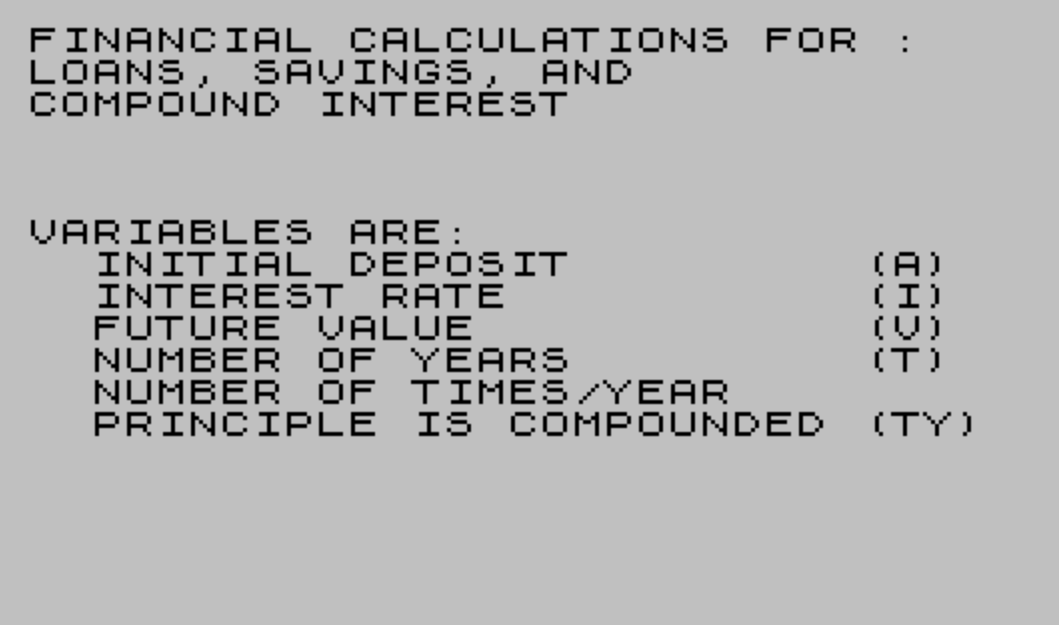
   10 PRINT AT 3,0;"FINANCIAL CALCULATIONS FOR :    LOANS, SAVINGS, AND             COMPOUND INTEREST"''
   15 PRINT AT 9,0;"VARIABLES ARE:                    INITIAL DEPOSIT         (A)     INTEREST RATE           (I)     FUTURE VALUE            (V)     NUMBER OF YEARS         (T)     NUMBER OF TIMES/YEAR            PRINCIPLE IS COMPOUNDED (TY)"
   16 PAUSE 0
   17 CLS
   20 PRINT " 1 COMPOUND INTEREST"
   25 PRINT '" 2 COMPOUND INTEREST  TO ACHIEVE    DESIRED AMOUNT"
   30 PRINT '" 3 RATE OF RETURN IN % PER YEAR"
   35 PRINT '" 4 FUTURE VALUE"
   40 PRINT '" 5 MONTHLY PAYMENT TO OBTAIN       DESIRED AMOUNT"
   45 PRINT '" 6 MONTHLY PAYMENTS FOR AMOUNT      TO BE FINANCED"
   50 PRINT '" 7 MONTHLY LOAN PAYMENT"
   55 PRINT '" 8 LOAN BALANCE AT END OF ANY      BLOCK OF PAYMENT PERIODS"
   60 PRINT '" 9 AFFORDABLE LOAN AMOUNT"
   65 PRINT '"10 SINKING FUND"
   70 INPUT "FINANCIAL CALCULATION DESIRED?         ";X
   72 IF X=0 THEN GO TO 9998
   73 IF X=11 THEN GO TO 9990
   74 IF X<1 OR X>11 THEN GO TO 10
   75 GO TO X*100+10+100*(X>9)
   80 STOP
  100 REM \{20}\{1}COMPOUND INTEREST\{20}\{0}
  110 CLS
  120 INPUT "AMOUNT TO BE COMPOUNDED? ";A
  130 INPUT "INTEREST RATE IN %? ";I:LET I=I/100
  140 INPUT "NUMBER OF YEARS MONEY IS TO COMPOUND? ";T
  150 INPUT "NUMBER OF COMPOUND PERIODS/YEAR? ";TY
  160 LET V=A*(1+I/TY)^(TY*T)
  170 PRINT "$"; INT (V*100+.5)/100;" COMPOUND INTEREST FOR ";T;" YEARS"
  180 PAUSE 0:RUN
  200 REM \{20}\{1}COMPOUND INTEREST\{20}\{0}
  210 CLS
  220 INPUT "AMOUNT TO BE COMPOUNDED? ";A
  230 INPUT "INTEREST RATE? ";I:LET I=I/100
  240 INPUT "FINAL DESIRED AMOUNT? ";V
  250 INPUT "NUMBER OF COMPOUND PERIODS/YEAR? ";TY
  260 LET T= LN (V/A)/(LN (1+I/TY)*TY)
  270 PRINT "COMPOUND ";TY;" TIMES PER YEAR WILL REQUIRE THE MONEY TO BE DEPOSITED "; INT (T*10+.5)/10;" YEARS"
  280 PAUSE 0:RUN
  300 REM \{20}\{1}RATE OF RETURN\{20}\{0}
  310 CLS
  320 INPUT "AMOUNT TO BE COMPOUNDED? ";A
  330 INPUT "FINAL AMOUNT? ";V
  340 INPUT "NUMBER OF YEARS MONEY IS TO COMPOUND? ";T
  350 INPUT "NUMBER OF COMPOUND PERIODS/YEAR? ";TY
  360 LET I=((V/A)^(1/(TY*T))-1)*TY
  370 PRINT "RATE OF RETURN IS ";I*100;"% PER YEAR"
  380 PAUSE 0:RUN
  400 REM \{20}\{1}FUTURE VALUE\{20}\{0}
  410 CLS
  420 INPUT "AMOUNT OF MONTHLY PAYMENT? ";A
  430 INPUT "INTEREST RATE IN %? ";I:LET I=I/1200
  440 INPUT "NUMBER OF YEARS? ";T:LET T=T*12
  450 LET FV=A/I*((1+I)^(T+1)-(1+I))
  460 PRINT "$"; INT (FV*100+.5)/100
  470 PAUSE 0:RUN
  500 REM \{20}\{1}PATMENTFOR AMOUNT\{20}\{0}
  510 CLS
  520 INPUT "FINAL DESIRED AMOUNT? ";FV
  530 INPUT "INTEREST RATE IN %? ";I:LET I=I/1200
  540 INPUT "NUMBER OF YEARS? ";T:LET T=T*12
  550 LET A=(FV*I)/((1-I)^(T+1)-(1+I))
  560 PRINT "$"; INT (A*100+.5)/100;" MONTHLY PAYMENTS"
  570 PAUSE 0:RUN
  600 REM \{20}\{1}NUMBER OF PAYMENTS\{20}\{0}
  610 CLS
  620 INPUT "AMOUNT TO BE FINANCED? ";P
  630 INPUT "INTEREST RATE IN %? ";I:LET I=I/1200
  640 INPUT "AMOUNT OF AFFORDABLE MONTHLY    PAYMENT? ";A
  650 LET N= LN (A/(A-P*I))/ LN (1+I)
  660 PRINT N;" MONTHLY PAYMENTS"
  670 PAUSE 0:RUN
  700 REM \{20}\{1}MONTHLY LOAN PAYMENT\{20}\{0}
  710 CLS
  720 INPUT "AMOUNT TO BE FINANCED? ";P
  730 INPUT "INTEREST RATE IN %? ";I:LET I=I/1200
  740 INPUT "NUMBER OF YEARS OF FINANCING? ";N:LET N=N*12
  750 LET A=P*(I/12)/(1-(1+I/12)^-N)
  760 PRINT "MONTHLY PAYMENT IS $"; INT (A*100+.5)/100
  770 PAUSE 0:RUN
  800 REM \{20}\{1}LOAD BALANCE\{20}\{0}
  810 CLS :INPUT "AMOUNT TO BE FINANCED? ";P
  820 INPUT "INTEREST RATE IN %? ";I:LET I=I/1200
  830 INPUT "MONTHLY PAYMENT? ";A
  840 INPUT "BEGINNING PAYMENT NUMBER? ";X
  850 INPUT "ENDING PAYMENT NUMBER? ";Y
  860 LET B=1/((I+1)^-Y)*((A*(((1+I)^-Y)-1))/I+P)
  870 PRINT "BALANCE AT THE END OF PAYMENT   NUMBER ";Y;"--$"; INT (B*100+.5)/100
  880 LET AI=B-(1/((I+1)^-(X-1))*((A*(((1+I)^-(X-1))-1))/I+P))+(Y-X+1)*A
  890 PRINT "ACCUMULATED INTEREST AT THE END OF PAYMENT NUMBER ";Y;"--$"; INT (AI*100+.5)/100
  895 PAUSE 0:RUN
 1000 REM \{20}\{1}LOAN AMOUNT\{20}\{0}
 1005 CLS
 1010 INPUT "NUMBER OF PAYMENTS DESIRED? ";N
 1020 INPUT "INTEREST RATE IN %? ";I:LET I=I/1200
 1030 INPUT "AMOUNT MONTHLY PAYMENT? ";A
 1040 LET P=A*(1-(1+I)^-N)/I
 1050 PRINT "YOU CAN AFFORD TO BORROW $";P
 1060 PAUSE 0:RUN
 1100 REM \{20}\{1}SINKING FUND\{20}\{0}
 1110 CLS
 1120 INPUT "AMOUNT TO BE ACCUMULATED? ";P
 1130 INPUT "INTEREST RATE IN %? ";I:LET I=I/100
 1140 INPUT "NUMBER OF YEARS OF ACCUMULATION? ";N
 1150 LET A=P*I/(((1+I)^N)-1)
 1160 PRINT "YEARLY DEPOSIT IS $"; INT (A*100+.5)/100
 1170 PAUSE 0:RUN
 3800 PAUSE 0:RUN
 9989 STOP
 9992 REM RANDOMIZE USR 100:SAVE "FNANCL.B1" LINE 5
 9996 RUN
 9998 REM RANDOMIZE USR 100:LOAD "L.B1"
Note: Type-in program listings on this website use ZMAKEBAS notation for graphics characters.