
This program is a hexadecimal machine-code loader that reads hex byte values entered by the user and POKEs them into memory. The user specifies a start and finish address, then enters each group of eight bytes as space-separated two-digit hex pairs (e.g., “C5 3A 00 42…”) per line. A running checksum total is accumulated and compared against a user-supplied value to catch data entry errors. Two DEF FN functions handle the hex conversion: `FN h$` converts a byte value to its two-character hex string, and `FN h` converts a single hex character back to its numeric nibble value.
Program Analysis
Program Purpose
The program allows a user to manually enter machine code listings in hexadecimal format and write them directly into RAM. It processes eight bytes per line, accumulates a checksum, and prompts the user to confirm the total before advancing, providing a basic error-detection mechanism for hand-typed hex data.
Program Structure
| Lines | Role |
|---|---|
| 10–15 | REM headers identifying the program |
| 20–30 | DEF FN definitions for hex conversion |
| 40–50 | User input: start and finish addresses |
| 60–170 | Main loop: prompt, input, decode, POKE, checksum verify |
Hex Conversion Functions
Two complementary DEF FN functions handle the hex/decimal translation:
FN h$(a)(line 20): Converts a byte value (0–255) to a two-character uppercase hex string. It splits the byte into high and low nibbles, adds 48 (ASCII ‘0’), and applies a +7 offset for values above 9 to bridge the gap between ‘9’ and ‘A’ in the character set.FN h(h$)(line 30): Converts a single hex character to its numeric nibble value. It reverses the encoding: subtracts 48 and conditionally subtracts 7 for letters A–F (characters greater than ‘9’).
Note that FN h$ is defined but never called in the main loop — only FN h is used to decode input characters.
Input Parsing
Each input line a$ is expected to contain eight two-digit hex values separated by single spaces, e.g. C5 3A 00 42 FF 01 7E 42. The inner loop (lines 80–120) processes the string by always reading characters 1 and 2, converting them via FN h(a$(1))*16+FN h(a$(2)), then slicing the string with LET A$=A$(4 TO ) to discard the consumed pair and its trailing space. This is a compact sliding-window parse technique common in Spectrum BASIC.
Checksum Mechanism
The variable tot (line 65) accumulates the sum of all eight decoded byte values. After the inner loop completes, the user is asked to INPUT t (line 140), supplying the expected total from the printed listing. If t <> tot, an error message is shown and control jumps back to line 62 to re-enter the same line. This is a simple additive checksum, not a CRC, but it is effective at catching most single-character transpositions.
Notable Techniques and Idioms
- The
IF a$="END" THEN STOPguard at line 75 provides a clean exit before the full address range is exhausted. - Mixed-case variable usage: the string is initially assigned to
a$(lowercase) but later manipulated asA$(uppercase) at line 110, which are the same variable in Sinclair BASIC. This inconsistency is harmless but worth noting. - Similarly, the inner loop counter is declared as
b(line 80) but theNEXTstatement referencesB(line 120) — again equivalent in Sinclair BASIC. - The
STEP 8on the outerFORloop (line 60) advances the address pointer by 8 after each full line is processed, matching the eight-bytes-per-line input format.
Bugs and Anomalies
- The comment at line 66 spells “hexadecimal” as “HEXIDECIMAL” — a common misspelling, not a code defect.
- If the finish address
fis not a multiple of 8 bytes beyonds, theFOR n=s TO f STEP 8loop may not reach exactlyf, potentially leaving the last few bytes unloaded. - There is no bounds checking on
a$length; if the user enters fewer than the expected 23 characters (8 pairs + 7 spaces), theA$(4 TO)slice at line 110 will eventually cause a BASIC error on the fifth or later iteration. FN h$is defined but unused in the program’s logic, suggesting this loader may be a stripped-down version of a larger utility that also included a hex-dump display feature.
Image Gallery
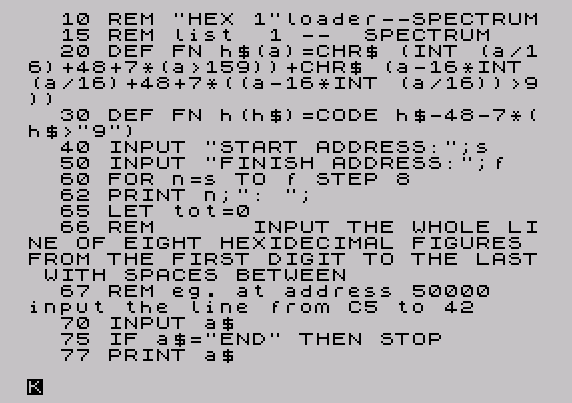
Source Code
   10 REM "HEX 1"loader--SPECTRUM
   15 REM list  1 --  SPECTRUM
   20 DEF FN h$(a)=CHR$ (INT (a/16)+48+7*(a>159))+CHR$ (a-16*INT (a/16)+48+7*((a-16*INT (a/16))>9))
   30 DEF FN h(h$)=CODE h$-48-7*(h$>"9")
   40 INPUT "START ADDRESS:";s
   50 INPUT "FINISH ADDRESS:";f
   60 FOR n=s TO f STEP 8
   62 PRINT n;": ";
   65 LET tot=0
   66 REM      INPUT THE WHOLE LINE OF EIGHT HEXIDECIMAL FIGURES FROM THE FIRST DIGIT TO THE LAST WITH SPACES BETWEEN
   67 REM eg. at address 50000   input the line from C5 to 42
   70 INPUT a$
   75 IF a$="END" THEN STOP
   77 PRINT a$
   80 FOR b=0 TO 7
   90 LET z=FN h(a$(1))*16+FN h(a$(2))
   95 LET tot=tot+z
  100 POKE (n+b),z
  110 LET A$=A$(4 TO )
  120 NEXT B
  130 PRINT " = ";
  135 REM  enter total
  140 INPUT t
  150 IF t<>tot THEN PRINT "DATA INPUT ERROR": GO TO 62
  160 PRINT t
  170 NEXT n
Note: Type-in program listings on this website use ZMAKEBAS notation for graphics characters.