
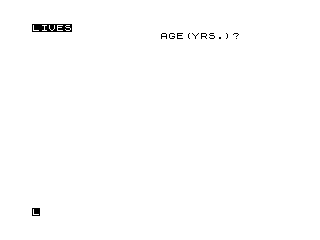
This program estimates a user’s life expectancy by asking a series of lifestyle and demographic questions, then computing a projected age at death separately for male and female outcomes. It starts with a base age value of 71 stored in variable A, then adjusts it up or down based on marital status, financial comfort, exercise habits, stress, smoking, alcohol consumption, illness frequency, and excess body weight. The subroutine at line 54 acts as a simple screen-clear-and-padding routine, calling CLS followed by three blank PRINT statements to create visual breathing room between questions. Notable is the deduction formula at line 51–52, where overweight pounds (P, accumulated in C) and alcohol score (G) are applied as fractional penalties, with females receiving a flat +7 year bonus.
Program Analysis
Program Structure
The program is a linear questionnaire with a single subroutine. Execution flows from line 1 through line 53 (STOP), collecting user responses and adjusting a running score in variable A. The subroutine at lines 54–58 is called repeatedly via GOSUB 54 to clear the screen between prompts. Lines 60 and 65 are utility lines (SAVE and RUN) that are never reached during normal execution.
Variable Usage
| Variable | Purpose |
|---|---|
A | Base life expectancy estimate, initially 71 (adjusted throughout) |
B | User’s current age in years |
C | Accumulated overweight pounds (used as a penalty divisor) |
G | Alcohol score (0, 5, or 10 entered by user) |
P | Number of pounds overweight (added to C) |
A$ | Married? response |
C$ | Financially well off? response |
D$ | Overweight? response |
E$ | Exercise frequency response |
F$ | Tense/stressed? response |
H$ | Smoker? response |
K$ | Often ill? response |
Scoring Logic
The base score A starts at 71 and is modified by the following rules:
- Married (
A$="YES"):Aset to 76 (overrides current value) - Financially comfortable (
C$="YES"):A = A - 3(anomaly — see below) - Exercises sometimes:
A = A + 3 - Exercises often:
A = A + 5 - Often tense:
A = A - 3 - Not tense:
A = A + 3 - Smoker:
A = A - 5 - Often ill:
A = A - 3 - Not often ill:
A = A + 3 - If current age
B > A:A = B + (B - A) / 2(age already exceeds estimate)
The final output applies additional penalties: overweight deduction is C/5 and alcohol deduction is G. Females receive a flat +7 year bonus over males.
Notable Techniques
The subroutine at line 54 is called both before and after some questions (e.g., lines 23 and 29 both call it around the exercise question), resulting in double screen clears in some flows. This is likely a copy-paste artifact rather than intentional design.
Line 38 handles the edge case where the user’s current age already exceeds the calculated estimate, pushing A further beyond B using a linear extrapolation: A = B + (B - A) / 2. Note that at this point B > A makes B - A positive, so the result is correctly higher than B.
Bugs and Anomalies
- Financial comfort reduces lifespan: Line 15 subtracts 3 from
Aif the user was financially well off (C$="YES" THEN LET A=A-3). This is counter-intuitive and is almost certainly a sign error — the intended adjustment was probablyA+3. - Married overwrites rather than adjusts: Line 10 sets
A=76rather than adding to the base of 71, meaning the marriage bonus is always exactly +5 regardless of prior state. IfAhad already been modified (it hasn’t at this point), the value would be lost. - Alcohol input not validated: The program trusts the user to enter exactly 0, 5, or 10 for the drink question; any numeric value is accepted and used directly as a deduction.
- Overweight logic skips input when age < 40: Line 19 jumps to line 24 if
B<40regardless ofD$, but the weight question has already been displayed. If the user answered “YES” to being overweight but is under 40, no pounds are recorded — this may be intentional (younger people’s weight is treated as less significant) but is not communicated to the user. - Double CLS calls: Lines 23 and 29 both call
GOSUB 54flanking the exercise question (lines 24–28), causing the screen to be cleared twice in quick succession on that path.
Image Gallery
Source Code
   1 LET C=0
   2 PRINT "%L%I%V%E%S"
   3 LET A=71
   4 PRINT ,"AGE(YRS.)?"
   5 INPUT B
   6 GOSUB 54
   7 PRINT ,"MARRIED?"
   8 INPUT A$
   9 GOSUB 54
  10 IF A$="YES" THEN LET A=76
  11 PRINT "HAVE YOU BEEN FAIRLY  WELL OFF"
  12 PRINT "FINANCIALLY,MOST OF YOUR LIFE?"
  13 INPUT C$
  14 GOSUB 54
  15 IF C$="YES" THEN LET A=A-3
  16 PRINT "ARE YOU OVERWEIGHT?"
  17 INPUT D$
  18 GOSUB 54
  19 IF D$="NO" OR B<40 THEN GOTO 24
  20 IF D$="YES" THEN PRINT ,"BY HOW MANY POUNDS?"
  21 INPUT P
  22 LET C=C+P
  23 GOSUB 54
  24 PRINT "EXERCISE?-NEVER/SOMETIMES/OFTEN"
  25 INPUT E$
  26 GOSUB 54
  27 IF E$="SOMETIMES" THEN LET A=A+3
  28 IF E$="OFTEN" THEN LET A=A+5
  29 GOSUB 54
  30 PRINT "ARE YOU OFTEN TENSE?"
  31 INPUT F$
  32 GOSUB 54
  33 IF F$="YES" THEN LET A=A-3
  34 IF F$="NO" THEN LET A=A+3
  35 PRINT "DRINK? LITTLE=0/MODERATE=5"
  36 PRINT ,"HEAVY=10)"
  37 INPUT G
  38 IF B>A THEN LET A=B+(B-A)/2
  39 GOSUB 54
  40 PRINT "DO YOU SMOKE?"
  41 INPUT H$
  42 IF H$="YES" THEN LET A=A-5
  43 GOSUB 54
  44 PRINT "OFTEN ILL?"
  45 INPUT K$
  46 IF K$="YES" THEN LET A=A-3
  47 IF K$="NO" THEN LET A=A+3
  48 GOSUB 54
  49 PRINT "EST. AGE AT DEATH:"
  50 PRINT
  51 PRINT ,"FEMALE-- ";A+7-C/5-G
  52 PRINT ,"MALE---- ";A-C/5-G
  53 STOP
  54 CLS
  55 PRINT
  56 PRINT
  57 PRINT
  58 RETURN
  60 SAVE "1005%2"
  65 RUN
Note: Type-in program listings on this website use ZMAKEBAS notation for graphics characters.