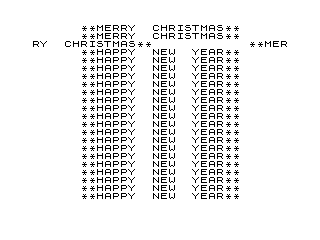
This program displays a scrolling Christmas and New Year greeting by printing messages at successive screen rows and calling a machine code routine embedded in the REM statement at line 1. The machine code (stored from address 16514) is invoked repeatedly via RAND USR 16514, which suppresses the resulting error return value. The routine itself appears to implement a colour-cycling or display effect — the inner loop of 32 calls to the machine code at line 50/110 produces a timed animation between each row advance. The program alternates between scrolling “**MERRY CHRISTMAS**” downward (rows 0–21) and “**HAPPY NEW YEAR**” upward (rows 21–0) in a continuous loop.
Program Analysis
Program Structure
The program has three distinct phases running in an infinite loop via GOTO 10 at line 140:
- Downward scroll (lines 10–70): Iterates
Afrom 0 to 21, printing “**MERRY CHRISTMAS**” at rowA, column 6, and calling the machine code routine 32 times per row for timing/effect. - Upward scroll (lines 80–130): Iterates
Afrom 21 down to 0, printing “**HAPPY NEW YEAR**” at the same column, again calling the machine code 32 times per row. - Loop restart (line 140):
GOTO 10repeats indefinitely. Line 160 is dead code — it is never reached due to line 140.
Machine Code Routine in REM
The REM statement at line 1 contains a machine code routine beginning at address 16514 (the second byte of the REM data, since 16514 = start of program + 4-byte line header + 1 for the REM token). The bytes are:
| Offset | Hex | Z80 Instruction | Notes |
|---|---|---|---|
| 0 | 3E 12 | LD A, 18 | Load attribute or border value |
| 2 | CD 1D 15 | CALL 0x151D | ROM routine (likely set colour attribute) |
| 5 | 3E 21 | LD A, 33 | Load next value |
| 7 | CD 1D 15 | CALL 0x151D | ROM routine called again |
| 10 | EF 04 34 | RST 08 / data bytes | RST 8 is ZX81 error/CALL ROM handler; 04 34 are parameters |
| 13 | CD A7 0E | CALL 0x0EA7 | ROM routine (likely SLOW/FAST display sync) |
| 16 | 2A 0C 40 | LD HL, (0x400C) | Load address from system variable area |
| 19 | 09 | ADD HL, BC | Offset into display file |
| 20 | 23 | INC HL | |
| 21 | 54 | LD D, H | |
| 22 | 5D | LD E, L | |
| 23 | 7E | LD A, (HL) | Read display byte |
| 24 | 23 | INC HL | |
| 25 | 01 1F 00 | LD BC, 31 | Block of 31 bytes |
| 28 | ED B0 | LDIR | Block copy (shift display left by one character) |
| 30 | 2B | DEC HL | |
| 31 | 77 | LD (HL), A | Write original byte to end |
| 32 | C9 | RET | Return to BASIC |
The routine performs a one-character left-rotate of a line in the display file — shifting 31 bytes left with LDIR and placing the first byte at the end, producing a hardware-level horizontal scroll effect on one row of the ZX81 display.
Role of POKE 16515
Address 16515 is the second data byte of the REM, used by the machine code as a parameter. By poking A into this location before calling the routine, the BASIC program tells the machine code which display row to scroll, synchronising the visual effect with the printed message position.
Key BASIC Idioms
RAND USR 16514— calls the machine code without needing a subroutine or risking a STOP; the random number side-effect is discarded.- The inner
FOR B=1 TO 32loop runs the scroll routine 32 times per row, providing both the scrolling animation and a timing delay. - Two-space padding in the message strings (“MERRY CHRISTMAS”, “HAPPY NEW YEAR”) is used for visual centering rather than AT column arithmetic.
Bugs and Anomalies
- Line 160 (
GOTO 10) is unreachable dead code; line 140 already loops the program back to line 10. - Line 150 is a
SAVEcommand embedded in the running program flow between lines 140 and 160 — it is also unreachable at runtime and appears to be a development artifact left in the listing.
Content
Source Code
1 REM E\CD itemtype='https://schema.org/Blog' itemscope='itemscope' class="wp-singular computer_media-template-default single single-computer_media postid-57142 wp-custom-logo wp-embed-responsive wp-theme-astra wp-child-theme-astra-child ast-desktop ast-separate-container ast-left-sidebar astra-4.12.5 group-blog ast-blog-single-style-1 ast-custom-post-type ast-single-post ast-inherit-site-logo-transparent ast-hfb-header ast-full-width-primary-header ast-box-layout ast-normal-title-enabled astra-addon-4.12.4"DE\CD itemtype='https://schema.org/Blog' itemscope='itemscope' class="wp-singular computer_media-template-default single single-computer_media postid-57142 wp-custom-logo wp-embed-responsive wp-theme-astra wp-child-theme-astra-child ast-desktop ast-separate-container ast-left-sidebar astra-4.12.5 group-blog ast-blog-single-style-1 ast-custom-post-type ast-single-post ast-inherit-site-logo-transparent ast-hfb-header ast-full-width-primary-header ast-box-layout ast-normal-title-enabled astra-addon-4.12.4"D\EF\CD\A7
Skip to content
Merry Christmas / Happy New Year
This file is part of Timex Sinclair Public Domain Library Tape 1002
. Download the collection to get this file.
This program displays a scrolling Christmas and New Year greeting by printing messages at successive screen rows and calling a machine code routine embedded in the REM statement at line 1. The machine code (stored from address 16514) is invoked repeatedly via RAND USR 16514, which suppresses the resulting error return value. The routine itself appears to implement a colour-cycling or display effect — the inner loop of 32 calls to the machine code at line 50/110 produces a timed animation between each row advance. The program alternates between scrolling “**MERRY CHRISTMAS**” downward (rows 0–21) and “**HAPPY NEW YEAR**” upward (rows 21–0) in a continuous loop.
Program Analysis
Program Structure
The program has three distinct phases running in an infinite loop via GOTO 10 at line 140:
- Downward scroll (lines 10–70): Iterates
A from 0 to 21, printing “**MERRY CHRISTMAS**” at row A, column 6, and calling the machine code routine 32 times per row for timing/effect.
- Upward scroll (lines 80–130): Iterates
A from 21 down to 0, printing “**HAPPY NEW YEAR**” at the same column, again calling the machine code 32 times per row.
- Loop restart (line 140):
GOTO 10 repeats indefinitely. Line 160 is dead code — it is never reached due to line 140.
Machine Code Routine in REM
The REM statement at line 1 contains a machine code routine beginning at address 16514 (the second byte of the REM data, since 16514 = start of program + 4-byte line header + 1 for the REM token). The bytes are:
Offset Hex Z80 Instruction Notes 0 3E 12LD A, 18 Load attribute or border value 2 CD 1D 15CALL 0x151D ROM routine (likely set colour attribute) 5 3E 21LD A, 33 Load next value 7 CD 1D 15CALL 0x151D ROM routine called again 10 EF 04 34RST 08 / data bytes RST 8 is ZX81 error/CALL ROM handler; 04 34 are parameters 13 CD A7 0ECALL 0x0EA7 ROM routine (likely SLOW/FAST display sync) 16 2A 0C 40LD HL, (0x400C) Load address from system variable area 19 09ADD HL, BC Offset into display file 20 23INC HL 21 54LD D, H 22 5DLD E, L 23 7ELD A, (HL) Read display byte 24 23INC HL 25 01 1F 00LD BC, 31 Block of 31 bytes 28 ED B0LDIR Block copy (shift display left by one character) 30 2BDEC HL 31 77LD (HL), A Write original byte to end 32 C9RET Return to BASIC
The routine performs a one-character left-rotate of a line in the display file — shifting 31 bytes left with LDIR and placing the first byte at the end, producing a hardware-level horizontal scroll effect on one row of the ZX81 display.
Role of POKE 16515
Address 16515 is the second data byte of the REM, used by the machine code as a parameter. By poking A into this location before calling the routine, the BASIC program tells the machine code which display row to scroll, synchronising the visual effect with the printed message position.
Key BASIC Idioms
RAND USR 16514 — calls the machine code without needing a subroutine or risking a STOP; the random number side-effect is discarded.
- The inner
FOR B=1 TO 32 loop runs the scroll routine 32 times per row, providing both the scrolling animation and a timing delay.
- Two-space padding in the message strings (“MERRY CHRISTMAS”, “HAPPY NEW YEAR”) is used for visual centering rather than AT column arithmetic.
Bugs and Anomalies
- Line 160 (
GOTO 10) is unreachable dead code; line 140 already loops the program back to line 10.
- Line 150 is a
SAVE command embedded in the running program flow between lines 140 and 160 — it is also unreachable at runtime and appears to be a development artifact left in the listing.
Content
Source Code
1 REM \3E\12\CD\1D\15\3E\21\CD\1D\15\EF\04\34\CD\A7\0E\2A\0C\40\09\23\54\5D\7E\23\01\1F\00\ED\B0\2B\77\C9
10 FOR A=0 TO 21
20 POKE 16515,A
30 PRINT AT A,6;"**MERRY CHRISTMAS**"
40 FOR B=1 TO 32
50 RAND USR 16514
60 NEXT B
70 NEXT A
80 FOR A=21 TO 0 STEP -1
85 POKE 16515,A
90 PRINT AT A,6;"**HAPPY NEW YEAR**"
100 FOR B=1 TO 32
110 RAND USR 16514
120 NEXT B
130 NEXT A
140 GOTO 10
150 SAVE "1009%1"
160 GOTO 10
Note: Type-in program listings on this website use ZMAKEBAS notation for graphics characters.
People
No people associated with this content.
E
Skip to content
Merry Christmas / Happy New Year
This file is part of Timex Sinclair Public Domain Library Tape 1002
. Download the collection to get this file.
This program displays a scrolling Christmas and New Year greeting by printing messages at successive screen rows and calling a machine code routine embedded in the REM statement at line 1. The machine code (stored from address 16514) is invoked repeatedly via RAND USR 16514, which suppresses the resulting error return value. The routine itself appears to implement a colour-cycling or display effect — the inner loop of 32 calls to the machine code at line 50/110 produces a timed animation between each row advance. The program alternates between scrolling “**MERRY CHRISTMAS**” downward (rows 0–21) and “**HAPPY NEW YEAR**” upward (rows 21–0) in a continuous loop.
Program Analysis
Program Structure
The program has three distinct phases running in an infinite loop via GOTO 10 at line 140:
- Downward scroll (lines 10–70): Iterates
A from 0 to 21, printing “**MERRY CHRISTMAS**” at row A, column 6, and calling the machine code routine 32 times per row for timing/effect.
- Upward scroll (lines 80–130): Iterates
A from 21 down to 0, printing “**HAPPY NEW YEAR**” at the same column, again calling the machine code 32 times per row.
- Loop restart (line 140):
GOTO 10 repeats indefinitely. Line 160 is dead code — it is never reached due to line 140.
Machine Code Routine in REM
The REM statement at line 1 contains a machine code routine beginning at address 16514 (the second byte of the REM data, since 16514 = start of program + 4-byte line header + 1 for the REM token). The bytes are:
Offset Hex Z80 Instruction Notes 0 3E 12LD A, 18 Load attribute or border value 2 CD 1D 15CALL 0x151D ROM routine (likely set colour attribute) 5 3E 21LD A, 33 Load next value 7 CD 1D 15CALL 0x151D ROM routine called again 10 EF 04 34RST 08 / data bytes RST 8 is ZX81 error/CALL ROM handler; 04 34 are parameters 13 CD A7 0ECALL 0x0EA7 ROM routine (likely SLOW/FAST display sync) 16 2A 0C 40LD HL, (0x400C) Load address from system variable area 19 09ADD HL, BC Offset into display file 20 23INC HL 21 54LD D, H 22 5DLD E, L 23 7ELD A, (HL) Read display byte 24 23INC HL 25 01 1F 00LD BC, 31 Block of 31 bytes 28 ED B0LDIR Block copy (shift display left by one character) 30 2BDEC HL 31 77LD (HL), A Write original byte to end 32 C9RET Return to BASIC
The routine performs a one-character left-rotate of a line in the display file — shifting 31 bytes left with LDIR and placing the first byte at the end, producing a hardware-level horizontal scroll effect on one row of the ZX81 display.
Role of POKE 16515
Address 16515 is the second data byte of the REM, used by the machine code as a parameter. By poking A into this location before calling the routine, the BASIC program tells the machine code which display row to scroll, synchronising the visual effect with the printed message position.
Key BASIC Idioms
RAND USR 16514 — calls the machine code without needing a subroutine or risking a STOP; the random number side-effect is discarded.
- The inner
FOR B=1 TO 32 loop runs the scroll routine 32 times per row, providing both the scrolling animation and a timing delay.
- Two-space padding in the message strings (“MERRY CHRISTMAS”, “HAPPY NEW YEAR”) is used for visual centering rather than AT column arithmetic.
Bugs and Anomalies
- Line 160 (
GOTO 10) is unreachable dead code; line 140 already loops the program back to line 10.
- Line 150 is a
SAVE command embedded in the running program flow between lines 140 and 160 — it is also unreachable at runtime and appears to be a development artifact left in the listing.
Content
Source Code
1 REM \3E\12\CD\1D\15\3E\21\CD\1D\15\EF\04\34\CD\A7\0E\2A\0C\40\09\23\54\5D\7E\23\01\1F\00\ED\B0\2B\77\C9
10 FOR A=0 TO 21
20 POKE 16515,A
30 PRINT AT A,6;"**MERRY CHRISTMAS**"
40 FOR B=1 TO 32
50 RAND USR 16514
60 NEXT B
70 NEXT A
80 FOR A=21 TO 0 STEP -1
85 POKE 16515,A
90 PRINT AT A,6;"**HAPPY NEW YEAR**"
100 FOR B=1 TO 32
110 RAND USR 16514
120 NEXT B
130 NEXT A
140 GOTO 10
150 SAVE "1009%1"
160 GOTO 10
Note: Type-in program listings on this website use ZMAKEBAS notation for graphics characters.
People
No people associated with this content.
A
Skip to content
Merry Christmas / Happy New Year
This file is part of Timex Sinclair Public Domain Library Tape 1002
. Download the collection to get this file.
This program displays a scrolling Christmas and New Year greeting by printing messages at successive screen rows and calling a machine code routine embedded in the REM statement at line 1. The machine code (stored from address 16514) is invoked repeatedly via RAND USR 16514, which suppresses the resulting error return value. The routine itself appears to implement a colour-cycling or display effect — the inner loop of 32 calls to the machine code at line 50/110 produces a timed animation between each row advance. The program alternates between scrolling “**MERRY CHRISTMAS**” downward (rows 0–21) and “**HAPPY NEW YEAR**” upward (rows 21–0) in a continuous loop.
Program Analysis
Program Structure
The program has three distinct phases running in an infinite loop via GOTO 10 at line 140:
- Downward scroll (lines 10–70): Iterates
A from 0 to 21, printing “**MERRY CHRISTMAS**” at row A, column 6, and calling the machine code routine 32 times per row for timing/effect.
- Upward scroll (lines 80–130): Iterates
A from 21 down to 0, printing “**HAPPY NEW YEAR**” at the same column, again calling the machine code 32 times per row.
- Loop restart (line 140):
GOTO 10 repeats indefinitely. Line 160 is dead code — it is never reached due to line 140.
Machine Code Routine in REM
The REM statement at line 1 contains a machine code routine beginning at address 16514 (the second byte of the REM data, since 16514 = start of program + 4-byte line header + 1 for the REM token). The bytes are:
Offset Hex Z80 Instruction Notes 0 3E 12LD A, 18 Load attribute or border value 2 CD 1D 15CALL 0x151D ROM routine (likely set colour attribute) 5 3E 21LD A, 33 Load next value 7 CD 1D 15CALL 0x151D ROM routine called again 10 EF 04 34RST 08 / data bytes RST 8 is ZX81 error/CALL ROM handler; 04 34 are parameters 13 CD A7 0ECALL 0x0EA7 ROM routine (likely SLOW/FAST display sync) 16 2A 0C 40LD HL, (0x400C) Load address from system variable area 19 09ADD HL, BC Offset into display file 20 23INC HL 21 54LD D, H 22 5DLD E, L 23 7ELD A, (HL) Read display byte 24 23INC HL 25 01 1F 00LD BC, 31 Block of 31 bytes 28 ED B0LDIR Block copy (shift display left by one character) 30 2BDEC HL 31 77LD (HL), A Write original byte to end 32 C9RET Return to BASIC
The routine performs a one-character left-rotate of a line in the display file — shifting 31 bytes left with LDIR and placing the first byte at the end, producing a hardware-level horizontal scroll effect on one row of the ZX81 display.
Role of POKE 16515
Address 16515 is the second data byte of the REM, used by the machine code as a parameter. By poking A into this location before calling the routine, the BASIC program tells the machine code which display row to scroll, synchronising the visual effect with the printed message position.
Key BASIC Idioms
RAND USR 16514 — calls the machine code without needing a subroutine or risking a STOP; the random number side-effect is discarded.
- The inner
FOR B=1 TO 32 loop runs the scroll routine 32 times per row, providing both the scrolling animation and a timing delay.
- Two-space padding in the message strings (“MERRY CHRISTMAS”, “HAPPY NEW YEAR”) is used for visual centering rather than AT column arithmetic.
Bugs and Anomalies
- Line 160 (
GOTO 10) is unreachable dead code; line 140 already loops the program back to line 10.
- Line 150 is a
SAVE command embedded in the running program flow between lines 140 and 160 — it is also unreachable at runtime and appears to be a development artifact left in the listing.
Content
Source Code
1 REM \3E\12\CD\1D\15\3E\21\CD\1D\15\EF\04\34\CD\A7\0E\2A\0C\40\09\23\54\5D\7E\23\01\1F\00\ED\B0\2B\77\C9
10 FOR A=0 TO 21
20 POKE 16515,A
30 PRINT AT A,6;"**MERRY CHRISTMAS**"
40 FOR B=1 TO 32
50 RAND USR 16514
60 NEXT B
70 NEXT A
80 FOR A=21 TO 0 STEP -1
85 POKE 16515,A
90 PRINT AT A,6;"**HAPPY NEW YEAR**"
100 FOR B=1 TO 32
110 RAND USR 16514
120 NEXT B
130 NEXT A
140 GOTO 10
150 SAVE "1009%1"
160 GOTO 10
Note: Type-in program listings on this website use ZMAKEBAS notation for graphics characters.
People
No people associated with this content.
CDE itemtype='https://schema.org/Blog' itemscope='itemscope' class="wp-singular computer_media-template-default single single-computer_media postid-57142 wp-custom-logo wp-embed-responsive wp-theme-astra wp-child-theme-astra-child ast-desktop ast-separate-container ast-left-sidebar astra-4.12.5 group-blog ast-blog-single-style-1 ast-custom-post-type ast-single-post ast-inherit-site-logo-transparent ast-hfb-header ast-full-width-primary-header ast-box-layout ast-normal-title-enabled astra-addon-4.12.4" itemtype='https://schema.org/Blog' itemscope='itemscope' class="wp-singular computer_media-template-default single single-computer_media postid-57142 wp-custom-logo wp-embed-responsive wp-theme-astra wp-child-theme-astra-child ast-desktop ast-separate-container ast-left-sidebar astra-4.12.5 group-blog ast-blog-single-style-1 ast-custom-post-type ast-single-post ast-inherit-site-logo-transparent ast-hfb-header ast-full-width-primary-header ast-box-layout ast-normal-title-enabled astra-addon-4.12.4"F
Skip to content
Merry Christmas / Happy New Year
This file is part of Timex Sinclair Public Domain Library Tape 1002
. Download the collection to get this file.
This program displays a scrolling Christmas and New Year greeting by printing messages at successive screen rows and calling a machine code routine embedded in the REM statement at line 1. The machine code (stored from address 16514) is invoked repeatedly via RAND USR 16514, which suppresses the resulting error return value. The routine itself appears to implement a colour-cycling or display effect — the inner loop of 32 calls to the machine code at line 50/110 produces a timed animation between each row advance. The program alternates between scrolling “**MERRY CHRISTMAS**” downward (rows 0–21) and “**HAPPY NEW YEAR**” upward (rows 21–0) in a continuous loop.
Program Analysis
Program Structure
The program has three distinct phases running in an infinite loop via GOTO 10 at line 140:
- Downward scroll (lines 10–70): Iterates
A from 0 to 21, printing “**MERRY CHRISTMAS**” at row A, column 6, and calling the machine code routine 32 times per row for timing/effect.
- Upward scroll (lines 80–130): Iterates
A from 21 down to 0, printing “**HAPPY NEW YEAR**” at the same column, again calling the machine code 32 times per row.
- Loop restart (line 140):
GOTO 10 repeats indefinitely. Line 160 is dead code — it is never reached due to line 140.
Machine Code Routine in REM
The REM statement at line 1 contains a machine code routine beginning at address 16514 (the second byte of the REM data, since 16514 = start of program + 4-byte line header + 1 for the REM token). The bytes are:
Offset Hex Z80 Instruction Notes 0 3E 12LD A, 18 Load attribute or border value 2 CD 1D 15CALL 0x151D ROM routine (likely set colour attribute) 5 3E 21LD A, 33 Load next value 7 CD 1D 15CALL 0x151D ROM routine called again 10 EF 04 34RST 08 / data bytes RST 8 is ZX81 error/CALL ROM handler; 04 34 are parameters 13 CD A7 0ECALL 0x0EA7 ROM routine (likely SLOW/FAST display sync) 16 2A 0C 40LD HL, (0x400C) Load address from system variable area 19 09ADD HL, BC Offset into display file 20 23INC HL 21 54LD D, H 22 5DLD E, L 23 7ELD A, (HL) Read display byte 24 23INC HL 25 01 1F 00LD BC, 31 Block of 31 bytes 28 ED B0LDIR Block copy (shift display left by one character) 30 2BDEC HL 31 77LD (HL), A Write original byte to end 32 C9RET Return to BASIC
The routine performs a one-character left-rotate of a line in the display file — shifting 31 bytes left with LDIR and placing the first byte at the end, producing a hardware-level horizontal scroll effect on one row of the ZX81 display.
Role of POKE 16515
Address 16515 is the second data byte of the REM, used by the machine code as a parameter. By poking A into this location before calling the routine, the BASIC program tells the machine code which display row to scroll, synchronising the visual effect with the printed message position.
Key BASIC Idioms
RAND USR 16514 — calls the machine code without needing a subroutine or risking a STOP; the random number side-effect is discarded.
- The inner
FOR B=1 TO 32 loop runs the scroll routine 32 times per row, providing both the scrolling animation and a timing delay.
- Two-space padding in the message strings (“MERRY CHRISTMAS”, “HAPPY NEW YEAR”) is used for visual centering rather than AT column arithmetic.
Bugs and Anomalies
- Line 160 (
GOTO 10) is unreachable dead code; line 140 already loops the program back to line 10.
- Line 150 is a
SAVE command embedded in the running program flow between lines 140 and 160 — it is also unreachable at runtime and appears to be a development artifact left in the listing.
Content
Source Code
1 REM \3E\12\CD\1D\15\3E\21\CD\1D\15\EF\04\34\CD\A7\0E\2A\0C\40\09\23\54\5D\7E\23\01\1F\00\ED\B0\2B\77\C9
10 FOR A=0 TO 21
20 POKE 16515,A
30 PRINT AT A,6;"**MERRY CHRISTMAS**"
40 FOR B=1 TO 32
50 RAND USR 16514
60 NEXT B
70 NEXT A
80 FOR A=21 TO 0 STEP -1
85 POKE 16515,A
90 PRINT AT A,6;"**HAPPY NEW YEAR**"
100 FOR B=1 TO 32
110 RAND USR 16514
120 NEXT B
130 NEXT A
140 GOTO 10
150 SAVE "1009%1"
160 GOTO 10
Note: Type-in program listings on this website use ZMAKEBAS notation for graphics characters.
People
No people associated with this content.
\ED\B0
Skip to content
Merry Christmas / Happy New Year
This file is part of Timex Sinclair Public Domain Library Tape 1002
. Download the collection to get this file.
This program displays a scrolling Christmas and New Year greeting by printing messages at successive screen rows and calling a machine code routine embedded in the REM statement at line 1. The machine code (stored from address 16514) is invoked repeatedly via RAND USR 16514, which suppresses the resulting error return value. The routine itself appears to implement a colour-cycling or display effect — the inner loop of 32 calls to the machine code at line 50/110 produces a timed animation between each row advance. The program alternates between scrolling “**MERRY CHRISTMAS**” downward (rows 0–21) and “**HAPPY NEW YEAR**” upward (rows 21–0) in a continuous loop.
Program Analysis
Program Structure
The program has three distinct phases running in an infinite loop via GOTO 10 at line 140:
- Downward scroll (lines 10–70): Iterates
A from 0 to 21, printing “**MERRY CHRISTMAS**” at row A, column 6, and calling the machine code routine 32 times per row for timing/effect.
- Upward scroll (lines 80–130): Iterates
A from 21 down to 0, printing “**HAPPY NEW YEAR**” at the same column, again calling the machine code 32 times per row.
- Loop restart (line 140):
GOTO 10 repeats indefinitely. Line 160 is dead code — it is never reached due to line 140.
Machine Code Routine in REM
The REM statement at line 1 contains a machine code routine beginning at address 16514 (the second byte of the REM data, since 16514 = start of program + 4-byte line header + 1 for the REM token). The bytes are:
Offset Hex Z80 Instruction Notes 0 3E 12LD A, 18 Load attribute or border value 2 CD 1D 15CALL 0x151D ROM routine (likely set colour attribute) 5 3E 21LD A, 33 Load next value 7 CD 1D 15CALL 0x151D ROM routine called again 10 EF 04 34RST 08 / data bytes RST 8 is ZX81 error/CALL ROM handler; 04 34 are parameters 13 CD A7 0ECALL 0x0EA7 ROM routine (likely SLOW/FAST display sync) 16 2A 0C 40LD HL, (0x400C) Load address from system variable area 19 09ADD HL, BC Offset into display file 20 23INC HL 21 54LD D, H 22 5DLD E, L 23 7ELD A, (HL) Read display byte 24 23INC HL 25 01 1F 00LD BC, 31 Block of 31 bytes 28 ED B0LDIR Block copy (shift display left by one character) 30 2BDEC HL 31 77LD (HL), A Write original byte to end 32 C9RET Return to BASIC
The routine performs a one-character left-rotate of a line in the display file — shifting 31 bytes left with LDIR and placing the first byte at the end, producing a hardware-level horizontal scroll effect on one row of the ZX81 display.
Role of POKE 16515
Address 16515 is the second data byte of the REM, used by the machine code as a parameter. By poking A into this location before calling the routine, the BASIC program tells the machine code which display row to scroll, synchronising the visual effect with the printed message position.
Key BASIC Idioms
RAND USR 16514 — calls the machine code without needing a subroutine or risking a STOP; the random number side-effect is discarded.
- The inner
FOR B=1 TO 32 loop runs the scroll routine 32 times per row, providing both the scrolling animation and a timing delay.
- Two-space padding in the message strings (“MERRY CHRISTMAS”, “HAPPY NEW YEAR”) is used for visual centering rather than AT column arithmetic.
Bugs and Anomalies
- Line 160 (
GOTO 10) is unreachable dead code; line 140 already loops the program back to line 10.
- Line 150 is a
SAVE command embedded in the running program flow between lines 140 and 160 — it is also unreachable at runtime and appears to be a development artifact left in the listing.
Content
Source Code
1 REM \3E\12\CD\1D\15\3E\21\CD\1D\15\EF\04\34\CD\A7\0E\2A\0C\40\09\23\54\5D\7E\23\01\1F\00\ED\B0\2B\77\C9
10 FOR A=0 TO 21
20 POKE 16515,A
30 PRINT AT A,6;"**MERRY CHRISTMAS**"
40 FOR B=1 TO 32
50 RAND USR 16514
60 NEXT B
70 NEXT A
80 FOR A=21 TO 0 STEP -1
85 POKE 16515,A
90 PRINT AT A,6;"**HAPPY NEW YEAR**"
100 FOR B=1 TO 32
110 RAND USR 16514
120 NEXT B
130 NEXT A
140 GOTO 10
150 SAVE "1009%1"
160 GOTO 10
Note: Type-in program listings on this website use ZMAKEBAS notation for graphics characters.
People
No people associated with this content.
B\C9
10 FOR A=0 TO 21
20 POKE 16515,A
30 PRINT AT A,6;"**MERRY CHRISTMAS**"
40 FOR B=1 TO 32
50 RAND USR 16514
60 NEXT B
70 NEXT A
80 FOR A=21 TO 0 STEP -1
85 POKE 16515,A
90 PRINT AT A,6;"**HAPPY NEW YEAR**"
100 FOR B=1 TO 32
110 RAND USR 16514
120 NEXT B
130 NEXT A
140 GOTO 10
150 SAVE "1009%1"
160 GOTO 10
Note: Type-in program listings on this website use ZMAKEBAS notation for graphics characters.