
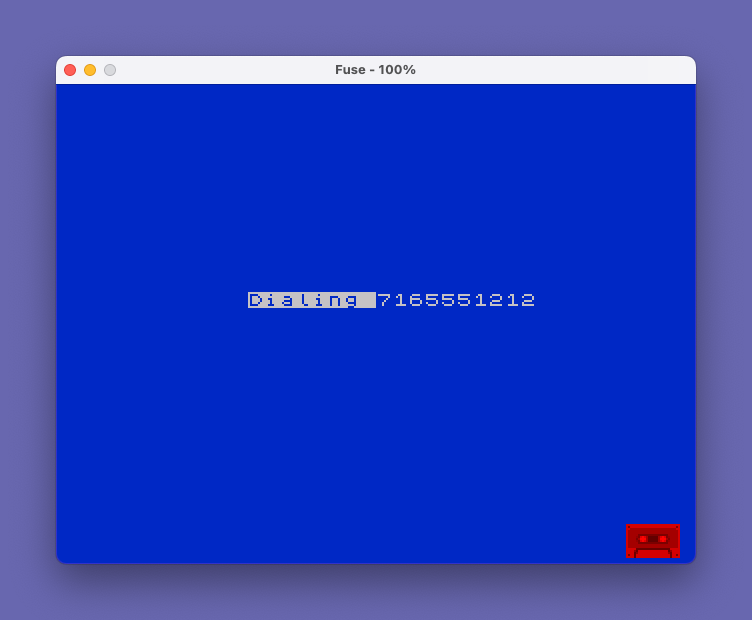
This program automates telephone dialing by sending pulse sequences through the TS2068’s expansion port (I/O port 119), then monitors the same port for a connection signal before launching MTerm. Each digit is converted into a series of ON/OFF pulses via OUT 119 instructions, with the zero digit correctly mapped to 10 pulses at line 32. After dialing, the program polls IN 119 for the value 133 (line 165) to detect a carrier signal, plays a BEEP alert on connection, then patches a block of machine code in RAM via POKE statements before invoking it with PRINT USR 54016. The DATA block at line 300 contains 20 bytes of Z80 machine code patched into addresses 61193–61211, and several other POKEs at lines 220–260 modify MTERM.
Program Analysis
Program Structure
The program is divided into four functional phases:
- Input & dial: Lines 1–55 — prompt for a phone number string, then loop over each character to generate dial pulses.
- Pulse generation subroutine: Lines 60–140 — a
GO SUBroutine that firesapulse pairs through port 119. - Connection detection: Lines 160–180 — poll
IN 119up to 2000 times, branching on value 133 (carrier detected), otherwise resetting and redialing. - MTERM launch: Lines 200–305 — alert the user with
BEEP, patch the resident terminal program in RAM, and invoke machine code viaPRINT USR 54016.
Note that line 55 jumps to line 150, which does not exist; execution falls through to line 160. This is an intentional technique to enter the connection-polling loop.
Pulse Dialing via Port 119
Port 119 is the TS2068’s expansion bus control port (also used by the AY sound chip interface region and external hardware). Here it is used to toggle an attached relay or phone interface. Each digit produces a sequence of pulse pairs:
OUT 119,ewithecycling 3→4 raises and lowers the line.PAUSE 2.5(approximately 50 ms at 50 Hz) sets pulse width.OUT 119,1andOUT 119,2provide inter-pulse spacing (line 110–120).- The digit zero is remapped to 10 pulses at line 32 (
IF a=0 THEN LET a=10), matching the standard pulse-dial convention. PAUSE 35at line 35 provides the inter-digit pause (~700 ms).
The initial OUT 119,31 at line 15 followed by PAUSE 50 appears to assert an off-hook condition before dialing begins.
Connection Detection
Lines 160–180 implement a polling loop. IN 119 is read up to 2000 iterations; if it returns the value 133, a carrier has been detected. If no carrier is found within the loop, OUT 119,0 hangs up, a pause is taken, and the program restarts at line 3 (re-displaying the dialing screen and redialing). The value 133 (binary 10000101) is hardware-specific to the attached modem or phone interface.
MTERM Patching and Machine-Code Launch
On successful connection, lines 220–280 directly patch a terminal program (MTERM) already loaded elsewhere in RAM. This is a sophisticated technique: rather than loading MTERM from tape at runtime, it is assumed to be pre-resident, and specific bytes are modified to configure it for the current session.
| Lines | Address Range | Purpose |
|---|---|---|
| 220 | 61157–61158 | POKE 24, 6 — likely a JP offset or configuration byte |
| 230 | 61170, 61172 | POKE 184 — baud rate or port configuration bytes |
| 240 | 61193–61211 | 19 bytes of Z80 machine code from the DATA block |
| 250 | 61311–61331 | Fill 21 bytes with 32 (ASCII space / Z80 NOP equivalent region) |
| 260 | 61699 | POKE 21 — likely a screen or protocol parameter |
The DATA bytes at line 300 are: 254,147,27,95,254,147,27,95,234,246,50,193,154,89,193,247,105,105,121,195. Decoding these as Z80 instructions reveals patterns such as CP 147 (FE 93), DEC DE (1B), LD E,A (5F), JP Z,nnnn (CA/C2), and LD A,C (79), suggesting a receive/transmit character dispatch routine. The terminal is then invoked with PRINT USR 54016, calling machine code at address 54016.
Notable BASIC Idioms and Anomalies
LET a=VAL a$(i)extracts a single digit from the phone number string by taking a one-character substring and converting it — a common Sinclair BASIC idiom since direct character-to-digit conversion is otherwise unavailable withoutCODE.- The connection-alert loop at lines 200–218 uses
INKEY$polled withoutPAUSE 0; it loops viaGO TO 200, replaying theBEEPsequence each pass, which gives a repeated beep until Enter is pressed. LISTat line 305 after launching the machine code is unreachable under normal execution and appears to be a debugging remnant.- The
FLASH 1attribute in both the dialing message (line 19) and the connected message (line 165) provides visual feedback without any additional logic. PAUSE 2.5at line 90 uses a non-integer argument; the system truncates or rounds this to the nearest frame count (2 or 3 frames, ~40–60 ms), giving approximate pulse timing for the phone line.
Image Gallery
Source Code
    1 INPUT "Phone Number?";a$
    3 CLS
   15 OUT 119,31
   18 PAUSE 50
   19 PRINT AT 10,8; FLASH 1;"Dialing "; FLASH 0;a$
   20 FOR i=1 TO LEN a$
   30 LET a=VAL a$(i)
   32 IF a=0 THEN LET a=10
   35 PAUSE 32
   40 GO SUB 60
   50 NEXT i
   55 GO TO 150
   60 FOR d=1 TO a
   70 FOR e=3 TO 4
   80 OUT 119,e
   90 PAUSE 2.5
  100 NEXT e
  110 OUT 119,1
  120 OUT 119,2
  130 NEXT d
  140 RETURN
  160 FOR i=1 TO 2000
  165 IF IN 119=133 THEN CLS : PRINT FLASH 1;"C O N N E C T E D ! !": GO TO 200
  168 NEXT i
  170 OUT 119,0
  175 PAUSE 100
  180 GO TO 3
  200 FOR i=1 TO 10: BEEP .05,18: NEXT i
  210 LET g$=INKEY$: PRINT AT 10,0; FLASH 1;"Hit <ENTER> to Start MTERM"
  215 IF g$=CHR$ 13 THEN GO TO 220
  218 GO TO 200
  220 POKE 61157,24: POKE 61158,6
  230 POKE 61170,184: POKE 61172,184
  240 FOR i=61193 TO 61211: READ m: POKE i,m: NEXT i
  250 FOR i=61311 TO 61331: POKE i,32: NEXT i
  260 POKE 61699,21
  280 OUT 119,34: PRINT USR 54016
  300 DATA 254,147,27,95,254,147,27,95,234,246,50,193,154,89,193,247,105,105,121,195
  305 LIST
Note: Type-in program listings on this website use ZMAKEBAS notation for graphics characters.