
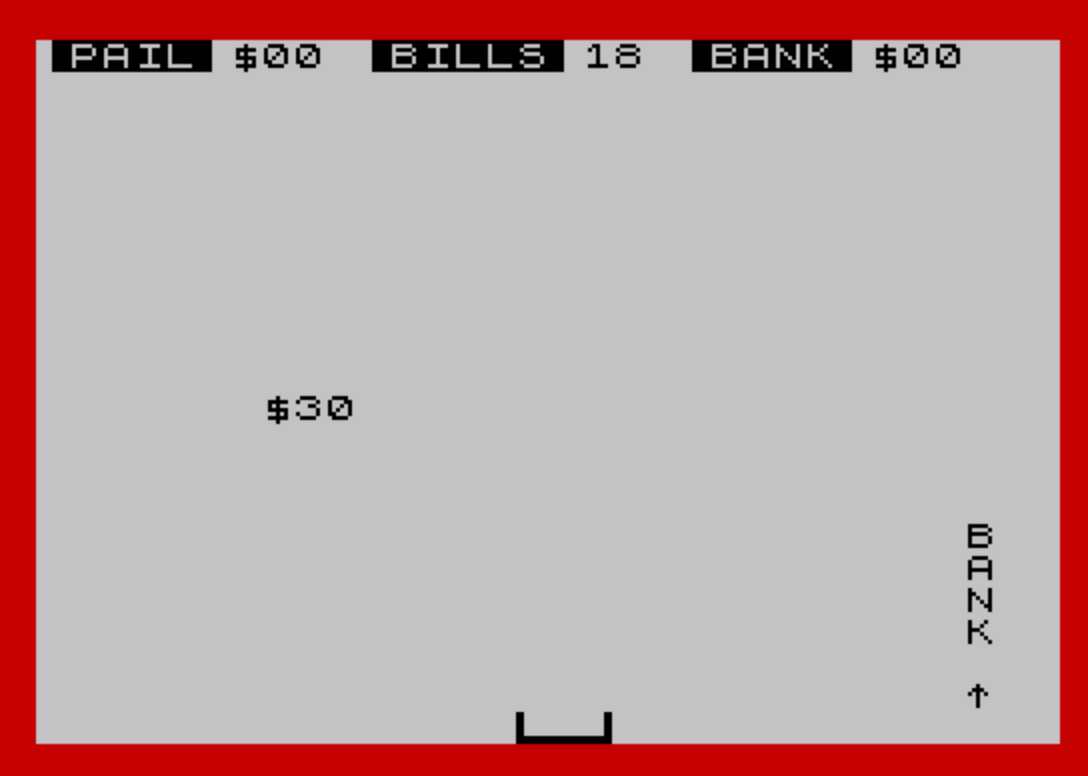
Money Pail is a catching game in which dollar bills of random denominations fall from the top of the screen and the player moves a pail left and right using the N and M keys to collect them. The pail has a capacity of five bills before it must be taken to a bank column on the right side of the screen, which is triggered automatically when the pail reaches column 27. Eight user-defined graphics (UDGs \a through \h) are loaded from DATA statements to draw the pail sprite and a progressive fill animation representing the bank vault. The SOUND statement is used extensively for audio feedback, including a multi-channel coin-collection fanfare and movement beeps whose pitch corresponds to the vertical position of the falling bill. Skill level selection adjusts two variables, d (BEEP delay) and h (starting row for the drop loop), controlling both fall speed and how early bills become visible.
Program Analysis
Program Structure
The code is organized into clearly separated functional blocks accessed via GO SUB:
- Lines 1–10: Startup beep and entry jump to the main initialization routine at line 1000.
- Lines 100–150: Score/collection subroutine — awards a point, plays a SOUND fanfare, and updates the pail graphic.
- Lines 200–230: Bank subroutine — resets the score counter, accumulates total, animates the bank filling up, and plays a two-tone beep.
- Lines 1000–1060: Main game initialization: calls UDG loader (6000), calls intro/skill screen (4000), sets border/paper/ink, initializes variables, and draws the HUD.
- Lines 2000–2140: Core game loop — 20 drops per round, each with a falling bill and player movement inner loop.
- Lines 3000–3040: End-of-round handler — prompts for replay, loops back to line 1020 (skipping UDG reload).
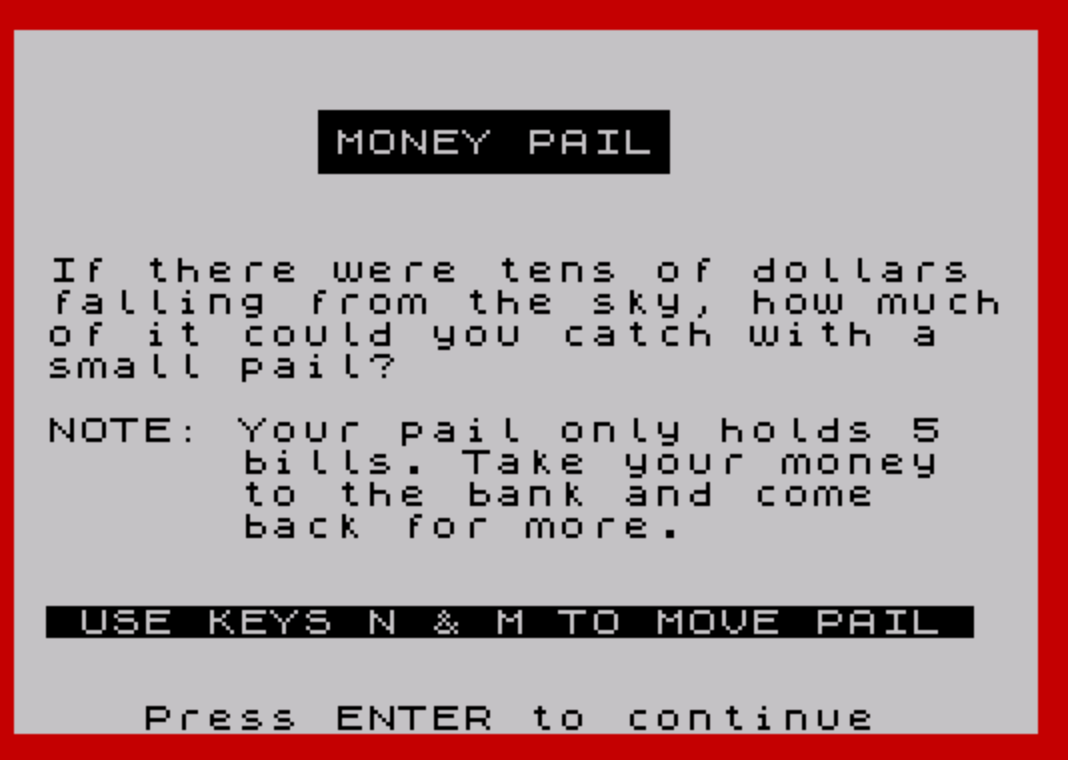
- Lines 4010–4100: Introduction screen, instructions, and skill level selector.
- Lines 6010–6050: UDG definition loader — reads 8×8-byte bitmaps from DATA into UDGs \a through \h.
- Lines 9998–9999: Save/verify block.
User-Defined Graphics
Eight UDGs (\a–\h) are defined at lines 6010–6036, each loaded by a dedicated FOR loop reading 8 bytes from the DATA block at line 6040. The 64 bytes encode eight tiles. UDGs \a, \b, \c form the three-character pail sprite displayed at line 21. UDG \d through \h appear to encode a progressive bar used in the bank fill animation at line 220, where successive PRINT AT statements walk upward from row 12 to row 2 in steps of 2 to simulate bills stacking.
The DATA at line 6040 follows a clear pattern: each successive 8-byte group adds one more set bit column from the left (192, 0, 3, then increasing fill patterns), suggesting a partial-fill visual sequence rather than pictographic characters.
Core Game Loop
The outer loop (lines 2010–2140) iterates 20 times per round (FOR a=1 TO 20). Each iteration:
- Picks a random denomination:
q=10*(INT(RND*9)+1), giving multiples of 10 from 10 to 90. The labela$is built as"$"+CHR$(q/10+48)+"0"— a three-character string like$30. - Picks a random horizontal column
cin the range 3–24. - Runs an inner loop (
FOR b=h TO 20) where the bill falls one row per iteration. The starting rowhis set by the skill level, making harder levels start higher and therefore give less reaction time. - Inside the inner loop, player movement is handled inline:
LET p=p-(INKEY$="n")+(INKEY$="m")with boundary clamping:LET p=p+(p=0)-(p=28). - After the fall, checks for a bank visit (line 2115,
p=27) and a catch (line 2120,c=p+1 AND sc<5).
Key BASIC Idioms and Techniques
- Boolean arithmetic for movement clamping:
p+(p=0)-(p=28)exploits the fact that Sinclair BASIC returns −1 for true conditions; the expression effectively clampspbetween 1 and 27 without IF statements. - Inline INKEY$ polling: Rather than a separate input-reading routine, INKEY$ is read directly inside the falling-bill loop, giving responsive controls without halting the drop animation.
- SOUND for multi-channel audio: Line 100 uses a chained
SOUNDstatement with channels 6–13 for a rich collection fanfare, followed by a silence command on channels 8–10. - Dynamic score display via CHR$: Line 110 constructs
b$usingCHR$(146+sc), selecting a UDG that visually represents the fill level of the pail (sc ranging 0–5), providing a live capacity indicator. - Skill-level encoding: Line 4080 derives both fall speed (
d=7-2*VAL c$) and starting row (h=7-d) from a single digit input, coupling animation speed and difficulty in one calculation. - HUD using block graphics: Line 1060 uses block graphic escapes (
\ :,\:,\:) to draw bordered labels for PAIL, BILLS, and BANK scores on a single line.
Anomalies and Notes
- Line 2115 checks
p=27for a bank visit; the right wall is clamped atp=28(exclusive), so column 27 is the effective rightmost reachable position, doubling as the bank trigger. This means the player cannot move right of the bank column without banking — a deliberate design constraint. - The variable
xaccumulates the dollar value caught (x=x+10*VAL a$(2), extracting the digit character of the denomination), whilesccounts bill count (max 5). These serve distinct display purposes:xfor dollar amount shown in the HUD at column 7,scfor pail fill graphic. - Line 4050 uses
PAUSE 0with no following INKEY$ check — it waits for any key press to exit the instructions screen, relying on PAUSE 0’s built-in keypress detection rather than a polling loop. - Line 3030 calls
GO SUB 4060(skipping the intro text at 4010–4050) before restarting at 1020 (skipping UDG reload at 1000–1010), correctly avoiding redundant re-initialization on replay. - UDGs \d through \h are defined in the DATA at lines 6032–6036 but are not explicitly referenced elsewhere in the visible listing by name; they may be used implicitly through the
CHR$(146+sc)calculation in line 110, as UDG \d corresponds to char 147 (144+3) and subsequent UDGs cover sc values 3–7.
Variable Summary
| Variable | Purpose |
|---|---|
sc | Current number of bills caught (0–5) |
x | Dollar value of bills currently in pail |
t | Total banked dollar amount |
p | Pail horizontal column position |
b$ | Three-char pail UDG sprite string |
a$ | Current falling bill label (e.g. “$30”) |
c | Falling bill column |
d | Speed/delay factor (derived from skill level) |
h | Starting row for bill drop (derived from skill level) |
q | Denomination value (multiple of 10) |
Image Gallery
Source Code
    5 BEEP .3,20
   10 GO TO 1000
  100 LET sc=sc+1: SOUND 6,6;7,7;8,16;9,16;10,16;12,56;13,8: PAUSE 10: SOUND 8,0;9,0;10,0
  110 LET b$=CHR$ 144+CHR$ (146+sc)+CHR$ 146
  120 LET x=x+10*VAL a$(2): PRINT AT 0,7;x
  150 RETURN
  200 LET sc=0: LET t=t+x: LET x=0: PRINT AT 0,7;"00 ";AT 0,27;t: BEEP .05,48: BEEP .07,44
  210 LET b$="\a\b\c": PRINT AT 21,28;b$
  220 FOR e=12 TO 2 STEP -2: PRINT AT e,29;"$";AT e+2,29;" ": NEXT e: PRINT AT 2,29;" "
  230 RETURN
 1000 GO SUB 4000
 1010 GO SUB 6000
 1020 BORDER 2: PAPER 7: INK 0: CLS
 1025 LET b$="\a\b\c"
 1030 PRINT AT 15,29;"B";TAB 29;"A";TAB 29;"N";TAB 29;"K";AT 21,29;AT 20,29;"^"
 1040 LET t=0: LET p=14: LET sc=0: LET x=0
 1050 PRINT AT 21,p;b$
 1060 PRINT AT 0,0;"\ :PAIL\: $00";TAB 10;"\ :BILLS\: 0";TAB 20;"\ :BANK\ :$00"
 2000 REM DROP
 2010 FOR a=1 TO 20
 2040 LET q=10*(INT (RND*9)+1): LET a$="$"+CHR$ (q/10+48)+"0": LET c=INT (RND*22)+3: PRINT AT 0,17;21-a;" "
 2060 REM GO
 2070 FOR b=h TO 20: PRINT AT b,c;a$: BEEP d/100,b: LET p=p-(INKEY$="n")+(INKEY$="m"): LET p=p+(p=0)-(p=28): PRINT AT 21,p;" ";b$;" ";AT b,c;"   ": NEXT b
 2110 REM HIT
 2115 IF p=27 THEN GO SUB 200
 2120 IF c=p+1 AND sc<5 THEN GO SUB 100
 2140 NEXT a
 3000 REM END
 3010 PRINT AT 10,5;"Press 'P' to try again"
 3020 LET d$=INKEY$: IF d$<>"p" THEN GO TO 3020
 3030 GO SUB 4060: GO TO 1020
 3040 STOP
 4010 INK 0: PAPER 7: BORDER 2: CLS
 4020 PRINT AT 2,9;"\ .\..\..\..\..\..\..\..\..\..\..\. ";TAB 9;"\ :MONEY PAIL\: ";TAB 9;"\ '\''\''\''\''\''\''\''\''\''\''\' "
 4030 PRINT AT 7,1;"If there were tens of dollars   falling from the sky, how much  of it could you catch with a    small pail?";AT 12,1;"NOTE: Your pail only holds 5          bills. Take your money          to the bank and come            back for more.";AT 18,1;" USE KEYS N & M TO MOVE PAIL "
 4040 PRINT AT 21,4;"Press ENTER to continue"
 4050 PAUSE 0: CLS
 4060 PRINT AT 3,7;"ENTER SKILL LEVEL:";AT 6,9;"(1) easy";TAB 9;"(2) so-so";TAB 9;"(3) hard";AT 10,5;"                      "
 4070 LET c$=INKEY$: IF c$<"1" OR c$>"3" THEN GO TO 4070
 4080 LET d=7-2*VAL c$: LET h=7-d
 4090 PRINT ; FLASH 1;AT 13,11;"READY?"; FLASH 0
 4095 PAUSE 60
 4100 RETURN
 6010 FOR n=0 TO 7: READ l: POKE USR "\a"+n,l: NEXT n
 6020 FOR n=0 TO 7: READ m: POKE USR "\b"+n,m: NEXT n
 6030 FOR n=0 TO 7: READ r: POKE USR "\c"+n,r: NEXT n
 6032 FOR n=0 TO 7: READ e: POKE USR "\d"+n,e: NEXT n
 6033 FOR n=0 TO 7: READ i: POKE USR "\e"+n,i: NEXT n
 6034 FOR n=0 TO 7: READ o: POKE USR "\f"+n,o: NEXT n
 6035 FOR n=0 TO 7: READ u: POKE USR "\g"+n,u: NEXT n
 6036 FOR n=0 TO 7: READ y: POKE USR "\h"+n,y: NEXT n
 6040 DATA 192,192,192,192,192,192,255,255,0,0,0,0,0,0,255,255,3,3,3,3,3,3,255,255,0,0,0,0,0,255,255,255,0,0,0,0,255,255,255,255,0,0,0,255,255,255,255,255,0,0,255,255,255,255,255,255,0,255,255,255,255,255,255,255
 6050 RETURN
 9998 CLEAR : SAVE "MoneyPail" LINE 1
 9999 VERIFY ""
Note: Type-in program listings on this website use ZMAKEBAS notation for graphics characters.