
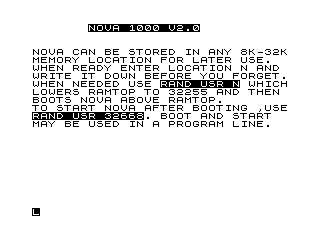
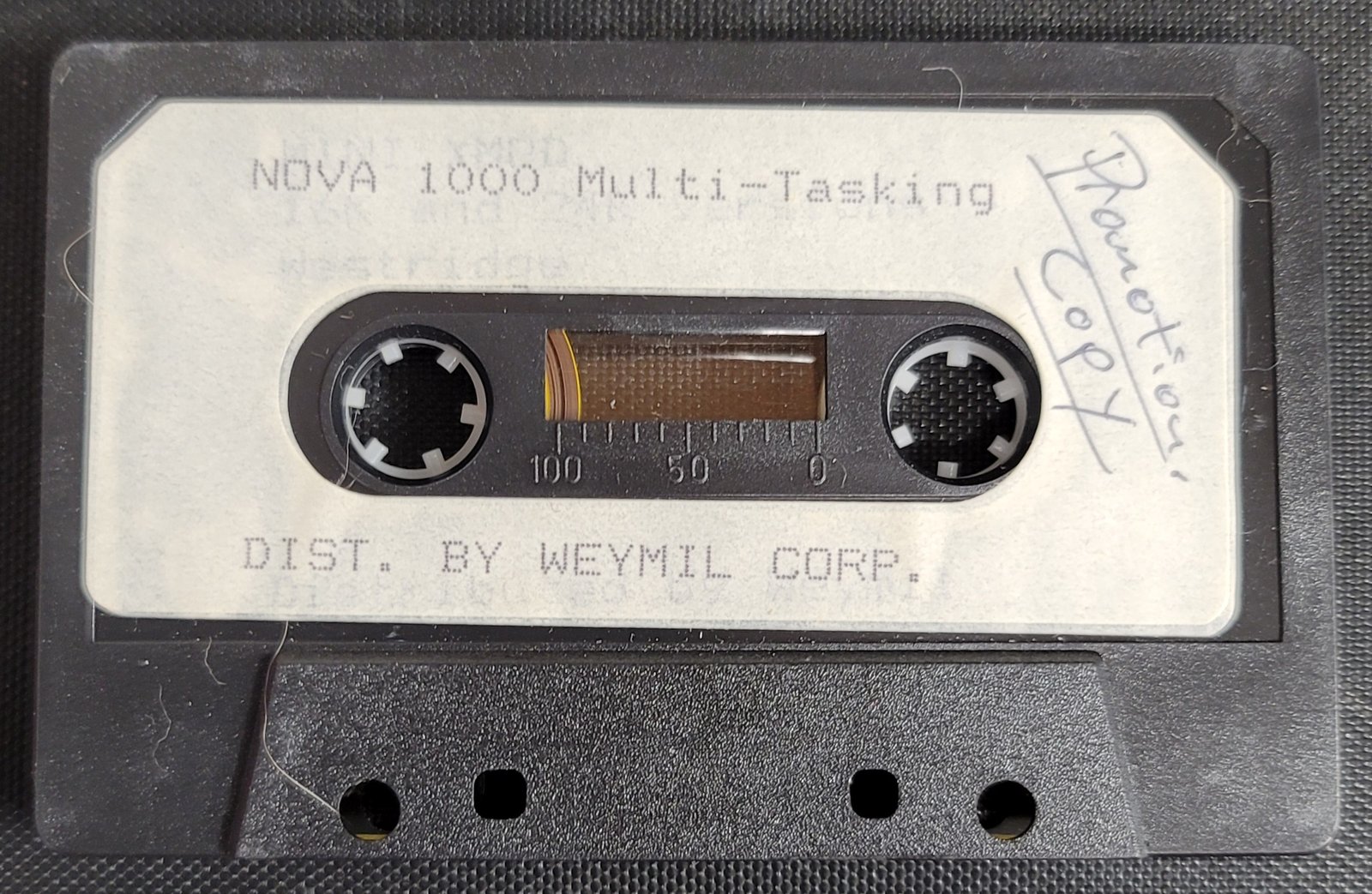
NOVA 1000 is a demonstration program that showcases a custom display system driven by a large machine code routine embedded in line 0’s REM statement. The machine code, loaded above RAMTOP via RAND USR 16535, implements a real-time clock, a scrollable virtual screen backed by a 2000-character array A$, and a command/repeat control system managed through POKE addresses at 32625 and 32626. The program demonstrates smooth left-scrolling and upward-scrolling of a 25×34 character virtual display, then waits on a software real-time clock (initialized via S$ and transferred with RAND USR 32674) before proceeding to a “HELLO” animation sequence. A second array S$ is dimensioned using USR 32671 as its size argument, illustrating how the machine code exposes parameters back to BASIC through fixed memory addresses.
Program Analysis
Program Structure
The program is organized into several distinct phases, each separated by REM comments that serve as documentation:
- Initialization (lines 10–50): Clears memory, dimensions a 2000-character display array
A$, fills its first 34 characters with an inverse-video title string, and transfers the machine code above RAMTOP viaRAND USR 16535. - Startup animation (lines 100–150): Calls the main machine code entry at
RAND USR 32668, then loops to printB$(“NOVA 1000”) diagonally across the screen while updating a line-count POKE. - Virtual screen fill and scroll demo (lines 200–390): Fills
A$with repeated copies of the title row, injects a “PRESS ANY KEY” message, then performs left-scroll (34 steps) and upward-scroll (800 steps of 34) animations usingRAND USR 32680+Nas an offset parameter. - Real-time clock sequence (lines 8000–8290): Redefines
S$with a size fromUSR 32671, loads a time string, transfers it to the RTC viaRAND USR 32674, then polls until the clock passes “10:11:12:13” before launching a final animation loop. - Save and listing (lines 9000–9020): Saves the program, lists from line 3, and stops.
Machine Code Routine
The machine code is stored in the REM statement at line 0, which is a standard technique for embedding binary data in a BASIC program. The entry points exposed to BASIC are:
| Address | Purpose |
|---|---|
32668 (0x7F9C) — approx. USR 32668 | Main initialization; sets up virtual screen pointers |
USR 32671 | Returns the size to use when dimensioning S$ |
USR 32674 | Transfers S$ contents to the real-time clock |
USR 32677 | Transfers RTC back to S$; returns an offset for string comparison |
USR 32680+N | Renders the virtual screen with offset N (left/up scroll position) |
The jump table visible near the end of the REM data (\C3\00\7E, \C3\08\7F, etc.) confirms that multiple Z80 JP instructions dispatch to different subsystem routines within the machine code block. The addresses 32625 and 32626 act as control registers: 32625 governs the command/repeat mode (3 = trace/command off, 2 = repeat on) and 32626 specifies the number of lines to display.
Virtual Screen Technique
Rather than manipulating the display file directly, the program maintains a 2000-character array A$ (25 rows × 34 columns, slightly wider than the 32-column screen plus padding) as an off-screen buffer. The machine code reads this buffer and copies the appropriate window into the display file based on the offset passed as the low byte of the RAND USR argument. This allows smooth horizontal and vertical scrolling without BASIC-level string manipulation of the display.
The left-scroll loop at lines 300–320 passes offsets 1 through 34 (one full row width), while the upward-scroll loop at lines 340–380 passes offsets 1 through 800 in steps of 34 (one row at a time), also decrementing the displayed line count variable at 32626 to create an upward-wipe effect.
Real-Time Clock Integration
The RTC subsystem is initialized by writing a time string in "HH:MM:SS:ff " format into S$ and calling RAND USR 32674. Polling is done entirely in BASIC at lines 8100–8110: S$(USR 32677+1 TO 11) uses the return value of the machine code call as a dynamic string slice index, comparing the current clock value against a target time string. This is an unusually tight integration between machine code return values and BASIC string slicing.
Key BASIC Idioms
RAND USR addr+N— passes a parameter to machine code via the low byte or full 16-bit value of the expression; used extensively for scroll offset control.DIM S$(USR 32671)— uses a machine code return value directly as the array dimension, allowing the machine code to specify the required buffer size.S$(USR 32677+1 TO 11)— uses a machine code return value as a dynamic string slice start index inside a conditional expression.- Inverse-video characters in
A$(1 TO 34)at line 30 produce a highlighted title banner in the virtual screen buffer. - The
GOTO 330at line 390 creates a continuous scroll loop that only exits on a keypress, usingINKEY$=""as the idle condition.
Notable Anomalies
- Line 2801 re-assigns
A$(851 TO 918)with the same “PRESS ANY KEY” message that was set at line 280, suggesting this block may be part of a repeat/loop path rather than dead code, though the flow from line 460 does not obviously reach it in a single pass. - The REM at line 9900 notes a typo in the listing itself (“HVE” for “HAVE”, “LISTIG” for “LISTING”), indicating the comment was typed directly without correction.
- Lines 8250–8280 pass offsets 0, 33, 66, … 700 to the scroll routine (step 33, not 34), which differs from the earlier scroll loop’s step of 34. This slight mismatch may produce a mild visual drift in the final animation sequence.
Image Gallery



Source Code
   0 REM 76761FF1F6FFCDC8A11B019ED5B3240EDB0C9CD23FF6FFCDC8A11220191107E1FF1EDB021FF7D224402B363E2BF92B2B22240CD2BFC3766DD2157EC9CD4D7ECDDC7ECD577ECD877ECD3D7ECD367E67CD2C7E3EEC8CDAB7ECD757FDD2157EC3A42000000010FEC9F5C5D5E5C33E23A717FCB4F284AF322740DDE1C3A2262CD2C7E217A7F184A629CD307EED5B737F7BB22892A10401911501892AC40191110200193A727FE61F47777C63B8E8181D673CD327E3A717FCB572058D698C9AF2A104011210ED52181CBFC3EDDC34103A717FCB47C811977F2A740118FCCDCE7E19CFFCDCE7E1F6FFCDCE7E3E1C851893E1C93C38FCED423DE63F1213C911847F2177F68371ACE0BE3F383121833E1C121B2BCB7E2821B2B10E9C92626802226802226802226AF2A164011F0ED527E21787F77E2060C9CD287F184CD287FEBEDB018192A1640E3E521787FCD4D0CD1C11116019117A7F1B0C9E1221640C92A1640E5E72A10407EFEC62010CD01321403EBED52385CDDD12303100ED43737F18D50000071400C9003FD1C1CE1C1CE1C1CE1C1C0033343B2601D1C1C1C03B1D1B1C00000013C307EC387FC31B7FC3207FC3467F000000000000000000000000000000000000
   3 REM N0VA 1.0 (C)1986 W.RIGTER
   4 REM SEE 9900 REM
  10 CLEAR
  19 REM VIEWABLE ARRAY
  20 DIM A$(2000)
  30 LET A$(1 TO 34)="% % %N%O%V%A% %1%0%0%0% %V%1%.%0% %(%C%)%8%6% %W%.%R%I%G%T%E%R% % % "
  40 LET B$="NOVA 1000"
  49 REM TRANSFER ABOVE RAMTOP
  50 RAND USR 16535
  99 REM START NOVA 1000
 100 RAND USR 32668
 120 FOR N=0 TO 21
 130 POKE 32626,N+1
 140 PRINT AT N,N;B$;
 150 NEXT N
 199 REM LINE=1 FOR FAST- SLOW
 200 POKE 32626,1
 210 CLS
 219 REM OFFSET=1/TOP OF ARRAY
 220 RAND USR 32680+1
 239 REM FILL ARRAY
 240 FOR N=35 TO 25*34 STEP 34
 250 LET A$(N TO N+33)=A$(1 TO 34)
 260 NEXT N
 269 REM LINES=22
 270 POKE 32626,22
 280 LET A$(817 TO 918)=">PRESS ANY KEY TO RETURN TO DFILE<"
 289 REM TURN OFF COMMAND
 290 POKE 32625,3
 299 REM SCROLL LEFT
 300 FOR N=1 TO 34
 310 RAND USR 32680+N
 320 NEXT N
 330 LET A=25
 339 REM SCROLL UP
 340 FOR N=1 TO 800 STEP 34
 350 POKE 32626,A
 360 RAND USR 32680+N
 370 LET A=A-1
 380 NEXT N
 390 IF INKEY$="" THEN GOTO 330
 399 REM LINES=1
 400 POKE 32626,1
 409 REM OFFSET=0 /NORMAL SCREEN
 410 RAND USR 32680+0
 440 PRINT A$(1 TO 704);
 449 REM LINES=24
 450 POKE 32626,24
 459 REM REPEAT ON
 460 POKE 32625,2
 2801 LET A$(851 TO 918)=">PRESS ANY KEY TO RETURN TO DFILE<"
 7999 REM REDEFINE COM VAR TO S$
 8000 DIM S$(USR 32671)
 8029 REM SET REAL TIME CLOCK
 8030 LET S$(1 TO 24)="10:11:05:00 "
 8039 REM TRANSFER S$ TO RTC
 8040 RAND USR 32674
 8050 PRINT AT 12,0;"     WAITING FOR 10:11:12:13    "
 8099 REM TRANSFER RTC TO S$ AND TEST
 8100 IF S$(USR 32677+1 TO 11)>"10:11:12:13" THEN GOTO 8200
 8110 GOTO 8100
 8209 REM TRACE 0N
 8210 POKE 32625,3
 8219 REM 22 LINES
 8220 POKE 32626,22
 8230 CLS
 8240 PRINT AT 12,14;"HELLO"
 8250 FOR N=0 TO 700 STEP 33
 8260 RAND USR 32680+N
 8270 RAND USR 32680+0
 8280 NEXT N
 8290 GOTO 120
 9000 SAVE "V%1"
 9010 LIST 3
 9020 STOP
 9900 REM THIS PROGRAM DOES NOT HVE A COMMAND LINE. YOU MAY HAVE TO HIT A KEY SEVERAL TIMES BEFORE THE PROGRAM STOPS. PRESS SHIFT/1 THEN ENTER TO SEE BASIC LISTIG. START WITH RUN. PAUSE 0 WILL STOP ALL AUTO FUNCTIONS.
Note: Type-in program listings on this website use ZMAKEBAS notation for graphics characters.