
This program implements a classic animal-guessing game using a binary decision tree stored in parallel arrays. The tree is represented by a string array `q$` holding questions and animal names, and a two-dimensional integer array `a` mapping each question node to its yes/no child indices. When the program fails to guess the player’s animal, it learns by prompting for the new animal’s name and a distinguishing question, then dynamically inserts both into the arrays and updates the branching pointers. The initial tree is seeded from DATA statements covering four animals (whale, blancmange, pangolin, ant) and three questions, with the tree pre-wired so nodes 1–3 are questions and nodes 4–7 are animals. A subroutine at line 910 trims trailing spaces before printing fixed-length strings from the DIM’d array.
Program Analysis
Program Structure
The program is organized into clearly delineated functional blocks, each introduced by a REM comment:
- Lines 5–70: Initialization — dimensions arrays, loads question/answer tree from
DATAstatements. - Lines 100–210: Main game loop — traverses the decision tree from root node
c=1until a leaf (animal) node is reached. - Lines 300–380: Animal guessing — presents the guessed animal name and reads a yes/no response.
- Lines 400–410: Success path — congratulates itself and jumps to the replay prompt.
- Lines 500–730: Learning path — expands the tree with a new animal and distinguishing question.
- Lines 800–840: Replay prompt — asks for another game or halts.
- Lines 900–940: Print subroutine — strips trailing spaces from fixed-length strings.
- Lines 1000–1020: Input subroutine — reads a reply and truncates to the first character.
- Lines 2000–2040:
DATA— seeds the initial four-animal, three-question tree.
Data Structures
The decision tree is encoded in two parallel structures:
q$(nq,50)— a 100×50 character string array holding both question text (internal nodes) and animal names (leaf nodes).a(nq,2)— a 100×2 numeric array wherea(c,1)is the child index for a “yes” answer anda(c,2)is the child index for a “no” answer. A value of0in both slots signals a leaf node.
The variable qf (next free slot) starts at 8. Questions occupy indices 1–3 initially, animals occupy indices 4–7. New animals are appended in pairs (old animal moved to qf, new animal at qf+1), and qf advances by 2 after each learning event.
Tree Traversal
Traversal begins at line 130 with c=1. At each step, the program checks a(c,1)=0 (line 140) to detect a leaf node. For internal nodes, the player’s yes/no response sets in to 1 or 2 respectively, and line 210 follows the branch: LET c=a(c,in). This is a clean, minimal binary tree walk entirely in BASIC.
Learning Mechanism
When the program guesses incorrectly (lines 500–720), it performs the following steps:
- Moves the previously guessed animal’s name string from slot
cto slotqf. - Reads the new animal’s name into slot
qf+1. - Reads a distinguishing question into slot
c, replacing the old animal name and turning the leaf into an internal node. - Sets
a(c,in)to point to the new animal anda(c,io)to point to the old animal, based on the player’s answer. - Increments
qfby 2.
The old animal at index c still has its a(c,1) and a(c,2) both zero (from the initial DIM), so the newly added leaf nodes are automatically recognized as leaves without needing explicit initialization.
Input Handling
The subroutine at line 1000 uses INPUT r$ and, if the string is non-empty, truncates it to its first character via r$=r$(1). This single-character capture is then compared case-insensitively by testing both "y"/"Y" and "n"/"N" at each decision point. The POKE 23658,8 at line 7 enables caps-lock mode, making lowercase input less likely, though the code still guards against it.
Print Subroutine
Because DIM q$(nq,50) pads all strings to exactly 50 characters with spaces, the subroutine at line 910 scans backwards from position 50 to find the last non-space character (n) and then prints p$(TO n). Line 905 prefixes a leading space before this trimmed output, while the entry point at line 910 skips the leading space — the two entry points (GO SUB 900 and GO SUB 910) are used in different contexts throughout the program.
Notable Techniques and Idioms
- The
DATAloader at lines 30–70 uses two separateFORloops: the first (lines 30–50) reads question strings with their two child indices; the second (lines 60–70) reads the initial animal name strings, which have no associateda()data since their child slots default to zero fromDIM. qf/2-1at line 30 computes the count of initial questions (3) from the initial free pointer (8), keeping the data count implicit rather than hardcoded separately.- Line 580 strips a trailing
?from the player-entered distinguishing question before storing it, since the game appends its own?on display. - The replay check at line 830 uses a double conditional idiom:
IF r$="Y" THEN CLS : IF r$="Y" THEN GO TO 100— the condition is tested twice to allowCLSto execute only on the affirmative path before theGO TO.
Bugs and Anomalies
- Line 540 contains a spelling error:
"DISTINGUEISHES"should be"DISTINGUISHES". - Line 630 initializes
in=1(yes → new animal) andio=2(no → old animal) before reading the response, but lines 650–680 only handle"Y"and"N"(uppercase). If the player types lowercase"y"or"n", neither branch is taken, and line 690 fires with “THAT’S NO GOOD.” — inconsistent with the rest of the program which accepts both cases. - Line 830’s replay check only tests for uppercase
"Y"; a lowercase"y"will fall through toSTOP. - The
SAVE "pangolins" LINE 0at line 3000 targets line 0, which does not exist; the conventional auto-run target would be line 5 or 7. This may prevent auto-run on load, though the save itself will succeed.
Image Gallery
Source Code
    5 REM pangolins
    7 CLS : POKE 23658,8
   10 LET nq=100: REM number of questions and animals
   15 DIM q$(nq,50): DIM a(nq,2): DIM r$(1)
   20 LET qf=8
   30 FOR n=1 TO qf/2-1
   40 READ q$(n): READ a(n,1): READ a(n,2)
   50 NEXT n
   60 FOR n=n TO qf-1
   70 READ q$(n): NEXT n
  100 REM start playing
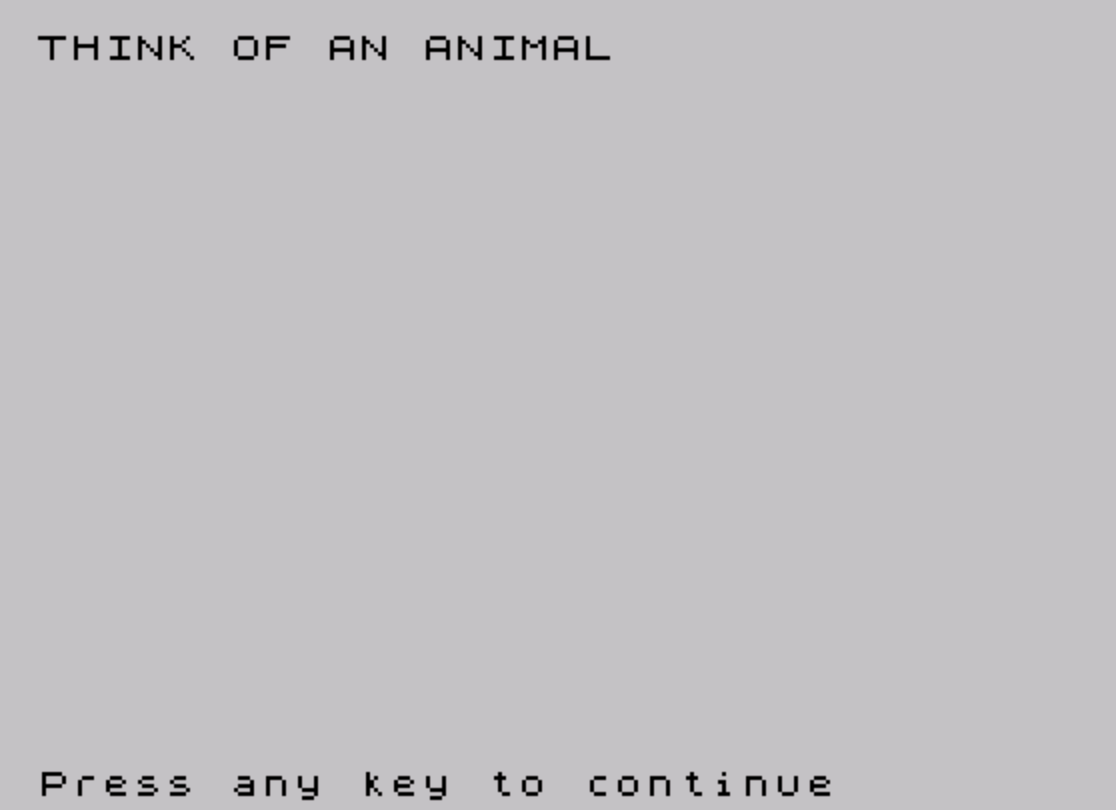
  110 PRINT "THINK OF AN ANIMAL"';#1;"Press any key to continue"
  120 PAUSE 0
  130 LET c=1: REM start with first question
  140 IF a(c,1)=0 THEN GO TO 300
  150 LET p$=q$(c): GO SUB 910
  160 PRINT "?": GO SUB 1000
  170 LET in=1: IF r$="y" THEN GO TO 210
  180 IF r$="Y" THEN GO TO 210
  190 LET in=2: IF r$="n" THEN GO TO 210
  200 IF r$<>"N" THEN GO TO 150
  210 LET c=a(c,in): GO TO 140
  300 REM animal
  310 PRINT "ARE YOU THINKING OF"
  320 LET P$=Q$(C): GO SUB 900: PRINT "?"'
  330 GO SUB 1000
  340 IF r$="y" THEN GO TO 400
  350 IF r$="Y" THEN GO TO 400
  360 IF r$="n" THEN GO TO 500
  370 IF r$="N" THEN GO TO 500
  380 PRINT "ANSWER ME PROPERLY WHEN I'M","TALKING TO YOU.": GO TO 300
  400 REM guessed it
  410 PRINT "I THOUGHT AS MUCH.": GO TO 800
  500 REM new animal
  510 IF qf>nq-1 THEN PRINT "I'M SURE YOUR ANIMAL IS VERY","INTERESTING, BUT I DON'T HAVE","ROOM FOR IT JUST NOW.": GO TO 800
  520 LET q$(qf)=q$(c): REM move oldanimal
  530 PRINT '"WHAT IS IT THEN?": INPUT q$(qf+1)
  540 PRINT '"TELL ME A QUESTION WHICH","DISTINGUEISHES BETWEEN "
  550 LET p$=q$(qf): GO SUB 900: PRINT " AND"
  560 LET p$=q$(qf+1): GO SUB 900: PRINT ""
  570 INPUT s$: LET b=LEN s$
  580 IF s$(b)="?" THEN LET b=b-1
  590 LET q$(c)=s$( TO b): REM insert question
  600 PRINT '"WHAT IS THE ANSWER FOR"
  610 LET p$=q$(qf+1): GO SUB 900: PRINT "?"
  620 GO SUB 1000
  630 LET in=1: LET io=2: REM answers for old and new animals
  650 IF r$="Y" THEN GO TO 700
  660 LET in=2: LET io=1
  680 IF r$="N" THEN GO TO 700
  690 PRINT "THAT'S NO GOOD.": GO TO 600
  700 REM update answers
  710 LET a(c,in)=qf+1: LET a(c,io)=qf
  720 LET qf=qf+2: REM next free animal space
  730 PRINT "THAT FOOLED ME."
  800 REM again?
  810 PRINT '"Do you want another go?": GO SUB 1000
  830 IF r$="Y" THEN CLS : IF r$="Y" THEN GO TO 100
  840 STOP
  900 REM print without trailing spaces
  905 PRINT " ";
  910 FOR n=50 TO 1 STEP -1
  920 IF p$(n)<>" " THEN GO TO 940
  930 NEXT n
  940 PRINT p$( TO n);: RETURN
 1000 REM get reply
 1010 INPUT r$: IF r$="" THEN RETURN
 1020 LET r$=r$(1): RETURN
 2000 REM initial animals
 2010 DATA "DOES IT LIVE IN THE SEA",4,2
 2020 DATA "IS IT SCALY",3,5
 2030 DATA "DOES IT EAT ANTS",6,7
 2040 DATA "A WHALE","A BLANCMANGE","A PANGOLIN","AN ANT"
 3000 SAVE "pangolins" LINE 0
Note: Type-in program listings on this website use ZMAKEBAS notation for graphics characters.