
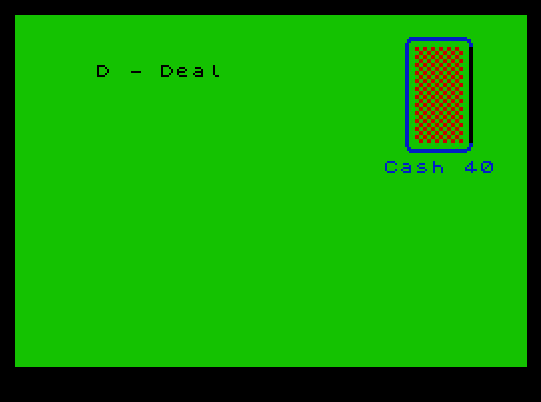
Pontoon card game (a variation of vingt-un) for the TS2068 with graphically rendered playing cards built from 11 custom UDGs — four suit symbols, a checkerboard card back, and a set of rounded box-drawing corners and edges assembled into a 5×7 card frame. The player starts with $50 and antes $10 per round, choosing to Twist or Stick against a randomly generated dealer score rather than a dealt hand. Suit symbols are selected randomly from the four UDG slots on each deal, and twisted cards scroll across the screen with column wrapping. A decorative cash-balance box is drawn on the right side of the screen using the same box-drawing UDGs.
Analysis
Platform: TS2068. Uses PAPER/INK/BORDER, UDGs, and SAVE "PONTOON" LINE 1. The UDG range USR "a" to USR "k"+7 (11 UDGs) is TS2068/Spectrum standard.
What it is: A Pontoon (British Blackjack/21) card game with graphically rendered playing cards built from UDGs, and a running cash balance.
UDG Definitions (Lines 570–700)
The setup subroutine at line 570 loads 11 UDGs (\a–\k) from DATA. Their shapes:
| UDG | DATA bytes | Shape | Role |
|---|---|---|---|
| \a | 24,60,126,255,255,126,60,24 | Solid symmetric diamond | ♥ Hearts |
| \b | 24,60,90,255,255,90,24,60 | Diamond with internal cutouts | ♣ Clubs |
| \c | 16,56,124,254,254,124,16,56 | Asymmetric offset diamond | ♦ Diamonds |
| \d | 68,238,254,254,254,124,56,16 | Wide top, tapering point | ♠ Spades |
| \e | 204,204,51,51,204,204,51,51 | Checkerboard | Card back |
| \f | 0,0,0,7,15,12,24,24 | Curve descending right | ╭ top-left corner |
| \g | 0,0,0,192,240,48,24,24 | Curve descending left | ╮ top-right corner |
| \h | 24,24,12,15,7,0,0,0 | Curve ascending right | ╰ bottom-left corner |
| \i | 24,24,48,240,192,0,0,0 | Curve ascending left | ╯ bottom-right corner |
| \j | 0,0,0,255,255,0,0,0 | Horizontal bar (mid-cell) | ─ horizontal edge |
| \k | 24,24,24,24,24,24,24,24 | Vertical bar (mid-cell) | │ vertical side |
The NOT PI trick in the DATA (lines 650–690) evaluates to 0 at runtime, since PI is non-zero and NOT of any non-zero value is 0 in Sinclair BASIC — a readable way to embed literal zeros without typing them.
The card frame assembled from these:
\f\j\j\j\g
\k  suit \k
\k       \k
\k  val  \k
\k       \k
\k  suit \k
\h\j\j\j\i
Rounded corners with suit symbol at top and bottom, face value in the middle — a neat compact playing card graphic.
Program Structure
| Lines | Section |
|---|---|
| 10 | Load UDGs |
| 20 | Set starting money ($50) |
| 30 | Deal subroutine (screen setup, ante, deal prompt) |
| 40–50 | Generate two random cards (value 1–10, random suit) |
| 60–120 | Draw two initial cards side-by-side |
| 130–320 | Twist/Stick input loop; draw additional twisted cards |
| 340–430 | Dealer resolution and win/loss logic |
| 440–460 | Broke screen |
| 470–560 | Deal setup subroutine (screen, ante deduction, cash display, wait for D) |
| 570–590 | UDG loader subroutine |
| 600–700 | UDG DATA |
| 710 | REM labeling the UDGs visually |
| 1000 | SAVE |
Game Logic
Each round costs $10 (line 480). Player starts with $50 — five rounds before going broke. Two cards are dealt; the player chooses Twist (take another card) or Stick. Additional twisted cards are drawn across the screen at column offsets tracked by p, wrapping if p>26. A bust (total > 21) is an immediate loss.
On Stick (line 340), the dealer’s “hand” is a single random number between 10 and 22 (INT(RND*13)+10) — not actual drawn cards. Dealer > 21 = dealer bust (player wins), dealer = 21 = “PONTOON!”, dealer > player total = dealer wins, otherwise player wins $50.
The cash display (lines 490–530) draws a decorative box in INK 1 (blue) on the right side of the screen showing the current balance.
Image Gallery
Source Code
   10 GO SUB 570
   20 LET money=50
   30 GO SUB 470
   40 LET c1=INT (RND*10)+1: LET b$=CHR$ (144+(INT (RND*4)))
   50 LET c2=INT (RND*10)+1: LET c$=CHR$ (144+(INT (RND*4)))
   60 PRINT AT 11,2;"\f\j\j\j\g \f\j\j\j\g"
   70 PRINT "  \k";b$;"  \k \k";c$;"  \k"
   80 PRINT "  \k   \k \k   \k"
   90 PRINT "  \k ";(CHR$ 8 AND c1=10);c1;" \k \k ";(CHR$ 8 AND c2=10);c2;" \k"
  100 PRINT "  \k   \k \k   \k"
  110 PRINT "  \k  ";b$;"\k \k  ";c$;"\k"
  120 PRINT "  \h\j\j\j\i \h\j\j\j\i"
  130 LET tot=c1+c2: LET c3=INT (RND*10)+1
  140 PRINT AT 5,5;"T - Twist"
  150 PRINT AT 7,5;"S - Stick"
  160 IF INKEY$="t" OR INKEY$="s" THEN GO TO 180
  170 GO TO 160
  180 IF INKEY$="s" THEN GO TO 340
  190 LET tot=tot+c3
  200 LET b$=CHR$ (144+(INT (RND*4)))
  210 IF p>26 THEN LET p=2: CLS
  220 PRINT AT 11,p;"\f\j\j\j\g"
  230 PRINT AT 12,p;"\k";b$;"  \k"
  240 PRINT AT 13,p;"\k   \k"
  250 PRINT AT 14,p;"\k ";(CHR$ 8 AND c3=10);c3;" \k"
  260 PRINT AT 15,p;"\k   \k"
  270 PRINT AT 16,p;"\k  ";b$;"\k"
  280 PRINT AT 17,p;"\h\j\j\j\i"
  290 IF tot>21 THEN PRINT AT 1,1;"BUST": GO TO 420
  300 LET p=p+6
  310 LET c3=INT (RND*10)+1
  320 GO TO 160
  330 STOP
  340 LET cs=INT (RND*13)+10
  350 CLS
  360 PRINT '"I have ";cs''"You have ";tot''
  370 IF cs>21 THEN PRINT "I have bust, You Win ": GO TO 410
  380 IF cs=21 THEN PRINT "PONTOON! ": GO TO 410
  390 IF cs>tot THEN PRINT "I win ": GO TO 410
  400 PRINT "You win $50!": LET money=money+50
  410 FOR k=1 TO 60: BEEP .008,k: BEEP .008,-k: NEXT k: GO TO 30
  420 PRINT "I win that game!"
  430 GO TO 410
  440 CLS
  450 PRINT AT 10,7;"You're out of money"
  460 INPUT "press enter to play again "; LINE a$: RUN
  470 BORDER 0: PAPER 4: INK 9: CLS
  480 LET p=14: LET money=money-10: IF money<0 THEN GO TO 440
  490 PRINT AT 1,24; INK 1;"\f\j\j\j\g"
  500 FOR a=1 TO 6
  510 PRINT TAB 24; INK 1;"\k\e\e\e\k"
  520 NEXT a
  530 PRINT TAB 24; INK 1;"\h\j\j\j\i";AT 9,23;"Cash ";money
  540 PRINT AT PI,5;"D - Deal"
  550 IF INKEY$<>"d" THEN GO TO 550
  560 RETURN
  570 FOR a=USR "a" TO USR "k"+7
  580 READ user: POKE a,user
  590 NEXT a: RETURN
  600 DATA 24,60,126,255,255,126,60,24
  610 DATA 24,60,90,255,255,90,24,60
  620 DATA 16,56,124,254,254,124,16,56
  630 DATA 68,238,254,254,254,124,56,16
  640 DATA 204,204,51,51,204,204,51,51
  650 DATA 0,NOT PI,NOT PI,7,15,12,24,24
  660 DATA 0,NOT PI,NOT PI,192,240,48,24,24
  670 DATA 24,24,12,15,7,NOT PI,NOT PI,0
  680 DATA 24,24,48,240,192,NOT PI,NOT PI,0
  690 DATA 0,NOT PI,NOT PI,255,255,NOT PI,NOT PI,0
  700 DATA 24,24,24,24,24,24,24,24
  710 REM a\ab\bc\cd\de\ef\fh\gi\hj\ij\jk\k
 1000 SAVE "PONTOON" LINE 1
Note: Type-in program listings on this website use ZMAKEBAS notation for graphics characters.