
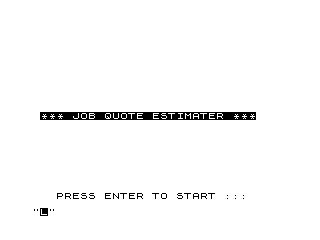
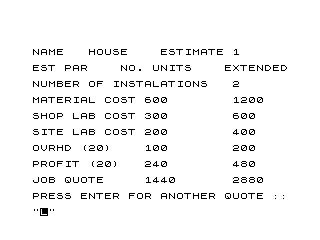
This program is a job cost estimator that calculates and prints a formatted quote for installation work, covering materials, shop labour, on-site labour, overhead, and profit. The user can choose to enter costs either as a single total or itemised line by line, with the itemisation routine (subroutine at line 1200) reused for materials, shop labour, and on-site labour. All monetary values are rounded to two decimal places using the classic INT(100*X+.05)/100 idiom before display. The quote summary is printed via a dedicated subroutine at line 3000, showing both per-unit and extended (total) figures in a tabulated layout using TAB stops.
Program Analysis
Program Structure
The program is organised into a main routine and three subroutines, with the main flow running from lines 10–690 and looping back to line 100 for repeated estimates. The global counter D (initialised at line 20, incremented at line 205) tracks the estimate number across sessions.
| Line Range | Purpose |
|---|---|
| 10–20 | Initialisation: CLS, set estimate counter D=0 |
| 100–690 | Main loop: title display, user prompts, cost collection, quote display, loop back |
| 1000–1190 | Subroutine: material cost entry (itemised or lump sum) |
| 1200–1670 | Subroutine: generic itemised cost entry, accumulating into C |
| 2000–2550 | Subroutine: shop and on-site labour entry (itemised or lump sum) |
| 3000–3270 | Subroutine: formatted quote printout |
| 9998–9999 | SAVE with auto-run flag, then RUN |
Itemised Entry Subroutine (Lines 1200–1670)
The subroutine at line 1200 is a reusable itemised cost collector. It loops, prompting for item name, unit cost, and quantity, computing the extended cost (E = A * G), and accumulating the running total in C. Entry of a blank item name (B$="" at line 1255) terminates the loop. The result is returned in C, which the calling code then assigns to the appropriate variable (M, L, or H). This reuse of a single subroutine for three different cost categories is the most structurally notable aspect of the program.
There is a variable name collision hazard: C is used both as the overhead percentage (entered at line 410 and used in the formula at line 430) and as the accumulator inside the itemised entry subroutine (line 1200). After an itemised entry call, C is immediately copied to the target variable (lines 1155, 2120), but the overhead percentage previously stored in C is overwritten if itemisation is called after line 410 — however, in the actual execution order, overhead is collected after all labour and material subroutines have returned, so in practice this does not corrupt the overhead value during normal flow. The overhead percentage value in C is still correctly used at line 3200 for display.
Cost Calculation (Lines 550–640)
The quote calculations at lines 550–640 derive all figures from the per-unit costs and the installation count Q:
B = Q * M— total materialsK = Q * L— total shop labourJ = H * Q— total on-site labourV = O * (L + H)— overhead per unit (percentage of direct labour)W = V * Q— total overheadR = P * (B + K + J + W)— total profitX = R / Q— profit per unitS = B + K + J + R + W— total job quoteT = S / Q— quote per unit
Rounding Technique
Monetary values are rounded to two decimal places just before display using the standard fixed-point idiom INT(100*X+.05)/100. This appears both in the itemised entry loop (line 1455) and throughout the summary subroutine (lines 3102–3256). The +.05 bias provides conventional rounding (round half up) rather than truncation.
SCROLL-Based Display
The program uses SCROLL extensively to control screen layout rather than CLS, producing a continuous paper-tape style output. Multiple consecutive SCROLL calls are used to create blank-line spacing between sections. CLS is reserved for major section transitions (title screen, start of quote entry, itemised cost screens).
Input Validation
Yes/No prompts are validated by checking the first character of the input string (e.g. B$(1)="Y"). If neither “Y” nor “N” is matched, execution falls through to a GOTO back to the INPUT line, forming a simple validation loop. This pattern appears at lines 1050–1070, 2040–2060, 2290–2310.
Notable Anomalies
- Line 1155 assigns
M=Cafter the itemised material subroutine, but note that the subroutine itself usesCas its accumulator, overwriting the overhead percentage if overhead were collected before this point. In the actual execution order this is safe, but the reuse ofCfor two distinct purposes is fragile. - The spelling “INSTALATIONS” (one ‘l’) at line 3080 is a typo in the output text.
- Line 2130 uses
GOTO 2240to skip the lump-sum shop labour input block, jumping directly to the on-site labour section — a straightforward forward jump with no structural issue. - The
INPUT Y$at line 220 and line 530 simply waits for Enter; the content ofY$is discarded, making these effectively “press Enter to continue” pauses.
Image Gallery
Source Code
  10 CLS
  20 LET D=0
 100 CLS
 110 PRINT AT 12,0;" %*%*%*% %J%O%B% %Q%U%O%T%E% %E%S%T%I%M%A%T%E%R% %*%*%*"
 200 SCROLL
 205 LET D=D+1
 210 PRINT "   PRESS ENTER TO START :::"
 220 INPUT Y$
 230 CLS
 240 SCROLL
 250 PRINT "JOB NAME?  ";
 260 INPUT N$
 270 PRINT N$
 280 SCROLL
 290 SCROLL
 300 PRINT "NUMBER OF INSTALLATIONS?"
 310 SCROLL
 320 INPUT Q
 330 PRINT ,Q
 340 SCROLL
 350 SCROLL
 360 GOSUB 1000
 370 GOSUB 2000
 380 SCROLL
 390 PRINT "OVERHEAD (PER. OF DIRECT LABOR)?"
 400 SCROLL
 410 INPUT C
 420 SCROLL
 425 PRINT ,C
 426 SCROLL
 430 LET O=C/100
 440 SCROLL
 450 PRINT "PROFIT (PER OF JOB COST)?"
 460 SCROLL
 470 INPUT Z
 480 PRINT ,Z
 490 SCROLL
 500 SCROLL
 510 LET P=Z/100
 520 PRINT "PRESS ENTER TO SEE QUOTE :::"
 530 INPUT Y$
 540 CLS
 550 LET B=Q*M
 560 LET K=Q*L
 570 LET J=H*Q
 590 LET V=O*(L+H)
 600 LET W=V*Q
 610 LET R=P*(B+K+J+W)
 620 LET X=R/Q
 630 LET S=B+K+J+R+W
 640 LET T=S/Q
 650 GOSUB 3000
 660 SCROLL
 665 SCROLL
 670 PRINT "PRESS ENTER FOR ANOTHER QUOTE ::"
 680 INPUT Y$
 690 GOTO 100
 1000 PRINT "ARE MATERIAL COSTS TO BE"
 1010 SCROLL
 1020 PRINT "ITEMIZED (Y/N)?"
 1030 SCROLL
 1040 INPUT B$
 1050 IF B$(1)="Y" THEN GOTO 1100
 1060 IF B$(1)="N" THEN GOTO 1160
 1070 GOTO 1040
 1100 SCROLL
 1110 SCROLL
 1120 PRINT "MATERIAL COSTS :::"
 1130 SCROLL
 1140 SCROLL
 1150 GOSUB 1200
 1155 LET M=C
 1156 RETURN
 1160 SCROLL
 1170 SCROLL
 1180 PRINT "TOTAL MATERIAL COST?  ";
 1184 INPUT M
 1186 PRINT M
 1188 SCROLL
 1190 RETURN
 1200 LET C=0
 1205 SCROLL
 1210 PRINT "ESTIMATE NO.";D
 1220 SCROLL
 1230 SCROLL
 1240 PRINT "ITEM?",
 1250 INPUT B$
 1255 IF B$="" THEN GOTO 1600
 1260 PRINT B$
 1270 SCROLL
 1280 SCROLL
 1290 PRINT "COST?",
 1300 INPUT A
 1310 PRINT A
 1320 SCROLL
 1340 SCROLL
 1350 PRINT "QUANTITY?",
 1360 INPUT G
 1370 PRINT G
 1380 LET E=A*G
 1390 SCROLL
 1400 SCROLL
 1410 SCROLL
 1430 PRINT "ITEM    COST    QUANT   EXTEND"
 1440 SCROLL
 1450 SCROLL
 1455 LET E=INT (100*E+.05)/100
 1460 PRINT B$;TAB 8;A;TAB 16;G;TAB 24;E
 1470 SCROLL
 1480 SCROLL
 1490 LET C=C+E
 1500 GOTO 1220
 1600 SCROLL
 1605 SCROLL
 1610 PRINT "TOTAL",C
 1620 SCROLL
 1630 SCROLL
 1640 PRINT "PRESS ENTER TO CONTINUE :::"
 1650 INPUT B$
 1660 CLS
 1670 RETURN
 2000 SCROLL
 2010 SCROLL
 2020 PRINT "DO YOU WANT SHOP LABOR ITEMIZED?"
 2030 INPUT Y$
 2040 IF Y$(1)="N" THEN GOTO 2140
 2050 IF Y$(1)="Y" THEN GOTO 2070
 2060 GOTO 2030
 2070 SCROLL
 2080 SCROLL
 2090 PRINT "SHOP LABOR PER HOUR"
 2100 SCROLL
 2110 SCROLL
 2115 GOSUB 1200
 2120 LET L=C
 2130 GOTO 2240
 2140 SCROLL
 2150 SCROLL
 2160 PRINT "COST FOR TOTAL SHOP LABOR?"
 2170 SCROLL
 2180 SCROLL
 2190 INPUT L
 2200 PRINT ,L
 2210 SCROLL
 2240 SCROLL
 2260 PRINT "ON SITE LABOR TO BE ITEMIZED?"
 2270 SCROLL
 2280 INPUT B$
 2290 IF B$(1)="Y" THEN GOTO 2320
 2300 IF B$(1)="N" THEN GOTO 2500
 2310 GOTO 2280
 2320 CLS
 2330 PRINT ,,"ON SITE LABOR PER HOUR :::"
 2340 GOSUB 1200
 2350 LET H=C
 2360 RETURN
 2500 SCROLL
 2510 SCROLL
 2520 PRINT "ON SITE LABOR TOTAL COST?"
 2530 INPUT H
 2540 SCROLL
 2550 RETURN
 3000 SCROLL
 3010 SCROLL
 3020 PRINT "NAME   ";N$;TAB 16;"ESTIMATE ";D
 3030 SCROLL
 3040 SCROLL
 3050 PRINT "EST PAR    NO. UNITS    EXTENDED"
 3060 SCROLL
 3070 SCROLL
 3080 PRINT "NUMBER OF INSTALATIONS   ";Q
 3090 SCROLL
 3100 SCROLL
 3102 LET M=INT (100*M+.05)/100
 3104 LET B=INT (100*B+.05)/100
 3110 PRINT "MATERIAL COST ";M;TAB 25;B
 3120 SCROLL
 3130 SCROLL
 3132 LET L=INT (100*L+.05)/100
 3134 LET K=INT (100*K+.05)/100
 3140 PRINT "SHOP LAB COST ";L;TAB 25;K
 3150 SCROLL
 3160 SCROLL
 3162 LET H=INT (100*H+.05)/100
 3164 LET J=INT (100*J+.05)/100
 3170 PRINT "SITE LAB COST ";H;TAB 25;J
 3180 SCROLL
 3190 SCROLL
 3195 LET W=INT (100*W+.05)/100
 3196 LET V=INT (100*V+.05)/100
 3200 PRINT "OVRHD";" (";C;")";TAB 14;V;TAB 25;W
 3210 SCROLL
 3220 SCROLL
 3225 LET R=INT (100*R+.05)/100
 3226 LET X=INT (100*X+.05)/100
 3230 PRINT "PROFIT";" (";Z;")";TAB 14;X;TAB 25;R
 3240 SCROLL
 3250 SCROLL
 3255 LET S=INT (100*S+.05)/100
 3256 LET T=INT (100*T+.05)/100
 3260 PRINT "JOB QUOTE";TAB 14;T;TAB 25;S
 3270 RETURN
 9998 SAVE "QUOT%E"
 9999 RUN
Note: Type-in program listings on this website use ZMAKEBAS notation for graphics characters.