
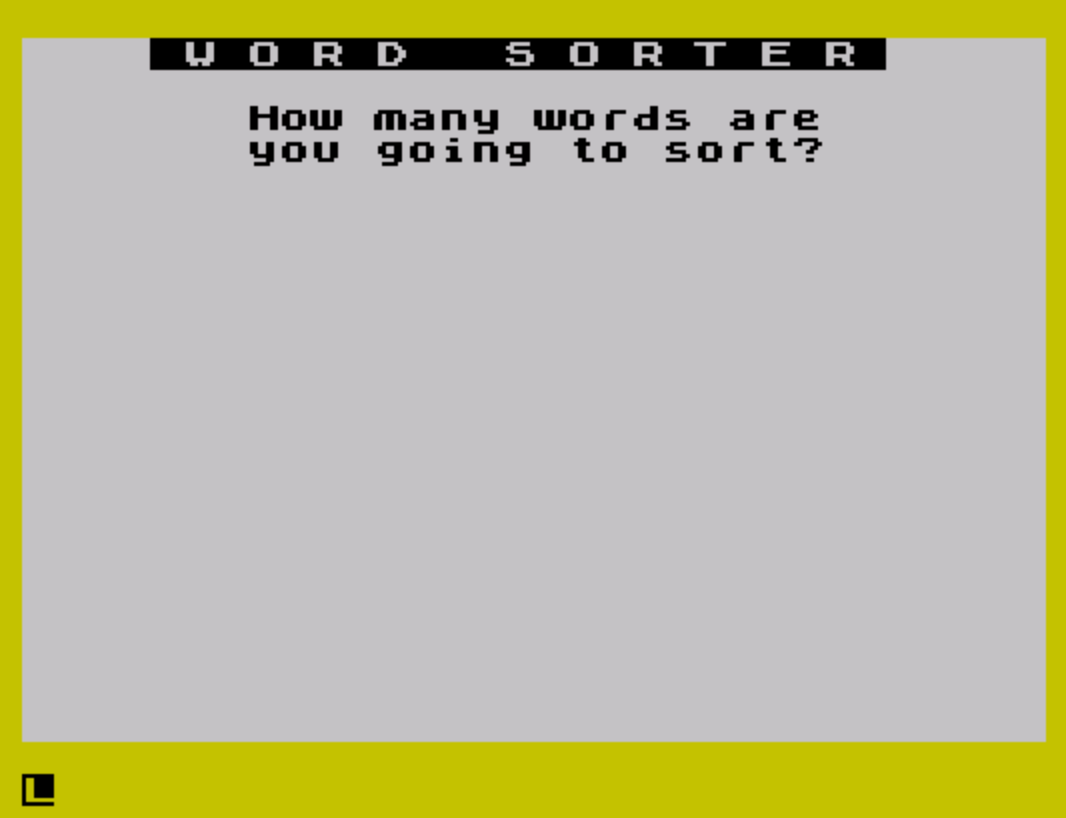
This program implements an interactive word sorter that accepts up to n words from the user, sorts them alphabetically using a Shell-Metzner (Shell sort) algorithm, and displays or prints the sorted list. It loads an external machine code routine from tape at address 57786, invoked via RANDOMIZE USR 57786, which provides a bold-print display effect. The Shell-Metzner sort in the subroutine at line 1500 uses a gap sequence derived from powers of 2 (F = 2^A – 1, halved each pass), operating directly on the string array a$(n,20). The program includes both screen display and printer output routines, with a loop at lines 170–180 allowing the user to redisplay, print, or restart the sort session. The SAVE line at 9999 persists both the BASIC program with auto-run and the machine code block as a separate CODE file.
Program Analysis
Program Structure
The program is organized into four logical phases: initialization and input (lines 5–70), sort invocation and display (lines 75–180), printer output (lines 185–205), and two subroutines — the Shell-Metzner sort (1500–1595) and the screen display loop (2000–2040). A final line (9999) handles saving both the BASIC program and the companion machine code file.
| Line Range | Purpose |
|---|---|
| 5–12 | REM header, load machine code, initialize display |
| 15–70 | User input: title and word list |
| 75–83 | Sort trigger, calls Shell-Metzner at 1500 |
| 125–180 | Display sorted list, user interaction loop |
| 185–205 | Printer (LPRINT) output routine |
| 1500–1595 | Shell-Metzner sort subroutine |
| 2000–2040 | Screen display subroutine |
| 9999 | SAVE routine for BASIC and CODE |
Machine Code Usage
Line 10 loads an external machine code block with LOAD ""CODE and immediately calls it via RANDOMIZE USR 57786. The companion file is named boldprint and is 100 bytes long, stored at address 57786 (near the top of a 48K memory map). Based on the program name and REM at line 5, this routine modifies the display or font rendering to produce bold text output. The machine code is preserved at line 9999 with SAVE "boldprint" CODE 57786,100.
Shell-Metzner Sort (Lines 1500–1595)
The sort uses the Shell-Metzner algorithm, a variant of Shell sort. The gap sequence is initialized as F = 2^A - 1 where A = INT(LN N / LN 2), effectively the largest power-of-2 minus 1 not exceeding N. Each outer pass halves the gap with F = INT(F/2), returning when F = 0.
- Compute initial gap:
A = INT(LN N / LN 2),F = 2^A - 1 - Halve gap:
F = INT(F/2); if zero,RETURN - Set range:
D = N - F,B = 1 - Compare
A$(A)andA$(E)whereE = A + F; swap if out of order - Walk back by gap while
A >= 1, then advanceB
Comments at lines 1535 and 1565 document how to reverse sort order (change > to <) or sort numbers (replace A$ with a numeric array A), indicating the routine was designed to be reusable.
Key BASIC Idioms
DIM a$(n,20)— dynamic string array dimensioned at runtime using user-suppliedn, with each element padded to 20 characters.TAB ((32-LEN l$)/2)— centers the title string across a 32-column display.INVERSE 1andFLASH 1— used for UI highlights on the sort-complete message and input prompts.RUN 15at line 178 restarts the program from the input phase without clearing the CODE routine loaded at line 10, sinceRUNwith a line number does not re-executeLOAD ""CODE.
User Interaction Loop
Lines 170–180 form a polling loop using bare INKEY$ (no PAUSE) that checks for y, c, or n/N keypresses. This is a standard busy-wait idiom. Notably, lowercase y and uppercase N are both handled, but uppercase Y and lowercase n are inconsistently treated — y only (line 170) versus both n and N (line 178).
Display vs. Print Subroutines
The program maintains two parallel output paths: the screen display subroutine at line 2000 uses PRINT and uppercase variable names (M, N, A$), while the printer routine at lines 185–205 uses LPRINT with lowercase names (m, n, a$). On this platform, variable names are case-sensitive, so M and m are distinct variables. The sort subroutine at 1500 uses uppercase A, B, D, E, F, N, A$, T$, while the input phase uses lowercase m, n, a$. The display subroutine at 2000 uses uppercase versions, which correctly reference the sorted array populated by the sort routine.
Notable Anomalies
- Line 175 calls
GO SUB 185for the print routine but does not have a correspondingRETURNpath back — after line 205 setsm=1and jumps toGO TO 135, control never returns to theGO SUBcaller. This effectively treats the print routine as a one-way branch rather than a true subroutine. - The gap initialization computes
Atwice — once as the log-based exponent (line 1505) and then reusesAas the inner loop index from line 1530 onward — relying onFhaving captured the initial gap value beforeAis overwritten.
Image Gallery
Source Code
    5 REM sortword2 with                  boldprint CODE
   10 LOAD ""CODE : RANDOMIZE USR 57786
   12 CLS : BORDER 6
   15 PRINT "    "; INVERSE 1;" W O R D   S O R T E R "
   20 PRINT
   25 PRINT "       How many words are"'"       you going to sort? ";
   30 INPUT n: PRINT INVERSE 1;n
   35 DIM a$(n,20)
   40 PRINT
   45 INPUT "Enter the title of the sort. ";l$
   50 PRINT "  Enter the words to be sorted.": PRINT
   55 PRINT
   60 FOR m=1 TO n
   65 INPUT a$(m): PRINT m;".";TAB 4;a$(m)
   70 NEXT m
   75 PRINT
   80 PRINT "   "; INVERSE 1;"Please wait while I sort."
   83 GO SUB 1500
  125 CLS
  130 PRINT TAB ((32-LEN l$)/2);l$
  135 PRINT
  138 GO SUB 2000
  155 PRINT : PRINT FLASH 1;"S O R T  I S   C O M P L E T E D"
  160 PRINT : PRINT "    Do you wish to see the list again? (y/n)"
  165 PRINT : PRINT "    If you wish to print the    list then press 'c'."
  170 IF INKEY$="y" THEN CLS : LET m=1: GO TO 130
  175 IF INKEY$="c" THEN CLS : LET m=1: GO SUB 185
  178 IF INKEY$="n" OR INKEY$="N" THEN CLS : RUN 15
  180 GO TO 170
  185 REM  print routine
  187 LPRINT TAB ((32-LEN l$)/2);l$: LPRINT
  190 FOR m=1 TO n
  195 LPRINT m;".";TAB 4;a$(m)
  198 LPRINT
  200 NEXT m
  205 LET m=1: GO TO 135
 1500 REM  Shell-Metzner Sort
 1505 LET A=INT (LN N/LN 2): LET F=2^A-1
 1510 LET F=INT (F/2): IF F=0 THEN RETURN
 1520 LET D=N-F: LET B=1
 1530 LET A=B
 1535 REM  Change Sign(>) in Line 1540 to Reverse Order
 1540 LET E=A+F: IF A$(A)>A$(E) THEN GO TO 1570
 1550 LET B=B+1: IF B>D THEN GO TO 1510
 1560 GO TO 1530
 1565 REM  Change A$ to A in Line 1570 for Number Sort
 1570 LET T$=A$(A): LET A$(A)=A$(E): LET A$(E)=T$
 1580 LET A=A-F: IF A<1 THEN GO TO 1550
 1590 GO TO 1540
 1595 RETURN
 2000 REM
 2010 FOR M=1 TO N
 2020 PRINT M;".";TAB 4;A$(M)
 2030 NEXT M
 2040 RETURN
 9999 SAVE "sortword2" LINE 1: SAVE "boldprint"CODE 57786,100: BEEP 1,32:
Note: Type-in program listings on this website use ZMAKEBAS notation for graphics characters.