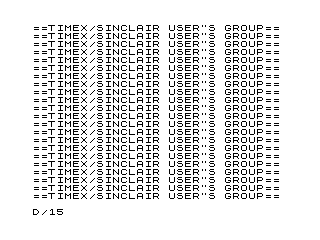
This program is a display demo for a Timex/Sinclair users’ group, cycling through eight machine-code routines stored as entry-point addresses in the array S(). The REM statement at line 0 contains a Z80 machine-code payload—approximately 100 bytes—that implements the various screen-effect routines called via RAND USR. The BASIC loop fills the screen with the text “==TIMEX/SINCLAIR USER’S GROUP==” (22 lines), then calls each machine-code routine 32 times before clearing the screen and advancing to the next effect. The eight S() values (16514–16633) are addresses within or near the REM statement’s data area, pointing to different sub-routines within that single block of Z80 code.
Program Analysis
Program Structure
The program is organized into three distinct phases: initialization (lines 1–9), the main display loop (lines 10–19), and housekeeping lines (20–21) that are not reached during normal execution. The core loop nests three levels: an outer loop over eight routines (X, lines 10–18), a screen-fill loop (I, lines 11–13), and a machine-code invocation loop (I, lines 14–16).
Machine Code in REM (Line 0)
Line 0 is a REM statement whose body is raw Z80 binary. This is the standard ZX81/TS1000 technique for embedding executable machine code: the first byte of a REM body lies at a well-known offset from the system variable RAMTOP, and RAND USR jumps directly into it. The payload is roughly 100 bytes and contains multiple entry points, all branching within the same block.
A partial disassembly of notable sub-routines (addresses are absolute, assuming the REM lands at the expected location near 0x4000):
- The opening bytes
2A 0C 40=LD HL,(400C)— loads the display-file pointer. ED B0=LDIRandED B8=LDDR— block copy instructions used for screen scrolling effects.10 FB/10 F2=DJNZ— tight inner loops for counting iterations.CD CC 40,CD 91 40,CD B0 40,CD 82 40=CALLinstructions — the tail of the REM chains calls to the sub-routines, combining them into composite effects for the later S() entries.- Each sub-routine ends with
C9=RET.
Entry-Point Array
The array S(8) holds the absolute Z80 addresses of eight entry points within the REM machine-code block. By iterating over this array and calling RAND USR S(X), the program selects a different screen effect for each pass.
| S() index | Address (decimal) | Address (hex) |
|---|---|---|
| 1 | 16626 | 0x40F2 |
| 2 | 16514 | 0x4082 |
| 3 | 16633 | 0x40F9 |
| 4 | 16560 | 0x40B0 |
| 5 | 16588 | 0x40CC |
| 6 | 16619 | 0x40EB |
| 7 | 16529 | 0x4091 |
| 8 | 16612 | 0x40E4 |
The higher-numbered entries (S(3), S(6), S(8)) appear to be composite routines—their Z80 entry points contain CALL sequences that chain two simpler sub-routines together before returning, giving more complex visual effects without duplicating code.
Key BASIC Idioms
- RAND USR address: The idiomatic ZX81/TS1000 way to call machine code;
RANDdiscards the return value, avoiding a syntax error from the integer result. - Infinite loop via GOTO: Line 19 jumps back to line 10, so the demo runs forever, cycling through all eight effects repeatedly.
- Variable reuse: The loop variable
Iis reused for both the screen-fill loop (lines 11–13) and the USR invocation loop (lines 14–16), saving a small amount of memory.
Screen Fill Technique
Before each machine-code effect, the program fills the screen by printing the banner string “==TIMEX/SINCLAIR USER’S GROUP==” 22 times (line 12, looped by lines 11–13). The string is 32 characters wide, exactly filling one display line, so 22 repetitions covers the full 24-line display minus the two system lines. This provides the raw pixel data that the machine-code scrolling and block-copy routines then manipulate.
Notable Techniques
- The machine-code entry points are not sequential; they are scattered through the REM block and selected in an order (1,2,3,…,8) chosen for visual variety rather than memory order.
- Each effect is applied 32 times (line 14:
FOR I=1 TO 32) beforeCLSand the next effect, giving a consistent duration per effect. - The
SAVEat line 20 andRUNat line 21 are unreachable from the infinite loop and serve only as a persistent storage / auto-start mechanism for the tape image.
Content
Source Code
0 REM
Skip to content
TSUG Demo
This file is part of and Timex Sinclair Public Domain Library Tape 1002. Download the collection to get this file.
This program is a display demo for a Timex/Sinclair users’ group, cycling through eight machine-code routines stored as entry-point addresses in the array S(). The REM statement at line 0 contains a Z80 machine-code payload—approximately 100 bytes—that implements the various screen-effect routines called via RAND USR. The BASIC loop fills the screen with the text “==TIMEX/SINCLAIR USER’S GROUP==” (22 lines), then calls each machine-code routine 32 times before clearing the screen and advancing to the next effect. The eight S() values (16514–16633) are addresses within or near the REM statement’s data area, pointing to different sub-routines within that single block of Z80 code.
Program Analysis
Program Structure
The program is organized into three distinct phases: initialization (lines 1–9), the main display loop (lines 10–19), and housekeeping lines (20–21) that are not reached during normal execution. The core loop nests three levels: an outer loop over eight routines (X, lines 10–18), a screen-fill loop (I, lines 11–13), and a machine-code invocation loop (I, lines 14–16).
Machine Code in REM (Line 0)
Line 0 is a REM statement whose body is raw Z80 binary. This is the standard ZX81/TS1000 technique for embedding executable machine code: the first byte of a REM body lies at a well-known offset from the system variable RAMTOP, and RAND USR jumps directly into it. The payload is roughly 100 bytes and contains multiple entry points, all branching within the same block.
A partial disassembly of notable sub-routines (addresses are absolute, assuming the REM lands at the expected location near 0x4000):
- The opening bytes
2A 0C 40 = LD HL,(400C) — loads the display-file pointer.
ED B0 = LDIR and ED B8 = LDDR — block copy instructions used for screen scrolling effects.
10 FB / 10 F2 = DJNZ — tight inner loops for counting iterations.
CD CC 40, CD 91 40, CD B0 40, CD 82 40 = CALL instructions — the tail of the REM chains calls to the sub-routines, combining them into composite effects for the later S() entries.
- Each sub-routine ends with
C9 = RET.
Entry-Point Array
The array S(8) holds the absolute Z80 addresses of eight entry points within the REM machine-code block. By iterating over this array and calling RAND USR S(X), the program selects a different screen effect for each pass.
S() index Address (decimal) Address (hex) 1 16626 0x40F2 2 16514 0x4082 3 16633 0x40F9 4 16560 0x40B0 5 16588 0x40CC 6 16619 0x40EB 7 16529 0x4091 8 16612 0x40E4
The higher-numbered entries (S(3), S(6), S(8)) appear to be composite routines—their Z80 entry points contain CALL sequences that chain two simpler sub-routines together before returning, giving more complex visual effects without duplicating code.
Key BASIC Idioms
- RAND USR address: The idiomatic ZX81/TS1000 way to call machine code;
RAND discards the return value, avoiding a syntax error from the integer result.
- Infinite loop via GOTO: Line 19 jumps back to line 10, so the demo runs forever, cycling through all eight effects repeatedly.
- Variable reuse: The loop variable
I is reused for both the screen-fill loop (lines 11–13) and the USR invocation loop (lines 14–16), saving a small amount of memory.
Screen Fill Technique
Before each machine-code effect, the program fills the screen by printing the banner string “==TIMEX/SINCLAIR USER’S GROUP==” 22 times (line 12, looped by lines 11–13). The string is 32 characters wide, exactly filling one display line, so 22 repetitions covers the full 24-line display minus the two system lines. This provides the raw pixel data that the machine-code scrolling and block-copy routines then manipulate.
Notable Techniques
- The machine-code entry points are not sequential; they are scattered through the REM block and selected in an order (1,2,3,…,8) chosen for visual variety rather than memory order.
- Each effect is applied 32 times (line 14:
FOR I=1 TO 32) before CLS and the next effect, giving a consistent duration per effect.
- The
SAVE at line 20 and RUN at line 21 are unreachable from the infinite loop and serve only as a persistent storage / auto-start mechanism for the tape image.
Content
Source Code
0 REM \2A\0C\40\E5\11\21\00\19\D1\01\D6\02\ED\B0\C9\2A\10\40\11\43\00\ED\52\E5\11\21\00\ED\52\D1\01\B5\02\ED\B8\2A\0C\40\06\20\23\36\00\10\FB\C9\2A\0C\40\11\D6\02\19\06\16\2B\4E\36\00\2B\7E\FE\76\28\02\18\03\10\F2\C9\71\4F\18\F1\2A\0C\40\06\16\23\4E\36\00\23\7E\FE\76\28\02\18\03\10\F2\C9\71\4F\18\F1\CD\CC\40\CD\91\40\C9\CD\B0\40\CD\91\40\C9\CD\B0\40\CD\82\40\C9\CD\CC\40\CD\82\40\C9
1 DIM S(8)
2 LET S(1)=16626
3 LET S(2)=16514
4 LET S(3)=16633
5 LET S(4)=16560
6 LET S(5)=16588
7 LET S(6)=16619
8 LET S(7)=16529
9 LET S(8)=16612
10 FOR X=1 TO 8
11 FOR I=1 TO 22
12 PRINT "==TIMEX/SINCLAIR USER""S GROUP=="
13 NEXT I
14 FOR I=1 TO 32
15 RAND USR S(X)
16 NEXT I
17 CLS
18 NEXT X
19 GOTO 10
20 SAVE "1007%4"
21 RUN
Note: Type-in program listings on this website use ZMAKEBAS notation for graphics characters.
People
No people associated with this content.
A
Skip to content
TSUG Demo
This file is part of and Timex Sinclair Public Domain Library Tape 1002. Download the collection to get this file.
This program is a display demo for a Timex/Sinclair users’ group, cycling through eight machine-code routines stored as entry-point addresses in the array S(). The REM statement at line 0 contains a Z80 machine-code payload—approximately 100 bytes—that implements the various screen-effect routines called via RAND USR. The BASIC loop fills the screen with the text “==TIMEX/SINCLAIR USER’S GROUP==” (22 lines), then calls each machine-code routine 32 times before clearing the screen and advancing to the next effect. The eight S() values (16514–16633) are addresses within or near the REM statement’s data area, pointing to different sub-routines within that single block of Z80 code.
Program Analysis
Program Structure
The program is organized into three distinct phases: initialization (lines 1–9), the main display loop (lines 10–19), and housekeeping lines (20–21) that are not reached during normal execution. The core loop nests three levels: an outer loop over eight routines (X, lines 10–18), a screen-fill loop (I, lines 11–13), and a machine-code invocation loop (I, lines 14–16).
Machine Code in REM (Line 0)
Line 0 is a REM statement whose body is raw Z80 binary. This is the standard ZX81/TS1000 technique for embedding executable machine code: the first byte of a REM body lies at a well-known offset from the system variable RAMTOP, and RAND USR jumps directly into it. The payload is roughly 100 bytes and contains multiple entry points, all branching within the same block.
A partial disassembly of notable sub-routines (addresses are absolute, assuming the REM lands at the expected location near 0x4000):
- The opening bytes
2A 0C 40 = LD HL,(400C) — loads the display-file pointer.
ED B0 = LDIR and ED B8 = LDDR — block copy instructions used for screen scrolling effects.
10 FB / 10 F2 = DJNZ — tight inner loops for counting iterations.
CD CC 40, CD 91 40, CD B0 40, CD 82 40 = CALL instructions — the tail of the REM chains calls to the sub-routines, combining them into composite effects for the later S() entries.
- Each sub-routine ends with
C9 = RET.
Entry-Point Array
The array S(8) holds the absolute Z80 addresses of eight entry points within the REM machine-code block. By iterating over this array and calling RAND USR S(X), the program selects a different screen effect for each pass.
S() index Address (decimal) Address (hex) 1 16626 0x40F2 2 16514 0x4082 3 16633 0x40F9 4 16560 0x40B0 5 16588 0x40CC 6 16619 0x40EB 7 16529 0x4091 8 16612 0x40E4
The higher-numbered entries (S(3), S(6), S(8)) appear to be composite routines—their Z80 entry points contain CALL sequences that chain two simpler sub-routines together before returning, giving more complex visual effects without duplicating code.
Key BASIC Idioms
- RAND USR address: The idiomatic ZX81/TS1000 way to call machine code;
RAND discards the return value, avoiding a syntax error from the integer result.
- Infinite loop via GOTO: Line 19 jumps back to line 10, so the demo runs forever, cycling through all eight effects repeatedly.
- Variable reuse: The loop variable
I is reused for both the screen-fill loop (lines 11–13) and the USR invocation loop (lines 14–16), saving a small amount of memory.
Screen Fill Technique
Before each machine-code effect, the program fills the screen by printing the banner string “==TIMEX/SINCLAIR USER’S GROUP==” 22 times (line 12, looped by lines 11–13). The string is 32 characters wide, exactly filling one display line, so 22 repetitions covers the full 24-line display minus the two system lines. This provides the raw pixel data that the machine-code scrolling and block-copy routines then manipulate.
Notable Techniques
- The machine-code entry points are not sequential; they are scattered through the REM block and selected in an order (1,2,3,…,8) chosen for visual variety rather than memory order.
- Each effect is applied 32 times (line 14:
FOR I=1 TO 32) before CLS and the next effect, giving a consistent duration per effect.
- The
SAVE at line 20 and RUN at line 21 are unreachable from the infinite loop and serve only as a persistent storage / auto-start mechanism for the tape image.
Content
Source Code
0 REM \2A\0C\40\E5\11\21\00\19\D1\01\D6\02\ED\B0\C9\2A\10\40\11\43\00\ED\52\E5\11\21\00\ED\52\D1\01\B5\02\ED\B8\2A\0C\40\06\20\23\36\00\10\FB\C9\2A\0C\40\11\D6\02\19\06\16\2B\4E\36\00\2B\7E\FE\76\28\02\18\03\10\F2\C9\71\4F\18\F1\2A\0C\40\06\16\23\4E\36\00\23\7E\FE\76\28\02\18\03\10\F2\C9\71\4F\18\F1\CD\CC\40\CD\91\40\C9\CD\B0\40\CD\91\40\C9\CD\B0\40\CD\82\40\C9\CD\CC\40\CD\82\40\C9
1 DIM S(8)
2 LET S(1)=16626
3 LET S(2)=16514
4 LET S(3)=16633
5 LET S(4)=16560
6 LET S(5)=16588
7 LET S(6)=16619
8 LET S(7)=16529
9 LET S(8)=16612
10 FOR X=1 TO 8
11 FOR I=1 TO 22
12 PRINT "==TIMEX/SINCLAIR USER""S GROUP=="
13 NEXT I
14 FOR I=1 TO 32
15 RAND USR S(X)
16 NEXT I
17 CLS
18 NEXT X
19 GOTO 10
20 SAVE "1007%4"
21 RUN
Note: Type-in program listings on this website use ZMAKEBAS notation for graphics characters.
People
No people associated with this content.
C\E5
Skip to content
TSUG Demo
This file is part of and Timex Sinclair Public Domain Library Tape 1002. Download the collection to get this file.
This program is a display demo for a Timex/Sinclair users’ group, cycling through eight machine-code routines stored as entry-point addresses in the array S(). The REM statement at line 0 contains a Z80 machine-code payload—approximately 100 bytes—that implements the various screen-effect routines called via RAND USR. The BASIC loop fills the screen with the text “==TIMEX/SINCLAIR USER’S GROUP==” (22 lines), then calls each machine-code routine 32 times before clearing the screen and advancing to the next effect. The eight S() values (16514–16633) are addresses within or near the REM statement’s data area, pointing to different sub-routines within that single block of Z80 code.
Program Analysis
Program Structure
The program is organized into three distinct phases: initialization (lines 1–9), the main display loop (lines 10–19), and housekeeping lines (20–21) that are not reached during normal execution. The core loop nests three levels: an outer loop over eight routines (X, lines 10–18), a screen-fill loop (I, lines 11–13), and a machine-code invocation loop (I, lines 14–16).
Machine Code in REM (Line 0)
Line 0 is a REM statement whose body is raw Z80 binary. This is the standard ZX81/TS1000 technique for embedding executable machine code: the first byte of a REM body lies at a well-known offset from the system variable RAMTOP, and RAND USR jumps directly into it. The payload is roughly 100 bytes and contains multiple entry points, all branching within the same block.
A partial disassembly of notable sub-routines (addresses are absolute, assuming the REM lands at the expected location near 0x4000):
- The opening bytes
2A 0C 40 = LD HL,(400C) — loads the display-file pointer.
ED B0 = LDIR and ED B8 = LDDR — block copy instructions used for screen scrolling effects.
10 FB / 10 F2 = DJNZ — tight inner loops for counting iterations.
CD CC 40, CD 91 40, CD B0 40, CD 82 40 = CALL instructions — the tail of the REM chains calls to the sub-routines, combining them into composite effects for the later S() entries.
- Each sub-routine ends with
C9 = RET.
Entry-Point Array
The array S(8) holds the absolute Z80 addresses of eight entry points within the REM machine-code block. By iterating over this array and calling RAND USR S(X), the program selects a different screen effect for each pass.
S() index Address (decimal) Address (hex) 1 16626 0x40F2 2 16514 0x4082 3 16633 0x40F9 4 16560 0x40B0 5 16588 0x40CC 6 16619 0x40EB 7 16529 0x4091 8 16612 0x40E4
The higher-numbered entries (S(3), S(6), S(8)) appear to be composite routines—their Z80 entry points contain CALL sequences that chain two simpler sub-routines together before returning, giving more complex visual effects without duplicating code.
Key BASIC Idioms
- RAND USR address: The idiomatic ZX81/TS1000 way to call machine code;
RAND discards the return value, avoiding a syntax error from the integer result.
- Infinite loop via GOTO: Line 19 jumps back to line 10, so the demo runs forever, cycling through all eight effects repeatedly.
- Variable reuse: The loop variable
I is reused for both the screen-fill loop (lines 11–13) and the USR invocation loop (lines 14–16), saving a small amount of memory.
Screen Fill Technique
Before each machine-code effect, the program fills the screen by printing the banner string “==TIMEX/SINCLAIR USER’S GROUP==” 22 times (line 12, looped by lines 11–13). The string is 32 characters wide, exactly filling one display line, so 22 repetitions covers the full 24-line display minus the two system lines. This provides the raw pixel data that the machine-code scrolling and block-copy routines then manipulate.
Notable Techniques
- The machine-code entry points are not sequential; they are scattered through the REM block and selected in an order (1,2,3,…,8) chosen for visual variety rather than memory order.
- Each effect is applied 32 times (line 14:
FOR I=1 TO 32) before CLS and the next effect, giving a consistent duration per effect.
- The
SAVE at line 20 and RUN at line 21 are unreachable from the infinite loop and serve only as a persistent storage / auto-start mechanism for the tape image.
Content
Source Code
0 REM \2A\0C\40\E5\11\21\00\19\D1\01\D6\02\ED\B0\C9\2A\10\40\11\43\00\ED\52\E5\11\21\00\ED\52\D1\01\B5\02\ED\B8\2A\0C\40\06\20\23\36\00\10\FB\C9\2A\0C\40\11\D6\02\19\06\16\2B\4E\36\00\2B\7E\FE\76\28\02\18\03\10\F2\C9\71\4F\18\F1\2A\0C\40\06\16\23\4E\36\00\23\7E\FE\76\28\02\18\03\10\F2\C9\71\4F\18\F1\CD\CC\40\CD\91\40\C9\CD\B0\40\CD\91\40\C9\CD\B0\40\CD\82\40\C9\CD\CC\40\CD\82\40\C9
1 DIM S(8)
2 LET S(1)=16626
3 LET S(2)=16514
4 LET S(3)=16633
5 LET S(4)=16560
6 LET S(5)=16588
7 LET S(6)=16619
8 LET S(7)=16529
9 LET S(8)=16612
10 FOR X=1 TO 8
11 FOR I=1 TO 22
12 PRINT "==TIMEX/SINCLAIR USER""S GROUP=="
13 NEXT I
14 FOR I=1 TO 32
15 RAND USR S(X)
16 NEXT I
17 CLS
18 NEXT X
19 GOTO 10
20 SAVE "1007%4"
21 RUN
Note: Type-in program listings on this website use ZMAKEBAS notation for graphics characters.
People
No people associated with this content.
\D1 itemtype='https://schema.org/Blog' itemscope='itemscope' class="wp-singular computer_media-template-default single single-computer_media postid-57125 wp-custom-logo wp-embed-responsive wp-theme-astra wp-child-theme-astra-child ast-desktop ast-separate-container ast-left-sidebar astra-4.12.6 group-blog ast-blog-single-style-1 ast-custom-post-type ast-single-post ast-inherit-site-logo-transparent ast-hfb-header ast-full-width-primary-header ast-box-layout ast-normal-title-enabled astra-addon-4.12.4"\D6
Skip to content
TSUG Demo
This file is part of and Timex Sinclair Public Domain Library Tape 1002. Download the collection to get this file.
This program is a display demo for a Timex/Sinclair users’ group, cycling through eight machine-code routines stored as entry-point addresses in the array S(). The REM statement at line 0 contains a Z80 machine-code payload—approximately 100 bytes—that implements the various screen-effect routines called via RAND USR. The BASIC loop fills the screen with the text “==TIMEX/SINCLAIR USER’S GROUP==” (22 lines), then calls each machine-code routine 32 times before clearing the screen and advancing to the next effect. The eight S() values (16514–16633) are addresses within or near the REM statement’s data area, pointing to different sub-routines within that single block of Z80 code.
Program Analysis
Program Structure
The program is organized into three distinct phases: initialization (lines 1–9), the main display loop (lines 10–19), and housekeeping lines (20–21) that are not reached during normal execution. The core loop nests three levels: an outer loop over eight routines (X, lines 10–18), a screen-fill loop (I, lines 11–13), and a machine-code invocation loop (I, lines 14–16).
Machine Code in REM (Line 0)
Line 0 is a REM statement whose body is raw Z80 binary. This is the standard ZX81/TS1000 technique for embedding executable machine code: the first byte of a REM body lies at a well-known offset from the system variable RAMTOP, and RAND USR jumps directly into it. The payload is roughly 100 bytes and contains multiple entry points, all branching within the same block.
A partial disassembly of notable sub-routines (addresses are absolute, assuming the REM lands at the expected location near 0x4000):
- The opening bytes
2A 0C 40 = LD HL,(400C) — loads the display-file pointer.
ED B0 = LDIR and ED B8 = LDDR — block copy instructions used for screen scrolling effects.
10 FB / 10 F2 = DJNZ — tight inner loops for counting iterations.
CD CC 40, CD 91 40, CD B0 40, CD 82 40 = CALL instructions — the tail of the REM chains calls to the sub-routines, combining them into composite effects for the later S() entries.
- Each sub-routine ends with
C9 = RET.
Entry-Point Array
The array S(8) holds the absolute Z80 addresses of eight entry points within the REM machine-code block. By iterating over this array and calling RAND USR S(X), the program selects a different screen effect for each pass.
S() index Address (decimal) Address (hex) 1 16626 0x40F2 2 16514 0x4082 3 16633 0x40F9 4 16560 0x40B0 5 16588 0x40CC 6 16619 0x40EB 7 16529 0x4091 8 16612 0x40E4
The higher-numbered entries (S(3), S(6), S(8)) appear to be composite routines—their Z80 entry points contain CALL sequences that chain two simpler sub-routines together before returning, giving more complex visual effects without duplicating code.
Key BASIC Idioms
- RAND USR address: The idiomatic ZX81/TS1000 way to call machine code;
RAND discards the return value, avoiding a syntax error from the integer result.
- Infinite loop via GOTO: Line 19 jumps back to line 10, so the demo runs forever, cycling through all eight effects repeatedly.
- Variable reuse: The loop variable
I is reused for both the screen-fill loop (lines 11–13) and the USR invocation loop (lines 14–16), saving a small amount of memory.
Screen Fill Technique
Before each machine-code effect, the program fills the screen by printing the banner string “==TIMEX/SINCLAIR USER’S GROUP==” 22 times (line 12, looped by lines 11–13). The string is 32 characters wide, exactly filling one display line, so 22 repetitions covers the full 24-line display minus the two system lines. This provides the raw pixel data that the machine-code scrolling and block-copy routines then manipulate.
Notable Techniques
- The machine-code entry points are not sequential; they are scattered through the REM block and selected in an order (1,2,3,…,8) chosen for visual variety rather than memory order.
- Each effect is applied 32 times (line 14:
FOR I=1 TO 32) before CLS and the next effect, giving a consistent duration per effect.
- The
SAVE at line 20 and RUN at line 21 are unreachable from the infinite loop and serve only as a persistent storage / auto-start mechanism for the tape image.
Content
Source Code
0 REM \2A\0C\40\E5\11\21\00\19\D1\01\D6\02\ED\B0\C9\2A\10\40\11\43\00\ED\52\E5\11\21\00\ED\52\D1\01\B5\02\ED\B8\2A\0C\40\06\20\23\36\00\10\FB\C9\2A\0C\40\11\D6\02\19\06\16\2B\4E\36\00\2B\7E\FE\76\28\02\18\03\10\F2\C9\71\4F\18\F1\2A\0C\40\06\16\23\4E\36\00\23\7E\FE\76\28\02\18\03\10\F2\C9\71\4F\18\F1\CD\CC\40\CD\91\40\C9\CD\B0\40\CD\91\40\C9\CD\B0\40\CD\82\40\C9\CD\CC\40\CD\82\40\C9
1 DIM S(8)
2 LET S(1)=16626
3 LET S(2)=16514
4 LET S(3)=16633
5 LET S(4)=16560
6 LET S(5)=16588
7 LET S(6)=16619
8 LET S(7)=16529
9 LET S(8)=16612
10 FOR X=1 TO 8
11 FOR I=1 TO 22
12 PRINT "==TIMEX/SINCLAIR USER""S GROUP=="
13 NEXT I
14 FOR I=1 TO 32
15 RAND USR S(X)
16 NEXT I
17 CLS
18 NEXT X
19 GOTO 10
20 SAVE "1007%4"
21 RUN
Note: Type-in program listings on this website use ZMAKEBAS notation for graphics characters.
People
No people associated with this content.
\ED\B0\C9
Skip to content
TSUG Demo
This file is part of and Timex Sinclair Public Domain Library Tape 1002. Download the collection to get this file.
This program is a display demo for a Timex/Sinclair users’ group, cycling through eight machine-code routines stored as entry-point addresses in the array S(). The REM statement at line 0 contains a Z80 machine-code payload—approximately 100 bytes—that implements the various screen-effect routines called via RAND USR. The BASIC loop fills the screen with the text “==TIMEX/SINCLAIR USER’S GROUP==” (22 lines), then calls each machine-code routine 32 times before clearing the screen and advancing to the next effect. The eight S() values (16514–16633) are addresses within or near the REM statement’s data area, pointing to different sub-routines within that single block of Z80 code.
Program Analysis
Program Structure
The program is organized into three distinct phases: initialization (lines 1–9), the main display loop (lines 10–19), and housekeeping lines (20–21) that are not reached during normal execution. The core loop nests three levels: an outer loop over eight routines (X, lines 10–18), a screen-fill loop (I, lines 11–13), and a machine-code invocation loop (I, lines 14–16).
Machine Code in REM (Line 0)
Line 0 is a REM statement whose body is raw Z80 binary. This is the standard ZX81/TS1000 technique for embedding executable machine code: the first byte of a REM body lies at a well-known offset from the system variable RAMTOP, and RAND USR jumps directly into it. The payload is roughly 100 bytes and contains multiple entry points, all branching within the same block.
A partial disassembly of notable sub-routines (addresses are absolute, assuming the REM lands at the expected location near 0x4000):
- The opening bytes
2A 0C 40 = LD HL,(400C) — loads the display-file pointer.
ED B0 = LDIR and ED B8 = LDDR — block copy instructions used for screen scrolling effects.
10 FB / 10 F2 = DJNZ — tight inner loops for counting iterations.
CD CC 40, CD 91 40, CD B0 40, CD 82 40 = CALL instructions — the tail of the REM chains calls to the sub-routines, combining them into composite effects for the later S() entries.
- Each sub-routine ends with
C9 = RET.
Entry-Point Array
The array S(8) holds the absolute Z80 addresses of eight entry points within the REM machine-code block. By iterating over this array and calling RAND USR S(X), the program selects a different screen effect for each pass.
S() index Address (decimal) Address (hex) 1 16626 0x40F2 2 16514 0x4082 3 16633 0x40F9 4 16560 0x40B0 5 16588 0x40CC 6 16619 0x40EB 7 16529 0x4091 8 16612 0x40E4
The higher-numbered entries (S(3), S(6), S(8)) appear to be composite routines—their Z80 entry points contain CALL sequences that chain two simpler sub-routines together before returning, giving more complex visual effects without duplicating code.
Key BASIC Idioms
- RAND USR address: The idiomatic ZX81/TS1000 way to call machine code;
RAND discards the return value, avoiding a syntax error from the integer result.
- Infinite loop via GOTO: Line 19 jumps back to line 10, so the demo runs forever, cycling through all eight effects repeatedly.
- Variable reuse: The loop variable
I is reused for both the screen-fill loop (lines 11–13) and the USR invocation loop (lines 14–16), saving a small amount of memory.
Screen Fill Technique
Before each machine-code effect, the program fills the screen by printing the banner string “==TIMEX/SINCLAIR USER’S GROUP==” 22 times (line 12, looped by lines 11–13). The string is 32 characters wide, exactly filling one display line, so 22 repetitions covers the full 24-line display minus the two system lines. This provides the raw pixel data that the machine-code scrolling and block-copy routines then manipulate.
Notable Techniques
- The machine-code entry points are not sequential; they are scattered through the REM block and selected in an order (1,2,3,…,8) chosen for visual variety rather than memory order.
- Each effect is applied 32 times (line 14:
FOR I=1 TO 32) before CLS and the next effect, giving a consistent duration per effect.
- The
SAVE at line 20 and RUN at line 21 are unreachable from the infinite loop and serve only as a persistent storage / auto-start mechanism for the tape image.
Content
Source Code
0 REM \2A\0C\40\E5\11\21\00\19\D1\01\D6\02\ED\B0\C9\2A\10\40\11\43\00\ED\52\E5\11\21\00\ED\52\D1\01\B5\02\ED\B8\2A\0C\40\06\20\23\36\00\10\FB\C9\2A\0C\40\11\D6\02\19\06\16\2B\4E\36\00\2B\7E\FE\76\28\02\18\03\10\F2\C9\71\4F\18\F1\2A\0C\40\06\16\23\4E\36\00\23\7E\FE\76\28\02\18\03\10\F2\C9\71\4F\18\F1\CD\CC\40\CD\91\40\C9\CD\B0\40\CD\91\40\C9\CD\B0\40\CD\82\40\C9\CD\CC\40\CD\82\40\C9
1 DIM S(8)
2 LET S(1)=16626
3 LET S(2)=16514
4 LET S(3)=16633
5 LET S(4)=16560
6 LET S(5)=16588
7 LET S(6)=16619
8 LET S(7)=16529
9 LET S(8)=16612
10 FOR X=1 TO 8
11 FOR I=1 TO 22
12 PRINT "==TIMEX/SINCLAIR USER""S GROUP=="
13 NEXT I
14 FOR I=1 TO 32
15 RAND USR S(X)
16 NEXT I
17 CLS
18 NEXT X
19 GOTO 10
20 SAVE "1007%4"
21 RUN
Note: Type-in program listings on this website use ZMAKEBAS notation for graphics characters.
People
No people associated with this content.
A
Skip to content
TSUG Demo
This file is part of and Timex Sinclair Public Domain Library Tape 1002. Download the collection to get this file.
This program is a display demo for a Timex/Sinclair users’ group, cycling through eight machine-code routines stored as entry-point addresses in the array S(). The REM statement at line 0 contains a Z80 machine-code payload—approximately 100 bytes—that implements the various screen-effect routines called via RAND USR. The BASIC loop fills the screen with the text “==TIMEX/SINCLAIR USER’S GROUP==” (22 lines), then calls each machine-code routine 32 times before clearing the screen and advancing to the next effect. The eight S() values (16514–16633) are addresses within or near the REM statement’s data area, pointing to different sub-routines within that single block of Z80 code.
Program Analysis
Program Structure
The program is organized into three distinct phases: initialization (lines 1–9), the main display loop (lines 10–19), and housekeeping lines (20–21) that are not reached during normal execution. The core loop nests three levels: an outer loop over eight routines (X, lines 10–18), a screen-fill loop (I, lines 11–13), and a machine-code invocation loop (I, lines 14–16).
Machine Code in REM (Line 0)
Line 0 is a REM statement whose body is raw Z80 binary. This is the standard ZX81/TS1000 technique for embedding executable machine code: the first byte of a REM body lies at a well-known offset from the system variable RAMTOP, and RAND USR jumps directly into it. The payload is roughly 100 bytes and contains multiple entry points, all branching within the same block.
A partial disassembly of notable sub-routines (addresses are absolute, assuming the REM lands at the expected location near 0x4000):
- The opening bytes
2A 0C 40 = LD HL,(400C) — loads the display-file pointer.
ED B0 = LDIR and ED B8 = LDDR — block copy instructions used for screen scrolling effects.
10 FB / 10 F2 = DJNZ — tight inner loops for counting iterations.
CD CC 40, CD 91 40, CD B0 40, CD 82 40 = CALL instructions — the tail of the REM chains calls to the sub-routines, combining them into composite effects for the later S() entries.
- Each sub-routine ends with
C9 = RET.
Entry-Point Array
The array S(8) holds the absolute Z80 addresses of eight entry points within the REM machine-code block. By iterating over this array and calling RAND USR S(X), the program selects a different screen effect for each pass.
S() index Address (decimal) Address (hex) 1 16626 0x40F2 2 16514 0x4082 3 16633 0x40F9 4 16560 0x40B0 5 16588 0x40CC 6 16619 0x40EB 7 16529 0x4091 8 16612 0x40E4
The higher-numbered entries (S(3), S(6), S(8)) appear to be composite routines—their Z80 entry points contain CALL sequences that chain two simpler sub-routines together before returning, giving more complex visual effects without duplicating code.
Key BASIC Idioms
- RAND USR address: The idiomatic ZX81/TS1000 way to call machine code;
RAND discards the return value, avoiding a syntax error from the integer result.
- Infinite loop via GOTO: Line 19 jumps back to line 10, so the demo runs forever, cycling through all eight effects repeatedly.
- Variable reuse: The loop variable
I is reused for both the screen-fill loop (lines 11–13) and the USR invocation loop (lines 14–16), saving a small amount of memory.
Screen Fill Technique
Before each machine-code effect, the program fills the screen by printing the banner string “==TIMEX/SINCLAIR USER’S GROUP==” 22 times (line 12, looped by lines 11–13). The string is 32 characters wide, exactly filling one display line, so 22 repetitions covers the full 24-line display minus the two system lines. This provides the raw pixel data that the machine-code scrolling and block-copy routines then manipulate.
Notable Techniques
- The machine-code entry points are not sequential; they are scattered through the REM block and selected in an order (1,2,3,…,8) chosen for visual variety rather than memory order.
- Each effect is applied 32 times (line 14:
FOR I=1 TO 32) before CLS and the next effect, giving a consistent duration per effect.
- The
SAVE at line 20 and RUN at line 21 are unreachable from the infinite loop and serve only as a persistent storage / auto-start mechanism for the tape image.
Content
Source Code
0 REM \2A\0C\40\E5\11\21\00\19\D1\01\D6\02\ED\B0\C9\2A\10\40\11\43\00\ED\52\E5\11\21\00\ED\52\D1\01\B5\02\ED\B8\2A\0C\40\06\20\23\36\00\10\FB\C9\2A\0C\40\11\D6\02\19\06\16\2B\4E\36\00\2B\7E\FE\76\28\02\18\03\10\F2\C9\71\4F\18\F1\2A\0C\40\06\16\23\4E\36\00\23\7E\FE\76\28\02\18\03\10\F2\C9\71\4F\18\F1\CD\CC\40\CD\91\40\C9\CD\B0\40\CD\91\40\C9\CD\B0\40\CD\82\40\C9\CD\CC\40\CD\82\40\C9
1 DIM S(8)
2 LET S(1)=16626
3 LET S(2)=16514
4 LET S(3)=16633
5 LET S(4)=16560
6 LET S(5)=16588
7 LET S(6)=16619
8 LET S(7)=16529
9 LET S(8)=16612
10 FOR X=1 TO 8
11 FOR I=1 TO 22
12 PRINT "==TIMEX/SINCLAIR USER""S GROUP=="
13 NEXT I
14 FOR I=1 TO 32
15 RAND USR S(X)
16 NEXT I
17 CLS
18 NEXT X
19 GOTO 10
20 SAVE "1007%4"
21 RUN
Note: Type-in program listings on this website use ZMAKEBAS notation for graphics characters.
People
No people associated with this content.
\ED\E5
Skip to content
TSUG Demo
This file is part of and Timex Sinclair Public Domain Library Tape 1002. Download the collection to get this file.
This program is a display demo for a Timex/Sinclair users’ group, cycling through eight machine-code routines stored as entry-point addresses in the array S(). The REM statement at line 0 contains a Z80 machine-code payload—approximately 100 bytes—that implements the various screen-effect routines called via RAND USR. The BASIC loop fills the screen with the text “==TIMEX/SINCLAIR USER’S GROUP==” (22 lines), then calls each machine-code routine 32 times before clearing the screen and advancing to the next effect. The eight S() values (16514–16633) are addresses within or near the REM statement’s data area, pointing to different sub-routines within that single block of Z80 code.
Program Analysis
Program Structure
The program is organized into three distinct phases: initialization (lines 1–9), the main display loop (lines 10–19), and housekeeping lines (20–21) that are not reached during normal execution. The core loop nests three levels: an outer loop over eight routines (X, lines 10–18), a screen-fill loop (I, lines 11–13), and a machine-code invocation loop (I, lines 14–16).
Machine Code in REM (Line 0)
Line 0 is a REM statement whose body is raw Z80 binary. This is the standard ZX81/TS1000 technique for embedding executable machine code: the first byte of a REM body lies at a well-known offset from the system variable RAMTOP, and RAND USR jumps directly into it. The payload is roughly 100 bytes and contains multiple entry points, all branching within the same block.
A partial disassembly of notable sub-routines (addresses are absolute, assuming the REM lands at the expected location near 0x4000):
- The opening bytes
2A 0C 40 = LD HL,(400C) — loads the display-file pointer.
ED B0 = LDIR and ED B8 = LDDR — block copy instructions used for screen scrolling effects.
10 FB / 10 F2 = DJNZ — tight inner loops for counting iterations.
CD CC 40, CD 91 40, CD B0 40, CD 82 40 = CALL instructions — the tail of the REM chains calls to the sub-routines, combining them into composite effects for the later S() entries.
- Each sub-routine ends with
C9 = RET.
Entry-Point Array
The array S(8) holds the absolute Z80 addresses of eight entry points within the REM machine-code block. By iterating over this array and calling RAND USR S(X), the program selects a different screen effect for each pass.
S() index Address (decimal) Address (hex) 1 16626 0x40F2 2 16514 0x4082 3 16633 0x40F9 4 16560 0x40B0 5 16588 0x40CC 6 16619 0x40EB 7 16529 0x4091 8 16612 0x40E4
The higher-numbered entries (S(3), S(6), S(8)) appear to be composite routines—their Z80 entry points contain CALL sequences that chain two simpler sub-routines together before returning, giving more complex visual effects without duplicating code.
Key BASIC Idioms
- RAND USR address: The idiomatic ZX81/TS1000 way to call machine code;
RAND discards the return value, avoiding a syntax error from the integer result.
- Infinite loop via GOTO: Line 19 jumps back to line 10, so the demo runs forever, cycling through all eight effects repeatedly.
- Variable reuse: The loop variable
I is reused for both the screen-fill loop (lines 11–13) and the USR invocation loop (lines 14–16), saving a small amount of memory.
Screen Fill Technique
Before each machine-code effect, the program fills the screen by printing the banner string “==TIMEX/SINCLAIR USER’S GROUP==” 22 times (line 12, looped by lines 11–13). The string is 32 characters wide, exactly filling one display line, so 22 repetitions covers the full 24-line display minus the two system lines. This provides the raw pixel data that the machine-code scrolling and block-copy routines then manipulate.
Notable Techniques
- The machine-code entry points are not sequential; they are scattered through the REM block and selected in an order (1,2,3,…,8) chosen for visual variety rather than memory order.
- Each effect is applied 32 times (line 14:
FOR I=1 TO 32) before CLS and the next effect, giving a consistent duration per effect.
- The
SAVE at line 20 and RUN at line 21 are unreachable from the infinite loop and serve only as a persistent storage / auto-start mechanism for the tape image.
Content
Source Code
0 REM \2A\0C\40\E5\11\21\00\19\D1\01\D6\02\ED\B0\C9\2A\10\40\11\43\00\ED\52\E5\11\21\00\ED\52\D1\01\B5\02\ED\B8\2A\0C\40\06\20\23\36\00\10\FB\C9\2A\0C\40\11\D6\02\19\06\16\2B\4E\36\00\2B\7E\FE\76\28\02\18\03\10\F2\C9\71\4F\18\F1\2A\0C\40\06\16\23\4E\36\00\23\7E\FE\76\28\02\18\03\10\F2\C9\71\4F\18\F1\CD\CC\40\CD\91\40\C9\CD\B0\40\CD\91\40\C9\CD\B0\40\CD\82\40\C9\CD\CC\40\CD\82\40\C9
1 DIM S(8)
2 LET S(1)=16626
3 LET S(2)=16514
4 LET S(3)=16633
5 LET S(4)=16560
6 LET S(5)=16588
7 LET S(6)=16619
8 LET S(7)=16529
9 LET S(8)=16612
10 FOR X=1 TO 8
11 FOR I=1 TO 22
12 PRINT "==TIMEX/SINCLAIR USER""S GROUP=="
13 NEXT I
14 FOR I=1 TO 32
15 RAND USR S(X)
16 NEXT I
17 CLS
18 NEXT X
19 GOTO 10
20 SAVE "1007%4"
21 RUN
Note: Type-in program listings on this website use ZMAKEBAS notation for graphics characters.
People
No people associated with this content.
\ED\D1 itemtype='https://schema.org/Blog' itemscope='itemscope' class="wp-singular computer_media-template-default single single-computer_media postid-57125 wp-custom-logo wp-embed-responsive wp-theme-astra wp-child-theme-astra-child ast-desktop ast-separate-container ast-left-sidebar astra-4.12.6 group-blog ast-blog-single-style-1 ast-custom-post-type ast-single-post ast-inherit-site-logo-transparent ast-hfb-header ast-full-width-primary-header ast-box-layout ast-normal-title-enabled astra-addon-4.12.4"\B5
Skip to content
TSUG Demo
This file is part of and Timex Sinclair Public Domain Library Tape 1002. Download the collection to get this file.
This program is a display demo for a Timex/Sinclair users’ group, cycling through eight machine-code routines stored as entry-point addresses in the array S(). The REM statement at line 0 contains a Z80 machine-code payload—approximately 100 bytes—that implements the various screen-effect routines called via RAND USR. The BASIC loop fills the screen with the text “==TIMEX/SINCLAIR USER’S GROUP==” (22 lines), then calls each machine-code routine 32 times before clearing the screen and advancing to the next effect. The eight S() values (16514–16633) are addresses within or near the REM statement’s data area, pointing to different sub-routines within that single block of Z80 code.
Program Analysis
Program Structure
The program is organized into three distinct phases: initialization (lines 1–9), the main display loop (lines 10–19), and housekeeping lines (20–21) that are not reached during normal execution. The core loop nests three levels: an outer loop over eight routines (X, lines 10–18), a screen-fill loop (I, lines 11–13), and a machine-code invocation loop (I, lines 14–16).
Machine Code in REM (Line 0)
Line 0 is a REM statement whose body is raw Z80 binary. This is the standard ZX81/TS1000 technique for embedding executable machine code: the first byte of a REM body lies at a well-known offset from the system variable RAMTOP, and RAND USR jumps directly into it. The payload is roughly 100 bytes and contains multiple entry points, all branching within the same block.
A partial disassembly of notable sub-routines (addresses are absolute, assuming the REM lands at the expected location near 0x4000):
- The opening bytes
2A 0C 40 = LD HL,(400C) — loads the display-file pointer.
ED B0 = LDIR and ED B8 = LDDR — block copy instructions used for screen scrolling effects.
10 FB / 10 F2 = DJNZ — tight inner loops for counting iterations.
CD CC 40, CD 91 40, CD B0 40, CD 82 40 = CALL instructions — the tail of the REM chains calls to the sub-routines, combining them into composite effects for the later S() entries.
- Each sub-routine ends with
C9 = RET.
Entry-Point Array
The array S(8) holds the absolute Z80 addresses of eight entry points within the REM machine-code block. By iterating over this array and calling RAND USR S(X), the program selects a different screen effect for each pass.
S() index Address (decimal) Address (hex) 1 16626 0x40F2 2 16514 0x4082 3 16633 0x40F9 4 16560 0x40B0 5 16588 0x40CC 6 16619 0x40EB 7 16529 0x4091 8 16612 0x40E4
The higher-numbered entries (S(3), S(6), S(8)) appear to be composite routines—their Z80 entry points contain CALL sequences that chain two simpler sub-routines together before returning, giving more complex visual effects without duplicating code.
Key BASIC Idioms
- RAND USR address: The idiomatic ZX81/TS1000 way to call machine code;
RAND discards the return value, avoiding a syntax error from the integer result.
- Infinite loop via GOTO: Line 19 jumps back to line 10, so the demo runs forever, cycling through all eight effects repeatedly.
- Variable reuse: The loop variable
I is reused for both the screen-fill loop (lines 11–13) and the USR invocation loop (lines 14–16), saving a small amount of memory.
Screen Fill Technique
Before each machine-code effect, the program fills the screen by printing the banner string “==TIMEX/SINCLAIR USER’S GROUP==” 22 times (line 12, looped by lines 11–13). The string is 32 characters wide, exactly filling one display line, so 22 repetitions covers the full 24-line display minus the two system lines. This provides the raw pixel data that the machine-code scrolling and block-copy routines then manipulate.
Notable Techniques
- The machine-code entry points are not sequential; they are scattered through the REM block and selected in an order (1,2,3,…,8) chosen for visual variety rather than memory order.
- Each effect is applied 32 times (line 14:
FOR I=1 TO 32) before CLS and the next effect, giving a consistent duration per effect.
- The
SAVE at line 20 and RUN at line 21 are unreachable from the infinite loop and serve only as a persistent storage / auto-start mechanism for the tape image.
Content
Source Code
0 REM \2A\0C\40\E5\11\21\00\19\D1\01\D6\02\ED\B0\C9\2A\10\40\11\43\00\ED\52\E5\11\21\00\ED\52\D1\01\B5\02\ED\B8\2A\0C\40\06\20\23\36\00\10\FB\C9\2A\0C\40\11\D6\02\19\06\16\2B\4E\36\00\2B\7E\FE\76\28\02\18\03\10\F2\C9\71\4F\18\F1\2A\0C\40\06\16\23\4E\36\00\23\7E\FE\76\28\02\18\03\10\F2\C9\71\4F\18\F1\CD\CC\40\CD\91\40\C9\CD\B0\40\CD\91\40\C9\CD\B0\40\CD\82\40\C9\CD\CC\40\CD\82\40\C9
1 DIM S(8)
2 LET S(1)=16626
3 LET S(2)=16514
4 LET S(3)=16633
5 LET S(4)=16560
6 LET S(5)=16588
7 LET S(6)=16619
8 LET S(7)=16529
9 LET S(8)=16612
10 FOR X=1 TO 8
11 FOR I=1 TO 22
12 PRINT "==TIMEX/SINCLAIR USER""S GROUP=="
13 NEXT I
14 FOR I=1 TO 32
15 RAND USR S(X)
16 NEXT I
17 CLS
18 NEXT X
19 GOTO 10
20 SAVE "1007%4"
21 RUN
Note: Type-in program listings on this website use ZMAKEBAS notation for graphics characters.
People
No people associated with this content.
\ED\B8
Skip to content
TSUG Demo
This file is part of and Timex Sinclair Public Domain Library Tape 1002. Download the collection to get this file.
This program is a display demo for a Timex/Sinclair users’ group, cycling through eight machine-code routines stored as entry-point addresses in the array S(). The REM statement at line 0 contains a Z80 machine-code payload—approximately 100 bytes—that implements the various screen-effect routines called via RAND USR. The BASIC loop fills the screen with the text “==TIMEX/SINCLAIR USER’S GROUP==” (22 lines), then calls each machine-code routine 32 times before clearing the screen and advancing to the next effect. The eight S() values (16514–16633) are addresses within or near the REM statement’s data area, pointing to different sub-routines within that single block of Z80 code.
Program Analysis
Program Structure
The program is organized into three distinct phases: initialization (lines 1–9), the main display loop (lines 10–19), and housekeeping lines (20–21) that are not reached during normal execution. The core loop nests three levels: an outer loop over eight routines (X, lines 10–18), a screen-fill loop (I, lines 11–13), and a machine-code invocation loop (I, lines 14–16).
Machine Code in REM (Line 0)
Line 0 is a REM statement whose body is raw Z80 binary. This is the standard ZX81/TS1000 technique for embedding executable machine code: the first byte of a REM body lies at a well-known offset from the system variable RAMTOP, and RAND USR jumps directly into it. The payload is roughly 100 bytes and contains multiple entry points, all branching within the same block.
A partial disassembly of notable sub-routines (addresses are absolute, assuming the REM lands at the expected location near 0x4000):
- The opening bytes
2A 0C 40 = LD HL,(400C) — loads the display-file pointer.
ED B0 = LDIR and ED B8 = LDDR — block copy instructions used for screen scrolling effects.
10 FB / 10 F2 = DJNZ — tight inner loops for counting iterations.
CD CC 40, CD 91 40, CD B0 40, CD 82 40 = CALL instructions — the tail of the REM chains calls to the sub-routines, combining them into composite effects for the later S() entries.
- Each sub-routine ends with
C9 = RET.
Entry-Point Array
The array S(8) holds the absolute Z80 addresses of eight entry points within the REM machine-code block. By iterating over this array and calling RAND USR S(X), the program selects a different screen effect for each pass.
S() index Address (decimal) Address (hex) 1 16626 0x40F2 2 16514 0x4082 3 16633 0x40F9 4 16560 0x40B0 5 16588 0x40CC 6 16619 0x40EB 7 16529 0x4091 8 16612 0x40E4
The higher-numbered entries (S(3), S(6), S(8)) appear to be composite routines—their Z80 entry points contain CALL sequences that chain two simpler sub-routines together before returning, giving more complex visual effects without duplicating code.
Key BASIC Idioms
- RAND USR address: The idiomatic ZX81/TS1000 way to call machine code;
RAND discards the return value, avoiding a syntax error from the integer result.
- Infinite loop via GOTO: Line 19 jumps back to line 10, so the demo runs forever, cycling through all eight effects repeatedly.
- Variable reuse: The loop variable
I is reused for both the screen-fill loop (lines 11–13) and the USR invocation loop (lines 14–16), saving a small amount of memory.
Screen Fill Technique
Before each machine-code effect, the program fills the screen by printing the banner string “==TIMEX/SINCLAIR USER’S GROUP==” 22 times (line 12, looped by lines 11–13). The string is 32 characters wide, exactly filling one display line, so 22 repetitions covers the full 24-line display minus the two system lines. This provides the raw pixel data that the machine-code scrolling and block-copy routines then manipulate.
Notable Techniques
- The machine-code entry points are not sequential; they are scattered through the REM block and selected in an order (1,2,3,…,8) chosen for visual variety rather than memory order.
- Each effect is applied 32 times (line 14:
FOR I=1 TO 32) before CLS and the next effect, giving a consistent duration per effect.
- The
SAVE at line 20 and RUN at line 21 are unreachable from the infinite loop and serve only as a persistent storage / auto-start mechanism for the tape image.
Content
Source Code
0 REM \2A\0C\40\E5\11\21\00\19\D1\01\D6\02\ED\B0\C9\2A\10\40\11\43\00\ED\52\E5\11\21\00\ED\52\D1\01\B5\02\ED\B8\2A\0C\40\06\20\23\36\00\10\FB\C9\2A\0C\40\11\D6\02\19\06\16\2B\4E\36\00\2B\7E\FE\76\28\02\18\03\10\F2\C9\71\4F\18\F1\2A\0C\40\06\16\23\4E\36\00\23\7E\FE\76\28\02\18\03\10\F2\C9\71\4F\18\F1\CD\CC\40\CD\91\40\C9\CD\B0\40\CD\91\40\C9\CD\B0\40\CD\82\40\C9\CD\CC\40\CD\82\40\C9
1 DIM S(8)
2 LET S(1)=16626
3 LET S(2)=16514
4 LET S(3)=16633
5 LET S(4)=16560
6 LET S(5)=16588
7 LET S(6)=16619
8 LET S(7)=16529
9 LET S(8)=16612
10 FOR X=1 TO 8
11 FOR I=1 TO 22
12 PRINT "==TIMEX/SINCLAIR USER""S GROUP=="
13 NEXT I
14 FOR I=1 TO 32
15 RAND USR S(X)
16 NEXT I
17 CLS
18 NEXT X
19 GOTO 10
20 SAVE "1007%4"
21 RUN
Note: Type-in program listings on this website use ZMAKEBAS notation for graphics characters.
People
No people associated with this content.
A
Skip to content
TSUG Demo
This file is part of and Timex Sinclair Public Domain Library Tape 1002. Download the collection to get this file.
This program is a display demo for a Timex/Sinclair users’ group, cycling through eight machine-code routines stored as entry-point addresses in the array S(). The REM statement at line 0 contains a Z80 machine-code payload—approximately 100 bytes—that implements the various screen-effect routines called via RAND USR. The BASIC loop fills the screen with the text “==TIMEX/SINCLAIR USER’S GROUP==” (22 lines), then calls each machine-code routine 32 times before clearing the screen and advancing to the next effect. The eight S() values (16514–16633) are addresses within or near the REM statement’s data area, pointing to different sub-routines within that single block of Z80 code.
Program Analysis
Program Structure
The program is organized into three distinct phases: initialization (lines 1–9), the main display loop (lines 10–19), and housekeeping lines (20–21) that are not reached during normal execution. The core loop nests three levels: an outer loop over eight routines (X, lines 10–18), a screen-fill loop (I, lines 11–13), and a machine-code invocation loop (I, lines 14–16).
Machine Code in REM (Line 0)
Line 0 is a REM statement whose body is raw Z80 binary. This is the standard ZX81/TS1000 technique for embedding executable machine code: the first byte of a REM body lies at a well-known offset from the system variable RAMTOP, and RAND USR jumps directly into it. The payload is roughly 100 bytes and contains multiple entry points, all branching within the same block.
A partial disassembly of notable sub-routines (addresses are absolute, assuming the REM lands at the expected location near 0x4000):
- The opening bytes
2A 0C 40 = LD HL,(400C) — loads the display-file pointer.
ED B0 = LDIR and ED B8 = LDDR — block copy instructions used for screen scrolling effects.
10 FB / 10 F2 = DJNZ — tight inner loops for counting iterations.
CD CC 40, CD 91 40, CD B0 40, CD 82 40 = CALL instructions — the tail of the REM chains calls to the sub-routines, combining them into composite effects for the later S() entries.
- Each sub-routine ends with
C9 = RET.
Entry-Point Array
The array S(8) holds the absolute Z80 addresses of eight entry points within the REM machine-code block. By iterating over this array and calling RAND USR S(X), the program selects a different screen effect for each pass.
S() index Address (decimal) Address (hex) 1 16626 0x40F2 2 16514 0x4082 3 16633 0x40F9 4 16560 0x40B0 5 16588 0x40CC 6 16619 0x40EB 7 16529 0x4091 8 16612 0x40E4
The higher-numbered entries (S(3), S(6), S(8)) appear to be composite routines—their Z80 entry points contain CALL sequences that chain two simpler sub-routines together before returning, giving more complex visual effects without duplicating code.
Key BASIC Idioms
- RAND USR address: The idiomatic ZX81/TS1000 way to call machine code;
RAND discards the return value, avoiding a syntax error from the integer result.
- Infinite loop via GOTO: Line 19 jumps back to line 10, so the demo runs forever, cycling through all eight effects repeatedly.
- Variable reuse: The loop variable
I is reused for both the screen-fill loop (lines 11–13) and the USR invocation loop (lines 14–16), saving a small amount of memory.
Screen Fill Technique
Before each machine-code effect, the program fills the screen by printing the banner string “==TIMEX/SINCLAIR USER’S GROUP==” 22 times (line 12, looped by lines 11–13). The string is 32 characters wide, exactly filling one display line, so 22 repetitions covers the full 24-line display minus the two system lines. This provides the raw pixel data that the machine-code scrolling and block-copy routines then manipulate.
Notable Techniques
- The machine-code entry points are not sequential; they are scattered through the REM block and selected in an order (1,2,3,…,8) chosen for visual variety rather than memory order.
- Each effect is applied 32 times (line 14:
FOR I=1 TO 32) before CLS and the next effect, giving a consistent duration per effect.
- The
SAVE at line 20 and RUN at line 21 are unreachable from the infinite loop and serve only as a persistent storage / auto-start mechanism for the tape image.
Content
Source Code
0 REM \2A\0C\40\E5\11\21\00\19\D1\01\D6\02\ED\B0\C9\2A\10\40\11\43\00\ED\52\E5\11\21\00\ED\52\D1\01\B5\02\ED\B8\2A\0C\40\06\20\23\36\00\10\FB\C9\2A\0C\40\11\D6\02\19\06\16\2B\4E\36\00\2B\7E\FE\76\28\02\18\03\10\F2\C9\71\4F\18\F1\2A\0C\40\06\16\23\4E\36\00\23\7E\FE\76\28\02\18\03\10\F2\C9\71\4F\18\F1\CD\CC\40\CD\91\40\C9\CD\B0\40\CD\91\40\C9\CD\B0\40\CD\82\40\C9\CD\CC\40\CD\82\40\C9
1 DIM S(8)
2 LET S(1)=16626
3 LET S(2)=16514
4 LET S(3)=16633
5 LET S(4)=16560
6 LET S(5)=16588
7 LET S(6)=16619
8 LET S(7)=16529
9 LET S(8)=16612
10 FOR X=1 TO 8
11 FOR I=1 TO 22
12 PRINT "==TIMEX/SINCLAIR USER""S GROUP=="
13 NEXT I
14 FOR I=1 TO 32
15 RAND USR S(X)
16 NEXT I
17 CLS
18 NEXT X
19 GOTO 10
20 SAVE "1007%4"
21 RUN
Note: Type-in program listings on this website use ZMAKEBAS notation for graphics characters.
People
No people associated with this content.
C
Skip to content
TSUG Demo
This file is part of and Timex Sinclair Public Domain Library Tape 1002. Download the collection to get this file.
This program is a display demo for a Timex/Sinclair users’ group, cycling through eight machine-code routines stored as entry-point addresses in the array S(). The REM statement at line 0 contains a Z80 machine-code payload—approximately 100 bytes—that implements the various screen-effect routines called via RAND USR. The BASIC loop fills the screen with the text “==TIMEX/SINCLAIR USER’S GROUP==” (22 lines), then calls each machine-code routine 32 times before clearing the screen and advancing to the next effect. The eight S() values (16514–16633) are addresses within or near the REM statement’s data area, pointing to different sub-routines within that single block of Z80 code.
Program Analysis
Program Structure
The program is organized into three distinct phases: initialization (lines 1–9), the main display loop (lines 10–19), and housekeeping lines (20–21) that are not reached during normal execution. The core loop nests three levels: an outer loop over eight routines (X, lines 10–18), a screen-fill loop (I, lines 11–13), and a machine-code invocation loop (I, lines 14–16).
Machine Code in REM (Line 0)
Line 0 is a REM statement whose body is raw Z80 binary. This is the standard ZX81/TS1000 technique for embedding executable machine code: the first byte of a REM body lies at a well-known offset from the system variable RAMTOP, and RAND USR jumps directly into it. The payload is roughly 100 bytes and contains multiple entry points, all branching within the same block.
A partial disassembly of notable sub-routines (addresses are absolute, assuming the REM lands at the expected location near 0x4000):
- The opening bytes
2A 0C 40 = LD HL,(400C) — loads the display-file pointer.
ED B0 = LDIR and ED B8 = LDDR — block copy instructions used for screen scrolling effects.
10 FB / 10 F2 = DJNZ — tight inner loops for counting iterations.
CD CC 40, CD 91 40, CD B0 40, CD 82 40 = CALL instructions — the tail of the REM chains calls to the sub-routines, combining them into composite effects for the later S() entries.
- Each sub-routine ends with
C9 = RET.
Entry-Point Array
The array S(8) holds the absolute Z80 addresses of eight entry points within the REM machine-code block. By iterating over this array and calling RAND USR S(X), the program selects a different screen effect for each pass.
S() index Address (decimal) Address (hex) 1 16626 0x40F2 2 16514 0x4082 3 16633 0x40F9 4 16560 0x40B0 5 16588 0x40CC 6 16619 0x40EB 7 16529 0x4091 8 16612 0x40E4
The higher-numbered entries (S(3), S(6), S(8)) appear to be composite routines—their Z80 entry points contain CALL sequences that chain two simpler sub-routines together before returning, giving more complex visual effects without duplicating code.
Key BASIC Idioms
- RAND USR address: The idiomatic ZX81/TS1000 way to call machine code;
RAND discards the return value, avoiding a syntax error from the integer result.
- Infinite loop via GOTO: Line 19 jumps back to line 10, so the demo runs forever, cycling through all eight effects repeatedly.
- Variable reuse: The loop variable
I is reused for both the screen-fill loop (lines 11–13) and the USR invocation loop (lines 14–16), saving a small amount of memory.
Screen Fill Technique
Before each machine-code effect, the program fills the screen by printing the banner string “==TIMEX/SINCLAIR USER’S GROUP==” 22 times (line 12, looped by lines 11–13). The string is 32 characters wide, exactly filling one display line, so 22 repetitions covers the full 24-line display minus the two system lines. This provides the raw pixel data that the machine-code scrolling and block-copy routines then manipulate.
Notable Techniques
- The machine-code entry points are not sequential; they are scattered through the REM block and selected in an order (1,2,3,…,8) chosen for visual variety rather than memory order.
- Each effect is applied 32 times (line 14:
FOR I=1 TO 32) before CLS and the next effect, giving a consistent duration per effect.
- The
SAVE at line 20 and RUN at line 21 are unreachable from the infinite loop and serve only as a persistent storage / auto-start mechanism for the tape image.
Content
Source Code
0 REM \2A\0C\40\E5\11\21\00\19\D1\01\D6\02\ED\B0\C9\2A\10\40\11\43\00\ED\52\E5\11\21\00\ED\52\D1\01\B5\02\ED\B8\2A\0C\40\06\20\23\36\00\10\FB\C9\2A\0C\40\11\D6\02\19\06\16\2B\4E\36\00\2B\7E\FE\76\28\02\18\03\10\F2\C9\71\4F\18\F1\2A\0C\40\06\16\23\4E\36\00\23\7E\FE\76\28\02\18\03\10\F2\C9\71\4F\18\F1\CD\CC\40\CD\91\40\C9\CD\B0\40\CD\91\40\C9\CD\B0\40\CD\82\40\C9\CD\CC\40\CD\82\40\C9
1 DIM S(8)
2 LET S(1)=16626
3 LET S(2)=16514
4 LET S(3)=16633
5 LET S(4)=16560
6 LET S(5)=16588
7 LET S(6)=16619
8 LET S(7)=16529
9 LET S(8)=16612
10 FOR X=1 TO 8
11 FOR I=1 TO 22
12 PRINT "==TIMEX/SINCLAIR USER""S GROUP=="
13 NEXT I
14 FOR I=1 TO 32
15 RAND USR S(X)
16 NEXT I
17 CLS
18 NEXT X
19 GOTO 10
20 SAVE "1007%4"
21 RUN
Note: Type-in program listings on this website use ZMAKEBAS notation for graphics characters.
People
No people associated with this content.
\FB\C9
Skip to content
TSUG Demo
This file is part of and Timex Sinclair Public Domain Library Tape 1002. Download the collection to get this file.
This program is a display demo for a Timex/Sinclair users’ group, cycling through eight machine-code routines stored as entry-point addresses in the array S(). The REM statement at line 0 contains a Z80 machine-code payload—approximately 100 bytes—that implements the various screen-effect routines called via RAND USR. The BASIC loop fills the screen with the text “==TIMEX/SINCLAIR USER’S GROUP==” (22 lines), then calls each machine-code routine 32 times before clearing the screen and advancing to the next effect. The eight S() values (16514–16633) are addresses within or near the REM statement’s data area, pointing to different sub-routines within that single block of Z80 code.
Program Analysis
Program Structure
The program is organized into three distinct phases: initialization (lines 1–9), the main display loop (lines 10–19), and housekeeping lines (20–21) that are not reached during normal execution. The core loop nests three levels: an outer loop over eight routines (X, lines 10–18), a screen-fill loop (I, lines 11–13), and a machine-code invocation loop (I, lines 14–16).
Machine Code in REM (Line 0)
Line 0 is a REM statement whose body is raw Z80 binary. This is the standard ZX81/TS1000 technique for embedding executable machine code: the first byte of a REM body lies at a well-known offset from the system variable RAMTOP, and RAND USR jumps directly into it. The payload is roughly 100 bytes and contains multiple entry points, all branching within the same block.
A partial disassembly of notable sub-routines (addresses are absolute, assuming the REM lands at the expected location near 0x4000):
- The opening bytes
2A 0C 40 = LD HL,(400C) — loads the display-file pointer.
ED B0 = LDIR and ED B8 = LDDR — block copy instructions used for screen scrolling effects.
10 FB / 10 F2 = DJNZ — tight inner loops for counting iterations.
CD CC 40, CD 91 40, CD B0 40, CD 82 40 = CALL instructions — the tail of the REM chains calls to the sub-routines, combining them into composite effects for the later S() entries.
- Each sub-routine ends with
C9 = RET.
Entry-Point Array
The array S(8) holds the absolute Z80 addresses of eight entry points within the REM machine-code block. By iterating over this array and calling RAND USR S(X), the program selects a different screen effect for each pass.
S() index Address (decimal) Address (hex) 1 16626 0x40F2 2 16514 0x4082 3 16633 0x40F9 4 16560 0x40B0 5 16588 0x40CC 6 16619 0x40EB 7 16529 0x4091 8 16612 0x40E4
The higher-numbered entries (S(3), S(6), S(8)) appear to be composite routines—their Z80 entry points contain CALL sequences that chain two simpler sub-routines together before returning, giving more complex visual effects without duplicating code.
Key BASIC Idioms
- RAND USR address: The idiomatic ZX81/TS1000 way to call machine code;
RAND discards the return value, avoiding a syntax error from the integer result.
- Infinite loop via GOTO: Line 19 jumps back to line 10, so the demo runs forever, cycling through all eight effects repeatedly.
- Variable reuse: The loop variable
I is reused for both the screen-fill loop (lines 11–13) and the USR invocation loop (lines 14–16), saving a small amount of memory.
Screen Fill Technique
Before each machine-code effect, the program fills the screen by printing the banner string “==TIMEX/SINCLAIR USER’S GROUP==” 22 times (line 12, looped by lines 11–13). The string is 32 characters wide, exactly filling one display line, so 22 repetitions covers the full 24-line display minus the two system lines. This provides the raw pixel data that the machine-code scrolling and block-copy routines then manipulate.
Notable Techniques
- The machine-code entry points are not sequential; they are scattered through the REM block and selected in an order (1,2,3,…,8) chosen for visual variety rather than memory order.
- Each effect is applied 32 times (line 14:
FOR I=1 TO 32) before CLS and the next effect, giving a consistent duration per effect.
- The
SAVE at line 20 and RUN at line 21 are unreachable from the infinite loop and serve only as a persistent storage / auto-start mechanism for the tape image.
Content
Source Code
0 REM \2A\0C\40\E5\11\21\00\19\D1\01\D6\02\ED\B0\C9\2A\10\40\11\43\00\ED\52\E5\11\21\00\ED\52\D1\01\B5\02\ED\B8\2A\0C\40\06\20\23\36\00\10\FB\C9\2A\0C\40\11\D6\02\19\06\16\2B\4E\36\00\2B\7E\FE\76\28\02\18\03\10\F2\C9\71\4F\18\F1\2A\0C\40\06\16\23\4E\36\00\23\7E\FE\76\28\02\18\03\10\F2\C9\71\4F\18\F1\CD\CC\40\CD\91\40\C9\CD\B0\40\CD\91\40\C9\CD\B0\40\CD\82\40\C9\CD\CC\40\CD\82\40\C9
1 DIM S(8)
2 LET S(1)=16626
3 LET S(2)=16514
4 LET S(3)=16633
5 LET S(4)=16560
6 LET S(5)=16588
7 LET S(6)=16619
8 LET S(7)=16529
9 LET S(8)=16612
10 FOR X=1 TO 8
11 FOR I=1 TO 22
12 PRINT "==TIMEX/SINCLAIR USER""S GROUP=="
13 NEXT I
14 FOR I=1 TO 32
15 RAND USR S(X)
16 NEXT I
17 CLS
18 NEXT X
19 GOTO 10
20 SAVE "1007%4"
21 RUN
Note: Type-in program listings on this website use ZMAKEBAS notation for graphics characters.
People
No people associated with this content.
A
Skip to content
TSUG Demo
This file is part of and Timex Sinclair Public Domain Library Tape 1002. Download the collection to get this file.
This program is a display demo for a Timex/Sinclair users’ group, cycling through eight machine-code routines stored as entry-point addresses in the array S(). The REM statement at line 0 contains a Z80 machine-code payload—approximately 100 bytes—that implements the various screen-effect routines called via RAND USR. The BASIC loop fills the screen with the text “==TIMEX/SINCLAIR USER’S GROUP==” (22 lines), then calls each machine-code routine 32 times before clearing the screen and advancing to the next effect. The eight S() values (16514–16633) are addresses within or near the REM statement’s data area, pointing to different sub-routines within that single block of Z80 code.
Program Analysis
Program Structure
The program is organized into three distinct phases: initialization (lines 1–9), the main display loop (lines 10–19), and housekeeping lines (20–21) that are not reached during normal execution. The core loop nests three levels: an outer loop over eight routines (X, lines 10–18), a screen-fill loop (I, lines 11–13), and a machine-code invocation loop (I, lines 14–16).
Machine Code in REM (Line 0)
Line 0 is a REM statement whose body is raw Z80 binary. This is the standard ZX81/TS1000 technique for embedding executable machine code: the first byte of a REM body lies at a well-known offset from the system variable RAMTOP, and RAND USR jumps directly into it. The payload is roughly 100 bytes and contains multiple entry points, all branching within the same block.
A partial disassembly of notable sub-routines (addresses are absolute, assuming the REM lands at the expected location near 0x4000):
- The opening bytes
2A 0C 40 = LD HL,(400C) — loads the display-file pointer.
ED B0 = LDIR and ED B8 = LDDR — block copy instructions used for screen scrolling effects.
10 FB / 10 F2 = DJNZ — tight inner loops for counting iterations.
CD CC 40, CD 91 40, CD B0 40, CD 82 40 = CALL instructions — the tail of the REM chains calls to the sub-routines, combining them into composite effects for the later S() entries.
- Each sub-routine ends with
C9 = RET.
Entry-Point Array
The array S(8) holds the absolute Z80 addresses of eight entry points within the REM machine-code block. By iterating over this array and calling RAND USR S(X), the program selects a different screen effect for each pass.
S() index Address (decimal) Address (hex) 1 16626 0x40F2 2 16514 0x4082 3 16633 0x40F9 4 16560 0x40B0 5 16588 0x40CC 6 16619 0x40EB 7 16529 0x4091 8 16612 0x40E4
The higher-numbered entries (S(3), S(6), S(8)) appear to be composite routines—their Z80 entry points contain CALL sequences that chain two simpler sub-routines together before returning, giving more complex visual effects without duplicating code.
Key BASIC Idioms
- RAND USR address: The idiomatic ZX81/TS1000 way to call machine code;
RAND discards the return value, avoiding a syntax error from the integer result.
- Infinite loop via GOTO: Line 19 jumps back to line 10, so the demo runs forever, cycling through all eight effects repeatedly.
- Variable reuse: The loop variable
I is reused for both the screen-fill loop (lines 11–13) and the USR invocation loop (lines 14–16), saving a small amount of memory.
Screen Fill Technique
Before each machine-code effect, the program fills the screen by printing the banner string “==TIMEX/SINCLAIR USER’S GROUP==” 22 times (line 12, looped by lines 11–13). The string is 32 characters wide, exactly filling one display line, so 22 repetitions covers the full 24-line display minus the two system lines. This provides the raw pixel data that the machine-code scrolling and block-copy routines then manipulate.
Notable Techniques
- The machine-code entry points are not sequential; they are scattered through the REM block and selected in an order (1,2,3,…,8) chosen for visual variety rather than memory order.
- Each effect is applied 32 times (line 14:
FOR I=1 TO 32) before CLS and the next effect, giving a consistent duration per effect.
- The
SAVE at line 20 and RUN at line 21 are unreachable from the infinite loop and serve only as a persistent storage / auto-start mechanism for the tape image.
Content
Source Code
0 REM \2A\0C\40\E5\11\21\00\19\D1\01\D6\02\ED\B0\C9\2A\10\40\11\43\00\ED\52\E5\11\21\00\ED\52\D1\01\B5\02\ED\B8\2A\0C\40\06\20\23\36\00\10\FB\C9\2A\0C\40\11\D6\02\19\06\16\2B\4E\36\00\2B\7E\FE\76\28\02\18\03\10\F2\C9\71\4F\18\F1\2A\0C\40\06\16\23\4E\36\00\23\7E\FE\76\28\02\18\03\10\F2\C9\71\4F\18\F1\CD\CC\40\CD\91\40\C9\CD\B0\40\CD\91\40\C9\CD\B0\40\CD\82\40\C9\CD\CC\40\CD\82\40\C9
1 DIM S(8)
2 LET S(1)=16626
3 LET S(2)=16514
4 LET S(3)=16633
5 LET S(4)=16560
6 LET S(5)=16588
7 LET S(6)=16619
8 LET S(7)=16529
9 LET S(8)=16612
10 FOR X=1 TO 8
11 FOR I=1 TO 22
12 PRINT "==TIMEX/SINCLAIR USER""S GROUP=="
13 NEXT I
14 FOR I=1 TO 32
15 RAND USR S(X)
16 NEXT I
17 CLS
18 NEXT X
19 GOTO 10
20 SAVE "1007%4"
21 RUN
Note: Type-in program listings on this website use ZMAKEBAS notation for graphics characters.
People
No people associated with this content.
C\D6
Skip to content
TSUG Demo
This file is part of and Timex Sinclair Public Domain Library Tape 1002. Download the collection to get this file.
This program is a display demo for a Timex/Sinclair users’ group, cycling through eight machine-code routines stored as entry-point addresses in the array S(). The REM statement at line 0 contains a Z80 machine-code payload—approximately 100 bytes—that implements the various screen-effect routines called via RAND USR. The BASIC loop fills the screen with the text “==TIMEX/SINCLAIR USER’S GROUP==” (22 lines), then calls each machine-code routine 32 times before clearing the screen and advancing to the next effect. The eight S() values (16514–16633) are addresses within or near the REM statement’s data area, pointing to different sub-routines within that single block of Z80 code.
Program Analysis
Program Structure
The program is organized into three distinct phases: initialization (lines 1–9), the main display loop (lines 10–19), and housekeeping lines (20–21) that are not reached during normal execution. The core loop nests three levels: an outer loop over eight routines (X, lines 10–18), a screen-fill loop (I, lines 11–13), and a machine-code invocation loop (I, lines 14–16).
Machine Code in REM (Line 0)
Line 0 is a REM statement whose body is raw Z80 binary. This is the standard ZX81/TS1000 technique for embedding executable machine code: the first byte of a REM body lies at a well-known offset from the system variable RAMTOP, and RAND USR jumps directly into it. The payload is roughly 100 bytes and contains multiple entry points, all branching within the same block.
A partial disassembly of notable sub-routines (addresses are absolute, assuming the REM lands at the expected location near 0x4000):
- The opening bytes
2A 0C 40 = LD HL,(400C) — loads the display-file pointer.
ED B0 = LDIR and ED B8 = LDDR — block copy instructions used for screen scrolling effects.
10 FB / 10 F2 = DJNZ — tight inner loops for counting iterations.
CD CC 40, CD 91 40, CD B0 40, CD 82 40 = CALL instructions — the tail of the REM chains calls to the sub-routines, combining them into composite effects for the later S() entries.
- Each sub-routine ends with
C9 = RET.
Entry-Point Array
The array S(8) holds the absolute Z80 addresses of eight entry points within the REM machine-code block. By iterating over this array and calling RAND USR S(X), the program selects a different screen effect for each pass.
S() index Address (decimal) Address (hex) 1 16626 0x40F2 2 16514 0x4082 3 16633 0x40F9 4 16560 0x40B0 5 16588 0x40CC 6 16619 0x40EB 7 16529 0x4091 8 16612 0x40E4
The higher-numbered entries (S(3), S(6), S(8)) appear to be composite routines—their Z80 entry points contain CALL sequences that chain two simpler sub-routines together before returning, giving more complex visual effects without duplicating code.
Key BASIC Idioms
- RAND USR address: The idiomatic ZX81/TS1000 way to call machine code;
RAND discards the return value, avoiding a syntax error from the integer result.
- Infinite loop via GOTO: Line 19 jumps back to line 10, so the demo runs forever, cycling through all eight effects repeatedly.
- Variable reuse: The loop variable
I is reused for both the screen-fill loop (lines 11–13) and the USR invocation loop (lines 14–16), saving a small amount of memory.
Screen Fill Technique
Before each machine-code effect, the program fills the screen by printing the banner string “==TIMEX/SINCLAIR USER’S GROUP==” 22 times (line 12, looped by lines 11–13). The string is 32 characters wide, exactly filling one display line, so 22 repetitions covers the full 24-line display minus the two system lines. This provides the raw pixel data that the machine-code scrolling and block-copy routines then manipulate.
Notable Techniques
- The machine-code entry points are not sequential; they are scattered through the REM block and selected in an order (1,2,3,…,8) chosen for visual variety rather than memory order.
- Each effect is applied 32 times (line 14:
FOR I=1 TO 32) before CLS and the next effect, giving a consistent duration per effect.
- The
SAVE at line 20 and RUN at line 21 are unreachable from the infinite loop and serve only as a persistent storage / auto-start mechanism for the tape image.
Content
Source Code
0 REM \2A\0C\40\E5\11\21\00\19\D1\01\D6\02\ED\B0\C9\2A\10\40\11\43\00\ED\52\E5\11\21\00\ED\52\D1\01\B5\02\ED\B8\2A\0C\40\06\20\23\36\00\10\FB\C9\2A\0C\40\11\D6\02\19\06\16\2B\4E\36\00\2B\7E\FE\76\28\02\18\03\10\F2\C9\71\4F\18\F1\2A\0C\40\06\16\23\4E\36\00\23\7E\FE\76\28\02\18\03\10\F2\C9\71\4F\18\F1\CD\CC\40\CD\91\40\C9\CD\B0\40\CD\91\40\C9\CD\B0\40\CD\82\40\C9\CD\CC\40\CD\82\40\C9
1 DIM S(8)
2 LET S(1)=16626
3 LET S(2)=16514
4 LET S(3)=16633
5 LET S(4)=16560
6 LET S(5)=16588
7 LET S(6)=16619
8 LET S(7)=16529
9 LET S(8)=16612
10 FOR X=1 TO 8
11 FOR I=1 TO 22
12 PRINT "==TIMEX/SINCLAIR USER""S GROUP=="
13 NEXT I
14 FOR I=1 TO 32
15 RAND USR S(X)
16 NEXT I
17 CLS
18 NEXT X
19 GOTO 10
20 SAVE "1007%4"
21 RUN
Note: Type-in program listings on this website use ZMAKEBAS notation for graphics characters.
People
No people associated with this content.
Skip to content
TSUG Demo
This file is part of and Timex Sinclair Public Domain Library Tape 1002. Download the collection to get this file.
This program is a display demo for a Timex/Sinclair users’ group, cycling through eight machine-code routines stored as entry-point addresses in the array S(). The REM statement at line 0 contains a Z80 machine-code payload—approximately 100 bytes—that implements the various screen-effect routines called via RAND USR. The BASIC loop fills the screen with the text “==TIMEX/SINCLAIR USER’S GROUP==” (22 lines), then calls each machine-code routine 32 times before clearing the screen and advancing to the next effect. The eight S() values (16514–16633) are addresses within or near the REM statement’s data area, pointing to different sub-routines within that single block of Z80 code.
Program Analysis
Program Structure
The program is organized into three distinct phases: initialization (lines 1–9), the main display loop (lines 10–19), and housekeeping lines (20–21) that are not reached during normal execution. The core loop nests three levels: an outer loop over eight routines (X, lines 10–18), a screen-fill loop (I, lines 11–13), and a machine-code invocation loop (I, lines 14–16).
Machine Code in REM (Line 0)
Line 0 is a REM statement whose body is raw Z80 binary. This is the standard ZX81/TS1000 technique for embedding executable machine code: the first byte of a REM body lies at a well-known offset from the system variable RAMTOP, and RAND USR jumps directly into it. The payload is roughly 100 bytes and contains multiple entry points, all branching within the same block.
A partial disassembly of notable sub-routines (addresses are absolute, assuming the REM lands at the expected location near 0x4000):
- The opening bytes
2A 0C 40 = LD HL,(400C) — loads the display-file pointer.
ED B0 = LDIR and ED B8 = LDDR — block copy instructions used for screen scrolling effects.
10 FB / 10 F2 = DJNZ — tight inner loops for counting iterations.
CD CC 40, CD 91 40, CD B0 40, CD 82 40 = CALL instructions — the tail of the REM chains calls to the sub-routines, combining them into composite effects for the later S() entries.
- Each sub-routine ends with
C9 = RET.
Entry-Point Array
The array S(8) holds the absolute Z80 addresses of eight entry points within the REM machine-code block. By iterating over this array and calling RAND USR S(X), the program selects a different screen effect for each pass.
S() index Address (decimal) Address (hex) 1 16626 0x40F2 2 16514 0x4082 3 16633 0x40F9 4 16560 0x40B0 5 16588 0x40CC 6 16619 0x40EB 7 16529 0x4091 8 16612 0x40E4
The higher-numbered entries (S(3), S(6), S(8)) appear to be composite routines—their Z80 entry points contain CALL sequences that chain two simpler sub-routines together before returning, giving more complex visual effects without duplicating code.
Key BASIC Idioms
- RAND USR address: The idiomatic ZX81/TS1000 way to call machine code;
RAND discards the return value, avoiding a syntax error from the integer result.
- Infinite loop via GOTO: Line 19 jumps back to line 10, so the demo runs forever, cycling through all eight effects repeatedly.
- Variable reuse: The loop variable
I is reused for both the screen-fill loop (lines 11–13) and the USR invocation loop (lines 14–16), saving a small amount of memory.
Screen Fill Technique
Before each machine-code effect, the program fills the screen by printing the banner string “==TIMEX/SINCLAIR USER’S GROUP==” 22 times (line 12, looped by lines 11–13). The string is 32 characters wide, exactly filling one display line, so 22 repetitions covers the full 24-line display minus the two system lines. This provides the raw pixel data that the machine-code scrolling and block-copy routines then manipulate.
Notable Techniques
- The machine-code entry points are not sequential; they are scattered through the REM block and selected in an order (1,2,3,…,8) chosen for visual variety rather than memory order.
- Each effect is applied 32 times (line 14:
FOR I=1 TO 32) before CLS and the next effect, giving a consistent duration per effect.
- The
SAVE at line 20 and RUN at line 21 are unreachable from the infinite loop and serve only as a persistent storage / auto-start mechanism for the tape image.
Content
Source Code
0 REM \2A\0C\40\E5\11\21\00\19\D1\01\D6\02\ED\B0\C9\2A\10\40\11\43\00\ED\52\E5\11\21\00\ED\52\D1\01\B5\02\ED\B8\2A\0C\40\06\20\23\36\00\10\FB\C9\2A\0C\40\11\D6\02\19\06\16\2B\4E\36\00\2B\7E\FE\76\28\02\18\03\10\F2\C9\71\4F\18\F1\2A\0C\40\06\16\23\4E\36\00\23\7E\FE\76\28\02\18\03\10\F2\C9\71\4F\18\F1\CD\CC\40\CD\91\40\C9\CD\B0\40\CD\91\40\C9\CD\B0\40\CD\82\40\C9\CD\CC\40\CD\82\40\C9
1 DIM S(8)
2 LET S(1)=16626
3 LET S(2)=16514
4 LET S(3)=16633
5 LET S(4)=16560
6 LET S(5)=16588
7 LET S(6)=16619
8 LET S(7)=16529
9 LET S(8)=16612
10 FOR X=1 TO 8
11 FOR I=1 TO 22
12 PRINT "==TIMEX/SINCLAIR USER""S GROUP=="
13 NEXT I
14 FOR I=1 TO 32
15 RAND USR S(X)
16 NEXT I
17 CLS
18 NEXT X
19 GOTO 10
20 SAVE "1007%4"
21 RUN
Note: Type-in program listings on this website use ZMAKEBAS notation for graphics characters.
People
No people associated with this content.
BE
Skip to content
TSUG Demo
This file is part of and Timex Sinclair Public Domain Library Tape 1002. Download the collection to get this file.
This program is a display demo for a Timex/Sinclair users’ group, cycling through eight machine-code routines stored as entry-point addresses in the array S(). The REM statement at line 0 contains a Z80 machine-code payload—approximately 100 bytes—that implements the various screen-effect routines called via RAND USR. The BASIC loop fills the screen with the text “==TIMEX/SINCLAIR USER’S GROUP==” (22 lines), then calls each machine-code routine 32 times before clearing the screen and advancing to the next effect. The eight S() values (16514–16633) are addresses within or near the REM statement’s data area, pointing to different sub-routines within that single block of Z80 code.
Program Analysis
Program Structure
The program is organized into three distinct phases: initialization (lines 1–9), the main display loop (lines 10–19), and housekeeping lines (20–21) that are not reached during normal execution. The core loop nests three levels: an outer loop over eight routines (X, lines 10–18), a screen-fill loop (I, lines 11–13), and a machine-code invocation loop (I, lines 14–16).
Machine Code in REM (Line 0)
Line 0 is a REM statement whose body is raw Z80 binary. This is the standard ZX81/TS1000 technique for embedding executable machine code: the first byte of a REM body lies at a well-known offset from the system variable RAMTOP, and RAND USR jumps directly into it. The payload is roughly 100 bytes and contains multiple entry points, all branching within the same block.
A partial disassembly of notable sub-routines (addresses are absolute, assuming the REM lands at the expected location near 0x4000):
- The opening bytes
2A 0C 40 = LD HL,(400C) — loads the display-file pointer.
ED B0 = LDIR and ED B8 = LDDR — block copy instructions used for screen scrolling effects.
10 FB / 10 F2 = DJNZ — tight inner loops for counting iterations.
CD CC 40, CD 91 40, CD B0 40, CD 82 40 = CALL instructions — the tail of the REM chains calls to the sub-routines, combining them into composite effects for the later S() entries.
- Each sub-routine ends with
C9 = RET.
Entry-Point Array
The array S(8) holds the absolute Z80 addresses of eight entry points within the REM machine-code block. By iterating over this array and calling RAND USR S(X), the program selects a different screen effect for each pass.
S() index Address (decimal) Address (hex) 1 16626 0x40F2 2 16514 0x4082 3 16633 0x40F9 4 16560 0x40B0 5 16588 0x40CC 6 16619 0x40EB 7 16529 0x4091 8 16612 0x40E4
The higher-numbered entries (S(3), S(6), S(8)) appear to be composite routines—their Z80 entry points contain CALL sequences that chain two simpler sub-routines together before returning, giving more complex visual effects without duplicating code.
Key BASIC Idioms
- RAND USR address: The idiomatic ZX81/TS1000 way to call machine code;
RAND discards the return value, avoiding a syntax error from the integer result.
- Infinite loop via GOTO: Line 19 jumps back to line 10, so the demo runs forever, cycling through all eight effects repeatedly.
- Variable reuse: The loop variable
I is reused for both the screen-fill loop (lines 11–13) and the USR invocation loop (lines 14–16), saving a small amount of memory.
Screen Fill Technique
Before each machine-code effect, the program fills the screen by printing the banner string “==TIMEX/SINCLAIR USER’S GROUP==” 22 times (line 12, looped by lines 11–13). The string is 32 characters wide, exactly filling one display line, so 22 repetitions covers the full 24-line display minus the two system lines. This provides the raw pixel data that the machine-code scrolling and block-copy routines then manipulate.
Notable Techniques
- The machine-code entry points are not sequential; they are scattered through the REM block and selected in an order (1,2,3,…,8) chosen for visual variety rather than memory order.
- Each effect is applied 32 times (line 14:
FOR I=1 TO 32) before CLS and the next effect, giving a consistent duration per effect.
- The
SAVE at line 20 and RUN at line 21 are unreachable from the infinite loop and serve only as a persistent storage / auto-start mechanism for the tape image.
Content
Source Code
0 REM \2A\0C\40\E5\11\21\00\19\D1\01\D6\02\ED\B0\C9\2A\10\40\11\43\00\ED\52\E5\11\21\00\ED\52\D1\01\B5\02\ED\B8\2A\0C\40\06\20\23\36\00\10\FB\C9\2A\0C\40\11\D6\02\19\06\16\2B\4E\36\00\2B\7E\FE\76\28\02\18\03\10\F2\C9\71\4F\18\F1\2A\0C\40\06\16\23\4E\36\00\23\7E\FE\76\28\02\18\03\10\F2\C9\71\4F\18\F1\CD\CC\40\CD\91\40\C9\CD\B0\40\CD\91\40\C9\CD\B0\40\CD\82\40\C9\CD\CC\40\CD\82\40\C9
1 DIM S(8)
2 LET S(1)=16626
3 LET S(2)=16514
4 LET S(3)=16633
5 LET S(4)=16560
6 LET S(5)=16588
7 LET S(6)=16619
8 LET S(7)=16529
9 LET S(8)=16612
10 FOR X=1 TO 8
11 FOR I=1 TO 22
12 PRINT "==TIMEX/SINCLAIR USER""S GROUP=="
13 NEXT I
14 FOR I=1 TO 32
15 RAND USR S(X)
16 NEXT I
17 CLS
18 NEXT X
19 GOTO 10
20 SAVE "1007%4"
21 RUN
Note: Type-in program listings on this website use ZMAKEBAS notation for graphics characters.
People
No people associated with this content.
Skip to content
TSUG Demo
This file is part of and Timex Sinclair Public Domain Library Tape 1002. Download the collection to get this file.
This program is a display demo for a Timex/Sinclair users’ group, cycling through eight machine-code routines stored as entry-point addresses in the array S(). The REM statement at line 0 contains a Z80 machine-code payload—approximately 100 bytes—that implements the various screen-effect routines called via RAND USR. The BASIC loop fills the screen with the text “==TIMEX/SINCLAIR USER’S GROUP==” (22 lines), then calls each machine-code routine 32 times before clearing the screen and advancing to the next effect. The eight S() values (16514–16633) are addresses within or near the REM statement’s data area, pointing to different sub-routines within that single block of Z80 code.
Program Analysis
Program Structure
The program is organized into three distinct phases: initialization (lines 1–9), the main display loop (lines 10–19), and housekeeping lines (20–21) that are not reached during normal execution. The core loop nests three levels: an outer loop over eight routines (X, lines 10–18), a screen-fill loop (I, lines 11–13), and a machine-code invocation loop (I, lines 14–16).
Machine Code in REM (Line 0)
Line 0 is a REM statement whose body is raw Z80 binary. This is the standard ZX81/TS1000 technique for embedding executable machine code: the first byte of a REM body lies at a well-known offset from the system variable RAMTOP, and RAND USR jumps directly into it. The payload is roughly 100 bytes and contains multiple entry points, all branching within the same block.
A partial disassembly of notable sub-routines (addresses are absolute, assuming the REM lands at the expected location near 0x4000):
- The opening bytes
2A 0C 40 = LD HL,(400C) — loads the display-file pointer.
ED B0 = LDIR and ED B8 = LDDR — block copy instructions used for screen scrolling effects.
10 FB / 10 F2 = DJNZ — tight inner loops for counting iterations.
CD CC 40, CD 91 40, CD B0 40, CD 82 40 = CALL instructions — the tail of the REM chains calls to the sub-routines, combining them into composite effects for the later S() entries.
- Each sub-routine ends with
C9 = RET.
Entry-Point Array
The array S(8) holds the absolute Z80 addresses of eight entry points within the REM machine-code block. By iterating over this array and calling RAND USR S(X), the program selects a different screen effect for each pass.
S() index Address (decimal) Address (hex) 1 16626 0x40F2 2 16514 0x4082 3 16633 0x40F9 4 16560 0x40B0 5 16588 0x40CC 6 16619 0x40EB 7 16529 0x4091 8 16612 0x40E4
The higher-numbered entries (S(3), S(6), S(8)) appear to be composite routines—their Z80 entry points contain CALL sequences that chain two simpler sub-routines together before returning, giving more complex visual effects without duplicating code.
Key BASIC Idioms
- RAND USR address: The idiomatic ZX81/TS1000 way to call machine code;
RAND discards the return value, avoiding a syntax error from the integer result.
- Infinite loop via GOTO: Line 19 jumps back to line 10, so the demo runs forever, cycling through all eight effects repeatedly.
- Variable reuse: The loop variable
I is reused for both the screen-fill loop (lines 11–13) and the USR invocation loop (lines 14–16), saving a small amount of memory.
Screen Fill Technique
Before each machine-code effect, the program fills the screen by printing the banner string “==TIMEX/SINCLAIR USER’S GROUP==” 22 times (line 12, looped by lines 11–13). The string is 32 characters wide, exactly filling one display line, so 22 repetitions covers the full 24-line display minus the two system lines. This provides the raw pixel data that the machine-code scrolling and block-copy routines then manipulate.
Notable Techniques
- The machine-code entry points are not sequential; they are scattered through the REM block and selected in an order (1,2,3,…,8) chosen for visual variety rather than memory order.
- Each effect is applied 32 times (line 14:
FOR I=1 TO 32) before CLS and the next effect, giving a consistent duration per effect.
- The
SAVE at line 20 and RUN at line 21 are unreachable from the infinite loop and serve only as a persistent storage / auto-start mechanism for the tape image.
Content
Source Code
0 REM \2A\0C\40\E5\11\21\00\19\D1\01\D6\02\ED\B0\C9\2A\10\40\11\43\00\ED\52\E5\11\21\00\ED\52\D1\01\B5\02\ED\B8\2A\0C\40\06\20\23\36\00\10\FB\C9\2A\0C\40\11\D6\02\19\06\16\2B\4E\36\00\2B\7E\FE\76\28\02\18\03\10\F2\C9\71\4F\18\F1\2A\0C\40\06\16\23\4E\36\00\23\7E\FE\76\28\02\18\03\10\F2\C9\71\4F\18\F1\CD\CC\40\CD\91\40\C9\CD\B0\40\CD\91\40\C9\CD\B0\40\CD\82\40\C9\CD\CC\40\CD\82\40\C9
1 DIM S(8)
2 LET S(1)=16626
3 LET S(2)=16514
4 LET S(3)=16633
5 LET S(4)=16560
6 LET S(5)=16588
7 LET S(6)=16619
8 LET S(7)=16529
9 LET S(8)=16612
10 FOR X=1 TO 8
11 FOR I=1 TO 22
12 PRINT "==TIMEX/SINCLAIR USER""S GROUP=="
13 NEXT I
14 FOR I=1 TO 32
15 RAND USR S(X)
16 NEXT I
17 CLS
18 NEXT X
19 GOTO 10
20 SAVE "1007%4"
21 RUN
Note: Type-in program listings on this website use ZMAKEBAS notation for graphics characters.
People
No people associated with this content.
BE\FE
Skip to content
TSUG Demo
This file is part of and Timex Sinclair Public Domain Library Tape 1002. Download the collection to get this file.
This program is a display demo for a Timex/Sinclair users’ group, cycling through eight machine-code routines stored as entry-point addresses in the array S(). The REM statement at line 0 contains a Z80 machine-code payload—approximately 100 bytes—that implements the various screen-effect routines called via RAND USR. The BASIC loop fills the screen with the text “==TIMEX/SINCLAIR USER’S GROUP==” (22 lines), then calls each machine-code routine 32 times before clearing the screen and advancing to the next effect. The eight S() values (16514–16633) are addresses within or near the REM statement’s data area, pointing to different sub-routines within that single block of Z80 code.
Program Analysis
Program Structure
The program is organized into three distinct phases: initialization (lines 1–9), the main display loop (lines 10–19), and housekeeping lines (20–21) that are not reached during normal execution. The core loop nests three levels: an outer loop over eight routines (X, lines 10–18), a screen-fill loop (I, lines 11–13), and a machine-code invocation loop (I, lines 14–16).
Machine Code in REM (Line 0)
Line 0 is a REM statement whose body is raw Z80 binary. This is the standard ZX81/TS1000 technique for embedding executable machine code: the first byte of a REM body lies at a well-known offset from the system variable RAMTOP, and RAND USR jumps directly into it. The payload is roughly 100 bytes and contains multiple entry points, all branching within the same block.
A partial disassembly of notable sub-routines (addresses are absolute, assuming the REM lands at the expected location near 0x4000):
- The opening bytes
2A 0C 40 = LD HL,(400C) — loads the display-file pointer.
ED B0 = LDIR and ED B8 = LDDR — block copy instructions used for screen scrolling effects.
10 FB / 10 F2 = DJNZ — tight inner loops for counting iterations.
CD CC 40, CD 91 40, CD B0 40, CD 82 40 = CALL instructions — the tail of the REM chains calls to the sub-routines, combining them into composite effects for the later S() entries.
- Each sub-routine ends with
C9 = RET.
Entry-Point Array
The array S(8) holds the absolute Z80 addresses of eight entry points within the REM machine-code block. By iterating over this array and calling RAND USR S(X), the program selects a different screen effect for each pass.
S() index Address (decimal) Address (hex) 1 16626 0x40F2 2 16514 0x4082 3 16633 0x40F9 4 16560 0x40B0 5 16588 0x40CC 6 16619 0x40EB 7 16529 0x4091 8 16612 0x40E4
The higher-numbered entries (S(3), S(6), S(8)) appear to be composite routines—their Z80 entry points contain CALL sequences that chain two simpler sub-routines together before returning, giving more complex visual effects without duplicating code.
Key BASIC Idioms
- RAND USR address: The idiomatic ZX81/TS1000 way to call machine code;
RAND discards the return value, avoiding a syntax error from the integer result.
- Infinite loop via GOTO: Line 19 jumps back to line 10, so the demo runs forever, cycling through all eight effects repeatedly.
- Variable reuse: The loop variable
I is reused for both the screen-fill loop (lines 11–13) and the USR invocation loop (lines 14–16), saving a small amount of memory.
Screen Fill Technique
Before each machine-code effect, the program fills the screen by printing the banner string “==TIMEX/SINCLAIR USER’S GROUP==” 22 times (line 12, looped by lines 11–13). The string is 32 characters wide, exactly filling one display line, so 22 repetitions covers the full 24-line display minus the two system lines. This provides the raw pixel data that the machine-code scrolling and block-copy routines then manipulate.
Notable Techniques
- The machine-code entry points are not sequential; they are scattered through the REM block and selected in an order (1,2,3,…,8) chosen for visual variety rather than memory order.
- Each effect is applied 32 times (line 14:
FOR I=1 TO 32) before CLS and the next effect, giving a consistent duration per effect.
- The
SAVE at line 20 and RUN at line 21 are unreachable from the infinite loop and serve only as a persistent storage / auto-start mechanism for the tape image.
Content
Source Code
0 REM \2A\0C\40\E5\11\21\00\19\D1\01\D6\02\ED\B0\C9\2A\10\40\11\43\00\ED\52\E5\11\21\00\ED\52\D1\01\B5\02\ED\B8\2A\0C\40\06\20\23\36\00\10\FB\C9\2A\0C\40\11\D6\02\19\06\16\2B\4E\36\00\2B\7E\FE\76\28\02\18\03\10\F2\C9\71\4F\18\F1\2A\0C\40\06\16\23\4E\36\00\23\7E\FE\76\28\02\18\03\10\F2\C9\71\4F\18\F1\CD\CC\40\CD\91\40\C9\CD\B0\40\CD\91\40\C9\CD\B0\40\CD\82\40\C9\CD\CC\40\CD\82\40\C9
1 DIM S(8)
2 LET S(1)=16626
3 LET S(2)=16514
4 LET S(3)=16633
5 LET S(4)=16560
6 LET S(5)=16588
7 LET S(6)=16619
8 LET S(7)=16529
9 LET S(8)=16612
10 FOR X=1 TO 8
11 FOR I=1 TO 22
12 PRINT "==TIMEX/SINCLAIR USER""S GROUP=="
13 NEXT I
14 FOR I=1 TO 32
15 RAND USR S(X)
16 NEXT I
17 CLS
18 NEXT X
19 GOTO 10
20 SAVE "1007%4"
21 RUN
Note: Type-in program listings on this website use ZMAKEBAS notation for graphics characters.
People
No people associated with this content.
\F2\C9F\F1
Skip to content
TSUG Demo
This file is part of and Timex Sinclair Public Domain Library Tape 1002. Download the collection to get this file.
This program is a display demo for a Timex/Sinclair users’ group, cycling through eight machine-code routines stored as entry-point addresses in the array S(). The REM statement at line 0 contains a Z80 machine-code payload—approximately 100 bytes—that implements the various screen-effect routines called via RAND USR. The BASIC loop fills the screen with the text “==TIMEX/SINCLAIR USER’S GROUP==” (22 lines), then calls each machine-code routine 32 times before clearing the screen and advancing to the next effect. The eight S() values (16514–16633) are addresses within or near the REM statement’s data area, pointing to different sub-routines within that single block of Z80 code.
Program Analysis
Program Structure
The program is organized into three distinct phases: initialization (lines 1–9), the main display loop (lines 10–19), and housekeeping lines (20–21) that are not reached during normal execution. The core loop nests three levels: an outer loop over eight routines (X, lines 10–18), a screen-fill loop (I, lines 11–13), and a machine-code invocation loop (I, lines 14–16).
Machine Code in REM (Line 0)
Line 0 is a REM statement whose body is raw Z80 binary. This is the standard ZX81/TS1000 technique for embedding executable machine code: the first byte of a REM body lies at a well-known offset from the system variable RAMTOP, and RAND USR jumps directly into it. The payload is roughly 100 bytes and contains multiple entry points, all branching within the same block.
A partial disassembly of notable sub-routines (addresses are absolute, assuming the REM lands at the expected location near 0x4000):
- The opening bytes
2A 0C 40 = LD HL,(400C) — loads the display-file pointer.
ED B0 = LDIR and ED B8 = LDDR — block copy instructions used for screen scrolling effects.
10 FB / 10 F2 = DJNZ — tight inner loops for counting iterations.
CD CC 40, CD 91 40, CD B0 40, CD 82 40 = CALL instructions — the tail of the REM chains calls to the sub-routines, combining them into composite effects for the later S() entries.
- Each sub-routine ends with
C9 = RET.
Entry-Point Array
The array S(8) holds the absolute Z80 addresses of eight entry points within the REM machine-code block. By iterating over this array and calling RAND USR S(X), the program selects a different screen effect for each pass.
S() index Address (decimal) Address (hex) 1 16626 0x40F2 2 16514 0x4082 3 16633 0x40F9 4 16560 0x40B0 5 16588 0x40CC 6 16619 0x40EB 7 16529 0x4091 8 16612 0x40E4
The higher-numbered entries (S(3), S(6), S(8)) appear to be composite routines—their Z80 entry points contain CALL sequences that chain two simpler sub-routines together before returning, giving more complex visual effects without duplicating code.
Key BASIC Idioms
- RAND USR address: The idiomatic ZX81/TS1000 way to call machine code;
RAND discards the return value, avoiding a syntax error from the integer result.
- Infinite loop via GOTO: Line 19 jumps back to line 10, so the demo runs forever, cycling through all eight effects repeatedly.
- Variable reuse: The loop variable
I is reused for both the screen-fill loop (lines 11–13) and the USR invocation loop (lines 14–16), saving a small amount of memory.
Screen Fill Technique
Before each machine-code effect, the program fills the screen by printing the banner string “==TIMEX/SINCLAIR USER’S GROUP==” 22 times (line 12, looped by lines 11–13). The string is 32 characters wide, exactly filling one display line, so 22 repetitions covers the full 24-line display minus the two system lines. This provides the raw pixel data that the machine-code scrolling and block-copy routines then manipulate.
Notable Techniques
- The machine-code entry points are not sequential; they are scattered through the REM block and selected in an order (1,2,3,…,8) chosen for visual variety rather than memory order.
- Each effect is applied 32 times (line 14:
FOR I=1 TO 32) before CLS and the next effect, giving a consistent duration per effect.
- The
SAVE at line 20 and RUN at line 21 are unreachable from the infinite loop and serve only as a persistent storage / auto-start mechanism for the tape image.
Content
Source Code
0 REM \2A\0C\40\E5\11\21\00\19\D1\01\D6\02\ED\B0\C9\2A\10\40\11\43\00\ED\52\E5\11\21\00\ED\52\D1\01\B5\02\ED\B8\2A\0C\40\06\20\23\36\00\10\FB\C9\2A\0C\40\11\D6\02\19\06\16\2B\4E\36\00\2B\7E\FE\76\28\02\18\03\10\F2\C9\71\4F\18\F1\2A\0C\40\06\16\23\4E\36\00\23\7E\FE\76\28\02\18\03\10\F2\C9\71\4F\18\F1\CD\CC\40\CD\91\40\C9\CD\B0\40\CD\91\40\C9\CD\B0\40\CD\82\40\C9\CD\CC\40\CD\82\40\C9
1 DIM S(8)
2 LET S(1)=16626
3 LET S(2)=16514
4 LET S(3)=16633
5 LET S(4)=16560
6 LET S(5)=16588
7 LET S(6)=16619
8 LET S(7)=16529
9 LET S(8)=16612
10 FOR X=1 TO 8
11 FOR I=1 TO 22
12 PRINT "==TIMEX/SINCLAIR USER""S GROUP=="
13 NEXT I
14 FOR I=1 TO 32
15 RAND USR S(X)
16 NEXT I
17 CLS
18 NEXT X
19 GOTO 10
20 SAVE "1007%4"
21 RUN
Note: Type-in program listings on this website use ZMAKEBAS notation for graphics characters.
People
No people associated with this content.
A
Skip to content
TSUG Demo
This file is part of and Timex Sinclair Public Domain Library Tape 1002. Download the collection to get this file.
This program is a display demo for a Timex/Sinclair users’ group, cycling through eight machine-code routines stored as entry-point addresses in the array S(). The REM statement at line 0 contains a Z80 machine-code payload—approximately 100 bytes—that implements the various screen-effect routines called via RAND USR. The BASIC loop fills the screen with the text “==TIMEX/SINCLAIR USER’S GROUP==” (22 lines), then calls each machine-code routine 32 times before clearing the screen and advancing to the next effect. The eight S() values (16514–16633) are addresses within or near the REM statement’s data area, pointing to different sub-routines within that single block of Z80 code.
Program Analysis
Program Structure
The program is organized into three distinct phases: initialization (lines 1–9), the main display loop (lines 10–19), and housekeeping lines (20–21) that are not reached during normal execution. The core loop nests three levels: an outer loop over eight routines (X, lines 10–18), a screen-fill loop (I, lines 11–13), and a machine-code invocation loop (I, lines 14–16).
Machine Code in REM (Line 0)
Line 0 is a REM statement whose body is raw Z80 binary. This is the standard ZX81/TS1000 technique for embedding executable machine code: the first byte of a REM body lies at a well-known offset from the system variable RAMTOP, and RAND USR jumps directly into it. The payload is roughly 100 bytes and contains multiple entry points, all branching within the same block.
A partial disassembly of notable sub-routines (addresses are absolute, assuming the REM lands at the expected location near 0x4000):
- The opening bytes
2A 0C 40 = LD HL,(400C) — loads the display-file pointer.
ED B0 = LDIR and ED B8 = LDDR — block copy instructions used for screen scrolling effects.
10 FB / 10 F2 = DJNZ — tight inner loops for counting iterations.
CD CC 40, CD 91 40, CD B0 40, CD 82 40 = CALL instructions — the tail of the REM chains calls to the sub-routines, combining them into composite effects for the later S() entries.
- Each sub-routine ends with
C9 = RET.
Entry-Point Array
The array S(8) holds the absolute Z80 addresses of eight entry points within the REM machine-code block. By iterating over this array and calling RAND USR S(X), the program selects a different screen effect for each pass.
S() index Address (decimal) Address (hex) 1 16626 0x40F2 2 16514 0x4082 3 16633 0x40F9 4 16560 0x40B0 5 16588 0x40CC 6 16619 0x40EB 7 16529 0x4091 8 16612 0x40E4
The higher-numbered entries (S(3), S(6), S(8)) appear to be composite routines—their Z80 entry points contain CALL sequences that chain two simpler sub-routines together before returning, giving more complex visual effects without duplicating code.
Key BASIC Idioms
- RAND USR address: The idiomatic ZX81/TS1000 way to call machine code;
RAND discards the return value, avoiding a syntax error from the integer result.
- Infinite loop via GOTO: Line 19 jumps back to line 10, so the demo runs forever, cycling through all eight effects repeatedly.
- Variable reuse: The loop variable
I is reused for both the screen-fill loop (lines 11–13) and the USR invocation loop (lines 14–16), saving a small amount of memory.
Screen Fill Technique
Before each machine-code effect, the program fills the screen by printing the banner string “==TIMEX/SINCLAIR USER’S GROUP==” 22 times (line 12, looped by lines 11–13). The string is 32 characters wide, exactly filling one display line, so 22 repetitions covers the full 24-line display minus the two system lines. This provides the raw pixel data that the machine-code scrolling and block-copy routines then manipulate.
Notable Techniques
- The machine-code entry points are not sequential; they are scattered through the REM block and selected in an order (1,2,3,…,8) chosen for visual variety rather than memory order.
- Each effect is applied 32 times (line 14:
FOR I=1 TO 32) before CLS and the next effect, giving a consistent duration per effect.
- The
SAVE at line 20 and RUN at line 21 are unreachable from the infinite loop and serve only as a persistent storage / auto-start mechanism for the tape image.
Content
Source Code
0 REM \2A\0C\40\E5\11\21\00\19\D1\01\D6\02\ED\B0\C9\2A\10\40\11\43\00\ED\52\E5\11\21\00\ED\52\D1\01\B5\02\ED\B8\2A\0C\40\06\20\23\36\00\10\FB\C9\2A\0C\40\11\D6\02\19\06\16\2B\4E\36\00\2B\7E\FE\76\28\02\18\03\10\F2\C9\71\4F\18\F1\2A\0C\40\06\16\23\4E\36\00\23\7E\FE\76\28\02\18\03\10\F2\C9\71\4F\18\F1\CD\CC\40\CD\91\40\C9\CD\B0\40\CD\91\40\C9\CD\B0\40\CD\82\40\C9\CD\CC\40\CD\82\40\C9
1 DIM S(8)
2 LET S(1)=16626
3 LET S(2)=16514
4 LET S(3)=16633
5 LET S(4)=16560
6 LET S(5)=16588
7 LET S(6)=16619
8 LET S(7)=16529
9 LET S(8)=16612
10 FOR X=1 TO 8
11 FOR I=1 TO 22
12 PRINT "==TIMEX/SINCLAIR USER""S GROUP=="
13 NEXT I
14 FOR I=1 TO 32
15 RAND USR S(X)
16 NEXT I
17 CLS
18 NEXT X
19 GOTO 10
20 SAVE "1007%4"
21 RUN
Note: Type-in program listings on this website use ZMAKEBAS notation for graphics characters.
People
No people associated with this content.
CE
Skip to content
TSUG Demo
This file is part of and Timex Sinclair Public Domain Library Tape 1002. Download the collection to get this file.
This program is a display demo for a Timex/Sinclair users’ group, cycling through eight machine-code routines stored as entry-point addresses in the array S(). The REM statement at line 0 contains a Z80 machine-code payload—approximately 100 bytes—that implements the various screen-effect routines called via RAND USR. The BASIC loop fills the screen with the text “==TIMEX/SINCLAIR USER’S GROUP==” (22 lines), then calls each machine-code routine 32 times before clearing the screen and advancing to the next effect. The eight S() values (16514–16633) are addresses within or near the REM statement’s data area, pointing to different sub-routines within that single block of Z80 code.
Program Analysis
Program Structure
The program is organized into three distinct phases: initialization (lines 1–9), the main display loop (lines 10–19), and housekeeping lines (20–21) that are not reached during normal execution. The core loop nests three levels: an outer loop over eight routines (X, lines 10–18), a screen-fill loop (I, lines 11–13), and a machine-code invocation loop (I, lines 14–16).
Machine Code in REM (Line 0)
Line 0 is a REM statement whose body is raw Z80 binary. This is the standard ZX81/TS1000 technique for embedding executable machine code: the first byte of a REM body lies at a well-known offset from the system variable RAMTOP, and RAND USR jumps directly into it. The payload is roughly 100 bytes and contains multiple entry points, all branching within the same block.
A partial disassembly of notable sub-routines (addresses are absolute, assuming the REM lands at the expected location near 0x4000):
- The opening bytes
2A 0C 40 = LD HL,(400C) — loads the display-file pointer.
ED B0 = LDIR and ED B8 = LDDR — block copy instructions used for screen scrolling effects.
10 FB / 10 F2 = DJNZ — tight inner loops for counting iterations.
CD CC 40, CD 91 40, CD B0 40, CD 82 40 = CALL instructions — the tail of the REM chains calls to the sub-routines, combining them into composite effects for the later S() entries.
- Each sub-routine ends with
C9 = RET.
Entry-Point Array
The array S(8) holds the absolute Z80 addresses of eight entry points within the REM machine-code block. By iterating over this array and calling RAND USR S(X), the program selects a different screen effect for each pass.
S() index Address (decimal) Address (hex) 1 16626 0x40F2 2 16514 0x4082 3 16633 0x40F9 4 16560 0x40B0 5 16588 0x40CC 6 16619 0x40EB 7 16529 0x4091 8 16612 0x40E4
The higher-numbered entries (S(3), S(6), S(8)) appear to be composite routines—their Z80 entry points contain CALL sequences that chain two simpler sub-routines together before returning, giving more complex visual effects without duplicating code.
Key BASIC Idioms
- RAND USR address: The idiomatic ZX81/TS1000 way to call machine code;
RAND discards the return value, avoiding a syntax error from the integer result.
- Infinite loop via GOTO: Line 19 jumps back to line 10, so the demo runs forever, cycling through all eight effects repeatedly.
- Variable reuse: The loop variable
I is reused for both the screen-fill loop (lines 11–13) and the USR invocation loop (lines 14–16), saving a small amount of memory.
Screen Fill Technique
Before each machine-code effect, the program fills the screen by printing the banner string “==TIMEX/SINCLAIR USER’S GROUP==” 22 times (line 12, looped by lines 11–13). The string is 32 characters wide, exactly filling one display line, so 22 repetitions covers the full 24-line display minus the two system lines. This provides the raw pixel data that the machine-code scrolling and block-copy routines then manipulate.
Notable Techniques
- The machine-code entry points are not sequential; they are scattered through the REM block and selected in an order (1,2,3,…,8) chosen for visual variety rather than memory order.
- Each effect is applied 32 times (line 14:
FOR I=1 TO 32) before CLS and the next effect, giving a consistent duration per effect.
- The
SAVE at line 20 and RUN at line 21 are unreachable from the infinite loop and serve only as a persistent storage / auto-start mechanism for the tape image.
Content
Source Code
0 REM \2A\0C\40\E5\11\21\00\19\D1\01\D6\02\ED\B0\C9\2A\10\40\11\43\00\ED\52\E5\11\21\00\ED\52\D1\01\B5\02\ED\B8\2A\0C\40\06\20\23\36\00\10\FB\C9\2A\0C\40\11\D6\02\19\06\16\2B\4E\36\00\2B\7E\FE\76\28\02\18\03\10\F2\C9\71\4F\18\F1\2A\0C\40\06\16\23\4E\36\00\23\7E\FE\76\28\02\18\03\10\F2\C9\71\4F\18\F1\CD\CC\40\CD\91\40\C9\CD\B0\40\CD\91\40\C9\CD\B0\40\CD\82\40\C9\CD\CC\40\CD\82\40\C9
1 DIM S(8)
2 LET S(1)=16626
3 LET S(2)=16514
4 LET S(3)=16633
5 LET S(4)=16560
6 LET S(5)=16588
7 LET S(6)=16619
8 LET S(7)=16529
9 LET S(8)=16612
10 FOR X=1 TO 8
11 FOR I=1 TO 22
12 PRINT "==TIMEX/SINCLAIR USER""S GROUP=="
13 NEXT I
14 FOR I=1 TO 32
15 RAND USR S(X)
16 NEXT I
17 CLS
18 NEXT X
19 GOTO 10
20 SAVE "1007%4"
21 RUN
Note: Type-in program listings on this website use ZMAKEBAS notation for graphics characters.
People
No people associated with this content.
E\FE
Skip to content
TSUG Demo
This file is part of and Timex Sinclair Public Domain Library Tape 1002. Download the collection to get this file.
This program is a display demo for a Timex/Sinclair users’ group, cycling through eight machine-code routines stored as entry-point addresses in the array S(). The REM statement at line 0 contains a Z80 machine-code payload—approximately 100 bytes—that implements the various screen-effect routines called via RAND USR. The BASIC loop fills the screen with the text “==TIMEX/SINCLAIR USER’S GROUP==” (22 lines), then calls each machine-code routine 32 times before clearing the screen and advancing to the next effect. The eight S() values (16514–16633) are addresses within or near the REM statement’s data area, pointing to different sub-routines within that single block of Z80 code.
Program Analysis
Program Structure
The program is organized into three distinct phases: initialization (lines 1–9), the main display loop (lines 10–19), and housekeeping lines (20–21) that are not reached during normal execution. The core loop nests three levels: an outer loop over eight routines (X, lines 10–18), a screen-fill loop (I, lines 11–13), and a machine-code invocation loop (I, lines 14–16).
Machine Code in REM (Line 0)
Line 0 is a REM statement whose body is raw Z80 binary. This is the standard ZX81/TS1000 technique for embedding executable machine code: the first byte of a REM body lies at a well-known offset from the system variable RAMTOP, and RAND USR jumps directly into it. The payload is roughly 100 bytes and contains multiple entry points, all branching within the same block.
A partial disassembly of notable sub-routines (addresses are absolute, assuming the REM lands at the expected location near 0x4000):
- The opening bytes
2A 0C 40 = LD HL,(400C) — loads the display-file pointer.
ED B0 = LDIR and ED B8 = LDDR — block copy instructions used for screen scrolling effects.
10 FB / 10 F2 = DJNZ — tight inner loops for counting iterations.
CD CC 40, CD 91 40, CD B0 40, CD 82 40 = CALL instructions — the tail of the REM chains calls to the sub-routines, combining them into composite effects for the later S() entries.
- Each sub-routine ends with
C9 = RET.
Entry-Point Array
The array S(8) holds the absolute Z80 addresses of eight entry points within the REM machine-code block. By iterating over this array and calling RAND USR S(X), the program selects a different screen effect for each pass.
S() index Address (decimal) Address (hex) 1 16626 0x40F2 2 16514 0x4082 3 16633 0x40F9 4 16560 0x40B0 5 16588 0x40CC 6 16619 0x40EB 7 16529 0x4091 8 16612 0x40E4
The higher-numbered entries (S(3), S(6), S(8)) appear to be composite routines—their Z80 entry points contain CALL sequences that chain two simpler sub-routines together before returning, giving more complex visual effects without duplicating code.
Key BASIC Idioms
- RAND USR address: The idiomatic ZX81/TS1000 way to call machine code;
RAND discards the return value, avoiding a syntax error from the integer result.
- Infinite loop via GOTO: Line 19 jumps back to line 10, so the demo runs forever, cycling through all eight effects repeatedly.
- Variable reuse: The loop variable
I is reused for both the screen-fill loop (lines 11–13) and the USR invocation loop (lines 14–16), saving a small amount of memory.
Screen Fill Technique
Before each machine-code effect, the program fills the screen by printing the banner string “==TIMEX/SINCLAIR USER’S GROUP==” 22 times (line 12, looped by lines 11–13). The string is 32 characters wide, exactly filling one display line, so 22 repetitions covers the full 24-line display minus the two system lines. This provides the raw pixel data that the machine-code scrolling and block-copy routines then manipulate.
Notable Techniques
- The machine-code entry points are not sequential; they are scattered through the REM block and selected in an order (1,2,3,…,8) chosen for visual variety rather than memory order.
- Each effect is applied 32 times (line 14:
FOR I=1 TO 32) before CLS and the next effect, giving a consistent duration per effect.
- The
SAVE at line 20 and RUN at line 21 are unreachable from the infinite loop and serve only as a persistent storage / auto-start mechanism for the tape image.
Content
Source Code
0 REM \2A\0C\40\E5\11\21\00\19\D1\01\D6\02\ED\B0\C9\2A\10\40\11\43\00\ED\52\E5\11\21\00\ED\52\D1\01\B5\02\ED\B8\2A\0C\40\06\20\23\36\00\10\FB\C9\2A\0C\40\11\D6\02\19\06\16\2B\4E\36\00\2B\7E\FE\76\28\02\18\03\10\F2\C9\71\4F\18\F1\2A\0C\40\06\16\23\4E\36\00\23\7E\FE\76\28\02\18\03\10\F2\C9\71\4F\18\F1\CD\CC\40\CD\91\40\C9\CD\B0\40\CD\91\40\C9\CD\B0\40\CD\82\40\C9\CD\CC\40\CD\82\40\C9
1 DIM S(8)
2 LET S(1)=16626
3 LET S(2)=16514
4 LET S(3)=16633
5 LET S(4)=16560
6 LET S(5)=16588
7 LET S(6)=16619
8 LET S(7)=16529
9 LET S(8)=16612
10 FOR X=1 TO 8
11 FOR I=1 TO 22
12 PRINT "==TIMEX/SINCLAIR USER""S GROUP=="
13 NEXT I
14 FOR I=1 TO 32
15 RAND USR S(X)
16 NEXT I
17 CLS
18 NEXT X
19 GOTO 10
20 SAVE "1007%4"
21 RUN
Note: Type-in program listings on this website use ZMAKEBAS notation for graphics characters.
People
No people associated with this content.
\F2\C9F\F1\CD\CC\CD\C9\CD\B0\CD\C9\CD\B0\CD\C9\CD\CC\CD\C9
1 DIM S(8)
2 LET S(1)=16626
3 LET S(2)=16514
4 LET S(3)=16633
5 LET S(4)=16560
6 LET S(5)=16588
7 LET S(6)=16619
8 LET S(7)=16529
9 LET S(8)=16612
10 FOR X=1 TO 8
11 FOR I=1 TO 22
12 PRINT "==TIMEX/SINCLAIR USER""S GROUP=="
13 NEXT I
14 FOR I=1 TO 32
15 RAND USR S(X)
16 NEXT I
17 CLS
18 NEXT X
19 GOTO 10
20 SAVE "1007%4"
21 RUN
Note: Type-in program listings on this website use ZMAKEBAS notation for graphics characters.