
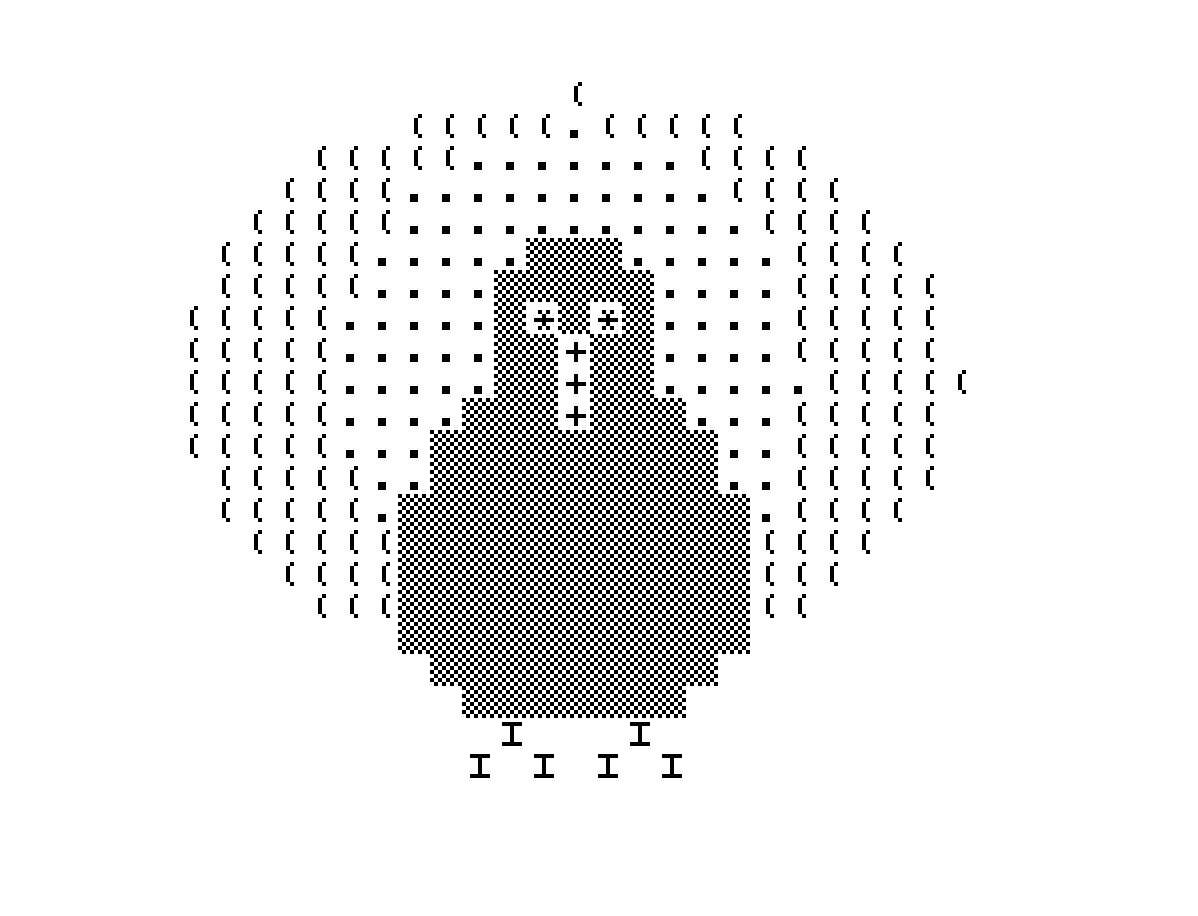
This program draws an ASCII-art figure of a turkey on screen using a subroutine that plots filled ellipses. The ellipse-fill algorithm works by iterating over rows within a bounding box, computing the horizontal half-width at each row via the standard ellipse equation x = a·√(1 − y²/b²), and printing a character across that span.
Program Structure
The program is divided into two logical parts: a main section (lines 10–310) that sets parameters and calls a reusable ellipse subroutine, and the subroutine itself (lines 320–390). Execution ends at the busy-loop GOTO 310 on line 310, which freezes the display indefinitely after drawing is complete.
- Lines 10–60: Head ellipse — centre approximately (8.6, 15), radii b=9, a=12, fill char CHR$ 16
- Lines 70–110: Torso ellipse — centre (8.6, 15), radii b=8, a=7, fill char CHR$ 27
- Lines 120–170: Left leg ellipse — centre (7.7, 15), radii b=3.4, a=2.7, fill char CHR$ 8
- Lines 180–210: Right leg ellipse — same X, YY=14, radii b=5.4, a=5.4, fill char CHR$ 8
- Lines 220–300: Individual PRINT AT statements for facial features, hands, and feet
Ellipse Fill Subroutine (Lines 320–390)
The subroutine at line 320 fills an axis-aligned ellipse centred at (YY, XX) with vertical semi-axis B and horizontal semi-axis A. For each row Y in the range YY−B to YY+B, it computes the normalised vertical displacement squared P = (Y−YY)², then derives the horizontal half-width M = A·√(1 − P/B²). It then prints the fill character CHR$ I at every column from XX−M to XX+M.
| Variable | Role |
|---|---|
YY | Row centre of ellipse |
XX | Column centre of ellipse |
B | Vertical semi-axis (rows) |
A | Horizontal semi-axis (columns) |
I | Character code used to fill the ellipse |
Y, X | Loop variables (row, column) |
P | Squared vertical distance from centre |
M | Computed horizontal half-width at row Y |
Notable Techniques
- The
ABSwrapper around1 − P/B²on line 340 guards against tiny negative floating-point values that could cause a square-root error at the exact top and bottom of the ellipse. - Non-integer values for
YY(8.6, 7.7) and the semi-axes shift the effective ellipse centre between character rows, giving the FOR loop slightly asymmetric extents and allowing finer positional tuning than integer coordinates alone. - Using
**2rather than multiplying a variable by itself is idiomatic but slightly slower; the inner loop already makes performance the main bottleneck since the subroutine uses a pixel-by-pixel horizontal fill. - The fill characters CHR$ 16, CHR$ 27, and CHR$ 8 are control codes that display as inverse or special block characters on the target system, giving each body region a visually distinct texture.
- Individual body details (eyes, mouth dots, hands marked
*, feet and joints markedI,+) are applied after the ellipses with directPRINT ATstatements, effectively painting over or beside the filled shapes.
Image Gallery
Source Code
 10 LET YY=8.6
 20 LET XX=15
 30 LET I=16
 40 LET B=9
 50 LET A=12
 60 GOSUB 320
 70 LET XX=15
 80 LET I=27
 90 LET B=8
 100 LET A=7
 110 GOSUB 320
 120 LET XX=15
 130 LET YY=7.7
 140 LET I=8
 150 LET A=2.7
 160 LET B=3.4
 170 GOSUB 320
 180 LET YY=14
 190 LET A=5.4
 200 LET B=5.4
 210 GOSUB 320
 220 PRINT AT 12,10; CHR$ 27; AT 17,20; CHR$ 8
 230 PRINT AT 19,18; CHR$ 8; AT 20,13; "I"
 240 PRINT AT 20,17; "I"; AT 8,12;"."
 250 PRINT AT 7,12;"."; AT 5,13;"."
 260 PRINT AT 4,15;"."; AT 7,14;"*"
 270 PRINT AT 7,16;"*"; AT 21,16;"I"
 280 PRINT AT 21,18;"I"; AT 21,12;"I"
 290 PRINT AT 21,14;"I"; AT 8,15;"+"
 300 PRINT AT 9,15;"+"; AT 10,15;"+"
 310 GOTO 310
 320 FOR Y=YY-B TO YY+B
 330 LET P=(ABS(Y-YY))**2
 340 LET M=A*SQR (ABS (1-P/B**2))
 350 FOR X=XX-M TO XX+M
 360 PRINT AT Y,X;CHR$ I
 370 NEXT X
 380 NEXT Y
 390 RETURN
Note: Type-in program listings on this website use ZMAKEBAS notation for graphics characters.