
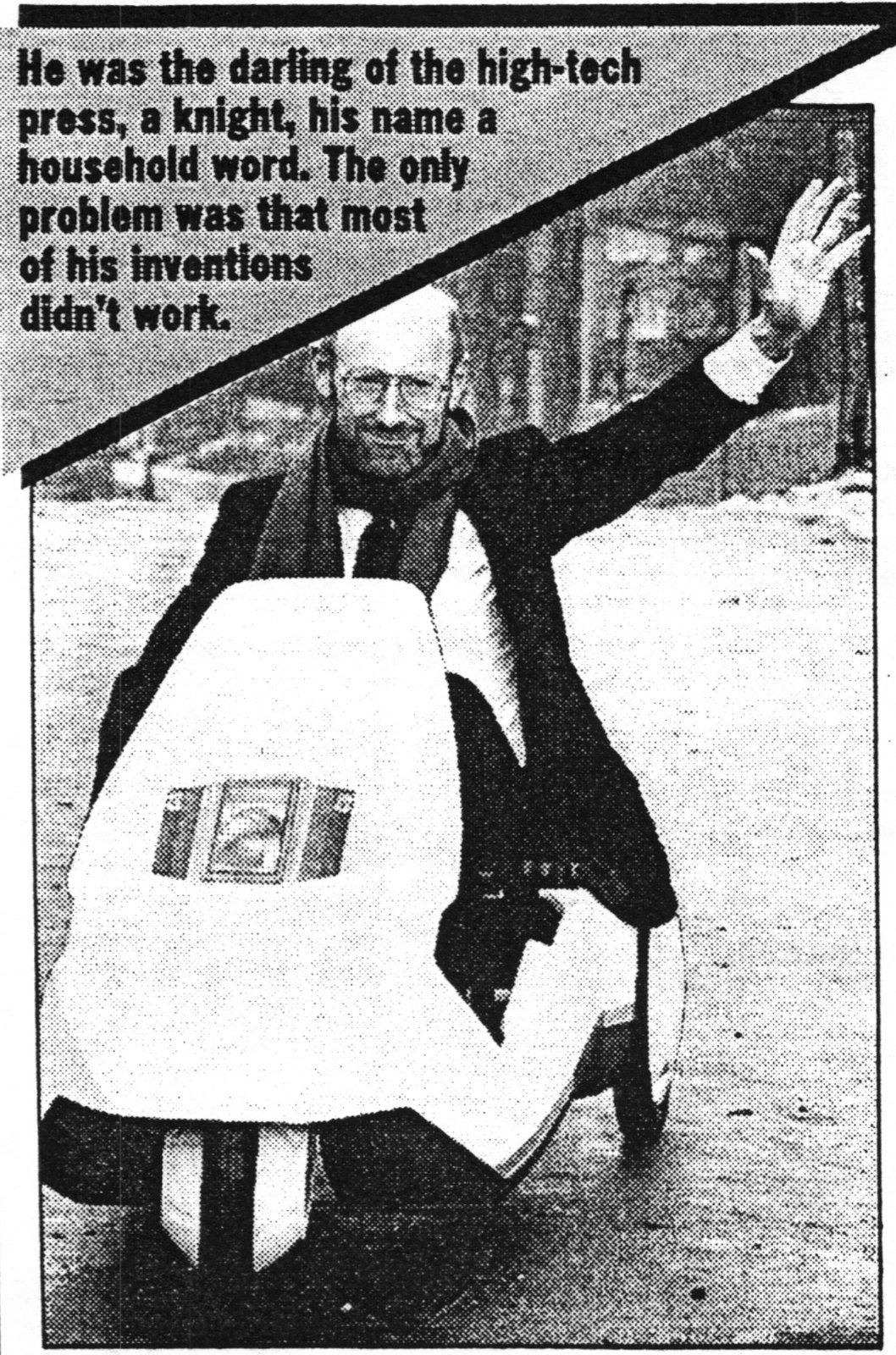
He was the darling of the high-tech press, a knight, his name a household word. The only problem was that most of his inventions didn’t work.
LONDON
It was called QL, for Quantum Leap, and it was supposed to be another of Sir Clive Sinclair‘s triumphs. The computer press swooned.
“Each of Sinclair’s machines has been more amazing than the one before but this time he has really excelled himself,” said Practical Computing.
“It is impossible not to be carried away by the QL . . . We can safely nominate it as Machine of the Year,” said Personal Computer News, although 1984 was barely a month old.
The enthusiasm was understandable, but it was flawed. “Uncle Clive,” as his hordes of devoted computer fans called him, was surfing a wave of success.
Prime Minister Margaret Thatcher had paid him tribute as the perfect example of the inventor-entrepreneur, the kind of genius who would lead Britain’s economy into a bright new high-tech renaissance. She had him knighted. He was named “young businessman of the year.” The Royal Society honored him with the prestigious Mullard Award for “outstanding contributions to the advancement of science or engineering of technology leading directly to national prosperity in the United Kingdom.”
By the end of 1983, he was a millionaire, a household name, the chairman of Britain’s Mensa — the elite group of super-intellects. His best-selling ZX81 home computer had introduced millions to home computer basics. The ZX81 was the Timex of computers, and the watch manufacturer built and sold Sir Clive’s products in North America.
But the wave had crested.
The QL didn’t work. No operating machine existed when the slavish reviews were published, and when the production line finally got under way, the first mail-order machine was returned, non-functioning, within a week. QL lasted less than a year. Other machines were just as capable, cost less and weren’t plagued by unreliability and delays. The Quantum Leap became Sir Clive’s first step to disaster.
It was soon followed by an even more embarrassing leap of misguided faith. Sir Clive’s second love was transportation and he had long wanted to marry electronics to a clean, personal vehicle.
Less than a year after non-working QL computers were unveiled, Sir Clive launched the C5, a “revolution in private transportation” that turned out to be a battery-powered trike with pedals for coping with even the slightest inclines. But this revolutionary transport couldn’t cope with them.
Sir Clive’s empire and his reputation were in ruins. The computer company and the Sinclair name were sold for a paltry £5-million ($10.8-million) in April, 1986, to his prime competitor, Amstrad Computers.
Instead of taking his visionary statements — “there’ll be robots to go out to the Third World with real intelligence and endless patience to educate vast numbers of people” — seriously, Sir Clive was suddenly being lampooned as a failed marketeer.
“The Sinclair myth . . . (was) an insidious chimera fostered by assiduous self-promotion (and) short-sighted business practices that resulted in a sequence of products plagued by technical faults and poor customer service,” was the verdict of a critical assessment of the rise and apparent fall of Sir Clive in a book published last year.
In retrospect, finding fault was easy. Sir Clive’s calculators did blow up (one in an ambassador’s pocket). The C5 was a joke, miniature TVs failed to catch on and Sinclair computers had a long history of delivery delays and failing to live up to promised performance.
Anyway, Britons like their boffins to be tweedily absent-minded with unmatching socks, not Porsche-driving, sharp dressers with expensive Italian shoes and not a trace of modesty.
His products came to be derided as mere copies. Critics sneered that Sir Clive’s talent was for marketing rather than inventing, that he was an “assembler” of bottom-end gadgets rather than a leading figure at the forefront of technology.
The boy who had dropped out of school at age 17 and launched a career selling mail order radio kits from a friend’s apartment grandly described in advertisements as Sinclair House became the “Midas who lost his touch” in a Financial Times of London story.
“It would be simplistic to conclude that Sir Clive is merely the victim of his own propaganda, although there is certainly an element of truth in such a view,” was the finding of Ian Adamson and Richard Kennedy, co-authors of Sinclair and the ‘Sunrise’ Technology.
“Although the products were promoted with the promise of new technology, their development was an exercise in style rather than a commercial scientific endeavor,” they added.
Sir Clive was, and is, entirely unfazed.
He airily dismisses the firesale disposal of Sinclair Computers. “We got into a financial bind so we chose to sell the problem.”
The C5 was “a stepping stone that I tripped over,” he added.
The collapse was the most serious, but hardly the first, setback in Sir Clive’s roller-coaster career.
In 1979, staggering losses had forced the state-owned National Enterprise Board to take over Sinclair Radionics.
Undaunted Sir Clive re-emerged with Sinclair computers. He clearly plans another comeback.
His new company, Anamartic, means “without fault” in Greek and presumably refers to the large wafer integrated circuit it hopes to develop, rather than any admission of previous failures.
Sir Clive now has another new computer on the market. Called the Z88, Sir Clive describes his laptop computer as “the first really light-weight machine” and promises it will be the first of a whole new line.
“We won’t be doing any ‘me-too’ products, we’ll only be going into areas where we can truly innovate,” he said.
It may be too soon to tell. The memory chips that were supposed to give the Z88 a massive advantage over other laptop computers won’t be available for months. In the meantime, the computer will have to rely on its low price, £249, and the not inconsiderable affection Sir Clive still commands among computer buffs at the low end of the market.
“I’m delighted to be inventing again,” he said. “I enjoy thinking, I’m not a workaholic.” His visions for a society transformed by personal computers and futuristic transportation (both presumably invented by him) remain unshaken, although, just occasionally, there is an uncharacteristic note of caution.
Asked about a successor to the C5, Sir Clive said: “It’s quite a long way off. The trouble with transportation is that you can’t do it on a small scale; you have to do it on a very big scale and I haven’t got that sort of funds.”