
Around 1978, in an Albuquerque elementary school, Jon Becker used a computer for the first time: a green-screen terminal and an acoustic modem that a visitor from the University of New Mexico brought in. His family later waited until the Timex Sinclair 1000 came down to $49.95 at Skaggs, and bought a small black-and-white TV to go with it. A TS 2068 followed a couple of years after that. As a young teenager he typed in programs, wrote games and wired the 2068 to robotics projects, until, around late 1984, an interfacing experiment killed its SCLD chip. He moved on to a Commodore 128 and then Amigas, and became an engineer.
This year he came back to the 2068 in a big way. Between February and November 2026 he posted to the TS2068 group on groups.io a stream of projects: arcade ports, a word processor, a video codec, speech on the AY chip, CP/M, a hardware diagnostic ROM and more. Most of it is on his GitHub, and most of it is now on this site. This post walks through it.
The cartridges that should have existed
A thread runs through much of Jon’s work: the 2068’s cartridge port, which got almost no software in the 1980s. He wrote that he imagines a stack of original-looking cartridges, the ones “that should have existed back in the day”. In April he found that a PicoROM in an EPROM cartridge board would run every cartridge he tried. In August he put VU-3D on a cartridge, a goal he’d had since its long tape loads, and then the Spectrum version of Elite on a 64K cartridge.
Then came arcade ports. Berzerk (August 31) talks, as the arcade game did. Jon first tried digitized speech at 5 to 6 kHz, which left the CPU no time for the game, and ended up with what he calls harmonic synthesis: fitting the AY chip’s square-wave tones to speech and updating them only about 60 times a second. That work became its own project, speech2ay and the TS2068 Audio Lab, a cartridge that compares ten ways of playing sound on the AY. Berzerk’s browser version adds touch controls, so you can play it on a phone. Sinistar followed in October.
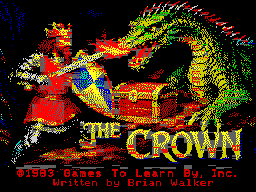
The Crown (Remastered) is personal. Jon bought the original from the Games to Learn By catalog around 1984, and in 2023 he rebuilt a working copy from his tape and a backup his teenage self had modified. In October he converted it to Charlie Day’s new Leap V2 BASIC, compiled it to bytecode, and put it on a cartridge with all three dungeon levels and an animated title screen. It ran so much faster that he had to slow the battles down. Along the way he found a bug in Leap, and his idea of using Leap to make cartridges became part of Charlie’s Leap IDE.
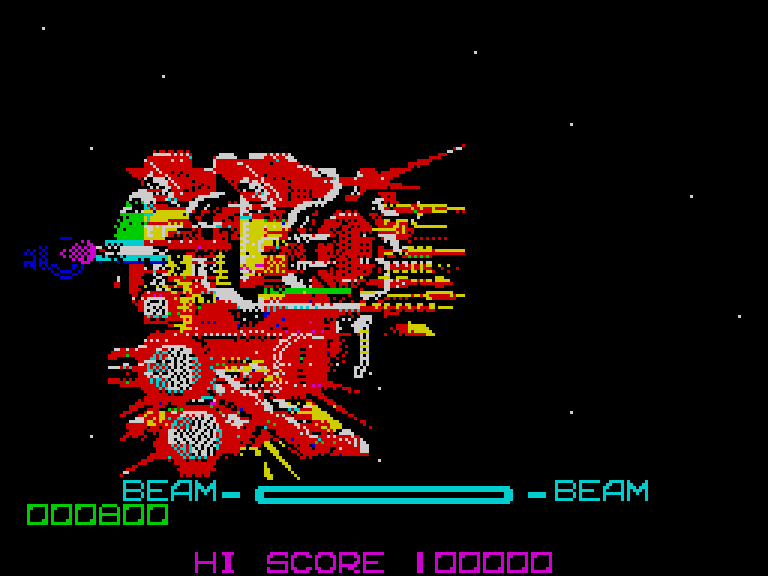
The newest port is R-Type Remastered (November 14). It starts from the ZX Spectrum conversion of the arcade game and redraws it in the 2068’s extended colour mode, with AY music and effects, joystick support and new boss graphics. Each of its eight levels fills a 64K cartridge, and a TS-Pico version loads the whole game into 512K.
Making more of the SCLD
The 2068’s SCLD has display modes that 1980s software hardly used: extended colour (ECM), with two colours for every 8×1 strip instead of every 8×8 cell, and a 512-pixel high-resolution mode. “Definitely past time to make more use of extended color mode,” Jon wrote in April, and he did:
- ECMview (July) is a viewer and slideshow for ECM pictures, with wipes between them.
- TSVideoCodec (August) plays video in ECM. It stores only what changes from frame to frame and packs the changes so they can run across the 2068’s 8K memory banks. The first demos were Newton’s cradle and the Amiga’s bouncing Boing ball, with AY sound.
- Beast Demo and Aqueduct Tides (September) are parallax-scrolling demos.
- SCLD Display Lab (October) is a gallery of cartridges that switch modes partway down the screen, mixing ECM, high resolution and standard colour on the same screen and even on the same line.
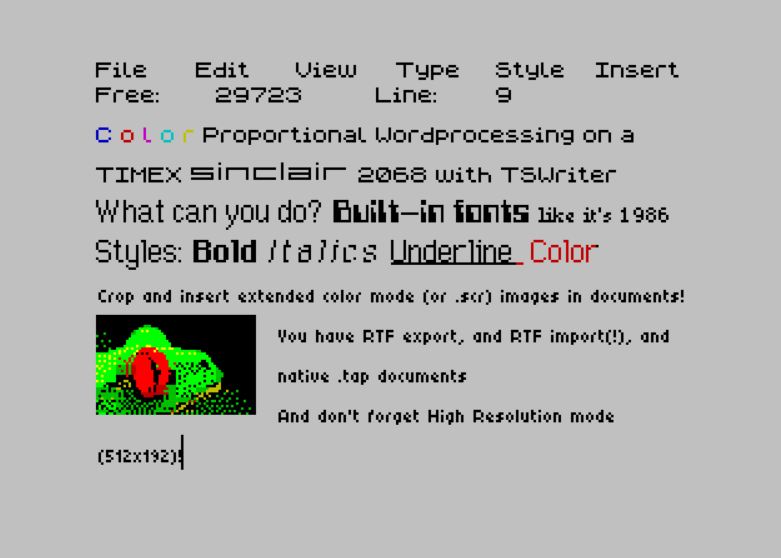
TSWriter (October 2) puts those modes to work. It’s a WYSIWYG word processor with proportional fonts, bold, italics, underline, colour, ECM pictures in documents and a 512-column mode, and it exchanges documents with modern word processors as RTF. Asked why, Jon answered: “Because it’s there.”
New system software
Jon has also written software that changes what the machine itself can do:
- ZXDesk2068 (October) ports mindbox77’s ZXDesk graphical desktop from the Spectrum to a stock 2068.
- TS2068 Diagnostic Lab (October) is a ROM that tests a 2068 without needing working RAM, names the suspect RAM chip by its board position, and reports through beeps and border colours when the screen can’t. A crash on my own 2068 started it.
- CP/M 2.2 2068 (October 22) runs CP/M from a cartridge, using TS-Pico memory as a RAM disk. It comes with Zork I and Planetfall.
- TS-Pico Spectrum 128 personalities (October 27) use the TS-Pico’s bank-switched memory to turn a 2068 into a Spectrum 128, menu and all.
- 512K Video (October 31) loads a film clip into the TS-Pico’s 512K of memory and plays it back.

How he works
Jon is open that AI coding tools are a big part of how he works. In December 2024 he wrote that he sees AI “as a tool to extend my reach”. This year that has mostly meant OpenAI’s Codex, which he switched to while porting Elite, because it could drive the Fuse emulator’s debugger by itself. He steps in when it gets stuck. TSWriter’s byline reads “By Jon Becker, with Codex”, and the Diagnostic Lab is described as Codex-generated.
He has also packed what he learned into the TS2068 AI Skill Library, a set of instructions, tools and reference material that teaches an AI assistant the 2068’s memory banks, cartridges and display modes.
He is just as careful about saying what has and hasn’t been tested on real hardware. ECMview and Berzerk ran on my 2068 at VCF Midwest, the Spectrum 128 personalities have been booted and used on a real 2068, and an earlier release of R-Type was confirmed on hardware. Many of the newer releases, including Sinistar, The Crown and the latest R-Type, have been checked in emulators and are waiting for someone to try them on a real 2068.
Working together
Jon’s projects and those of two other new developers in the group keep feeding each other. When Josef Jelinek released TSRun, his browser emulator for the 2068, Jon asked for hooks to make games playable on a phone. Most of his projects now have a TSRun player you can try in a browser. His VU-3D cartridge prompted Josef’s WU-3D, a modern re-creation of the program. Josef also helped with Elite’s loading screen and TSVideoCodec’s dithering. And The Crown was the first game converted to Charlie Day’s Leap BASIC.
Everything above is on Jon’s GitHub and his TS2068 project page, and on his page on this site. If you have a 2068, a cartridge board or a TS-Pico, he’d like to hear how it runs on real hardware. The TS2068 group is the place to tell him.