
Unlike previous Sinclair computers, the Sinclair QL was not–by design–optimized for computer games. The sound and graphics systems of the QL are adapted for professional and business use, partly in an attempt by Sinclair Research to live down a reputation as a producer of computers for children. But the innate flexibility of the QL’s CPU, QDOS, and SuperBASIC permits certain types of computer games to be programmed which are second-to-none. Psion’s QL-Chess, the world’s microcomputer chess champion in 1984, is, in every way–playing strength, flexibility, appearance, and user-friendliness–absolutely superior and a very good buy. It can provide chess fans at any level, countless hours of delight, instruction, and analysis (of chess problems, tournament games, ect.). Psion’s Match Point is another example of their formidable prowess in programming life-like computer simulations–in this case, tennis.
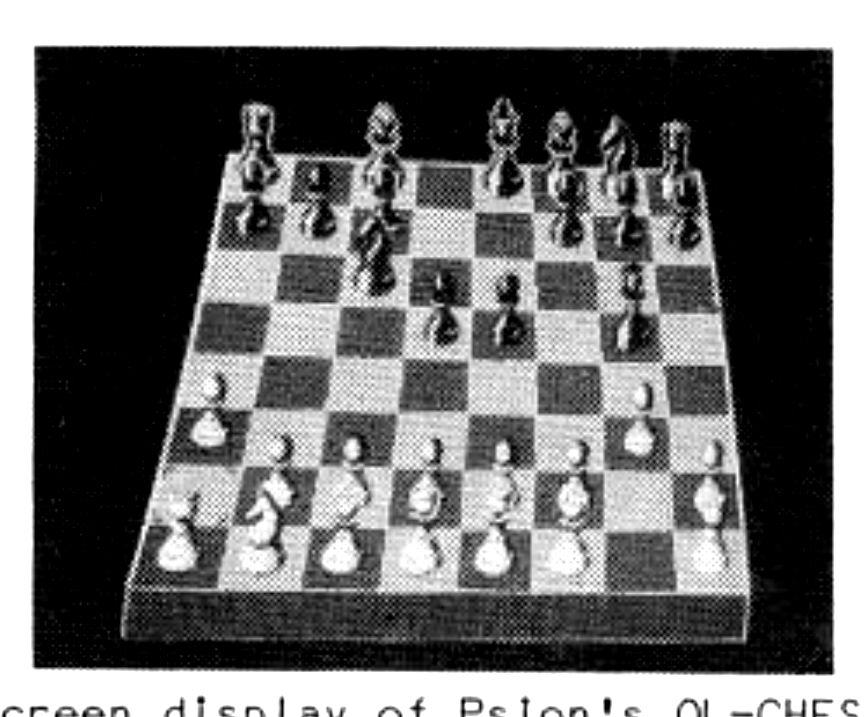
QL-Chess is a comprehensive, realistic simulation of the ancient game featuring 3-D pieces and playing board (no glasses required), 28 levels of play from novice to champion, chess clocks, too many analysis functions to describe in a short article, and numerous playing options. Get it. You’ll love it. One of the best computer programs of all time, a steal at $25. (At today’s prices, the combination of the QL and QL-Chess alone–never mind the QL’s other uses–make it an exceedingly good buy; it is ironic, perhaps, to consider how well-received such a combination might be in a chess-playing nation such as Russia.)
If you use a QL with additional RAM and QL-Chess will not load correctly, try deleting lines 110 and 120 of the BOOT program on your backup copy of the program cartridge. This shouldn’t work, but it does for me. Some programs don’t work with a full 640K RAM on the QL, so, if like me you hesitate to remove a difficult-to-install RAM card before loading a game, inquire of your dealer whether a given game will work with your QL set-up.
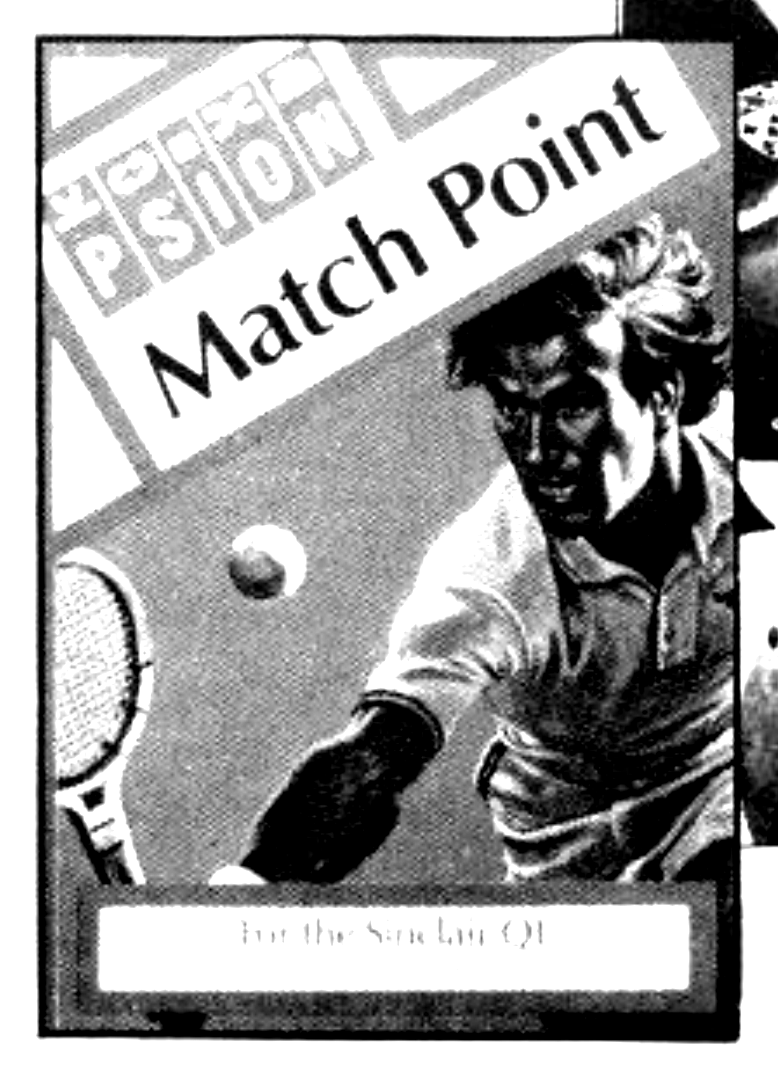
Psion’s Match Point is a tennis simulation featuring extraordinary graphics (even the shadow of the ball on the playing surface is true-to-life, as are the ball boys and girls who retrieve net balls). A game for one or two players, Match Point provides the opportunity for both strategy and dexterity–you can decide whether to employ a baseline or net game on each service and, depending upon the movement of your player and the timing of his swing, impart various kinds of “stuff” to the ball.
As is the case with QL-Chess, the rules of the computer game are the same as those for the real game, and play is only slightly less difficult. Unless they are really virtuosi, small children may find considerable difficulty in returning balls. A stick is a necessity–play with the cursor and SPACE keys is a near impossibility. (The Archer Deluxe Competition Joystick, available from Radio Shack, is a good economical choice for this and other QL games.)
Match Point is visually attractive and challenging (demanding might be a better word) enough to hold an adult’s interest over time. And, if you find that play–even at the quarter finals level–is too tough for you, it is always a pleasure to watch the computer a computer demo game at the finals level.
After the Psion games, there is, with few exceptions, a distinct drop-off and a wide variance in the quality of “lesser” games. In what follows, I will only discuss the relatively few QL games that I’ve actually tested, so, if I have left out your favorite game, forgive me and consider touting it yourself, in a letter to the editor.
War In The East by Mark Steuber of SHARP’s INC., in Virginia, is the first major American game for the QL and is, in its way the equal of Psion’s games. A military strategy and tactics game like its Avalon Hill and Strategy and Tactics forebearers, but with all of the time-consuming and laborious tasks fully automated–you don’t even need a pencil–War In The East is a simulation of the Russo-German conflict during World War Two. Three scenarios are available: Scenario I, “Barbarossa 1941”, dealing with the epic Nazi invasion and near conquest of Soviet Russia before and just after Pearl Harbor; Scenario II, “Stalingrad 1942”, dealing with the second summer of the Nazi-Soviet conflict and the psychological turning point of World War Two; and Scenario III, “Destruction of Army Group Center 1944”, dealing with the German Army’s Gotterdammerung attempts to withstand overwhelming Soviet superiority at the end of the war. War In The East comes with Scenario I included; the other two scenarios are available for purchase separately.
Taking six or seven hours to play, War In The East may not be a game for everyone, but it represents an extremely accurate representation of the several campaigns–so much so that it should be very useful in teaching mobile land tactics and strategy to military officers in staff colleges. I don’t know of a comparable personal computer game in this regard. At move 14 when the rainy seasons begins, you can almost feel the tug on your boots as General Mud takes over, and at move 17 when the screen background turns white, you can almost feel the ground harden and the icy blasts as General Winter takes field. For a better appreciation of the game, I recommend that interested players take the time to review the historical record of the campaigns simulated in the various scenarios. There is only one problem–one which Mark Steuber should soon correct with a patch to the BOOT program: the game will not load on a QL with a full 640K of RAM. Highly recommended.
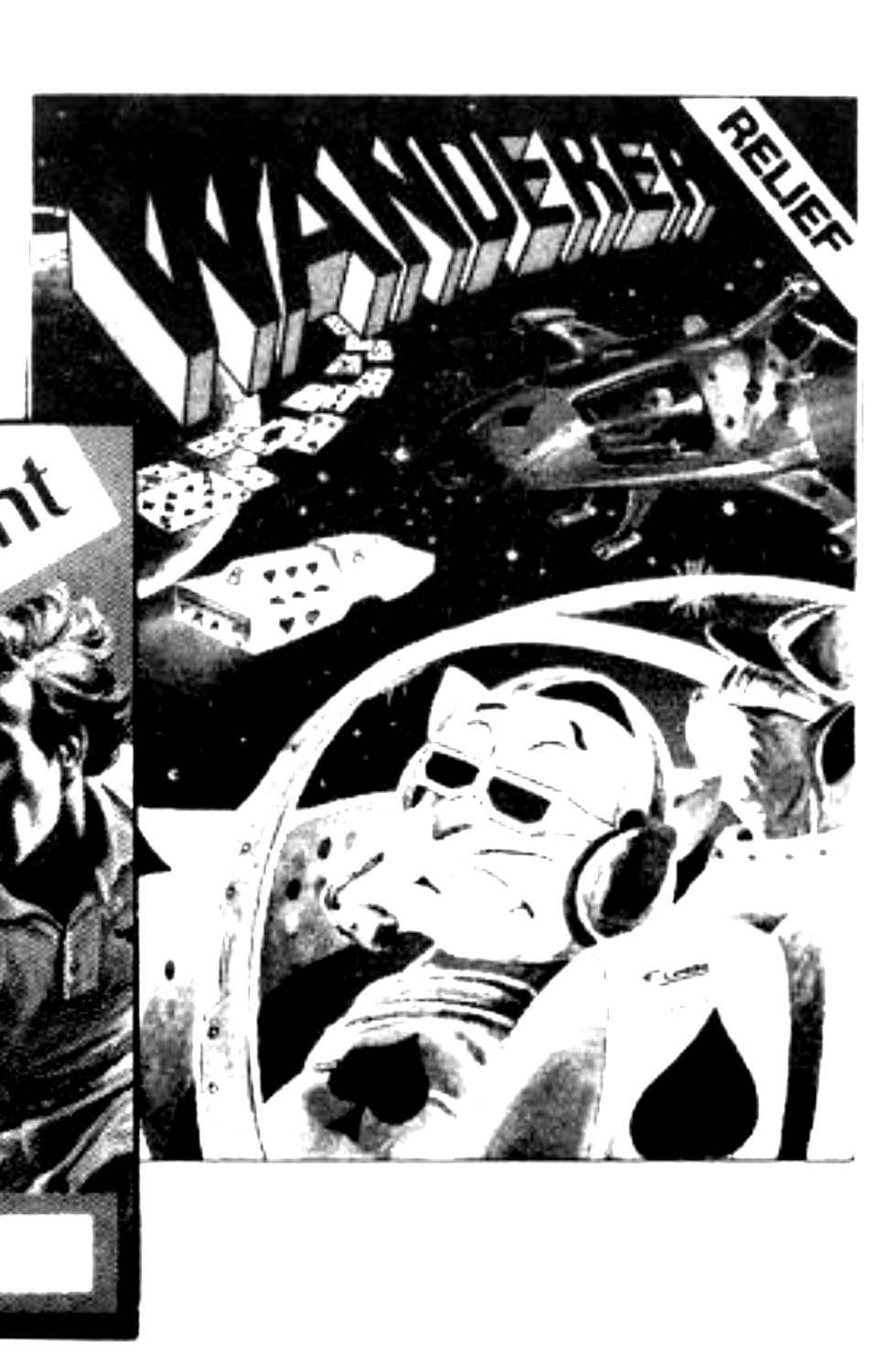
WANDERER, by Pyramide of Paris, is a state-of-the-art, 3-D, space adventure game–you actually wear a pair of cardboard spectacles with one red and one blue lens–in which you maneuver your space craft, attempt to evade or destroy hostile spacecraft, test your wits in a poker like exercise, explore black holes, ect., all in a supreme effort to rescue your neighbor’s cat!
Subtitled, “The Planets Play Poker”, Wanderer is unique in its 3-D line graphics and is probably good enough to hold your interest, even without glasses. (If you wear glasses yourself–or even if you don’t–consider using clear colored plastic, a product available at large stationers’ called Chart-Pak, or even the plastic in the cardboard specs that come with the game taped to your glasses’ frame.)
Wanderer’s documentation is inadequate, so here are a few tips. You replace your spacecraft’s fuel and win game points by zapping other space vehicles–friendly, neutral, or otherwise, I believe, but you can convert a neutral to an enemy by firing at it. TIP: save your “cats” (the unit of currency), for extra or replacement shields which protect your craft from destruction while they last; do not plan to spend your cats for “energy”. There is no telling who your enemies are until they fire, but there is an alarm to warn if you’re currently being shot at and missed. Your spacecraft is equipped with two side-by-side radar scopes: the left radar portrays left-right and up-down indications of other spacecraft (your spacecraft is at the center of both scopes); the right radar depicts left-right and ahead-behind data. Final aiming is “from the hip”. There is no gunsight for precision aiming.
How does Wanderer stack up? Graphics, impressive; space maneuvering and firing, good; documentation, not so good–there is a language problem; game concept, fair; prolonged ability to hold your interest, probably not great, but then Wanderer is not my kind of game.
Squadrons is my kind of game, a simulation of one day’s air combat during the early phase of the Battle of Britain in 1940 by Peakcrown Ltd. In this simulation, you are at an RAF air defense control center with the responsibility to launch and vector fighters from six air fields against multiple German air raids launched across the British Channel and North Sea against Southeast and South Central England, including London. Some German raids are feints or deceptively routed in concert with other raids, some are designed to attrite “the few” RAF pilots, knock out British radars or airfields (which limits your ability to defend), still others to attack population and industrial centers. Your specific duties as RAF Group Air Controller are extensive: you must decide when to launch fighters, and how many to launch; decide which German “raids” to attack; steer fighters in against these raids from the proper direction (up sun) and at the proper altitute (not too low or too high); break off attacks and recover fighters when necessary and in order to recover them safely before they run out of gas–no mean task during the “fog and friction” of combat (RAF fighter “combat” losses are a function of relative numbers of aircraft, height and directional factors, and ammunition expenditure); establish air patrols in case of radar outages; direct anti-aircraft units defending fighter airfields to “standby” and “stand down”–you can, if negligent, lose RAF fighters to “friendly fire”; monitor airfield status and deal with such things as communications outages, runway damage, and clearing the field for further operations; monitor a myriad of incoming messages and take the appropriate actions; and notify all cities in the area of air raid warnings and “all clear” signals–yes, you are graded in this latter respect by the number of civilian casualties incurred and factory production hours unnecessarily lost. And if all of this were not enough, something like spinning plates on television, time is compressed: 12 minutes equals one hour.
Squadrons offers five levels of play in a game lasting as long as three hours (a “pause” function is available for when the phone rings). Considerable latitude is offered in the way of tactics and strategy. Should RAF fighters attack heavily defended formations? Should you, as Group Controller, make your first priority the defense of your cities or the preservation of your defensive force? At what stage of their sortie should fighters be recovered to minimize losses due to communications outages or running out of gas? Should air patrols be employed in certain key sectors, ect., ect.? Squadrons’ graphics are perfectly adequate but not spectacular. Highly recommended. Not for hypertensives.
QL Hyperdrive, by David Woodward and The English Software Company, is a one-player, 100% machine-code grand prix motor racing game. Its features include 3-D perspective graphics, five skill levels, music and sound effects, and road hazards in the form of oil slicks. To proceed to the next higher stage (skill level and roadway), you must pass 20 cars within a short time limit. As a grand prix driver you may throttle, brake, and steer right or left.
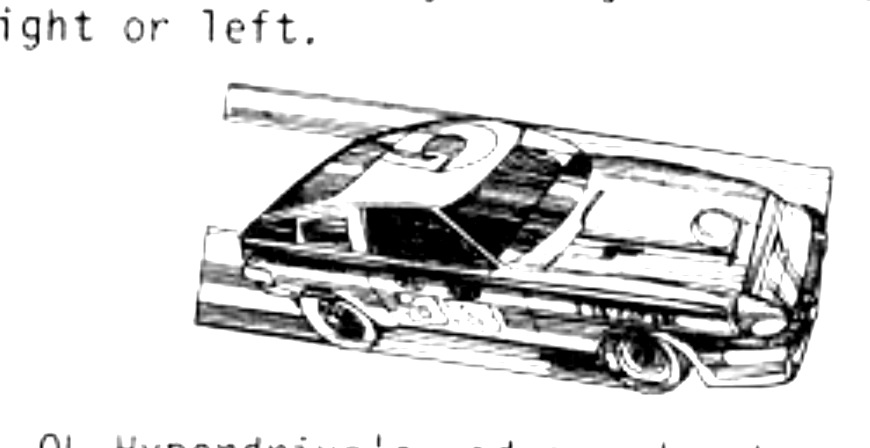
In QL Hyperdrive’s advanced stages, other cars swerve toward you necessitating prompt evasive action. I recommend use of a joystick, but play is feasible and not too bad using the cursor keys. It takes some practice and an average speed of about 90 to qualify in the first stage. As it is, smaller children may find it difficult to qualify for higher stages, but should still enjoy steering right or left and accelerating and breaking as they weave between cars at slower speeds. QL Hyperdrive does not load on my 640K RAM QL, and, although it should be a relatively simple matter to overcome this, I was not able to do so in the time available. Recommended.
QL Bridge Player II is a one-player contract bridge simulation by CP Software. It employs the somewhat quirky British ACOL bidding system which many American players may find annoying. Computer play is at times weak and inconsistent, and there is no analysis of bidding or play, that is, it does not explain reasons for a given bid or play. But all of these shortcomings are easily corrected. If our QL distributors squawk loudly enough, CP Software may replace QL Bridge Player-II with the much improved Bridge Player III, now available for the Spectrum. As it stands, QL Bridge Player-II, though somewhat entertaining, is not recommended in its present form.
1986 Thomas B. Woods Award
In the March/April ’86 issue of Time Designs, I offered a $10 cash award to the first reader to come up with a program for the QL comparable to the following old Sinclair program and using ten or less program statements:
10 INPUT "Formula? "; n$
20 PRINT n$;" = "; VAL n$
30 GO TO 10
Sinclair SuperBASIC does not include the VAL function.
There were no submissions, but, for those of you interested, I did figure out a QL procedure that would produce the result. Since it entails using a Microdrive, disk, or RAMdisk file and the input/output of information, it works best with RAMdisks. The following program listing uses a Microdrive. To use RAMdisk, change the indicated program lines to read as follows:
5 FORMat ram8_10: OPEN #3,ser1
9 OPEN_NEW #4,ram8_work
12 MERGE ram8_work
13 DELETE ram8_work
Figure 1.
1 DEFine PROCedure VAL
2 CLEAR: CLS
3 INPUT "Hard Copy? (Y/N): ";p$
4 IF NOT p$=="y": GO TO 6
5 OPEN #3,ser1
6 PRINT "Enter math expression or 'z' to exit VAL"
7 INPUT f$;
8 IF f$=="z": CLOSE #3: END DEFine
9 OPEN_NEW #4, mdv2_work
10 PRINT #4,"14 y = ";f$
11 CLOSE #4
12 MERGE mdv2_work
13 DELETE mdv2_work
14 REMark
15 PRINT " = ";y
16 IF p$=="y": PRINT #3,f$;" = ";y
17 GO TO 7
18 END DEFine
Include the procedure in your BOOT or other programs or in a collection of defined function and procedures. Call the procedure by keying and entering VAL, then follow screen instructions. The VAL procedure will evaluate all mathematical expressions possible using SuperBASIC, including those with root, power, and trig functions and those using multiple sets of brackets. The procedure gives you a printing calculator result on the screen or your printer. I think you will come to find it one of your most useful SuperBASIC procedures.
Next time: A surprise! I have requested the use of some hardware for the QL and will discuss whatever turns up of general interest.
WANDERER, SQUADRONS, QL HYPERDRIVE, and QL BRIDGE PLAYER II were obtained from Curry Computer for the QL GAMES article. QL-CHESS and MATCH POINT were obtained from RMG Enterprises. WAR IN THE EAST was obtained from Sharp’s, Inc.
Note: Type-in program listings on this website use ZMAKEBAS notation for graphics characters.