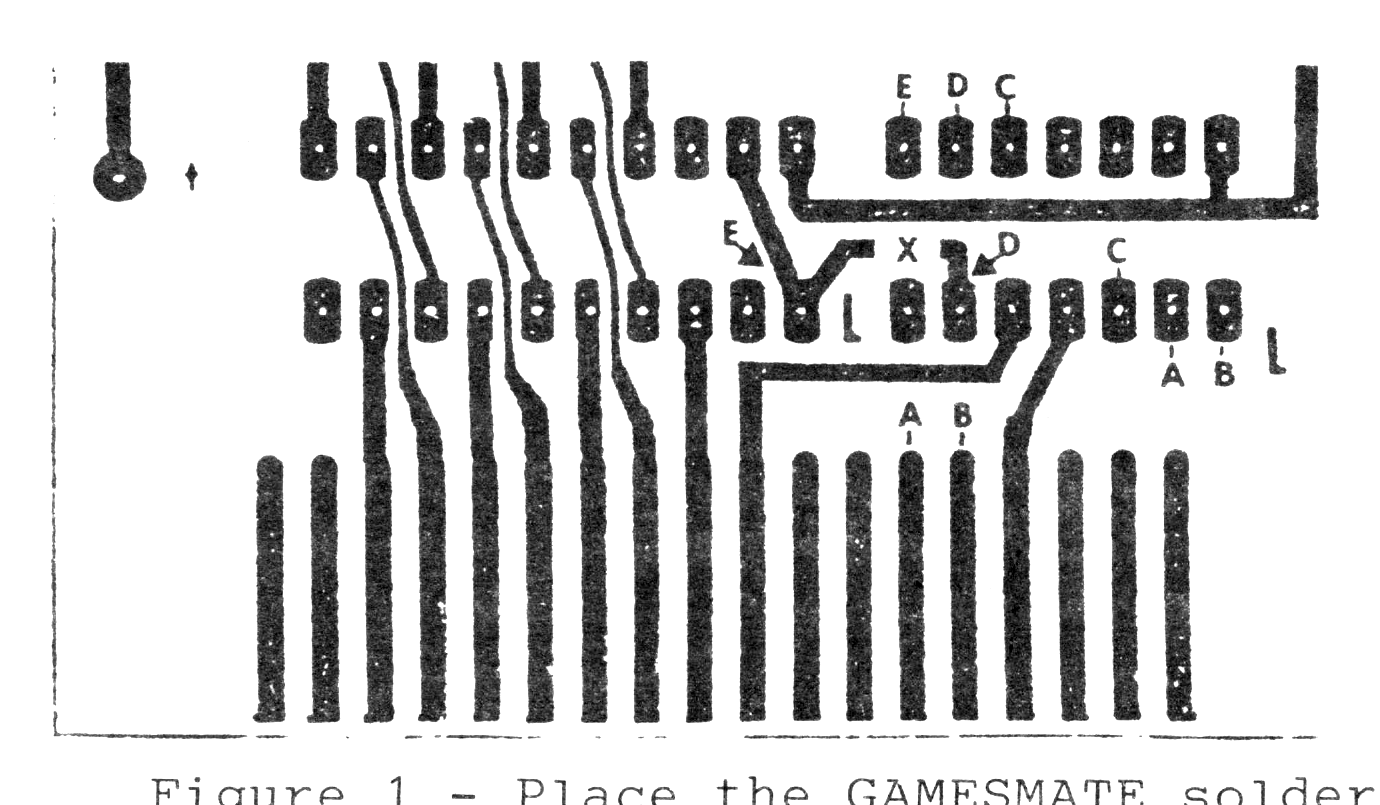
Those who have purchased the GAMESMATE Kempston compatable joystick interface may have noticed conflicts with other add-ons such as the AERCO disk interface. This is due to the minimal decoding techniques used by so many of the third party peripherals, including the GAMESMATE, for the Spectrum and 2068. Further decoding can be accomplished relatively simply and without additional parts, that will resolve most of these conflicts. Understanding the circuit isn’t necessary, so if you wish, refer to FIGURE 1 and make the changes.
Essentially, two more address lines, A6 and A7, are being brought into play. Originally, if I/Oreq was low(active) and A5 was low(inactive), the joystick would be enabled. Thus the GAMESMATE I/F would be active every time an I/O operation was performed and A5 wasn’t used. By bringing A6 and A7 into play, we can effectively restrict the joystick to an I/O address of 31 decimal/1F hex and below. The first move is to cut the trace (marked with the X) running from pin 6 of the LS32 to pin 1 of the LS244. A6 and A7, marked A and B at the finger connectors, are jumpered to pins 1 and 2 of the LS32, and the output is then respectively taken from pin 3 and jumpered to pin 10 of the same chip. Pin 6 is jumpered to pin 9, again, on the same chip. Finally we can take our new enable signal to the LS244 by jumpering pin 8 of the LS32 to pin 1 of the LS244.
This fix doesn’t work on the Zebra Graphics Tablet, which is mapped in at 0-16. Your questions and problems can be directed to Steve Wyatt [phone number omitted]. I would like to know if this fix works with the A & J Mikrodrives.