
MORE ON THE TS – PC CONTROVERSY
Dear Tim,
Recently there has been much discussion about featuring some IBM PC related material in Timex Sinclair publications. Personnally I would hate to see this happen. I understand the problems of a shrinking user base; and I understand the siren call of millions of PC/PC Compatible users. But seriously, is there anything a TS publication could offer a PC user that isn’t already being offered? The answer is no! The odds of a TS publication being able to attract a PC user (unless said user is also a TS fan) is almost non-existent. Such a shift in editorial content would only antagonize die-hard TS users, while offering little to the “double-dippers”.
The problem is that the PC market and the TS market are worlds apart philosophically. The PC user, generally speaking, is business oriented, able and willing to spend more on equipment and software (do I hear that siren call again?), and not the least interested in do-it-yourself hardware projects. The PC user expects to buy a complete system, plug in a diskette, and go to work. Have you ever noticed that few PC magazines have program listings? And no hardware projects, either.
The TS market, on the other hand, is a hold over from the original hacker movement of the 60’s and 70’s. TS users would rather do it ourselves. We delight in taking what most would consider an obsolete system and making it “state of the art”. I wish I had a dollar for every time a co-worker has asked, “A Timex? Why do you use that toy? Why don’t you get a real computer?” My answer remains: Because it’s fun…that’s why!” As Fred Nachbaur pointed out, I have a chance of truly understanding a ZX81. After an eight hour day working with products of the “Big Blue”, I am ready to enjoy the frustrations of a soldering iron and schematic. Man derives delight from creating and doing; solving problems is extremely satisfying! Our technological age has removed the opportunity for problem-solving, for the simple act of creating. Such activities as modeling, painting, sculpting, and TS hardware/software hacking give us back some of that lost creativity.
Obviously, this leaves you (and other TS suppliers) out on a limb. In order to remain viable, in an age of increasing costs and declining profits, you and every other TS related business must increase you customer base. However, in my opinion, attempting to reach out to a PC market would only result in sawing off the limb behind you!
Personally, I believe a better answer might be to address all of the orphans. For example, Coleco Adam and Texas Instrument users are in the same boat as TS Users. An effort to bring together all orphaned owners could only result in a renewed interest in all of these machines. I recently acquired a TI99 in a trade. How nice it would have been to have a common source of information, hardware and software! Anyone who bothers to retain and use one of these “classic” computers possesses at least a little of the “Hacker Ethic”. Perhaps we should pool our resources? At least we would share a common goal and purpose, one we do not share with the average PC user.
Finally, in closing, I would like to congratulate you in your efforts to continue to serve us, the family of TS users. I would also like to thank the suppliers who continue to give us, the TS user, new products, old products, reasonable prices, and a new “lease on life” everyday.
Edward Snow
Orlando, Florida
Editor: I’m glad your letter came in this week, as it will allow me to clarify our editorial policy. Some letters received recently, lead me to believe that there was some confusion as to what I was saying in the article entitled “Send In The Clones” (see TDM, Jan/Feb ’88). To restate: “At this time, I feel that to include IBM information as part of our regular format in TDM isn’t really necessary. There are already hundreds of PC publications, but only a few for the Timex Sinclair…TIME DESIGNS will remain a Sinclair magazine”.
I’m not sure how folks have concluded that we are “switching over”…but the fact is, this is simply not true (one particular gent wrote: “I hope that your transition over to the other brands of computers is a slow one…I still enjoy my Timex”.). Eee Gads! Maybe their confusing us with somebody else.
Ed, while I agree with your excellent letter entirely, I still feel that it may be possible to interest those subscribers who have gone on to bigger computers to stay with us here at TDM, simply for the fact of their Sinclair “heritage”. Even though I now own a foreign import automobile, I am still very interested in “classic” Chevrolat hot rods that I followed as a young person. Maybe I am totally off-the wall, and even dead wrong. But don’t you think the PC converted ex-Sinclair person would be interested in what’s going on in our little neck of the woods? (Such as news about what Sir Clive is dabbling with, perhaps a do-it-yourself project using surplus PC parts, or even the compatibility link between say the Z88, or the QL, with other computers.) I have been pursuing this issue even in our promotional literature…to try and attract, and bring back to the “fold” these ex-TIMEXers. I know that the purist Sinclair folks, and even the “double dippers” (borrowing your phrase) to some extent are good customers…but is it too presumptuous on my part to assume these prodigals would ever spend $16.95 to get our mag?? I would like to hear from those folks who right now are on the tail-end of their subscription with us and have traded in for new equipment. Will they re-inlist for another year?
The “other orphan” issue is an interesting one, and has been recommended to me before. I understand that there is a large contigent of Adam users who are dying to find resources for their favorite computer brand. I think much marketing research would need to be done before any conclusion could be drawn about adopting these other orphans. I would be interested in hearing from anyone who is in touch with the “other orphan” markets, concerning, what other publications are available, are any dealers still catering to them, and what the estimated number of users might be?
DON’T LET ‘EM BURN!
Sirs,
First, I would like to commend you on producing the best Timex Sinclair magazine ever! So much information, it is like being a member of a user’s club. Should my house catch fire, save the TDM issues please, Mr. Fireman.
Secondly, does anyone out ther know of a product similar to the EPROM programmer produced by Orme, in the U.K.? I read a description of the board in an old Sync issue (May/June 1983, page 36), where you just poked the values into the 8192-10239 area, and the chip was then programmed. Sounds perfect to me. I have not had very good luck with ordering overseas, and hope someone on this side knows about it or a similar product.
Has anyone built the 64K Buffer/Programmer that was in Radio-Electronics Magazine (August 1985, page 59, and continued to September 1985 page 78)? I have finally worked out the bugs. The schematic and parts list contain untold errors. I will help anyone if they send a SASE.
David Hartman
[address omitted]
Portsmouth, Virginia
Editor: You might try writing to John Oliger, 11601 Whidbey Drive, Cumberland, IN 46229, for information on the EPROM programmer that he sells in both kit form and a fully assembled version.
DROP DOWN MENUS
Dear Editor,
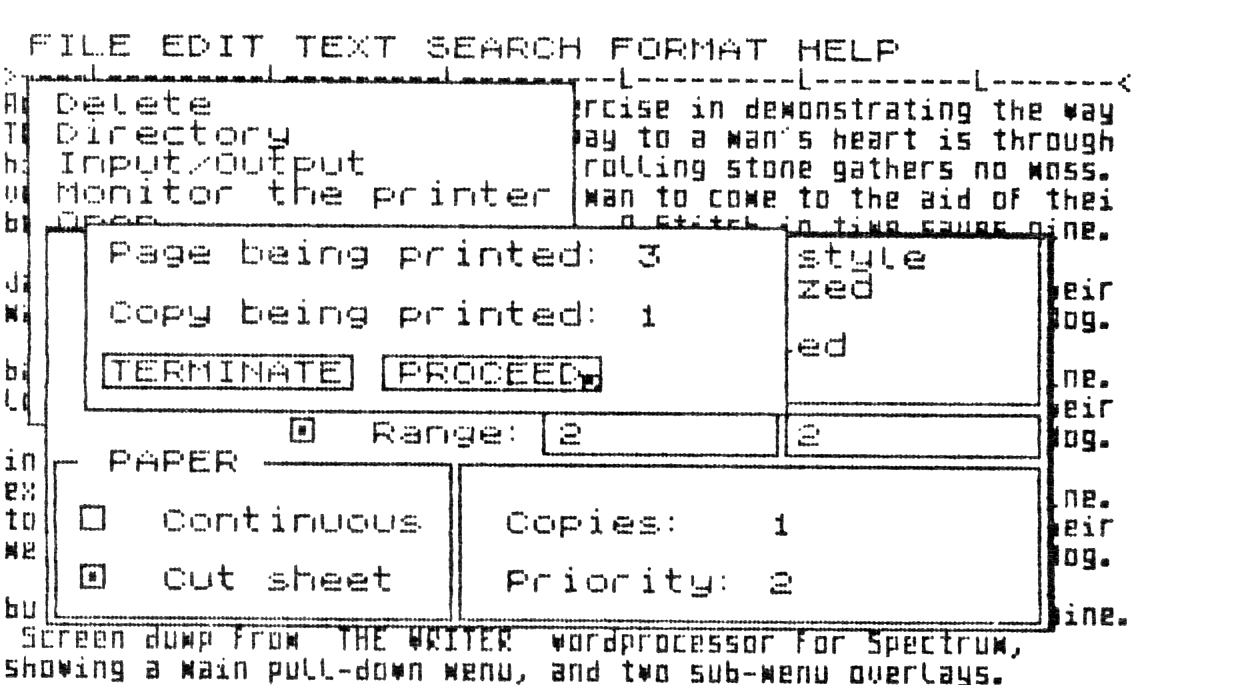
Mr. Lemke‘s article in the March/April ’88 issue gives us a very useful facility, and ends with “maybe someday we’ll see some 2068 programs using real drop-down menus”. This only reinforces my long-held contention that the current level of 2068 programming sadly lacks sophistication compared to that for the Spectrum.
The WRITER (see the accompanying screen dump) has superb windowing facilities (6 main menus, 10 sub-menus) to match those “newer, bigger” computers, and has been available for at least two years, as has the ART STUDIO, to name but two. Surely we have some 2068 programmers who can produce something like this, or have they all gone over to those “newer, bigger” machines?
Bill Rutter
Burnaby, British Columbia
Canada
Editor: Your point is well taken. I would be interested in compiling a list of companies in Great Britain that are reliable to deal with, and handle foreign orders. Does anyone have a favorite Spectrum software or hardware dealer?
TS2068 GRAPHICS
Here is a short graphics program called “windows” submitted by Eric-J. Kongs, Wilmington, California. Try it out on your TS2068 to see the special effect.
Using the Graphics Mode and the Symbol Shift (s) key the graphics of a$ can be entered as follows:
a$(1)="(s)4,3,3,7"
a$(2)="(s)5,space,space,5"
a$(3)="(s)5,space,space,5"
a$(4)="(s)1,(s)3,(s)3,(s)2"
  1 REM "WINDOWS"
 10 GOSUB 200
 20 LET q=FN r(29):LET t=FN r(19)
 30 LET i=FN r(7):LET p=FN r(8)
 40 IF i=p THEN GOTO 30
 50 FOR n=0 TO 3
 55 REM try BEEP .03,q here
 60 PRINT INK i; PAPER p;AT t+n,q;a$(n+1)
 70 NEXT n
 80 IF INKEY$="s" THEN STOP
 90 IF INKEY$="c" THEN CLS
100 GOTO 20
200 RANDOMIZE:BORDER 0:INK 0:PAPER 7:CLS
210 DEF FN r(x)=INT (RND*x)
220 DIM a$(4,4)
230 LET a$(1)=CHR$139+CHR$131+CHR$131+CHR$135
240 LET a$(2)=CHR$138+CHR$32+CHR$32+CHR$133
250 LET a$(3)=CHR$138+CHR$32+CHR$32+CHR$133
260 LET a$(4)=CHR$142+CHR$140+CHR$140+CHR$141
270 RETURN
PRIME FACTORS
The following short listing was sent in by Ron Ruegg of Prairieville, Louisiana. “PRIME FACTORS” will be of interest to those who like solving puzzles (lines 10-45). It should be self-explanatory, but lines 1010-1020 have been included to illustrate a simple way of using it.
  10 REM Prime Factors/RRRuegg
  11 REM Enter with G=Given #
         Positive Integer>= 2
  12 REM Exit with N Factors in
         ascending order in F(N)
  13 REM Uses H,H(),I
  14 IF G<2 OR INT G<>G THEN LET
 G=0: RETURN
  16 LET N=0: LET H=2
  18 LET N=N+1: LET H=2*H
  20 IF H<G+1 THEN GO TO 18
  22 DIM H(N): LET H(1)=1
  24 LET N=0: LET H=3
  26 LET N=N+1
  28 IF INT (G/2)=G/2 THEN LET H
(N)=2: LET G=G/2: GO TO 26
  30 IF H>G THEN GO TO 36
  32 IF INT (G/H)=G/H THEN LET H
(N)=H: LET G=G/H: LET N=N+1: GO
TO 32
  34 LET H=H+2: GO TO 30
  36 LET N=N-1: DIM F(N)
  38 FOR I=1 TO N
  40 LET G=G*H(I): LET F(I)=H(I)
  42 NEXT I
  44 DIM H(1): RETURN
  45 REM G same as at entry
1010 CLS : INPUT G
1015 GO SUB 10
1020 FOR I=1 TO N: PRINT F(I): N
EXT I
A FASTER JOYSTICK
Dear Tim,
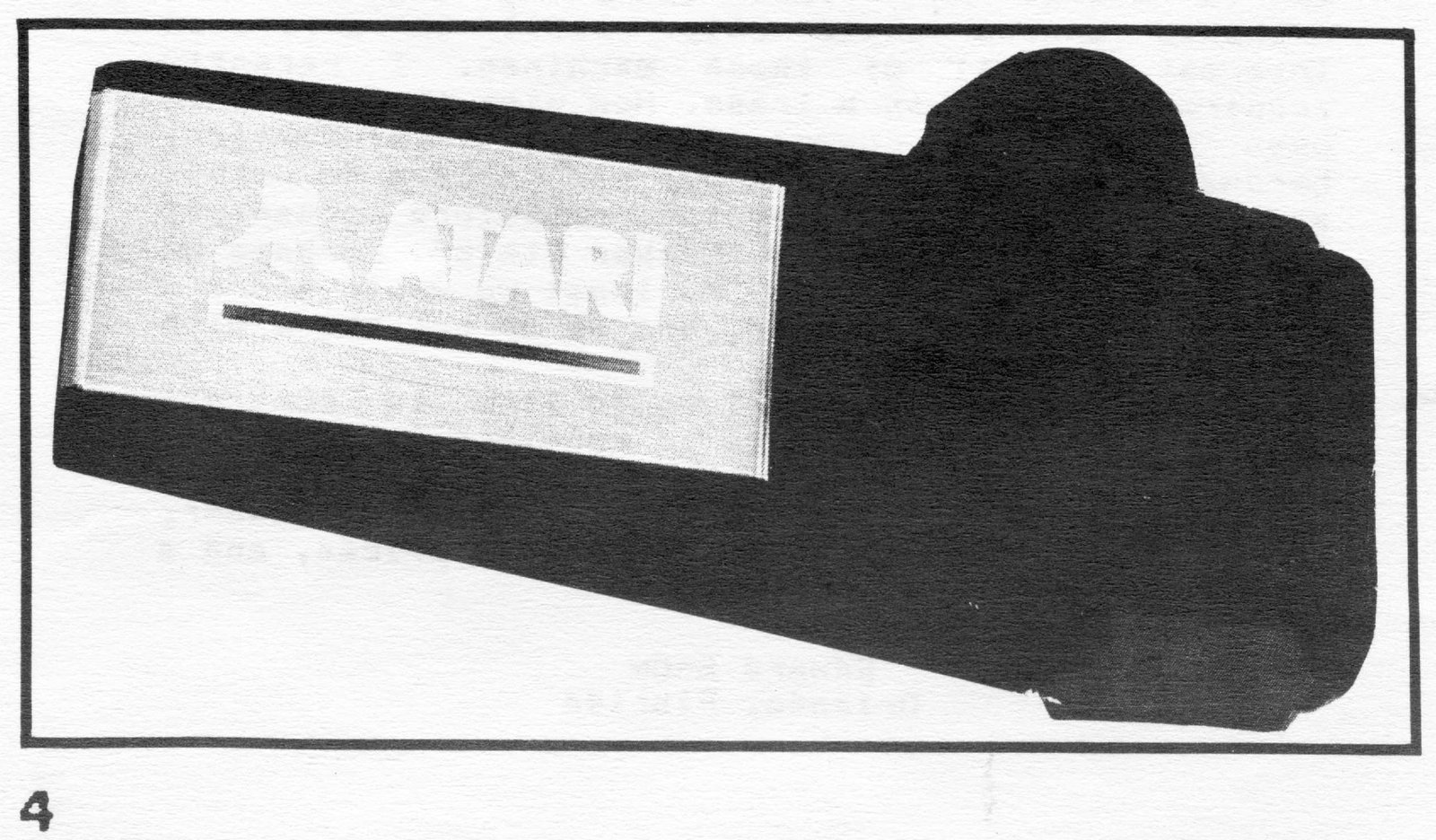
I just found a good joystick for the QL or 2068 which has an excellent reaction time…the Atari Pro-Line model CX24 (about $10). To adapt it to our computers, take it apart (two screws) and slide off the red and yellow wires from the circuit board contact. Put it back together and your in business.
Earl L. Kielgass
Tempe, Arizona
Note: Type-in program listings on this website use ZMAKEBAS notation for graphics characters.